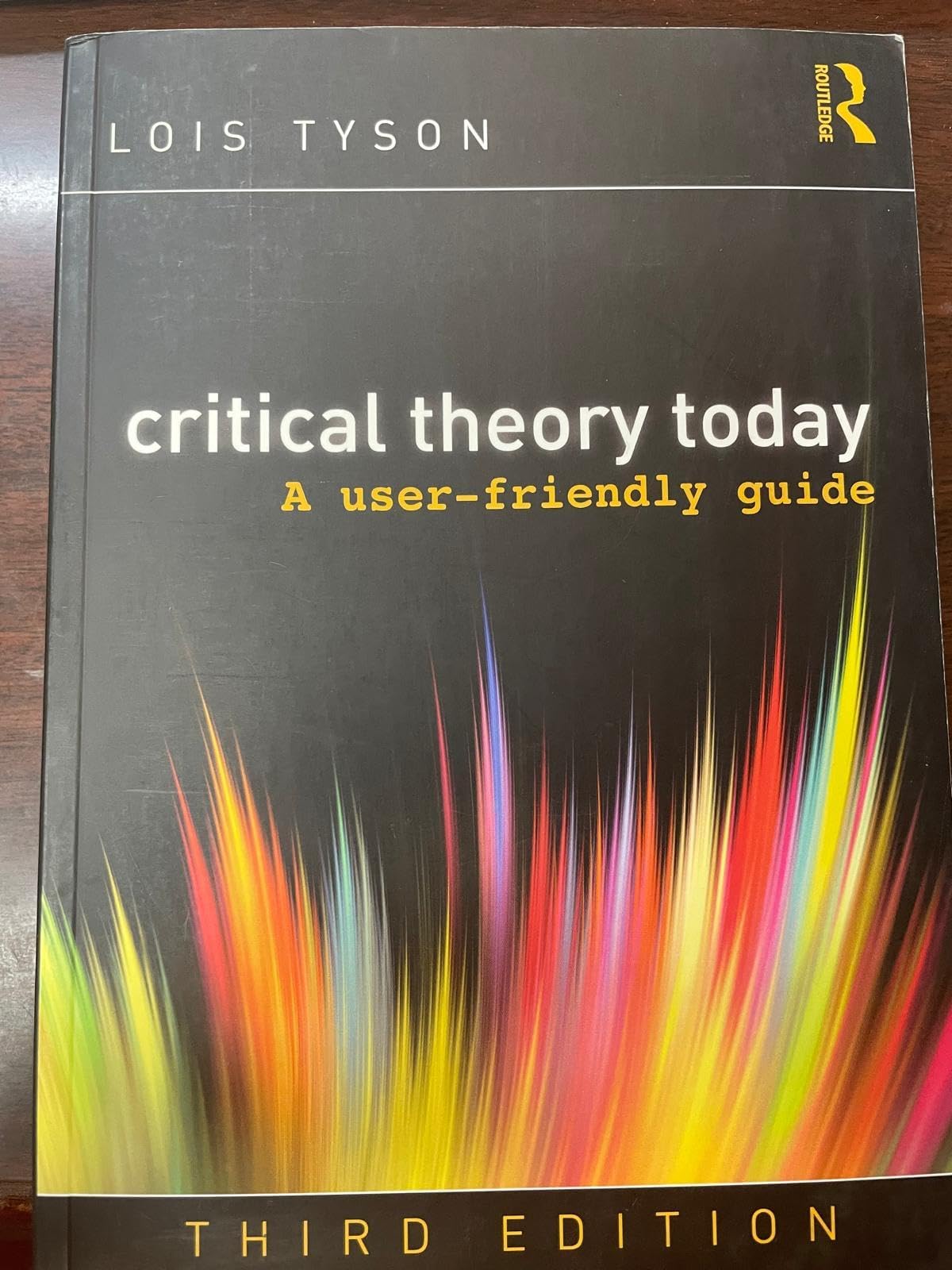


Critical Theory Today: A User-Friendly Guide
Product ID: 11039791
Desertcart purchases this item on your behalf and handles shipping, customs, and support to OMAN.
desertcart.com: Critical Theory Today: A User-Friendly Guide: 8601421976046: Tyson, Lois: Books Review: As Claimed: A User Friendly Guide - I used this book as a text for third year university students. I had previously lectured to the same students in classes which required and hopefully motivated students to read a variety of genres; now I wanted them to be critical on a more academic level. The students had two tasks. Each student was to choose a work to read. Duplications were not allowed and all selections were to be approved by me. Class sessions were devoted to a chapter from the Tyson text. Chapters were not covered in order, with four of the chapters (four class sessions) students had to submit a question relevant to the assigned chapter prior to the start of class; my presentations for these classes were based on student questions with the addition of a point or two I thought the students may have missed or points I thought were too culturally referenced for my Indonesian students to understand without further expansion. A final examination required the students to use one or more critical methods in a review of their chosen book. I read along with the students. Chapters one, two, and three were a great introduction to the books organization. I liked the section where Tyson suggested the questions an advocate of a particular method might ask. I pointed out to students that they should think about and use these questions; there was no need for them to struggle with attempts at originality in questioning, that part of the struggle had been done for them. Tyson’s examples throughout the book, exclusive of the Gatsby examples, emphasized that theory is nice, but then…what do we do with it? The use of different theories to criticize Gatsby was a very effective compare and contrast strategy to analyze a book that should be familiar to many; if they hadn’t read it they probably saw the movie. It is a start. Chapters subsequent to chapter three seemed to be a bit more confusing to my students who generally want a clearly defined answer to something. They do not like the academically generic comments such as “Different theorists looking at this methodology will have different interpretations” and “This method can also contain elements of the following approaches.” While the above paraphrases are accurate, they can be very frustrating to students who then come to believe “Everything is everything.” I found that my task was to constantly reinforce the idea that the purpose of this text was to shed light on precisely these problems and encourage student reflection. There were things I would like to have seen in the text, but I have to defer to the rights of the author to pick and choose some definitive events or examples and leave out others. In the chapter on African American criticism I spent time explaining the differences in power between federal and state legal systems of the US. This was unique to students outside the US, but I felt it necessary when talking about Brown vs. Board of Education (1954). The text encouraged readers to believe that the Supreme Court case was not followed up with any action, but that ignored the horrible conflicts that erupted over programs of mandatory school bussing, programs that were influenced, if not directed by, the federal Supreme Court. In the chapter on LBGT criticism, I realize the emphasis is on literature, but Eleanor Roosevelt was a prolific writer as she promoted many programs inclusive of the African American community, the Jewish community, and, not surprisingly, the community of those with different capabilities. I ended the class with the chapter on Reader-Response criticism. Given the comments by Tyson on the first page of the chapter (most students initially think this is easy), it may not surprise some readers after reading the chapter that this is one of the more difficult chapters. Overall, I found this a high value book for my students as well as myself. I recommend it to anyone attempting to tackle and explain literary criticism. If there were things left out that are favorites of mine, maybe I will include them in my later writings. Review: Great for helping insomniacs get to sleep. - This book is a treasure trove of literary theory. Nice, thin pages. Perfect for wiping away my tears while I stay up all night studying.


| ASIN | 0415506751 |
| Best Sellers Rank | #1,332,267 in Books ( See Top 100 in Books ) #129 in Literary Theory #4,266 in Literary Criticism & Theory #5,880 in Literary Movements & Periods |
| Customer Reviews | 4.6 4.6 out of 5 stars (287) |
| Dimensions | 6.14 x 1.1 x 9.21 inches |
| Edition | 3rd |
| ISBN-10 | 9780415506755 |
| ISBN-13 | 978-0415506755 |
| Item Weight | 1.8 pounds |
| Language | English |
| Print length | 486 pages |
| Publication date | November 24, 2014 |
| Publisher | Routledge |
R**K
As Claimed: A User Friendly Guide
I used this book as a text for third year university students. I had previously lectured to the same students in classes which required and hopefully motivated students to read a variety of genres; now I wanted them to be critical on a more academic level. The students had two tasks. Each student was to choose a work to read. Duplications were not allowed and all selections were to be approved by me. Class sessions were devoted to a chapter from the Tyson text. Chapters were not covered in order, with four of the chapters (four class sessions) students had to submit a question relevant to the assigned chapter prior to the start of class; my presentations for these classes were based on student questions with the addition of a point or two I thought the students may have missed or points I thought were too culturally referenced for my Indonesian students to understand without further expansion. A final examination required the students to use one or more critical methods in a review of their chosen book. I read along with the students. Chapters one, two, and three were a great introduction to the books organization. I liked the section where Tyson suggested the questions an advocate of a particular method might ask. I pointed out to students that they should think about and use these questions; there was no need for them to struggle with attempts at originality in questioning, that part of the struggle had been done for them. Tyson’s examples throughout the book, exclusive of the Gatsby examples, emphasized that theory is nice, but then…what do we do with it? The use of different theories to criticize Gatsby was a very effective compare and contrast strategy to analyze a book that should be familiar to many; if they hadn’t read it they probably saw the movie. It is a start. Chapters subsequent to chapter three seemed to be a bit more confusing to my students who generally want a clearly defined answer to something. They do not like the academically generic comments such as “Different theorists looking at this methodology will have different interpretations” and “This method can also contain elements of the following approaches.” While the above paraphrases are accurate, they can be very frustrating to students who then come to believe “Everything is everything.” I found that my task was to constantly reinforce the idea that the purpose of this text was to shed light on precisely these problems and encourage student reflection. There were things I would like to have seen in the text, but I have to defer to the rights of the author to pick and choose some definitive events or examples and leave out others. In the chapter on African American criticism I spent time explaining the differences in power between federal and state legal systems of the US. This was unique to students outside the US, but I felt it necessary when talking about Brown vs. Board of Education (1954). The text encouraged readers to believe that the Supreme Court case was not followed up with any action, but that ignored the horrible conflicts that erupted over programs of mandatory school bussing, programs that were influenced, if not directed by, the federal Supreme Court. In the chapter on LBGT criticism, I realize the emphasis is on literature, but Eleanor Roosevelt was a prolific writer as she promoted many programs inclusive of the African American community, the Jewish community, and, not surprisingly, the community of those with different capabilities. I ended the class with the chapter on Reader-Response criticism. Given the comments by Tyson on the first page of the chapter (most students initially think this is easy), it may not surprise some readers after reading the chapter that this is one of the more difficult chapters. Overall, I found this a high value book for my students as well as myself. I recommend it to anyone attempting to tackle and explain literary criticism. If there were things left out that are favorites of mine, maybe I will include them in my later writings.
N**H
Great for helping insomniacs get to sleep.
This book is a treasure trove of literary theory. Nice, thin pages. Perfect for wiping away my tears while I stay up all night studying.
B**S
This book meets the requirements!
I didn’t read this book. Hell, I don’t even know what it’s about. What I do know is that my daughter told me she needed it for one of her college courses, so I bought it. I’m giving this 5-stars because it fulfilled her course requirements like a mofo! Both my daughter and her professor agree that this is exactly the book required. Literally no other book can claim the same. Well done, book…well done.
R**C
with excellent essay and discussion topics
I continue to use this text in my college-level literary theory course. It is a clear, well-organized introductory text, with excellent essay and discussion topics. Tyson's analyses of The Great Gatsby illustrate that no one method of analysis exhausts the text's meanings. Moreover, each analysis can stand alone as a critical essay on The Great Gatsby; I have used Tyson's Marxist and feminist analyses in my literature courses. I updated to this edition because it is revised and updated. Not disappointed - of all the lit theory texts that I've examined, Tyson's remains the best by far.
H**C
This book is easy to read
I bought this to suplement my required (graduate level) book. I needed something written for actual people. This book is easy to read, the organization is good. The ideas on theory are clear and to the point. I was able to use this book to help in my understanding.
R**S
Defiantly a user friendly guide
This is the best guide for anyone who is trying to understand Theory. Whether your a student or a teacher, I highly recommend this book to get a better concept of the different types of theories and how to use them properly. You won't be disappointed.
M**E
Best critical theory book on the market
This text can get meaty and long winded, but it is simply the best for making critical theory accessible without betraying the theory. Purdue quotes Tyson, with good reason! Highly recommended!
S**F
An eye-opening experience
I had read the novel The Great Gatsby one or two times for it was one required books not knowing any of theories it was just one classic I had to read. However now I am fully grown up reading this theory book to understand enough all the interpretations of it is just mind blowing!
S**3
Excellent reference book explaining to a relative newcomer to English Literature study how literary theory works in all its firms.
A**.
finally an introduction to literary theory/criticism that is both academic and very readable even for a senior high school student. and it covers all the subjects I wished to have explained. the concept of interpreting the same novel (the great gatsby) using the various critical approaches treated in this book allows for a direct comparison and is a real eye-opener. many thanks to lois tyson!!! alexander rahm, ph.d.
A**R
excellent academic study; excellent service.
Trustpilot
3 days ago
2 weeks ago