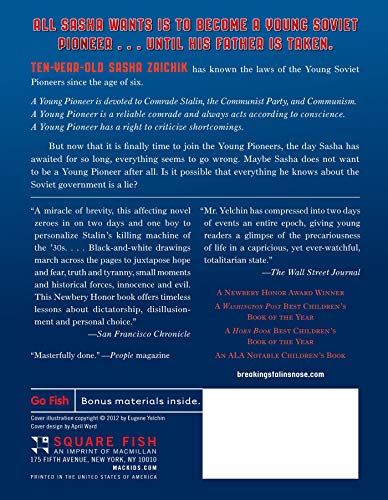
Breaking Stalin's Nose: (Newbery Honor Book)
M**.
life in Russia under Stalin, for kids, teens and adults
I bought this book for myself as an adult after seeing it reviewed for use with kids and teens. A Newberry winner, It's a fictional story that tells a lot about life under Stalin, written by a Russian-American who lived under Communism in Russia, though not specifically under Stalin in the 1930's, when this story takes place. Although the intended audience is 4th-7th grade, and the reading level is appropriate for students in this age range, it also could work well for older students up through 12th grade. The book shows what it was like under Stalin, with people spying on each other and reporting each other, and the secret police system operated in partnership with Stalin's paranoia. The main character is believable and relatable, a boy who starts out as a strong believer in Stalin and in Communism, who within 24 hours discovered reasons to change his mind. This could spark good discussions about living in totalitarian societies and how they operate today, and discussions about the Constitutional protections we have in the U.S. It is an easy read, with its 176 pages including numerous illustrations, but not at all babyish, and could be a good introduction into this subject for any high school student. The story is entertaining and told with humor despite the serious topics it addresses. I see from the reviews that many think this is fine for 8-year-olds even - and perhaps for some, it is. The caution I would give is that the story may be too dark for some younger children. There are hints in the story that the mother had previously been executed as a spy - though the boy continues to believe she died of illness in a hospital. And the father, an officer in the secret police who is arrested, is probably never coming home - may have been executed - though the boy initially believes that it is only a mistake and Stalin will take care of this once he learns of the error. The boy, in the end, is befriended by a woman whose son has been arrested, and she has room in her heart and her home to take in this boy who is now a homeless orphan - though it is never confirmed as to whether the father is in prison or has perhaps been executed already. The author does not describe any torture or executions, and the hints the books gives may be clearer to adults than to children. Still - some younger children may find it sad, though it seems fine for middle school and high school. It does give insight into how totalitarian societies function, and what it is like when everyone worships a dictator, when everyone spies on everyone, and when there are no Constitutional protections as we have in the US.
O**A
The First Book about Stalinism for children
Евгений Ельчин, признанный американский детский писатель и художник-иллюстратор с русскими корнями, рассказывает короткую историю от лица десятилетнего Саши. Отличник Саша мечтает стать пионером. Но его папа, работник НКВД, арестован, как и его мама несколько раньше, и мальчик переживает крушение не только своего домашнего мира, но и кризис веры в ясное и справедливое устройство мира со школьными друзьями, бодрыми песнями по радио, домашними заданиями и бюстом Сталина в актовом зале школы.Прозрачная невесомая проза, лаконичная графика рисуют повседневную зимнюю Москву 30-х годов – коммунальную квартиру, утренний обледеневший переполненный трамвай, игру в снежки на школьном дворе. В этом черно-серо -белом пространстве повести мы узнаем соцреалистический набор образов знакомых до аллергии по рассказам Аркадия Гайдара – Сашино письмо Сталину с выражением любви, пионерская клятва хором в классе, выслеживание шпионов… Сюжет развивается молниеносно и неожиданно, но в бесхитростном Сашином нарративе чудесные и зловещие метаморфозы органичны даже когда они воплощаются в гоголевском гротеске – беседой героя с Носом (тем самым из заглавия – сталинским) или аресте монстроидной учительницы. Мужской, скупой на эмоции и прилагательные, отстраненный стиль повествования усиливает ощущение катастрофы “за кадром”. Так, всего лишь одна короткая фраза лейтенанта НКВД, которую Саша даже не понимает, открывает читателю размах поистинее шекспировской трагедии, которая произошла в его семье. За тривиальной оболочкой школьной жизни разворачивается эпическая схватка Добра и Зла. Мальчик по фамилии Зайчик (!) делает выбор между дружбой и предательством ( и оступается), отстаивает автономность своей личности перед лицом сплоченного большинства и авторитетов и находит в себе силы противостоять потоку обстоятельств.От повести невозможно оторваться. Удивительно, что она не производит угнетающего впечатления, чего так боятся современные гедонисты. Дочитав книгу, мы хотим верить, что Саша справится с испытаниями, добрые люди его поддержат, а Зло будет наказано. Даже американская культура с ее культом счастливого конца отдает дань признания этой повести и присуждает ей один приз за другим. Среди них Newbery award - наивысшая американская награда за книгу для юношества, как Оскар в киноиндустрии. Теперь книга будет включена в американскую школьную программу и все библиотеки. Готовится издание на китайском языке в Тайване. Но именно российским детям такая книга более всего необходима ввиду отчаяной скудости знания о недавней нашей истории в обшестве вообще и зияющем отсутствии темы в детском чтении в частности. Гран соли в бульоне современного чтения им отнюдь не повредит. Исторически точная в мельчайших деталях, книга введет мальчика или девочку (и их папу и маму) в историю ушедшей советской цивилизации, деликатно и без пафоса представит мир прадедушек и прабабушек, когда они были их сверстниками.
H**N
It drew me in; well written.
Guessing my read was easily under 2 hours today; but each time I needed to set it down, I was hoping to be able to quickly pick it up again to discover what would happen next.The well written story drew this age 40’s reader in; I don’t think that my school age kids will want to put it down either. I anticipate great conversations over the main character’s thoughts about his world & the circumstances that he experiences.I plan to offer this book to our school’s administrator as a suggestion for our student’s summer reading list.
J**R
A child's struggle under an authoritarian government
I used the book, "Breaking Stalin's Nose," in my classroom of 7th graders for years. It is a Newberry Honor Award Winner, among other noted awards. The author, Eugene Yelchin, having grown up in Russia, offers a stark insight to the world of the Russian children and families when ruled by Joseph Stalin from 1923 - 1953. As Yelchin explains, Stalin "executed, imprisoned, or exiled over twenty million people," mostly in secrecy. In these days and times, it is more important than ever to keep a watchful eye on American independence! Because of the war in Ukraine, I would advise reading it prior to sharing it with your children. The book may be somewhat difficult to find but very much worth the effort.
M**.
Very vivid, a sort of equivalent to 'One Day in the Life of Ivan Denisovitch' for children
Written and illustrated by a survivor of the later Russian communist regime, the author produces a sort of equivalent to 'One Day in the Life of Ivan Denisovitch' for children. I suppose any child from about eight upwards would be able to read it, but an adult may be required to explain the odd part. Not all parts of the narrative flow so well, the dream is a little disjointed and may confuse someone not reading carefully. A very vivid account, full of scenes from someone who really knew what it was like to share one small toilet per 48 people, and live in fear of informers all the time.
B**U
rare book
I always wanted to introduce my children to the history of Soviet Union in engaging and entertaining way. This book gave me this opportunity. The story is told by the young boy who experienced Stalin purges. Despite quite a grim subject the book is full of humour and easy read. The author shows how ridiculous and absurb the whole political system was. My daughter couldn't believe that people reported on their neighbours to NKVD only to recieve their room in the communal flats when the neighbour were arrested.It is the first time when I came across the book of this kind. Suitable from 8+
M**S
a child in Stalinist Russia
I would recommend this book to 8 year-olds (read together with an adult) and older children to read themselves. My own grandson entered into the life and feelings of the protagonist, anticipated (not always correctly) what would happen, becoming completely absorbed in the story, and entering into the moral and emotional dilemmas, while at the same time gaining an insight into the Stalinist era and its implications for the people who lived through it.
D**A
Five Stars
Great book!
M**S
Brilliant
Brilliant in its simplicity, Yelchin takes us into a slice of time during Stalin's Terror years through the eyes of a young boy.
ترست بايلوت
منذ أسبوعين
منذ شهرين