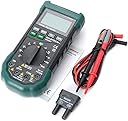
FeaturesDisplay: 3 3/4 digital large LCD with 4000 countsManual & Auto rangesData holdBacklightFull overload protectionBuilt-resettable fuse protection Fuse Protection: mA and mA file: resettable fuse; 10A file: F 10A/250V 6.332mmMisconnection alarm systemRed lights to show the correct terminalsAudible warning for over-range"Sleep mode", auto power off & low battery indicationUnit symbol displayContinuity test Diode test Duty Cycle Measurement Relative value measurement SpecificationsDC voltage: 400m/4V/40V/400V +-0.7%, 1000V +- 0.8% AC voltage: 400mV +-3.0%, 4V/40V/400V +-0.8%, 750V +-1.0% Resistance: 400/4k/40k/400k/4M¸ +-1.0%, 40M¸ +-2.0% DC current: 400uA/4000uA/40mA/400mA +-1.5%,10A +-2.0% AC current: 400uA/4000uA/40mA/400mA +- 1.5%,10A +-3.0% Capacitance: 20n/200n/2uF/20uF +-4.0% Frequency: 10/100/1000/10k/200kHz +-2.0% Transistor hFE: 1 ~ 1000 Continuity test Diode test Duty Cycle Measurement Relative value measurementSampling Rate: approx. 3 times / secondTest Leads: 1KV 10ASafety Standards: IEC1010-1, CAT. III 600V & CAT. II 1000VOperating Temperature: 0 ~ 40 C (32 ~ 104 F)Operating Humidity: below 80% RH, Storage Temperature: -10 ~ 60 C (14~ 140 F)Storage Humidity: below 80% RHPower: 3 x 1.5V AAA batteries (included)Dimensions: 195 mm x 92 mm x 55mm (7.68' X 3.62' X 2.17' inch)Weight: Approx.380g (13.40oz)
| Brand | Mastech |
| Power Source | Battery Powered |
| Style | Digital |
| Color | MS8268 |
| Item Weight | 0.1 Kilograms |
| Min. Operating Voltage | 400 Millivolts |
| Upper Temperature Rating | 4E+1 Degrees Celsius |
| Measurement Type | Multimeter |
| UPC | 713831670761 619636139864 714833891291 713831671492 |
| Manufacturer | Mastech |
| Package Dimensions | 9.2 x 5 x 2.5 inches |
| Item Weight | 3.52 ounces |
| ASIN | B0050LVFS0 |
| Item model number | MS8268 |
| Batteries | 3 AAA batteries required. |
| Is Discontinued By Manufacturer | No |
| Date First Available | May 13, 2011 |
G**N
Pretty Nice Meter For the Price
I have had a digital Radio Shack Multimeter for many years and it works ok. What interested me in this meter is that it has extra functions like capacitance and hfe. In the past, I haven't really had much of a need for these functions but, over time, it has become harder to obtain parts like capacitors and transistors. Sure, you can order online for a dollar or two, but then you have to pay 6 to 8 dollars postage and wait. So, this meter could help me use some of the parts I've collected over 30 plus years. I don't think you can beat the price, not much more than a bottle of Jack Daniels.The quality is good, everything looks solid, and I'm very pleased so far with the functionality. It comes with batteries but just toss these and put in Duracells. I've had too many problems with off brand and "bunny" brand batteries leaking.The included test leads are pretty good and there is a test lead storage feature on the back that keeps the leads from just dangling when not in use. Interestingly, and perhaps helpful for us who are drinking Jack Daniels while testing, when you switch to a specific mode, the applicable "jacks" light up to make sure you're using the correct ones. The negative test lead was a little "loose". That is, you would have to "jiggle" it to get things to read correctly sometimes. The fix for this is pretty easy, just insert a small blade into the lead to "spread" the connector. Any good tech knows that you have to prove that the measurement equipment is working before you fault the test item.If there is one nit, it is the capacitance range, shown as "nfarads" or nanofarads. Most of us geeks use "microfards" or "picofarads". So, you have to mentally move the decimal point 3 places but not a big deal. I tested a few caps and they seemed to read ok. I don't have a need for absolute accuracy so precision is not a problem. I just want to know if the cap is good or bad and about the value expected.The meter does take a few seconds for the measurement to stabilize but this was not really a problem for me. The "stand" holds the meter at a convenient viewing angle.
D**P
Solid feel, great features including frequency
In the middle of a power outage from Hurricane Sandy, the rusty governor spring on my generator finally broke leaving the engine running at idle. Fashioning a replacement spring and adjusting the generator output to 120 volts got us through the outage, but after it was over I wanted to set the governor more precisely to get exactly 60 Hz. I was planning to buy a dedicated panel-mount frequency meter but discovered that many multimeters now include a frequency function, and since the Mastech was under $30, I ordered it. It arrived two days later, a day faster than promised.My first impressions on opening the box were: 1) it's big, and 2) it's decent quality. The rotary dial and the pushbuttons click into place with authority, the case feels solid and doesn't flex, and the probes are heavy gauge wire. I ran through some AC and DC voltage and resistance checks; the results agree with my other meter though I don't have a NIST-traceable reference to test its absolute accuracy. House power frequency reads 59.96 Hz, as expected. The manual briefly describes the Cat II and Cat III safety standards the meter claims to meet - I have no way to verify compliance but it feels like it could take a beating in a lineman's toolbelt with no problem. A few minor observations that haven't been covered in other reviews:1) It takes some effort to insert the probes the first time. I pushed until they felt fully seated, but there was still 1/4 inch of plastic sleeve exposed and the LED indicators didn't go out. The sockets are a standard size and the probes from my other meter went in smoothly all the way and extinguished the LEDs, so I forced the new probes all the way in. After that they are still stiffer than my old probes but no longer require excessive force.2) The LCD display has a good viewing angle range in reflected light, but when using the backlight it is washed out when your eye is above 90 degrees from the display. The display contrast isn't user adjustable, but the default is fine from anywhere without the backlight and from below 90 degrees when using the backlight.3) You can't set the backlight to stay on - it always fades out after 5 seconds from pressing the light button. But there is a display hold button, so if you are operating in a dim area you could capture the reading you want using hold and then light the display to read it.4) There are two different ways of reading frequency. You can measure AC voltage or current using the function dial and then press the frequency button to cycle between voltage, frequency, and duty cycle. Or you can select frequency on the function dial and switch between frequency and duty cycle with the button. The manual indicates that the available ranges are different depending on whether the dial is set to voltage/current or to frequency, but either way works fine for 60 Hz power.5) Other reviews said the beeper is weak; it sounds fine to me. But when using the continuity test function it has an odd stutter sound when making a connection - be-be-beeeeeeeep. Nothing to worry about, just an indicator that there is some electronics involved rather than a simple battery and beeper connected directly to the probes.All in all a great meter; far more than I expected. Other reviewers say "great meter for the money" but in my opinion it's a great meter, period. The Fluke 175 claims .15%+2 accuracy for DC volts and 1.0%+3 for AC volts; this meter claims .7%+2 DC and .8%+3 AC on most ranges which is more than I need. I'll still use my old multimeter most of the time because it is more compact to carry around (I posted a picture for size comparison with the Equus 3320 Auto-Ranging Digital Multimeter). But it's nice to have the Mastech for when I need the extra features.
ترست بايلوت
منذ 3 أسابيع
منذ 5 أيام