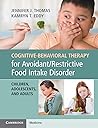
Cognitive-Behavioral Therapy for Avoidant/Restrictive Food Intake Disorder
Product ID: 119563141
Desertcart purchases this item on your behalf and handles shipping, customs, and support to OMAN.
Avoidant/restrictive food intake disorder (ARFID) is a common eating disorder diagnosis that describes children and adults who cannot meet their nutritional needs, typically because of sensory sensitivity, fear of adverse consequences and/or apparent lack of interest in eating or food. This book is the first of its kind to offer a specialist treatment, specifically for ARFID. Developed, refined and studied in response to this urgent clinical need, this book outlines a specialiZed cognitive-behavioral treatment: Cognitive-Behavioral Therapy for Avoidant/Restrictive Food Intake Disorder (CBT-AR). This treatment is designed for patients across all age groups, supported by real-life case examples and tools to allow clinicians to apply this new treatment in their own clinical settings. Review: ARFID treatment manual for MH clinicians - With few, if any, RCT studies on the treatment of ARFID to date, this is a helpful empirically-based step-by-step treatment manual for mental health providers targeting weight gain/restoration and increasing variety in the food the individual eats. It uses a variety of exposure techniques (systematic desensitization, interoceptive exposure, graded exposure), psychoeducation, and parent-/self-monitoring. A previous clinician complained that it is written for dietitians and MDs while not addressing psychological problems. Coming from an FBT background, I disagree. The treatment addresses underlying mechanism from a CBT perspective and I love that it includes a therapeutic meal and in-session exposures to feared/disliked foods. It is far different from the days past when therapists treated eating disorders as a symptom of an underlying control issue or hidden psychological injury/need/drive and relied on the MD/dietitian to discuss what they should be eating. Of course, eating disorder treatment should be a team effort. If you are a an adult or parent of a child with ARFID considering this book, I strongly suggest that you find a therapist trained in CBT-AR (adults and youth) or FBT-ARFID (youth treatment) There are too many scary medical complications that can come with eating disorders and it’s very difficult to treat on your own. This book might give adults/parents some insight into their or their child’s ARFID, but it’s NOT written for parents and especially not written for teens/kids to read. Best wishes to all who struggle with ARFID and the providers trying to help them! Review: ARFID necessity - must read for providers working with ARFID


| Best Sellers Rank | #67,577 in Books ( See Top 100 in Books ) #36 in Mental Health (Books) #61 in Psychopathology #67 in Self-Help for Eating Disorders & Body Image Issues (Books) |
| Customer Reviews | 4.5 out of 5 stars 283 Reviews |
K**A
ARFID treatment manual for MH clinicians
With few, if any, RCT studies on the treatment of ARFID to date, this is a helpful empirically-based step-by-step treatment manual for mental health providers targeting weight gain/restoration and increasing variety in the food the individual eats. It uses a variety of exposure techniques (systematic desensitization, interoceptive exposure, graded exposure), psychoeducation, and parent-/self-monitoring. A previous clinician complained that it is written for dietitians and MDs while not addressing psychological problems. Coming from an FBT background, I disagree. The treatment addresses underlying mechanism from a CBT perspective and I love that it includes a therapeutic meal and in-session exposures to feared/disliked foods. It is far different from the days past when therapists treated eating disorders as a symptom of an underlying control issue or hidden psychological injury/need/drive and relied on the MD/dietitian to discuss what they should be eating. Of course, eating disorder treatment should be a team effort. If you are a an adult or parent of a child with ARFID considering this book, I strongly suggest that you find a therapist trained in CBT-AR (adults and youth) or FBT-ARFID (youth treatment) There are too many scary medical complications that can come with eating disorders and it’s very difficult to treat on your own. This book might give adults/parents some insight into their or their child’s ARFID, but it’s NOT written for parents and especially not written for teens/kids to read. Best wishes to all who struggle with ARFID and the providers trying to help them!
M**W
ARFID necessity
must read for providers working with ARFID
M**S
A much needed resource for ED RDs
I read this mostly for personal interest with a side of being able to earn CEU’s for my license that is renewing in Sept. My personal interest comes from suspecting my daughter has ARFID, or at least would benefit from ARFID-like treatment. This was a FANTASTIC resource both for my role as her mother (that also happens to be an RD), and my role as an RD with my patients struggling with binge eating. Binge eating is a common comorbidity with ARFID so I am very grateful to have more tools and education on the topic for my clients. Overall, a really great resource to earn 11 CEU’s. Very happy with this choice.
K**N
Great read
Great read. Helped me as a parent understand my son better and helped me work with him.
O**L
there is hope!
I really despaired at getting my ARFID under control. The traditional ED clinics were of little help. With this book, I'm finally making progress. I have all three subtypes of ARFID. Won't lie, this is hard work, and I'm still far from "normal" eating, but I've made great strides in expanding the variety and volume of nutrients I can stomach. Still working on enjoying the food, but at least I'm not constantly faint with hunger. I have energy to do things, instead of constantly sleeping. It can get better!
B**S
Finally an answer!
For years I have wondered what is wrong with me!! Ever since my childhood I have had bouts of very low appetite, afraid to eat cause every time I would eat I would feel nauseous, eating at odd times compared to everyone else and only wanting to eat “safe” foods. I have lost so much, but I would read up on Anorexia, bulimia, generalized anxiety disorder and depression but none of them fit me completely until I learned about ARFID!!! Now I do have anxiety and depression but that has formed after years of counseling and never knowing what is truly wrong with me. I have just been labeled as MDD with GAD but I would tell them over and over how I felt about food and how I missed eating and enjoying food like a normal person but they would just blow me off. I began to actually feel crazy! Until now, now that I know it is a real disorder and there is hope I feel like I have a voice.
C**E
Informative!!
This is easy to understand and extremely informative.
S**B
Perhaps helpful for dietitians and MDs, but not for counselors/therapists
Though this book provides basic education on ARFID and a plan for re-feeding, it does not address the psychological component to the illness or interventions to address psychological barriers to food/eating aversions. The interventions focus on psychoeducation and creating a plan for re-introducing food, however it leads one to believe that it is as simple as that. From my experience as a therapist and eating disorder specialist, this is typically more complex. Also, from a therapist's point of view, it is typically the dietitian creating meal plans and addressing the nutritional component (Focus of this book), while the therapist addresses the psychological component, which again, this book does not offer other than providing psychoeducation on nutrition. I would not recommend for therapists.
A**E
Great Resource!
Great resource in identifying a complex disorder and ways of solving
L**E
Brilliant!
This book is great. As a parent of a child with ARFID this has taught me a lot! Definitely recommend!
C**H
Quick easy transaction.
Fantastic groundbreaking.
A**J
Might work for a very simplistic case. If you're a parent, don't bother
Frankly quite a basic book, and the approach is very simplistic. These are the instances when it works: 1. The child is willing to be reasoned with 2. The child is eager to change and just needs to be guided These are when it does not work: 1. The child has sensory, oral motor or any other issues 2. It's difficult to reason with the child, or has any other underlying conditions, or falls anywhere in the autism spectrum disorder (quite frequently a child within the ASD spectrum might also display feeding challenges) 3. The child has a strong desire to refuse food The knowledge you'll gain in this book is probably great for a very unaware practitioner who wants a guide book that teaches them basics after a 5-6 hour read for the simplest of cases. If you're a parent or carer, you probably already know everything mentioned in this book.
Trustpilot
1 day ago
2 weeks ago