![Darkest Hour [4K UHD]](https://m.media-amazon.com/images/I/81peyc3OI1L._AC_SL3840_.jpg)


Darkest Hour [4K UHD]
Product ID: 120941169
Details
- Format4K
- GenreArt House & &
- Initial release date2018-06-12
- LanguageEnglish
Desertcart purchases this item on your behalf and handles shipping, customs, and support to OMAN.
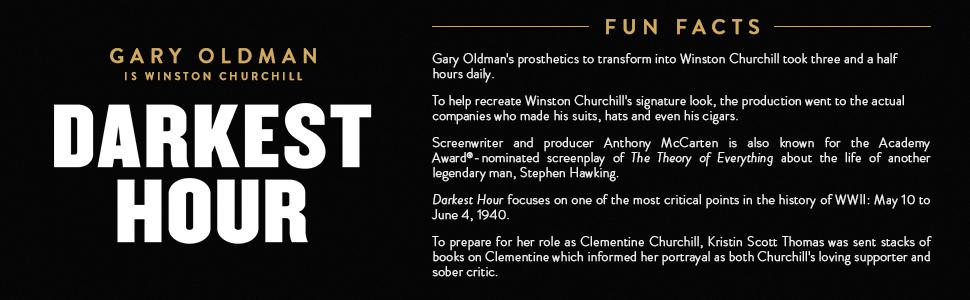
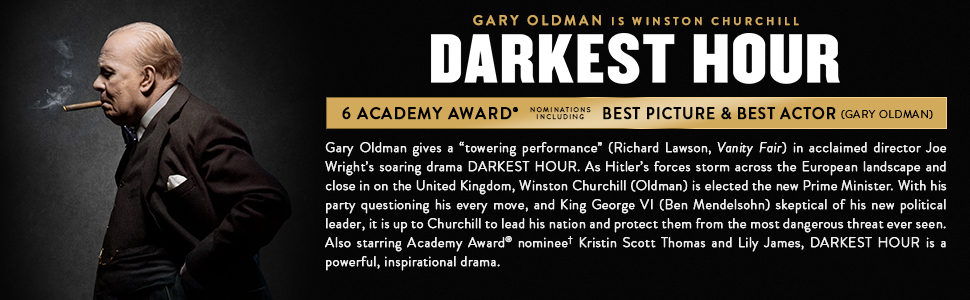
Academy Award® winner Gary Oldman gives a "towering performance" (Richard Lawson, Vanity Fair) in acclaimed director Joe Wright's soaring drama Darkest Hour. As Hitler's forces storm across the European landscape and close in on the United Kingdom, Winston Churchill (Oldman) is elected the new Prime Minister. With his party questioning his every move, and King George VI (Ben Mendelsohn) skeptical of his new political leader, it is up to Churchill to lead his nation and protect them from the most dangerous threat ever seen. Also starring Academy Award® nominee Kristin Scott Thomas and Lily James, Darkest Hour is a powerful, inspirational drama. Review: Two Excellent Films Look At The Same Events From Different Angles - As someone interested in history, but who is not a scholar, I decided to do a bit of homework before watching the movies Dunkirk (2017) (BD) [Blu-ray ] and Darkest Hour. I looked them up on the Internet, using resources like Wikipedia to simply get the gist of what was going on, historically, so I might better grasp the dramatizations created in the two movies. I watched Dunkirk first, and Darkest Hour a few days later. Because I was so bowled over by both movies, I can confidently recommend that these films be watched back to back, because they cover the same period, both specifically (Dunkirk – one event) and generally (Darkest Hour – about a nation’s resolve, leading into the war years). Conversely, the action of Dunkirk is seen through the eyes of an “everyman” character, a soldier among many soldiers, sailors and airmen, mostly nameless, but who made up the forces, which eventually helped England, defend itself from Hitler’s massive assault machine during World War II. Because they had been successfully evacuated from the encircled Dunkirk, British forces were able to regroup and come back stronger. Had this event not occurred, they might have been largely wiped out, and the war could have had an entirely different and deeply tragic conclusion. Meanwhile, Darkest Hour takes up the story from the perspective of Winston Churchill, portrayed brilliantly by Gary Oldman, who deservedly won the 2017 Best Actor Oscar for this film, along with his wife, his young secretary, members of the British Parliament, and even the King. Dunkirk is a mesmerizing and relentless portrayal of a turning point in a battle that was very nearly lost. In case readers here want to be kept in suspense, I won’t reveal its climactic moments, but this same time in history is briefly visualized in Darkest Hour. Both films have incredibly moving sequences. The aerial dogfights in Dunkirk were made real by the filmmakers’ refusal to turn them into some kind of Star Wars, breakneck-speed fest. It’s clear by the fine details that these airmen were working with technology quite primitive by today’s standards. Because we are invited into their cockpits through the use of beautifully calculated camera close-ups, their heroism becomes palpable, and we sweat and grit our teeth and hold on to our seats as if we were in there with them. Two scenes in the final half hour of Dunkirk may resonate with some viewers long after the movie is over. They did me, not to mention the breathtaking cinematography (shots of the beaches from the air, with thousands of men lined up to be rescued while the Germans continued their bombing raids, are among the most memorable scenes in the movie). While Dunkirk is saturated in tones of aqua, blue, pale yellow, green and white, Darkest Hour uses warm browns and sepias, with accents of red, orange, navy blue and beige. It is another animal entirely, but is a perfect counterpoint, dramatically and emotionally, to Dunkirk. Churchill, I learned from my research, was a tremendously complex individual, with a history of both failures and successes in various leadership roles. He had detractors as well as champions. While other portions of his life and career apparently revealed him as a deeply flawed human being, what Darkest Hour makes clear is that he was a tremendous communicator, and it was much to his credit that England did not surrender, but fought to the bitter end, and with the help of its allies, arose triumphant. Now I’m not knowledgeable enough to speculate that the British Empire would have triumphed over the Nazis if America had not finally been sucked into the war. But Darkest Hour pulls out all the emotional stops as it races toward its conclusion, and I was left with both tears and renewed astonishment at the fortitude of a small nation’s resilience, sacrifice and determination – all foreshadowed in the speeches of Winston Churchill. Darkest Hour is not an action film, and yet compared to Dunkirk, it seems to be over much, much faster. Personally, I attribute this to the extraordinary Gary Oldman. This is surely his finest hour on the Big Screen! Each of these two movies is stronger, I think, because of the existence of the other. The prime message that I took from this pair of fine films was not so much some notion of the “glory of war,” but just how valuable and hard won is the peace. During World War II, Hollywood movies seem to have been created as rallying cries to the battlefield and to victory, with manly men proudly marching into danger and destruction, and sturdy women working in the factories and keeping “the home fires burning” – and these entertainments often fulfilled their purpose. Dunkirk and Darkest Hour accomplish something a bit different – to remind us of the necessity of shared sacrifice, so important when the world faced down the “Great Dictator,” but which seems almost like a foreign, impossible concept now. I don’t see any leaders today who have the strength of character of a Winston Churchill, who can help us put aside our petty differences and to see ourselves as a nation with common goals, a society capable of achieving some kind of unity while remaining free. Woe to us if we ever have to face another Hitler! Review: Best dramatic film I've seen in many years - a tour de force! - Despite some critical claims that there were many historical inaccuracies in this film's plot, and between the enactment on film and real events in 1940, this was an outstanding film, and eminently worth watching. Oldman's performance was superb, as was the screen play in general. I found the finale of the film electrifying, as the portrayed Churchill followed his instincts, and courageously addressed Parliament with a rousing, forceful speech to go to war. To watch the resolve of the British people to defend their country has elicited some strong emotions. It's been quite some time since I enjoyed a film as much as this one. He was quite a character: brash and outspoken. His wife, in the movie, called him a "brute". ----- This is a postscript to my original review (above). After reading a lengthy Wikipedia article on Churchill's involvement in the debates prior to going to war against Germany, I was astonished to learn that it was Neville Chamberlain (the pacifist prime minister) who actually delivered the declaration of war to Germany - while he was still prime minister. Not Churchill! So, there are some historical inaccuracies in the story. This is not exactly what actually happened. You can say the film was "inspired by actual events". Nevertheless, the movie is electrifying and worth watching. Oldman's portrayal of Churchill was so effective, that Ben Mendelsohn, the actor who portrayed King George VI in this film, was prompted to confess that the characterization of Churchill made him feel that he was as close to meeting the real Churchill as he'll ever come.





| Contributor | Anthony McCarten, Ben Mendelsohn, Douglas Urbanski, Eric Fellner, Gary Oldman, Joe Wright, Kristin Scott Thomas, Lily James, Lisa Bruce, Stephen Dillane, Tim Bevan Contributor Anthony McCarten, Ben Mendelsohn, Douglas Urbanski, Eric Fellner, Gary Oldman, Joe Wright, Kristin Scott Thomas, Lily James, Lisa Bruce, Stephen Dillane, Tim Bevan See more |
| Customer Reviews | 4.7 out of 5 stars 15,120 Reviews |
| Format | 4K |
| Genre | Art House & International, Drama, Military & War |
| Language | English |
| Runtime | 2 hours and 5 minutes |
M**E
Two Excellent Films Look At The Same Events From Different Angles
As someone interested in history, but who is not a scholar, I decided to do a bit of homework before watching the movies Dunkirk (2017) (BD) [Blu-ray ] and Darkest Hour. I looked them up on the Internet, using resources like Wikipedia to simply get the gist of what was going on, historically, so I might better grasp the dramatizations created in the two movies. I watched Dunkirk first, and Darkest Hour a few days later. Because I was so bowled over by both movies, I can confidently recommend that these films be watched back to back, because they cover the same period, both specifically (Dunkirk – one event) and generally (Darkest Hour – about a nation’s resolve, leading into the war years). Conversely, the action of Dunkirk is seen through the eyes of an “everyman” character, a soldier among many soldiers, sailors and airmen, mostly nameless, but who made up the forces, which eventually helped England, defend itself from Hitler’s massive assault machine during World War II. Because they had been successfully evacuated from the encircled Dunkirk, British forces were able to regroup and come back stronger. Had this event not occurred, they might have been largely wiped out, and the war could have had an entirely different and deeply tragic conclusion. Meanwhile, Darkest Hour takes up the story from the perspective of Winston Churchill, portrayed brilliantly by Gary Oldman, who deservedly won the 2017 Best Actor Oscar for this film, along with his wife, his young secretary, members of the British Parliament, and even the King. Dunkirk is a mesmerizing and relentless portrayal of a turning point in a battle that was very nearly lost. In case readers here want to be kept in suspense, I won’t reveal its climactic moments, but this same time in history is briefly visualized in Darkest Hour. Both films have incredibly moving sequences. The aerial dogfights in Dunkirk were made real by the filmmakers’ refusal to turn them into some kind of Star Wars, breakneck-speed fest. It’s clear by the fine details that these airmen were working with technology quite primitive by today’s standards. Because we are invited into their cockpits through the use of beautifully calculated camera close-ups, their heroism becomes palpable, and we sweat and grit our teeth and hold on to our seats as if we were in there with them. Two scenes in the final half hour of Dunkirk may resonate with some viewers long after the movie is over. They did me, not to mention the breathtaking cinematography (shots of the beaches from the air, with thousands of men lined up to be rescued while the Germans continued their bombing raids, are among the most memorable scenes in the movie). While Dunkirk is saturated in tones of aqua, blue, pale yellow, green and white, Darkest Hour uses warm browns and sepias, with accents of red, orange, navy blue and beige. It is another animal entirely, but is a perfect counterpoint, dramatically and emotionally, to Dunkirk. Churchill, I learned from my research, was a tremendously complex individual, with a history of both failures and successes in various leadership roles. He had detractors as well as champions. While other portions of his life and career apparently revealed him as a deeply flawed human being, what Darkest Hour makes clear is that he was a tremendous communicator, and it was much to his credit that England did not surrender, but fought to the bitter end, and with the help of its allies, arose triumphant. Now I’m not knowledgeable enough to speculate that the British Empire would have triumphed over the Nazis if America had not finally been sucked into the war. But Darkest Hour pulls out all the emotional stops as it races toward its conclusion, and I was left with both tears and renewed astonishment at the fortitude of a small nation’s resilience, sacrifice and determination – all foreshadowed in the speeches of Winston Churchill. Darkest Hour is not an action film, and yet compared to Dunkirk, it seems to be over much, much faster. Personally, I attribute this to the extraordinary Gary Oldman. This is surely his finest hour on the Big Screen! Each of these two movies is stronger, I think, because of the existence of the other. The prime message that I took from this pair of fine films was not so much some notion of the “glory of war,” but just how valuable and hard won is the peace. During World War II, Hollywood movies seem to have been created as rallying cries to the battlefield and to victory, with manly men proudly marching into danger and destruction, and sturdy women working in the factories and keeping “the home fires burning” – and these entertainments often fulfilled their purpose. Dunkirk and Darkest Hour accomplish something a bit different – to remind us of the necessity of shared sacrifice, so important when the world faced down the “Great Dictator,” but which seems almost like a foreign, impossible concept now. I don’t see any leaders today who have the strength of character of a Winston Churchill, who can help us put aside our petty differences and to see ourselves as a nation with common goals, a society capable of achieving some kind of unity while remaining free. Woe to us if we ever have to face another Hitler!
S**I
Best dramatic film I've seen in many years - a tour de force!
Despite some critical claims that there were many historical inaccuracies in this film's plot, and between the enactment on film and real events in 1940, this was an outstanding film, and eminently worth watching. Oldman's performance was superb, as was the screen play in general. I found the finale of the film electrifying, as the portrayed Churchill followed his instincts, and courageously addressed Parliament with a rousing, forceful speech to go to war. To watch the resolve of the British people to defend their country has elicited some strong emotions. It's been quite some time since I enjoyed a film as much as this one. He was quite a character: brash and outspoken. His wife, in the movie, called him a "brute". ----- This is a postscript to my original review (above). After reading a lengthy Wikipedia article on Churchill's involvement in the debates prior to going to war against Germany, I was astonished to learn that it was Neville Chamberlain (the pacifist prime minister) who actually delivered the declaration of war to Germany - while he was still prime minister. Not Churchill! So, there are some historical inaccuracies in the story. This is not exactly what actually happened. You can say the film was "inspired by actual events". Nevertheless, the movie is electrifying and worth watching. Oldman's portrayal of Churchill was so effective, that Ben Mendelsohn, the actor who portrayed King George VI in this film, was prompted to confess that the characterization of Churchill made him feel that he was as close to meeting the real Churchill as he'll ever come.
J**N
Excellent film on Churchill and WWII
Gary Oldman is an excellent actor and I have enjoyed several of his films like Bram Stoker's Dracula, Air Force One, the Batman films as Commissioner Gordon and as Smiley in the remake of Tinker, Taylor, Soldier, Spy (originally Alec Guiness which is also very good). In Darkest Hour, I feel he surpasses his acting ability compared to his other films. To me, he brought Churchill to life, in the way he spoke, his physical mannerisms, his dress, being a hard drinker and heavy smoker, showing his frailties, which made him stronger and determined to show he was right about "that man", whom Chamberlain was arrogantly blind to believe his "signed paper" he brings to England, after meeting "that man" was their salvation, yet the country was still Blitzed. The kindness he shows to his secretary when he takes her to the map room to show her Dunkirk explaining the, what and why, and he feels the pain that she and other Londoners are experiencing. The sets are very well done and the filming in darker lighting enhanced the scenes of the war, and meetings between Churchill and other officials, and the one with King George VI where they each state their belief and trust in each other. I have watched the film three times now, and still enjoy it as much as the first viewing. My favorite scene is of Churchill finishing his speech in Parliament to the cheers and he starts walking out of the chamber, it was not Oldman I saw, but Churchill. I was eleven when I got to see Churchill's funeral on TV, something I have not forgotten. I highly recommend the film. UPDATE: Just finishing reading some other comments about this film. I do agree with some statements that Churchill was a determined man with his opinions already set in place, would not bow to anyone, whether political opponents or family members, though I am sure that he had some moments, where he thought long and hard on many issues. Some aristocratic/political heads deemed him a traitor to his own aristocratic class. No head of state/country will ever please every citizen, every time in everything. Another reviewer made the comments about how Gary Oldman as Churchill was made to look older than what he really was, so I would have to give that is correct. Churchill still had hair and was a bit chubby but not obese. As to historical accuracy, well, Hollywood films are for the sole purpose of "entertainment" not "educational" value, to which, one would watch a documentary on History Channel. But for purpose of movie entertainment, I still enjoyed the film and Oldman's performance. I have not seen the Albert Finney version, but some reviewers suggest that it is a good one.
F**S
A film outdone by its main performance, but fine work nonetheless.
There have been a LOT of representations of Winston Churchill lately--Brian Cox, Brendan Gleeson, John Lithgow (to names the ones I can think of just off the top of my head)--Gary Oldman's portrayal is probably the best because he really had to inhabit the character, which he did a remarkable job of doing. I did not see any aspect of Gary Oldman the actor on the screen. That said, Brendan Gleeson has the best natural look to play Churchill. Unfortunately, the Academy weighs heavily to what degree an actor changes his or her appearance to give a good performance, or what harrowing and/or gruesome things the actor is willing to do for the sake of the performance (consider Charlize Theron in Monster, Robert DeNiro in Raging Bull, Daniel Day Lewis in My Left Foot, Leonardo DiCaprio in The Revenant, Matthew McConaughey in Dallas Buyers Club, and Jared Leto, supporting actor, in the same movie, Adrian Brody in The Pianist, Nicole Kidman in The Hours...). I'm not saying that's always the case but, actors seem to get extra points for it. If anyone were to win on those merits alone, Oldman would have a lock, because I have never seen such a convincing performance through appearance-modification As for the film. It was good. But it is one of those films in which the performance is better than the film. Both are excellent, but Oldman raises the film to a level it might not otherwise have reached, like Daniel Day-Lewis did for There Will be Blood (which, while being a remarkable film in every way, boasted a performance for the ages from Day-Lewis). This script in Darkest Hour is a little clumsy in places, and doesn't give you enough context in places. The "Miracle at Dunkirk" was a truly astonishing moment in history, but we don't really get to see how it came to be considered "a miracle." One unfortunate aspect of the disc occurs in the special features, when the director says the film is somewhat prescient in its message. One might think he is referring to a growth in Russian aggression, North Korea, totalitarian regimes in the Middle-East, or perhaps terror attacks all over Europe. But no, to him, the threat is "right wing populism" sweeping through Europe and the United States. "We will fight them on the beaches, in the air, on land, in the water, in the streets." To the director, conservative or right wing politics is what we must rise up and fight against in the streets. It was absolutely inane, and I could hardly believe my ears when I heard it. What a disappointment.
A**R
An Honest Look At History
I have been wanting to see this movie since I first heard about it. It did not disappoint. For anyone who is interested in WWII history, you need to watch Darkest Hour. How brave the British were under insurmountable odds. My only suggestion, watch The Gathering Storm first. It is then you will understand the brilliance of Winston Churchill.
R**M
You’ve got to see it.
Excellent! Gary Oldman is a superior actor. Churchill came across as very believable
W**Y
Great movie
Smooth transaction
D**M
The Man of the Darkest Hour
A stirring rennactment of the drama around the survival of Britain at the start of the WWII. I thought the casting was great and the portrayal of Winston Churchill - with his foibles and weaknesses along with his bulldog British stubbornness and resolve to go on and never give up - was accurate.. I have no love for the English - being of Irish descent - but I have great respect for the British nation for their courage and resiliance during the terror of those days. My father was a tank sergeant in the Canadian army in that great war. He used to tell me stories about that time and he clearly thought that Churchill was a great man and that without Churchill in command England would surely have gone down. I would not have wanted to make the decision to sacrifice the garrison at Calais - in order to give the Allied army at chance to evacuate at Dunkirk. But Churchill made the call and took the heat. The movie also and showed the shocking courage of the British people to cross the channel in those small boats to evacuate the 300,000. This was IMHO a magnificent act. It certainly shocked Hitler and the British military high command - military people who could not have imagined that the civilian population could have risen to such a challenge when, militarily there was no way out. And it would not have happened if Churchill had not given the order. The scene with Winston Churchill on the "underground" with the common British subjects was striking. I don't know if it was real or just a mental aberration of the directors and screen writers to impress naive idealistic people like me - but it worked. It strengthened the impression that I already had of the humility of Churchill and resolve of the people that he served. Indeed I think I understand better what it was that transformed the apparently defeated British nation into a dedicated, united, courageous nation - a nation that would need that courage and resolve to make it through the next five years of hardship to ultimate victory. And that transformation happened during that dark May of 1940. I think Churchill, with his faults was the man of the darkest hour.
C**T
Sehr gut
Ein ausgezeichneter Film über die Zeit als Churchill Premierminister wurde, bis zur Niederlage Frankreichs. Der Film stellt Churchill in einem persönlichen Licht dar mit all seinen Schwächen und Schrullen. Für die Szene in der U-Bahn gibt es zwar kein Zeugnis, allerdings war Churchill bekannt dafür während des Krieges immer wieder irgendwo in London aufzutauchen und mit Menschen zu sprechen. Eine völlig andere empfehlenswerte Kriegsgeschichte ist "Der Flieger von Tsingtau" von Gunther Plüschow.
U**3
Si vous appréciez l'histoire de l'Angleterre et de la France...
Churchill est sans aucun doute l'une des personnalités les plus influentes du XXe siècle. Plus j'en apprends sur lui, plus j'apprécie à quel point il était doué, parfait et imparfait... quel homme merveilleux il était pour son époque. Lorsque nous apprenons l'histoire de France de nos jours, nous ne lui accordons pas suffisamment de crédit pour ses efforts inlassables avant la Seconde Guerre mondiale, et évidemment pendant la guerre, non seulement pour protéger la Grande-Bretagne, mais aussi pour libérer la France. Il était francophile et entretenait des liens d'amitié étroits avec de nombreux hommes politiques français. L'un des paradoxes est que les bons amis français de Churchill appartenaient souvent à la gauche radicale et socialiste, notamment Reynaud, Léon Blum, Édouard Daladier et Georges Mandel. En juin 1940, alors que la France tombe aux mains des nazis, Churchill reconnaît en de Gaulle « l'homme du destin ». Mais leur relation va se transformer en montagnes russes, entre admiration mutuelle, suspicion et, pour Churchill, dégoût. Pour lui, il ne faisait tout simplement pas confiance à de Gaulle, dont l'ego démesuré et l'apparente ingratitude « dégoûtaient » Churchill. En France, de Gaulle est présenté à la plupart des gens comme un héros, mais plus j'en apprends, plus je pense que c'est un peu déformé. Certes, en tant que soldat, de Gaulle était brillant, mais en tant qu'homme politique, il était autoritaire et semble avoir travaillé à l'encontre des valeurs nationales à plusieurs reprises, et il a tenu ses alliés à une distance qui n'était pas nécessaire. Bien sûr, ce n'est pas le sujet de ce film, mais pour comprendre la vie de Churchill, il est important de comprendre ce contexte. Personne n'est parfait, ce film montre les défauts et le génie du personnage de Churchill. Si vous aimez l'histoire, ce film vous aidera, comme plusieurs autres films, à comprendre cet Anglais complexe. Bien sûr, ce n'est pas le sujet de ce film, mais pour comprendre la vie de Churchill, il est important de comprendre ce contexte. Personne n'est parfait, ce film montre les défauts et le génie du personnage de Churchill. Si vous aimez l'histoire, lisez certains des livres de Churchill. Il était un écrivain prolifique et a reçu le prix Nobel pour son travail sur l'histoire de la politique mondiale et de la Seconde Guerre mondiale du point de vue de l'Empire britannique. En tout cas, ce film est top.
J**S
Quality film
Excellent film ,of good quality and portrays the story correctly
A**R
Brilliant
Imaginative tale.
M**.
Every One should watch this
This is how Britain was back then. Politics haven't changed much in real terms, but when I was born in 1951 I feel Britain needs reminding that we need each other in a time of crisis. for too long, we have been consumed by corrupt governments who have Sunday not a day of rest for many, benefits and allowances broken in an old computer software, that I probably have better, and all we seemed to interested in making money at any cost. I remember back not that many years ago when petrol was £1 gallon, which stayed that way every year apart from budget hikes. Oldman played this like a pro, the only downside was his voice should have been deeper. The actual elements of the sets and the period was spot on to, whether he actually did go down on an Underground train to talk to ordinary folk I have no idea, but its make me sad my country is no longer British, more like a foreign country with open arms migration, that has lead to most of us being isolated in our own country. Churchill and my parents, one a WRAC medic and my father on a Minesweeper In the North Sea, fought to save our country, but when some brute kills a 100 year old lady in an attack not related to war, It makes you wonder how this country ever got into the state its in. This film / documentary should be seen by our teens to see what Britain was really like in 40's and 50' and try and take from the film positive attitudes to use in today's world.
Trustpilot
1 month ago
2 months ago