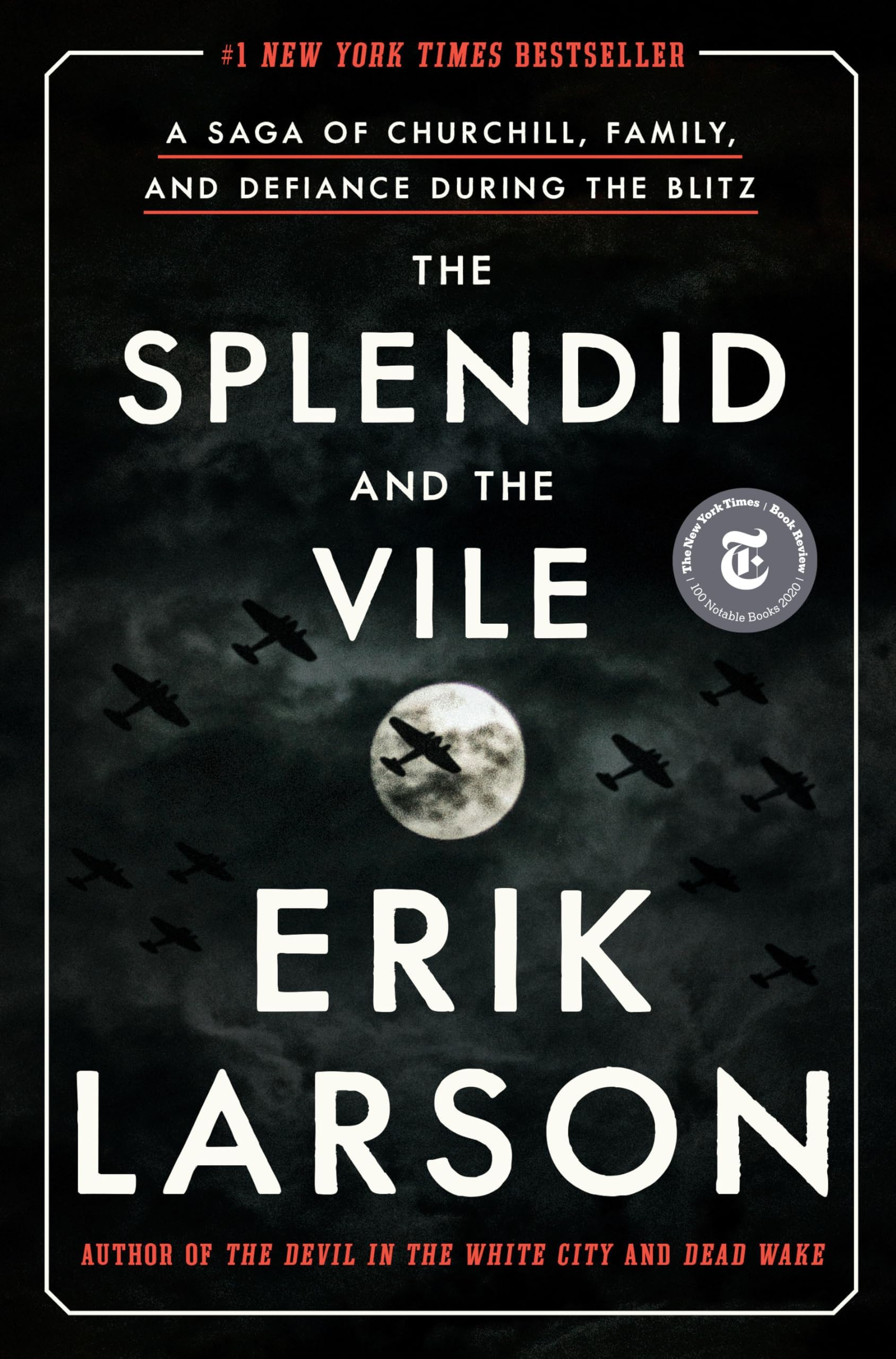
The Splendid and the Vile: A Saga of Churchill, Family, and Defiance During the Blitz
Product ID: 155968631
Desertcart purchases this item on your behalf and handles shipping, customs, and support to OMAN.
#1 NEW YORK TIMES BESTSELLER • The author of The Devil in the White City and Dead Wake delivers an intimate chronicle of Winston Churchill and London during the Blitz—an inspiring portrait of courage and leadership in a time of unprecedented crisis “One of [Erik Larson’s] best books yet . . . perfectly timed for the moment.”— Time • “A bravura performance by one of America’s greatest storytellers.”—NPR NAMED ONE OF THE BEST BOOKS OF THE YEAR BY The New York Times Book Review • Time • Vogue • NPR • The Washington Post • Chicago Tribune • The Globe & Mail • Fortune • Bloomberg • New York Post • The New York Public Library • Kirkus Reviews • LibraryReads • PopMatters On Winston Churchill’s first day as prime minister, Adolf Hitler invaded Holland and Belgium. Poland and Czechoslovakia had already fallen, and the Dunkirk evacuation was just two weeks away. For the next twelve months, Hitler would wage a relentless bombing campaign, killing 45,000 Britons. It was up to Churchill to hold his country together and persuade President Franklin Roosevelt that Britain was a worthy ally—and willing to fight to the end. In The Splendid and the Vile , Erik Larson shows, in cinematic detail, how Churchill taught the British people “the art of being fearless.” It is a story of political brinkmanship, but it’s also an intimate domestic drama, set against the backdrop of Churchill’s prime-ministerial country home, Chequers; his wartime retreat, Ditchley, where he and his entourage go when the moon is brightest and the bombing threat is highest; and of course 10 Downing Street in London. Drawing on diaries, original archival documents, and once-secret intelligence reports—some released only recently—Larson provides a new lens on London’s darkest year through the day-to-day experience of Churchill and his family: his wife, Clementine; their youngest daughter, Mary, who chafes against her parents’ wartime protectiveness; their son, Randolph, and his beautiful, unhappy wife, Pamela; Pamela’s illicit lover, a dashing American emissary; and the advisers in Churchill’s “Secret Circle,” to whom he turns in the hardest moments. The Splendid and the Vile takes readers out of today’s political dysfunction and back to a time of true leadership, when, in the face of unrelenting horror, Churchill’s eloquence, courage, and perseverance bound a country, and a family, together. Review: Another winner from Erik Larsen - If you ever find yourself in conversation with someone and they admit, "I really never liked history," allow me to suggest the perfect rejoinder: "Apparently you haven't read Erik Larson." History is taught poorly in most schools, losing the 'story' aspect of the subject and instead focusing on memorizing dates, names of leaders, etc. Erik Larson "Devil in the White City," "In the Garden of Beasts," "Dead Wake," and others) rejects that style of history and instead focuses entirely on the story . . . and he has the knack for picking *great* stories. From a serial killer at large during the Chicago World's Fair to the descent of Germany into Nazi madness to other tales, Larson either has the gift or labors hard to find captivating stories and tells those stories in a captivating, seemingly effortless way. (As anyone who has ever tried to write will tell you, making writing look effortless takes Herculean effort.) With "The Splendid and the Vile," Larson takes the reader to the inner circle of Winston Churchill during the outbreak of World War II, and most particularly, the Blitz, when Germany rained bombs down on Britain seemingly at will. When Americans study World War II, we usually focus on America's role - that the war helped yank America out of the Great Depression and America went to war to help struggling allies. "The Splendid and the Vile" gets into the grit of the struggle one of America's staunchest allies went through . . . and oh, the humanity. Winston Churchill looms large over this story, and all the usual anecdotes are there - the excessive drinking, the bizarre fashion sense, the childlike delight in gadgets as well as 'playing soldier,' and so on. But we also get to see Churchill's family - the wastrel son who gambles and drinks away his fortune, the daughter who comes of age during the chaos of war, and so on. We also see the chaos of the Blitz. It's one thing to read, "The English were tough and endured horrific bombing." It's another to read details of the carnage unleashed on a glamorous nightclub when bombs rip it apart mid-show, or the vanishing of a church, or a bomb blasting a building where dozens of children are sleeping. Larson puts this in context - we see the Germans trying to pound the British into submission, getting angrier and angrier at the British refusal to submit. We also see Churchill trying to woo in the Americans into the fight while simultaneously building up the British ability to strike back at Germany on its own - Churchill may have understood that America was essential to the British effort, but the average Brit sure didn't want to depend entirely on the second-class Americans. And from the British perspective, one gains an understanding of how frustrating it must have been to endure nightly bombing only to be told that "Lend-Lease" is the best President Roosevelt could do, due to isolationists in the American Congress. Wonderfully written, reveling in the humanity of the struggle (Larson writes with great sensitivity and humor about the increased British sex drive that the Blitz inspired), "The Splendid and the Vile" is a wonderful history . . . and a reminder of what a genuine struggle actually is. Highest recommendation. Review: Interesting Book On England and World War 2 - The book is very well researched and well written. Great storytelling and gripping action. Excellent character development. I strongly recommend the book for everyone interested in World War 2.




| Best Sellers Rank | #22,790 in Books ( See Top 100 in Books ) #1 in U.K. Prime Minister Biographies #4 in WWII Biographies #13 in World War II History (Books) |
| Customer Reviews | 4.7 out of 5 stars 46,221 Reviews |
S**N
Another winner from Erik Larsen
If you ever find yourself in conversation with someone and they admit, "I really never liked history," allow me to suggest the perfect rejoinder: "Apparently you haven't read Erik Larson." History is taught poorly in most schools, losing the 'story' aspect of the subject and instead focusing on memorizing dates, names of leaders, etc. Erik Larson "Devil in the White City," "In the Garden of Beasts," "Dead Wake," and others) rejects that style of history and instead focuses entirely on the story . . . and he has the knack for picking *great* stories. From a serial killer at large during the Chicago World's Fair to the descent of Germany into Nazi madness to other tales, Larson either has the gift or labors hard to find captivating stories and tells those stories in a captivating, seemingly effortless way. (As anyone who has ever tried to write will tell you, making writing look effortless takes Herculean effort.) With "The Splendid and the Vile," Larson takes the reader to the inner circle of Winston Churchill during the outbreak of World War II, and most particularly, the Blitz, when Germany rained bombs down on Britain seemingly at will. When Americans study World War II, we usually focus on America's role - that the war helped yank America out of the Great Depression and America went to war to help struggling allies. "The Splendid and the Vile" gets into the grit of the struggle one of America's staunchest allies went through . . . and oh, the humanity. Winston Churchill looms large over this story, and all the usual anecdotes are there - the excessive drinking, the bizarre fashion sense, the childlike delight in gadgets as well as 'playing soldier,' and so on. But we also get to see Churchill's family - the wastrel son who gambles and drinks away his fortune, the daughter who comes of age during the chaos of war, and so on. We also see the chaos of the Blitz. It's one thing to read, "The English were tough and endured horrific bombing." It's another to read details of the carnage unleashed on a glamorous nightclub when bombs rip it apart mid-show, or the vanishing of a church, or a bomb blasting a building where dozens of children are sleeping. Larson puts this in context - we see the Germans trying to pound the British into submission, getting angrier and angrier at the British refusal to submit. We also see Churchill trying to woo in the Americans into the fight while simultaneously building up the British ability to strike back at Germany on its own - Churchill may have understood that America was essential to the British effort, but the average Brit sure didn't want to depend entirely on the second-class Americans. And from the British perspective, one gains an understanding of how frustrating it must have been to endure nightly bombing only to be told that "Lend-Lease" is the best President Roosevelt could do, due to isolationists in the American Congress. Wonderfully written, reveling in the humanity of the struggle (Larson writes with great sensitivity and humor about the increased British sex drive that the Blitz inspired), "The Splendid and the Vile" is a wonderful history . . . and a reminder of what a genuine struggle actually is. Highest recommendation.
E**S
Interesting Book On England and World War 2
The book is very well researched and well written. Great storytelling and gripping action. Excellent character development. I strongly recommend the book for everyone interested in World War 2.
R**T
Good novel but too much of it filled with descriptions of nightly bombings
I enjoyed the book when it dealt with Churchill himself but the book dealt too much with the nightly bombings suffered by Great Britain during the war. We became aware that there was a great deal of suffering from the bombings but every chapter was filled with descriptions of the bombings. There were few anecdotes of Churchill and FDR and Stalin was completely left out. I would have liked to know Churchill’s feelings about having to deal with Stalin, a man just as bad as Hitler. Too bad that wasn’t included but maybe that’s another book.
L**R
Good book
This was such an interesting book. Hitler never invaded England, but before this book I had no idea how many thousands of people were killed there because of the relentless bombing and how terrified they were that Hitler would invade England like he did Poland and France. Using diaries, the author shows how Churchill and those around him responded to the war. I learned a lot.
J**D
A Personal Account
The Splendid and the Vile is a recounting of the hectic first year of Winston Churchill's Prime Ministership, from May 1940 to May 1941. As I hope most readers already know, Churchill took office at a moment of extreme challenge for the British Empire, when Nazi Germany had conquered most of Europe. Over the next year Churchill guided his nation through innumerable perils, as bombs flattened cities and killed thousands while a badly outnumbered but valiant air force fought back against a seemingly all powerful foe. This is a tale which has been told many times before, but it always bears recounting, especially at the hands of such a masterly story teller as Erik Larson, who is well known for creating works of history that read like the most sensational fiction. Here Larson portrays Churchill not only as the indomitable war leader but also as a harried husband and father, dealing with a wayward son and daughter in law, a teenage daughter, a loving but mercurial wife, and a lifetime habit of lavish spending that his income could not support. Churchill the crafty diplomat and Machiavellian is also well depicted, especially in Larson's recountings of the Prime Minister's efforts to convince the US President (another Machiavellian) to bring his country into the war. We also get personal views of what life was like during the Blitz and the Battle of Britain from the memoirs and other accounts of countless numbers of ordinary Londoners, along with asides from the German leadership's own point of view. Larson's research is thorough, making use of archives in the US and Europe as well as many published accounts. His writing is vivid and colorful, with a keen eye for anecdotes like those recounting the amount of work Churchill did while soaking in bathtubs or when, shortly after Pearl Harbor during a visit to the White House, he had a lengthy conversation with FDR while nude. If after reading The Splendid and the Vile you would like to learn more about Churchill, Roosevelt, and the period,I can do no better than to recommend Doris Kearns Goodwin's No Ordinary Time and Lynne Olson's Citizens of London, Last Hope Island, and Those Angry Days.
P**T
Great book
Good read and lots of things I didn't know!
J**Y
The bombing of England in the days leading up to United States entering the war!
As an American, I really didn't recall school history teachers talking about England prior to the U.S. entering WWII. Rightfully so I suspect because after all it was American History. But then again, World History classes didn't discuss the subject either. Erick Larson however with his very detailed style of writing, did a masterful job of describing the dire consequences England was facing during this period. Winston Churchill had just become Prime Minister and his army was fleeing for their lives at Dunkirk. The only good news was, not as many British Soldiers were killed in this evacuation as predicted. If one may call that good news. Mr. Larson really has the reader feeling how alone England really was in their efforts of defending democracy from the German Empire. Germany's Blitzkrieg rolled over Europeans with great ease and the soon realized vulnerable French, were now the only defense between them and the German army. The French had prepared for the invasion by building a massive line of impenetrable connected bunkers. Who knew the German army would just go around them. Shortly, the French negotiated a surrender with Germany and now there was no protection from being invaded. For the 1st year of Churchill's administration each and every day the British people were unnerved at the prospect of be invaded. The only thought Hitler and his staff didn't consider was resistance. Hitler mistakenly took the entire British Empire as nothing to be concerned about and with his advisors were convinced they could take England with their air bombardment followed up by a ground invasion. What i learned from this book is more about the resolve of the British people. For many days, several in a row, the clouds over England at night were full of bombers applying massive destruction to a historic empire. And yet, people went out to dinner, attended movies, plays and actually danced many nights away at local and regional night clubs. I'm sure there were people that stayed in bunkers, basements or what have you, but for the most part, people seem to treat the bombs as an inconvenience as they went about their work days. I really enjoyed the description by Mr. Larsen of Joseph Goebbels, one of the most powerful leaders of the Nazi party, as he painted his fingernails and dressed up in lavish outfits to attend public parties. There seems to be no denying that Churchill had is idiosyncrasies as well. Mr. Larson described how he enjoyed putting on his uni suit and marching around in front of his dinner guests to military marching tunes until way into the early hours of the following day. There were at times I thought perhaps too much ink was spent on Mary Churchill but then again, it sets the tone for what all British citizens were up to as well. I have read all of Erick Larson's books and as soon as I saw this one offered for a pre purchase via Amazon I clicked the order button with out even reading the bibliography. It's not my favorite Larson book, but by far not my least favorite. Very entertaining and causes one to reflect on some of the similarities we are all facing with this deadly Covid19 Virus. Treat yourself and buy this book.
N**H
Almost first person view of Churchill's first year as Prime Minister during World War 2
The Splendid and the Vile Story of Churchill’s first year in office as Prime Minister of Britain during World War 2. The focus is more on how he ran the government and on some of the people around him, rather than what was happening during the war. What is interesting about this is how small his group of advisors is and how he relied on them for different aspects. His relationship with Beaverbrook reminds one these days of what is happening between Trump and Musk. It is also interesting to note how the same thing is happening in the U.S. with Roosevelt relying on Hopkins and another small coterie of close advisors while navigating the shoals of Congress and the U.S. Public to join the war. The family relationships around Churchill are detailed to some extent. Only two of his four children are discussed (Randolph and Mary). Of those, I knew that Randolph was a problem, but had not realized that Randolph’s wife (Pamela) ended up divorcing him after the war and many years later marrying Averill Harriman (whom she had an affair with during the war) and becoming the U.S. ambassador to France! The unusual work habits that Churchill had were well known but the importance of his country retreats and the inability of the RAF to stop the nighttime bombing raids were new to me. This last was especially interesting given that the British and American bombers had such a difficult time bombing Germany only a couple of years later. So, why was it so difficult for the British to inflict damage on the Germans? Even so, the book mentions that the life expectancy of a British bomber at that time was about two weeks? So why the discrepancy? The book does not discuss this issue. The other person this book focuses on is one of Churchill’s private secretaries by the name of Collville. While this brings to life some of the inner workings of the Churchill regime, the private details of his life outside of work serve as somewhat of a distraction which I found unnecessary. A minor disagreement I have with the author is his belief that Churchill focused on the U.S. almost from the beginning of his administration as the only possible way for the British to survive and win the war. Other books and readings I’ve done do not highlight this to such an extent and I am wondering if the author is not taking this too far. Overall, this is an interesting work that adds somewhat to our understanding of how Churchill operated during the first year in which he established his reputation and got the British to survive the trials and tribulations and move forward from there.
S**O
masterpiece
A well written, interesting, and complete recount of Churchill’s first year as PM during the war. Erik Larkson goes into lots of very interesting detail, with s splash of humour that the novel enjoyable to read!
J**O
A so delightful book to read
I enjoyed so much to read. It has been a pleasure time to invest in this reading, I personally believe W.Churchill was a true leader that saves England to be defeated.
F**N
A Saga of Churchill, Family, and Defiance During the Blitz
May, 1940. Already weakened by failures in Norway, the successful blitzkrieg in Holland and Belgium sounded the death knell for Chamberlain as Prime Minister. Reluctantly King George VI offered the position to Winston Churchill, a man adored by the public although many of his colleagues thought him too erratic for the role. Larson sets out to tell of Churchill’s first year in power: holding British morale together during the Blitz; desperately working to build up British forces to defend against the expected invasion; battling to get America, even if they weren’t willing to put boots on the ground, to at least assist with money and equipment while Britain stood alone against the overpowering forces of the Nazi war machine. Larson is brilliant at bringing historical events to life so that it feels as if the reader is there in the room rather than reading a dry recital of historical facts years afterwards. Here he uses a variety of personal accounts to paint a vivid picture of Churchill through this dramatic period – primarily the diaries of his daughter, Mary, and his private secretary, Jock Colville, supplemented by various letters and memos between Churchill and members of his inner team. Larson also turns to contemporaneous reports in the newspapers and on radio, to show what people knew and how they felt at the time rather than through the lens of hindsight. It’s probably true to say there’s nothing startlingly new in the book, but Larson brings out the drama and emotion of the time without sacrificing factual accuracy and detail. Names from the history books become living, breathing people – Beaverbrook, Lindemann, Goering, Hess, et al – and we see their weaknesses and vanities along with their passion and commitment, whichever side they were on. The use of the word “saga” in the subtitle made me fear this might be too geared towards gossip about Churchill’s family, but in fact we learn just enough about them to get a feel for Churchill as a family man, and through Mary’s diary extracts we also get a picture of how the young upper-classes lived and played during this early part of the war, and how their attitudes changed and hardened as the dark realities of modern air-led warfare became clear. What Larson does so well, though, is to bring the lives of the mass of ordinary working people into the story, not simply as a kind of audience for the great and the good, but as real participants in their own fate. For this, he uses extensively the records of the Mass Observation project, where many volunteer observers kept diaries in which they recorded not just their own lives but their impressions of what was happening in their localities. We see London reeling and terrified after the first air-raids, but the Londoners gradually realising that they were brave enough to take it, and showing the resilience and defiance for which they are remembered. He shows a kind of euphoria developing, and a good deal of sexual licence on display, due to a growing eat, drink and be merry attitude. Larson takes us to Coventry to see the devastating raid there and its aftermath, and his description of this piece of history I already knew well is so vivid that he reduced me to tears and roused my rage anew at this mindless death and destruction. Back with Churchill, we get to know the people in his smallish inner circle and how they interacted. We are critical of all government ministers and of course they should not be above criticism, but we perhaps don’t cut them enough slack for the enormous responsibilities we expect them to deal with on our behalf. Churchill lived a life of comparative luxury, and rationing, which hit the general public hard, didn’t seem to make his table any less lavish, or his brandy to run out. But he worked such long hours his staff were permanently exhausted and he himself became ill (and worked through it), he had to tolerate and soothe the ruffled feelings of those to whom he delegated the impossible while still driving them to get it done yesterday, he regularly put himself in danger to show the public that he understood and shared what they were going through, he had to cajole and flatter the American president endlessly for very little return in the way of practical assistance; and frankly I didn’t begrudge him his smuggled cigars and chocolate, his extensive cellar, his extra meat provided by grateful landowning Dukes, even the money that was raised by supporters to help pay his household expenses. I suspect his poor entourage regularly wanted to beat him over the head with a brick, especially when he would put on records and start dancing round the dining room at 1 a.m. after a twenty-hour working day, but I’m glad they didn’t. Another excellent book from Larson, his trademark blending of historical facts with the personal building to give an intimate and affectionate portrait of Churchill’s personality and daily life as he led Britain through its darkest hour. Highly recommended.
J**K
戦争の本質を理解していたチャーチル首相と、戦争をヤクザの出入りと勘違いしてた東条首相
チャーチル首相が就任した1940年(昭和15年)から一年間のバトルオブブリテンを主題にしたドキュメンタリー。ヒトラー総統、ゲーリング元帥の元、猛威を振るったドイツ軍にただ一人最後まで抵抗したチャーチル首相。彼は戦争の本質を見抜き、米国を味方に付ければ、その工業力、資源力、そして国民数によってナチスドイツに勝利するとの確信を持っていたのです。翌年の日本軍による真珠湾攻撃の後、時のルーズベルト大統領からの知らせで翌日、米国は日本に宣戦布告をすると聞き、第二次世界大戦の勝利を確信し、喜びを抑えきれぬまま就寝したのです。当時の英政権、ドイツ政権の内情と戦況観が的確に描かれ興味深いです。一方で英国の貴族階級の常軌を逸した行動も描かれ英国王室を見る参考にも成りました。
J**O
Churchill in not used details
A very special biography in which Churchill is seen from the very depths
Trustpilot
2 days ago
5 days ago