Buy anything from 5,000+ international stores. One checkout price. No surprise fees. Join 2M+ shoppers on Desertcart.
Desertcart purchases this item on your behalf and handles shipping, customs, and support to OMAN.
✏️ Sharpen your edge, own your craft.
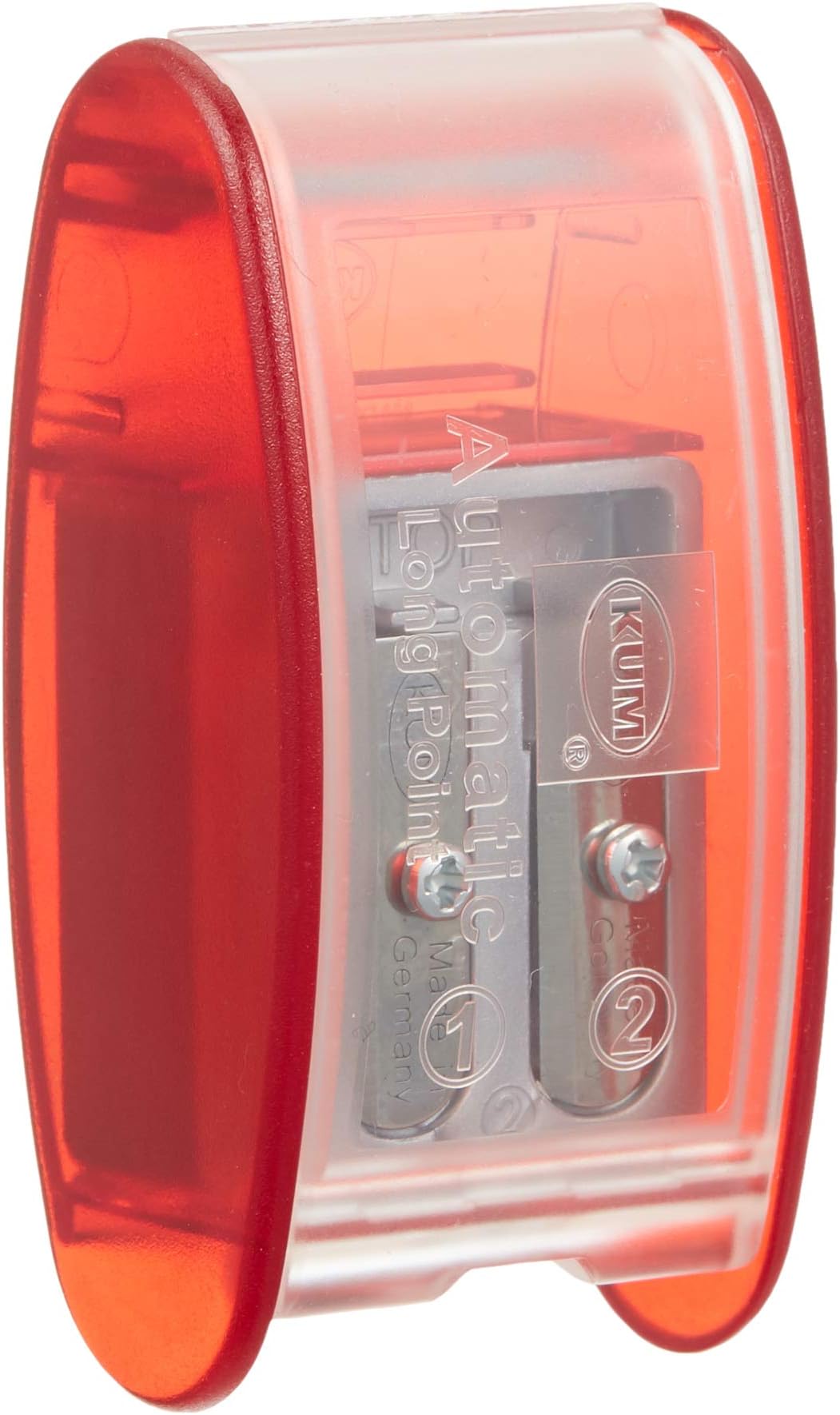
The Kum AS2 is a compact, automatic two-hole pencil sharpener engineered with high-carbon steel blades and dynamic torsion action to deliver ultra-smooth, long-point tips. Designed for both standard and draftsman pencils, it offers precision control and durability, making it a must-have tool for professionals and creatives who demand flawless sharpening every time.
| ASIN | B003G560JQ |
| Additional Features | Flexible |
| Best Sellers Rank | #25,343 in Office Products ( See Top 100 in Office Products ) #109 in Pencil Sharpeners |
| Brand | Kum |
| Brand Name | Kum |
| Color | Red |
| Customer Reviews | 4.5 out of 5 stars 1,918 Reviews |
| Global Trade Identification Number | 04064900010770 |
| Item Weight | 23 Grams |
| Manufacturer | Agnika Inc., dba KUM |
| Manufacturer Part Number | 105.30.21 |
| Material | Wood |
| Material Type | Wood |
| Model Number | 105.30.21 |
| Power Source | Hand Powered |
| Specific Uses For Product | Graphite Pencil |
| Target Audience | Artist |
| UPC | 885641111854 885823465324 885860587980 781068196545 013071018935 785934100216 406490001075 885807318622 885639461114 885599062475 |
| Unit Count | 1.0 Count |
P**R
Wonderful Sharpener for COLORED pencils too!
To keep my colored pencils sharp, I have tried dozens of sharpeners, from the pricey electric and battery powered to the cheapest and simplest handheld ones that range from $7 to 50¢. This one is the best I have found so far. I won't go into the mechanics of it, as the other reviews do that in detail, except to reiterate that sharpening with the KUM is a two step process that cannot be condensed down to one step. The first step cuts away the wood and the second sharpens the graphite or wax or whatever material the lead is made from. When I tested the KUM with colored pencils, I used every kind I had except my Derwents as they are larger than the average pencil and would be a bit too big to fit the one-size hole. However, despite a cartoon that seemed to indicate that only hexagonal pencils were appropriate for use in the sharpener, I tried my round Prismacolor Premier, my Prismacolor Verithin, Caran D'ache Pablo, Derwent Studio thin, and my round Faber Castell Polychromos pencils. What a delight to find that each and every pencil sharpened perfectly in the KUM sharpener, when I followed the 2-step process. THe points are extremely long and razor sharp, though because of this they are of course delicate and need to be handled with care. You cannot expect to press down hard on them without having them break. I will say, though, that not a single pencil broke inside the sharpener when I did my testing. In addition, when I attempted to mend a pencil with a known broken core, by "nuking" it in the microwave for 20 seconds, then using the KUM sharpener, the process actually worked the first time I did it. It was nice to know I could save a pencil I thought I had lost... Two important suggestions: 1) I chose not to close the top of the sharpener, but used it over a wastebasket every time. This allowed me to watch the pencil as I sharpened it and to see when to stop step 1. The receptacle for shavings is tiny anyway, and gets in the way of seeing what is happening to your pencil, so I recommend that you do not use it. That way you won't run the risk of cutting off too much pencil wood at a time. 2) If you are using the KUM to sharpen colored pencils, you must make sure you sharpen a graphite pencil in it at least every 5 or 6 pencils. Otherwise the exquisite sharpness of the blades will get dull too fast. (It was a stroke of either genius or kindness that the KUM people included two extra blades inside the sharpener, to be attached with just a simple screw driver. So when the original blades dull, you won't be up a creek, having to wait for another KUM to arrive by mail...) I never thought I would be giving thumbs up to one of the simplest of sharpeners as the best I have found, but there you have it: TWO THUMBS UP! Congratulations to KUM for designing a really decent pencil sharpener, one that works well and with nearly ALL pencils.
R**E
Spectacular! Blew My Mind!
This is the first two-stage sharpener I've owned, and I can't believe what a great tool it is. It's like having all the control of knife sharpening, but none of the hassle. If you've never used one before, you sharpen the wood in the first hole, and the graphite in second hole, so there's no guesswork. (It's not the same as sharpeners that have a small hole for regular pencils and a larger hole for wider ones.) Another advantage is you can see what you're going - there's no sticking your pencil in a hole crossing your fingers that the tip doesn't snap off. And it produces an incredibly sharp tip. I've included a comparison picture with two other sharpeners - an inexpensive Staedtler metal sharpener that I've used for years, and a Blackwing One-Pull that I received as a gift. Although the Blackwing struggled until I bought replacement blades for it, now it's fantastic, and all three produce great results. That said, the KUM is sharper, you have more control with it, and it works great every single time. It doesn't feel nearly as nice in the hand as the other tools, but, if I was getting rid of the clutter in my life and paring down to one sharpener, I'd keep the KUM Automatic without hesitation, even though it's plastic. Plus, it's CHEAP, and it includes extra blades. In terms of how much satisfaction I've gotten for such a small expenditure, this is probably one of the greatest purchases I've ever made. Highly recommended.
P**A
S H A R P.!.........A N D......C A N.....S A V E.....M O N E Y....O N.....B U Y I N G.....P E N C I L S..!
The KUM LONG-POINT PENCIL SHARPENER(S), looks a little more sophisticated than the usual hand-sharpener for pencils -- and is also a bit more expensive. But it's worth it! : ) Desk-(or wall) manual-type sharpeners might last a bit longer, and electric sharpeners might be easier to use -- but each of these have drawbacks. Desk-or-wall manual-type sharpeners must be anchored to desk or wall, either by suction, (desk), or nails, (wall. This means one must always get up from where one is sitting to sharpen one's pencils; yes, it gives excercise, but can also be a nuisance after a while. Most electric sharpeners also cannot be taken to one's desk, and used while sitting down --plus they have an annoying habit of seeming to "grab" the pencil, and you, the person sharpening the pencil, has very little control over the sharpening action. Often, electric pencil sharpeners sharpen way to much of the pencil off, (the "Sorcerer's Apprentice Syndrome", seen in many electric appliances, and in some too-over-eager housekeepers, sigh!) As part of this....electric pencil sharpeners can actually break pencil points, far too often.... This KUM Long-Point Pencil Sharpener, like all hand-held pencil sharpeners, can be.....well, held in your hand! And carried around, and placed in pocket, purse, or just near you on the desk, and no suction cupping, (which often doesn't work), is needed! What makes this KUM Long-Point Pencil Sharpener different is that it has TWO holes. One might think: "...Wow! Two blades! This will save a lot of money, because when the first blade gets dull, I can use the second blade!" Well, it doesn't work quite like that. You CAN save money -- but on pencils, not on the pencil sharpener. Hole No. One, you see, is for pencils that have never had a point. What sharpening in Hole No. One does, you see, is to sharpen JUST THE OUTSIDE WOOD OF THE PENCIL. If you continue sharpening, ONLY in Hole No. 1, you will get lead coming out of the wood, forming a point, (of sorts), but NOT a very sharp one. If what you are using the pencil for does NOT require too sharp a point, you actually CAN save money this way -- for, in sharpening a point, you are actually creating a sort of elongated "cone" shape, and to create this "cone" shape, part of the lead itself must be taken off.... If you don't need a sharp point, though, you don't need the point....and the KUM No. 1 Hole is then enough. You will obviously save some of the lead this way. Not much....but all those little bits of pencil lead that are not dispensed with to make a point, do add up! I DON'T KNOW OF ANY OTHER PENCIL SHARPENER THAT WILL DO THIS! If, however, what you are doing requires a very sharp point, the KUM Long-Point Pencil Sharpener will give you this, as well! Just use Hole No. 2 after having used Hole No. 1. Carefully sharpening in Hole No. 2 will now give you a nice, long, and very sharp point! I noticed, just now, that one is supposed to get two extra blades with this sharpener. I did not see any in the package, but looking very closely, I do see two pieces of metal, held in place by screws, in a separate compartment in my KUM hand-held sharpener. But they look far too short to be replacement blades.... Hmmmm... What to do when the blades get dull? Well, I remember Peg Bracken, in her "I HATE TO HOUSEKEEP BOOK" mentioning that one could sharpen scissors by cutting non-soaped steel-wool pads in half. I don't happen to have any steel-wool pads at home at present....but may consider buying some. However, doing so JUST to sharpen the blades on a pencil sharpener may be a false economy. Maybe I'll just be happy with all the extra lead my KUM Hand-held pencil sharpener is giving me. Because right now, I'm lucky enough NOT to need extra sharp pencils... Every little bit helps! $ : )
D**C
The best sharpener I've come across!
One of the other reviewers showed it best, comparing KUM with Staedtler and Blackwing. I've been searching for a small sharpener which would fit my drawing/animating needs and KUM blew my mind with how fine the point is! Staedtler is a good sharpener, but KUM is superior. It also treats the wood on my pencils better than Staedtler. For context, I use the Prismacolor col-erase red, blue, and green pencils. Staedtler ended up grinding the wood on those, but KUM cuts them smooth without issue. They've also been good for sharpening plan old every day #2 pencils. I'm giving it 4 stars because of its small capacity to hold shavings and the shavings tend to stick to the top of the blade and not filter down to the bulk of the case. Translation: it doesn't take too many sharpenings before you have to dump out the case. Overall, I think this is a keeper.
C**M
Excellent point.
Why get a long point sharpener? One reason is that it takes a little longer to get dull, and makes better use of the lead. Even more, though, you have more control over your strokes. You can do larger areas with the side of the lead, preserving the tip for the places where you need a sharp line. If you have high end pencils, this can be a good savings. You want the pencils to last as long as possible. The long point from this sharpener is lovely, and the blades are sharp and precise. This pencil sharpener is a little different from the twisty ones you remember from school. It has two holes, but they are not for two different sizes of pencils. Rather, the first hole is for shaping the wood and the second is for shaping the lead. This is what enables it to get such a long point. Kum pencil sharpeners already have a strong reputation with strong, sharp titanium blades. I had one already that I liked a lot, but it didn't have a shavings catcher so I thought I would upgrade, especially when I saw this long point sharpener. I was not disappointed. I was a little confused because the sharpener arrived in a box that is apparently the same box used for an almost identical sharpener that also comes with a pencil pointer in the side for 2mm lead holder leads. The box indicated it, but it wasn't the case. (No problem, I hadn't ordered one with the lead pointer, so I had no reason to expect one.) The one thing to be aware of is that it can't do miracles on a pencil that doesn't have the lead right in the middle. Some of my Prismacolors are unevenly leaded, and it was impossible to get those sharp in this sharpener. The fault is really with the pencil, though, not the sharpener. A pencil that is not evenly filled will always be hard to sharpen. (Derwent Colorsoft and Faber Castell Polychromos are similar quality colored pencils but more centered.) I've included a photo of pencils sharpened with this sharpener alongside some that are not yet sharpened.
L**H
ONLY Sharpener for me!
I absolutely love these pencil sharpeners. They are the only ones I use. I am an avid “pencil writer” and as such, spend the extra money to purchase quality pencils (I prefer Mirado Black Warrior pencils). I also like my pencils sharpened to a nice, fine point—for which you pretty much need a two step sharpener such as this. I see there are some negative reviews where buyers claim this sharpener is dull, won’t work, etc. I will say that I have noticed that if you use this great piece of German engineering on cheap pencils (or worse, “recycled wood” pencils—sorry trees!), you may have trouble with it or not like the result. If you use cheap pencils, you should probably buy a cheap pencil sharpener. I have had the tips of cheap pencils break repeatedly with this sharpener, which I believe is too sharp for them, not too dull. Also, it absolutely works best, and uses up less of your pencil, when you use the two-step process, and sharpen your pencil more often. Please also note that these sharpeners contain extra blades, located on the inside of it, to use as replacements. I’ve had several of these for over ten years and have never had to use the replacement blades yet, on any of them. I have found their one weakness to be that on some of them, the shavings cover gets disconnected at the hinge, though it is easily repaired with a piece of scotch tape. KUM also sells a blue colored version of this which actually has tiny sharpeners on the side (two different sizes) to sharpen automatic pencils—fantastic, if you use those. Other than perhaps improving on the lid hinge, I wouldn’t change a thing about these great little sharpeners!
K**N
Game Changer!
I used to think that all pencil sharpeners were pretty much the same. NOT SO!!! This two step sharpener is amazing! Remember, your sharpening technique also plays a part in sharpening success. If you find you're not getting a smooth cut, hold your pencil stationary, and turn the sharpener, instead of turning your pencil inside the sharpener. This little inexpensive pencil sharpener has given me the most glorious long points on my colored pencils. I've used it for Prismacolors so far, but I'm about to drag out the Polychromos and the Caran D'ache to sharpen those up as well. It even comes with two replacement blades, big plus. My one complaint, if you could even call it that, is while there is a small reservoir for shavings, the lid is a bit too close to the blades to allow the shavings to fall into the reservoir, so you have to empty the sharpener after every pencil. I'll happily deal with that for the incredible points I get. Remember, it is a two step sharpener (and the steps are marked on the lid). Step 1 is to whittle away the excess wood, and Step 2 is to refine that beautiful, sharp point. I would enthusiastically buy several more of these!
A**H
USED to work like a charm...recently purchased ones have poor quality control!
This review started out short, but after numerous updates is now incredibly lengthy. For those of you who don't want to read that much about a pencil sharpener, here is an abridged version: This pencil sharpener is very good when it works, but I have experienced inconsistency in the multiple instances I have purchased. Some work great, while others don't work at all. For more details, see below. My most recently purchased one DOES work, so I would recommend buying one, but if you experience problems right out of the box, don't spend too much time messing with it and just return it. I am less dependent on the sharpener now as I have moved to 2mm mechanical pencils (which work pretty well), but it's still nice to have a good sharpener on hand for shading pencils, and when this one works, it's by far the best I have ever used. UPDATE: 1-27-2014 My recent update below detailed how this pencil sharpener used to work great for me, but the last 6 I have bought (all from Amazon) were faulty. After I wrote that update, I placed an order with Dick Blick art supply, and decided to throw in one more Kum Long Point sharpener with the order. Upon receiving this sharpener, which was boxed exactly the same as the ones from Amazon, and had the same "Made in Germany" stamping on the blades as the two I most recently purchased from Amazon (which didn't work, as detailed below), I tested it out on several pencils and it worked PERFECTLY. It was the same old Kum Long Point that I bought originally and loved. I don't know why, but the 3 sharpeners I've bought from Dick Blick worked perfectly (they now stock replacement blades, too, something I couldn't find in the past), while the 6 I bought from Amazon didn't work at all. Again, the packaging and appearance of the sharpeners is the same. I would suggest that Dick Blick had a huge stock of older ones that they are still selling, and the newer ones are the problem, but the one I just bought had the newer blade markings. Basically, buying this sharpener appears to be a gamble. It might work absolutely perfectly, or it might be useless. When it works, it works WELL. Unfortunately, at this time I have no idea why some of them work and some don't. UPDATE: 1-10-2014 I regretfully must update this review with the information that Kum's quality control has taken a dive on recent Long Point pencil sharpeners, once again leaving me with no sharpener that actually works for me (more on that in a bit). As you can see by my original glowing review below, I absolutely loved this sharpener when I bought my first one in 2010 from Dick Blick art supply. After the blades wore out and I was unsuccessful at finding replacement blades anywhere, I bought a second one, which also worked well...until its blades also wore out. The THIRD one I bought, from Amazon, didn't work at all. I suspected a defective product, but as I was in the middle of a piece of artwork with a stringent deadline, I bought another three to ensure I didn't get another dud. Unfortunately, NONE of the three worked correctly. I managed to swap blades around from my growing collection, and got something that worked well enough to finish that piece and actually get me partway through another. However, in late 2013 I once again ran into the issue and bought two MORE (I now have 8 housings floating around). Straight out of the box, neither of the two brand new ones (which have different blade markings than my older ones) worked. Kum has chosen to use injection molded plastic for every part of the sharpener except the blades and screws. This means that if you replace blades often (such as when trying to find one that works...), the screw will eventually strip out the plastic, leaving the housing useless. This is one quality control issue, but not one that affects brand new sharpeners. Blade design is another issue. I've found that the blades are slightly concave, i.e. if you lay one edge-down on a flat surface, you'll see a small gap in the middle. Some of the blades that I've come across, however, are straight or even convex, and these never work. I have also run into inconsistency with the placement of the automatic stop, and the diameter of the pencil opening. I can group the failure mode of these sharpeners into 3 groups, as follows: 1. Pencil does not get sharpened at all This is the case when the blade screw is beginning to strip out, when the blade is straight or convex, when the automatic stop is too close to the opening, or when the opening is too small. The stage 1 sharpener hole works fine to expose the core, but the stage 2 will only sharpen to a dull point, at which time you can turn the pencil a hundred times and nothing more happens. Trying to force the pencil further into the sharpener will usually result in the tip snapping. 2. Pencil breaks This is the case when the blade is TOO aggressively concave, and sometimes when the opening is too small. It usually occurs when transitioning from the stage 1 to stage 2 holes with the large, cylindrical core exposed...even using the most careful degree of finesse, the pencil will turn a few times, then instantly bind and snap. Making things worse is that the snapped off tip will usually get lodged between the automatic stop and the blade, requiring you to remove the blade to free it. Attempts to poke it out with the same screwdriver used to remove the blade screws can result in damage to the automatic stop, since it's plastic. 3. Pencil sharpens to a certain point then necks out This is the most common failure mode I've experienced with the Kum Long Point and was the exact problem with the two brand new units I most recently purchased. It seems to occur when the opening is too large, the blade is not aggressive enough, or the automatic stop is too far from the opening. The pencil sharpens just fine to a certain point, but then it reaches the end of the blade. At that point, the tip of the pencil is no longer in contact with the blade and receives no further sharpening. Instead, the pencil continues to sharpen farther and farther up the barrel, while the tip extrudes out like a mechanical pencil, forming a bottleneck shape. This is useless. Not only does this extruded section immediately snap off when it touches the paper, it's not even a sharp point to begin with anyway. Once it snaps off, OR if you manually stop sharpening instead of relying on the automatic stop, the pencil is dull and doesn't come to a point...which defeats the entire purpose of using a pencil sharpener. I attempted to contact Kum via email about this, but after typing out a very detailed description of the problem, their site kindly informed me that it had an internal server error and deleted my message. At this time I have 32 blades (since each comes with 4). Some are dull, others are shaped wrong, and some seem OK until you try to use them. 6 of my 8 housings have stripped out screws. I've tried all 32 blades in each of the two remaining housings (the newest ones) and none of them work. One of the 3 above failures happens with each blade. I've burned through at least 10 entire pencils in my testing. At $6-7, these things aren't that expensive, but I don't want to buy 15 of them and have the same result with each, nor do I want to abuse Amazon's return system by repeatedly returning the same product for the same reason. I have tried 3 other pencil sharpeners since then. The first is the Staedtler Double-Hole Pencil Sharpener which has rave reviews here on Amazon and is listed as a #1 Best Seller. Perhaps mine is defective...but it is COMPLETE trash. On all the different pencils I tried (Staedtler Rally, Ticonderoga, Papermate Mirado Black Warrior), the sharpener splintered the wood and left the tip jagged, uneven, and not sharp. It probably works fine for writing, but for drawing I require a needle-like tip, which the original Kum Long Point was able to provide. Nothing doing with the Staedtler. The second is the Solid Brass Single Hole Pencil Sharpener which also has good reviews. It's tricky to use due to not having a compartment for shavings nor an automatic stop. The only pencil that I was able to consistently sharpen with it was the Staedtler Rally, which is a little larger in diameter than the others, and thus fits more snugly in the opening. By sharpening VERY gently and carefully, I was able to achieve a great point that satisfied my requirements. However, my other pencils were merely ground to dust in this thing without successful sharpening, because they were able to wobble around too much in the oversized opening. The third is the Dux 3-Way Adjustable Brass sharpener, which is not readily available; I paid $28 for one from PencilThings.com. Despite the rave reviews I read in various forums about this sharpener, the one I received is a complete piece of junk. It might work for large diameter pencils just fine, but for my standard sized ones, the opening is far too large and the adjustable 3-position automatic stop has such a large gap from the blade that the pencil continues well beyond the blade (just like failure mode 3 on the Kum) resulting in an elongated, deformed, jagged, and entirely dull tip. So the quest continues for a sharpener that will actually reliably sharpen my pencils. I'm sad that the Kum quality has dropped, because it was THE solution back when it functioned as intended. I've dropped the review from 5 stars to 3. Really, the sharpener in its current state is worth 1 star if that, but the old ones actually worked perfectly. Perhaps I just suffered from buying multiple examples of one bad batch. However, considering that the two I bought most recently (approximately one year after the 4 prior ones) have "Made in Germany" stamped on the blades instead of just "Germany," it seems unlikely that they are from the same batch. I'm 100% open to suggestions about pencil sharpeners that actually work. I strongly prefer a long tip over a short one (as this Kum provided...when it worked), and I require a SHARP point, not one that is merely suitable for writing. In the meantime, I may end up switching over to 2mm mechanical and avoid wooden pencils entirely. UPDATE: 1-26-2012 I have been using this pencil sharpener faithfully since my original review, to the extent that 2 things happened. First, the blades (including the spare set) finally dulled, and I discovered that buying a pack of blades is a rather difficult task. Not wanting to leave the comfort of my apartment to venture to a physical art store, I searched online a bit and finally just bought another one of these sharpeners, largely because of the second thing: the lid broke off. The "hinge" for the clear plastic lid is just thin flexible plastic, but after opening and closing it enough times to dump the shavings, it broke off. This is hardly a design flaw as a metal hinge would be ridiculous and the sharpener worked well for a VERY long time. It is just worth noting. ORIGINAL REVIEW: I do a lot of pencil drawing with regular #2 pencils and I demand a very sharp point for thin, precise lines. Electric sharpeners can be good, but finding the right one is giant pain as many tend to do more harm than good. I have one that I use on brand new pencils, but for actually creating the desired sharp tip, or restoring the tip after a brief bit of drawing, a hand sharpener is best. I have tried many of these as well, mostly cheap items from the back-to-school bin, and they really don't work. Some shatter the pencil while others leave the tip dull and rounded, completely invalidating their purpose. The Kum long point sharpener is not cheap rubbish. Its price, while relatively low, may seem steep for a simple hand pencil sharpener, but it's worth the extra bucks. The sharpener includes two blades. One is used to get the pencil "ready" for the second blade; it's a sort of preliminary "prep" blade. If you only used the first one, you would be pretty disappointed with the results. But, use the second blade afterward, and the pencil takes on a perfect, extremely sharp tip. The sharpener includes a small compartment for the pencil shavings, so that you don't have to hold it over the trash while using it. I'm very pleased with the Kum long point sharpener, and I would recommend it to any artist who is fed up with other, ineffective sharpening tools.
S**J
My friends are all annoyed at how often I talk about this life changing pencil sharpener
It's obviously a sign of hitting my 30s now, but after spending hours reading reviews, discussions and videos online about pencil sharpeners, this was the one I landed on ordering! From the first twist of my pencil, it was love at first sight. The blades are sharp as samurai swords and cut through the wood leaving a smooth finish, and then onto the second hole (haha) where the second blade will then cut your lead into a perfect point that could take an eye out. Most small pencil sharpeners like this, the cheap ones, snap the pencil tip every few sharpens but this one has given me absolutely flawless sharpens every single use now! Oh, and there's some spare blades hiding in the chamber too. Ditch your dollar store pencil sharpener because this thing is a game changer and will give you a whole new appreciation for a sharpened pencil.
B**Y
Wunderspitzer!
Ich habe jahrelang nur mit Druckbleistiften gezeichnet, weil ich eine immer scharfe Spitze wollte, aber so richtig glücklich war ich damit nicht. Dieser Spitzer macht nicht nur wunderbar stabile, lange Spitzen, sondern schont auch noch das Material - er nimmt trotz zweier Spitzgänge nur die Hälfte von dem Holz ab. was ein normaler Spitzvorgang abnimmt, bei einer Spitze, die wirklich ewig spitz bleibt. Tolle Qualität - und Ersatzklingen sind auch dabei! Der Preis ist happig für einen Anspitzer, aber 100% gerechtfertigt.
C**L
Quality Sharpener
Works well. Recommend.
I**N
Long Point Ramble
O.K. I'm a Philistine. I use fine-line mechanical pencils for most of my sketching and the early stages of my drawing and according to those that teach How to draw" in on-line courses, this is the wrong thing to do. I disagree, but I'll concede that there occasions when a traditional pencil is a much better solution - usually when very soft or hard lead grades are required or very subtle tone has to be laid in. The pencil has to be kept sharp to be controllable, however, and unless the wood-case is essential for the pending operation, normally it's simpler to reach for the mechanical pencil instead. When I was a student, pencil sharpeners were forbidden. We had to sharpen our graphites with a Stanley or Xacto knife or we'd be humiliated, marked down and suffer derision. In fear of the dunce's cap and ritual abuse, I consequently learned to sharpen pencils like obsidian spears, long and tapered and extremely sharp. Pencils you could lobotomise a gnat with. Pencils that made a zinging noise as you waved them through the air, cleaving the fabric of reality. Pencils that broke if anything but a masterful touch was used in executing a drawing. The process was - and still is - tedious, fraught and (pun alert) pointless. OK, a hand-crafted point is great for doing "finished" drawings with lots of subtle tone or very very fine dark details but for everything else, when no-one's looking, I happily use the Velos 55 desktop sharpener with its coffee-grinder helical blade that I acquired second hand about 35 years ago. It produces reasonably sharp - i.e. practically usable - points (even better since I drilled out the back stop slightly) and unless I'm showing off to visitors, I'll use it routinely on my "proper" pencils. It's effective and economical when used on good quality pencils but when used on el-cheapo ones full of broken leads, it fares no better than poor quality sharpeners. I'm still trying to learn that lesson but I'm stubbornly optimistic about saving money, which of course costs me dear in the long run. Those of you who aren't as stupid as I, take heed. The Veios is a good sharpener, even if not _quite_ as good as a new knife and a patient, steady hand. It wins hands down in real-life convenience though. It isn't exactly pocketable, unfortunately, and so I need something else for situations where I'm away from my desk, which is most of the time. Why Have I wasted your time dribbling on and on about knives and antique sharpeners cast in unobtainium alloy? It's to establish a baseline, so the product proper has some sort of context. I could just make comments in a vacuum, but how useful a review would that really be? I've tried dozens of sharpeners over the years. Most have been unable to produce the sort of point I could pretend had been made with a knife and those that started out acceptable became awful pretty quickly. Lead breaking in the process of sharpening is usually the main problem. The worst case I remember was my own fault. I bought a pack of thirty cheap HB from that well-known chain of everything's a pound retailers and got through the entire length of twenty of them without producing a single usable point. Twist twist snap, twist twist twist snap… and so in. False economy indeed. I didn't have opportunity to try them in the Velos so I wasn't certain whether they were pre-broken or just incredibly fragile, with the leads not bonded to the wood. As I'm digressing and being paid by the word, I'll confess I rather like the die-cast novelty sharpeners that come in a bronze effect finish and resemble old gramophones or railway engines, candlestick telephones and motorcycles. Some of them actually work quite well but they're fragile and don't last well. Ornaments, really, but when they're new some of them are great for non-critical use. The standard metal school-type single or double hole sharpeners are invariably crap and produce bluntish tapers and invariably start breaking leads after a few uses on anything other than a new, unshocked pencil.. They're also jolly uncomfortable to use for more than a few seconds. Plastic bodied "cheapies" tend to be better both for cutting and comfort, until the sharpener itself breaks or the blade stops seating tightly. Trying to reseat the blade never works, in my experience. I confess I've no experience of the fully enclosed tub style things since I was at dame-school and wrote on a slate. I suspect some of them are quite good but, like all the other portable sharpeners, tend to produce the steeply angled points that were the reason that my tutors made us learn to sharpen long shallow tapers with knives. Anyway, I happened upon the KUM Long Point Pencil & Lead Sharpener while browsing on Amazon and was impressed with the enthusiastic reviews. Yes, I read them all and decided it was worth a punt though I wasn't sure what _really_ to expect. I ordered. It came. I sharpened. I've only had it a couple of days but I've put a lot of mileage on the clock, hence my early review. It works beautifully. It also seems to work consistently, which is the biggest plus point, really. The cardboard "sleeve" box what it kums in is kleverly made without the usual locking tab slits on the folds, so instead of being the single-use point-of-sale packaging that nearly everything comes in today, it can be used to keep the sharpener in without it tearing or falling apart if you're the sort of person who likes keeping things in boxes. Kute. The company name is a bit smirkworthy if you're an internet roaming eleven year old but I haven't noticed so I won't comment… is it an acronym? Klein UberMesser or somesuch? I could research, but frankly… no. It's probably written on the box but it's on the other side of the room and I can't be bothered to look. GOOD little box though. Nice touch. The reviewers from sensible people will already have explained the principle of the thing. I concur. It's a great idea. Some reviewers have become upset by the description "automatic,"which is used rather unconventionally by the manufacturers and doesn't imply the thing has artificial intelligence or a self-changing gearbox but simply stops cutting when the exposed lead reaches the cut-limiting back-stop. Unfortunately popular inference is rather different from the specific implication of what I trust is an honest description rather than an attempt at misleading marketing. Maybe it should say "self-limiting" rather than "automatic" but then any traditional, ineert screwdriver could be described as "cordless" Not strictly inaccurate but equally and perturbingly unconventional. I can forgive the idiosyncrasy because the item is of German manufacture which now has the same cachet that "Made in England" once had. Then, of course, anything made in Germany tended to be simply labelled "Foreign" to avoid the stigma and contempt of the Blitz rememberers; hopefully irrelevant now. Maybe, just maybe, there is still a slightly foreign handle on the English language which would account for this slight oddness. I see no malice in it. Anyway, German made = quality, in popular perception and this little beauty has that Teutonic efficiency, good design look and feel which makes it a joy to own. It's a gorgeous piece of design; it really is. Simple, elegant and functional. It's operation is not, however, intuitive and I don't think you could simply pass it to a passer-by without instructions and expect them to use it to full advantage. The box has the - simplified - basics written on it and so keeping the box is probably a good idea if you're ever going to lend it out. I would tend to regard this as a one-man tool, like a fountain pen, toothbrush or fine chisel though. To recap on the operation (for pencils): The lead is exposed without being sharpened in the stage 1 orifice, marked "1". This takes longer than might be expected as quite a length of lead needs to be exposed ready for stage 2, but it is "automatic" in the sense that it is self-limiting and won't whittle your precious pencil away to nothing (which cheap electric sharpeners tend to do very efficiently.) You'll feel it stop cutting and you can stop turning, but you should keep turning the pencil on and on until you reach that point. A light touch is all that is required rather than screwing a pencil in with the gusto of hand cranking an Austin 7 into life which may make you miss your cue to stop and have you sharpening all the way up to your elbow. It's sharp, it cuts. Let the blade do the work without stressing it. The second hole, marked "2" simply applies a point to the exposed lead. Again a light twirling is all that's necessary. It's a VERY good point really, in practical terms as good as those produced after all the Jedi training and meditation even if not reaching into nether dimensions and capable of splitting atoms. I don't think it could be bettered by any mass-produced –:automatic:– solution and the sharpener is therefore the best pocketable one I have ever seen or used. The transparent lid has been criticised for flimsiness. The real issue is that it encloses quite a small space and the sharpener produces an awesome amount of shavings for each pencil. After a couple of new pencils, the shaving compartment is effectively full and needs emptying. Continued use will overfill the space and start to force the lid off and determinedly continuing to turn the pencil like the Hulk crank-starting Optimus Prime _will_ strain the lid, particularly if he attempts to hold it shut. It's a cover, not a trash-compactor and it's effective at stopping your hands getting covered in graphite when you're sharpening on the go. If you're having a full-on sharpening session, get thee to ye binne. I can't comment on the clutch pencil pointing holes as I have no clutch pencils, but if they work as well as the rest of the device, I'm tempted to buy one so I can use sepia leads like I did back in the days… nice for silverpoint effects, maybe. I've just put a new pencil through each of the KUM and the "tuned" Velos and compared them carefully. The KUM point is definitely longer and sharper, but not remarkably. That said it is streets ahead of any other hand sharpener I've encountered and gives a nice long taper. A couple of rather friable no-brand cheapy HBs that wouldn't sharpen without breaking in the last couple of sharpeners came up loverly in the KUM and a range of Derwents from 7H down to 5B were handled without fuss. THIS is confidence, though. I have a Staedtler 9H which I bought over forty years ago. It is still almost full length though i use it fairly regularly but due to its adamantine hardness I only hone, rather than fully sharpen it about every five or ten years and I use it for laying in subtle hilights on pencil works, twirling it as I work so it tends to keep sharp anyway. I risked it in the KUM, though admittedly without cutting back very far into new wood. It rewarded me with a longer point every bit as good as anything I could produce by any other method. I'm really impressed. Alas these remarkable pencils are no longer made. I know, I've looked hard, the 9H has been off the catalogue for over thirty years, I think, and the other grades just don't have the same feel as the older versions. Progress, I suppose. So far I'm happy to put any of my best graphites into the KUM, and on the strength of that alone I'd recommend it to any prospective purchaser. The Velos is probably 45+ years old and is still going strong on its original blade. I have no idea how long the KUM will last but I'd expect that if `i have to replace it in 5 years time, that would be good value. It may last far longer. I hope so; the quality appears adequate to this expectancy. I suspect that the blades may no longer be viable before that and I have no idea if replacements will be available for purchase though I've just read that someone has had good results rehoning the originals so that may be the way forward. Great, well-designed and rather attractive little product. Maximum stars.
E**N
Lange punten
Doet wat t moet doen. Mijn slijper voor onderweg
Trustpilot
5 days ago
1 day ago