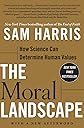

Desertcart purchases this item on your behalf and handles shipping, customs, and support to OMAN.
New York Times bestselling author Sam Harris’s first book, The End of Faith , ignited a worldwide debate about the validity of religion. In the aftermath, Harris discovered that most people—from religious fundamentalists to non-believing scientists—agree on one point: science has nothing to say on the subject of human values. Indeed, our failure to address questions of meaning and morality through science has now become the primary justification for religious faith. In this highly controversial book, Sam Harris seeks to link morality to the rest of human knowledge. Defining morality in terms of human and animal well-being, Harris argues that science can do more than tell how we are; it can, in principle, tell us how we ought to be. In his view, moral relativism is simply false—and comes at an increasing cost to humanity. And the intrusions of religion into the sphere of human values can be finally repelled: for just as there is no such thing as Christian physics or Muslim algebra, there can be no Christian or Muslim morality. Using his expertise in philosophy and neuroscience, along with his experience on the front lines of our “culture wars,” Harris delivers a game-changing book about the future of science and about the real basis of human cooperation. Review: A Model Book for the Scientific Frontier of Morality - The notion that morals cannot be determined by facts, proposed centuries ago by philosophical luminaries such as David Hume and E. G. Moore, is greatly challenged in Sam Harris's The Moral Landscape. Harris believes that what constitutes something being ethically "good" or "bad" can be shown through a harmonious combination of scientific evidence and simple rationality. His book thus follows a rhetoric of defining common psychological phenomena such as "belief" and "well-being" coupled with many examples of how subjective perception of these phenomena leads to objectively immoral decisions. Being a neuroscientist and well-known critic of religion, Harris speaks of morality as a frontier of science not up for religious or philosophical debate. He provides such great insight into the field of ethics that makes it a mandatory read for any current or aspiring scientist. However, the average reader is warned: Harris frequently slams religion and if you already have an unfavorable opinion on science, you will probably find this book difficult to agree with. With growing knowledge of the genetic and molecular basis of human behavior, Harris believes that by studying the states of the brain in relation to events in the world, a universal moral compass can be created to follow by all. Differences in gene expression among human beings highly accounts for the differences in our moral intuition and social perception - or at least our natural inclinations of these. However, just as the expression of certain genes can create biological predispositions unwanted by many individuals (tendency for psychopathy, fatal disease, etc.), Harris posits that it is likewise possible to have an undesirable, harmful moral intuition. Thus, morality cannot be treated as a purely subjective topic - there must be undeniable truths in morality. Harris effectively expresses "truths" and not "truth," specifically, because of what he calls the moral landscape, or the area in which there are multiple high and low points of viewing morality so that a great life can be fulfilled. What every individual wants to achieve in life and what kind of impact they want to leave is undeniably subjective; however, there will always be a right and wrong way to achieve their goal. He demonstrates rational differences between opinions of morality through many examples of torture, rape and suffering, often all in the name of religion. The zealots responsible believe these actions are for the well-being of mankind and produce the greatest happiness possible as promised by their religion; however, Harris cautions blind following of moral reasoning. Poor men and women who are castrated, exiled, who view their children being raped and murdered against their own will surely do not live with the same prosperity and happiness as lives that ensure longevity, wealth and intrinsic personal satisfaction. A sense of morality that leads to the former scenario cannot be the right choice or happier life - it just goes against everyway we think rationally. Perhaps Harris' largest flaw is his advocation of such rationality. Myself an aspiring neuroscientist in college, I've learned that science just should not be based off of the major differences in intrinsic reasoning found among everyone - science is meant to be a focused, honest approach to the mysteries of life. Human rationality itself is a much debated topic. Throwing that uncertainty into the supposed truth of science is very contradictory. However, Harris points out that it is nigh impossible to neglect all reason and rationality in science. His reasoning for that comes through the "moral landscape": since subjective rationality can reflect individuals' personalities, we should acknowledge it to understand the unique ways individuals can achieve a moral life. If an individual cannot listen to their own feelings at least to some degree, then how can they have an honest, happy life? Despite it being the biggest flaw in The Moral Landscape to me, I find he handles it quite well because he makes his arguments very agreeable. When he discusses "being right or wrong," he asks if we should be morally able to synthesize and publish a recipe for smallpox to the public. Due to the fact there will always be extremists who want human society to fall, I agree and feel most would agree that that would be immoral to do because many innocent individuals would die from a few individuals' management of a lethal disease. It's just irony that Harris uses rationality to suggest the usefulness of rationality. Future scientific research could show the use of rationality to be absolutely inappropriate in our search for truth, so Harris' opinion can only be tested with time. However, despite the potential flaw, Harris's really convinces you with his greatest point: what constitutes an individual's well-being and happiness can be proven through neuroscience, as we can see the molecular differences in brain states between unhappy people and happy people. For example, with use of fMRI, we can correlate happiness and quality of life with blood-flow in the brain (in his studies, mainly the prefrontal cortex and parietal lobe are relevant). If certain reactions to stimuli depicting an event deemed to reduce an individual's quality of life cause higher brain activity associated with lower happiness, then we become closer to finding the truths of morality. It is easier to detect unhappiness, Harris suggests, than happiness, as the moral landscape has peaks in which every individual has his/her own pinnacle of maximizing moral decisions with subjective well-being. This is because every individual is still slightly unique in what makes them happy. Thus, he argues that morality should be a followed set of answers rather than a personal open-ended question, as we can find how the correct moral sense leads to what human beings intrinsically deem as "the best possible lives." Along with gene expression and activity in certain brain regions, The Moral Landscape enlightens you on how even evolution plays in determining moral values. Harris posits that we are not evolutionarily adapted for our society - we are not selected to become better government officials or shopkeepers. Thus, as we describe and define moral values with science, he suggests that we must recognize that morality will be impartial to personal thought. For example, Harris describes how individuals who see the life of one disadvantaged individual relevant to charitable organizations are much more likely to donate than if they saw how their donation is necessary for the world at whole. This, he suggests, may represent our selected behavior to care for only a few individuals; while we were not selected to care for the entire world, there is no argument against the entire world needing some form of care. Thus, according to Harris, we must disregard our predisposed beliefs and come to moral conclusions with science. In all, it is a truly inspirational read - a read that has changed my life and has helped me ground the way I think. The text is engaging and very enjoyable - Harris' memorable analogies are not only mind-stimulating but merit his book a delightful re-read. I will always keep this book in mind as I come across moral warfare in the realm of scientific research. Review: Essential Reading - This book marks a watershed moment in the development of moral philosophy. As a longtime student and teacher of the subject, I can no more teach my classes the same after The Moral Landscape than a physicist could teach gravitation the same after Einstein. With startling clarity, Harris systematically clears the centuries of weeds that have confused our collective thinking. I will not attempt to restate Harris's arguments here. If you have not, I strongly suggest that you read the book (or at least watch this excellent talk that he gave at Berkeley). We are provided with a clear framework that should promote sensible public discussions regarding civilization’s most important questions. Reason never had a better advocate. Some have called Harris’s book a mere repackaging of consequentialism. While this might be technically true, it's repackaged in a way that eliminates every reasonable concern that one might have with it. It is no small feat to systematically tear down every argument against a long-standing moral system (that always seemed appealing but, before Harris, at least partially problematic). There is a big difference between an answer that nearly works and one that works. Harris's conception of a Moral Landscape works in a way that traditional consequentialism never quite did. As payment for this great contribution to our collective discourse, Harris has received heaps of scorn from the intellectual community. Of course, he shouldn't be surprised. When Andrew Wiles solved the world's "most difficult math problem" (by proving Fermat's last theorem), mathematicians everywhere leapt at the opportunity to prove him wrong and to protect their own egos (begrudgingly, they could not). The same seems to be happening to Harris. Unfortunately, egos may be even larger in the field of moral philosophy and the stakes far higher. This is a shame; the longer other leaders in the field insist on holding onto their debunked alternative theories, the more time we lose in building a global civilization. Read carefully every criticism that you encounter regarding Harris's approach. Each either fails to (a) make sense or (b) grasp what Harris actually is saying. The responses have been eye opening and frankly embarrassing for many of his critics. I have lost a great deal of respect for the intellectual community while reading reviews of Harris's book. While Harris is plenty capable of defending himself, I want to make three points in defense of his theory: I. Harris is Not a Fascist Mad Scientist Many commentators seem to believe that Harris is suggesting that science currently has all of the answers. He is not. In fact, he's admitting to quite the opposite. In practice, science currently has few clear answers on how best to promote the subjective well being of humanity. Harris believes that this is a very long-term project unlikely to ever be “completed.” However, we know enough already to answer some easy questions (e.g., don't add cholera to the water supply, don't encourage honor killings, don't throw acid in the face of girls who want to learn to read). Most questions are open to further inquiry and rigorous debate (e.g., what is the optimal balance of individual privacy and collective security?). Harris undoubtedly believes that we should be careful before condemning practices without knowing a sufficient amount regarding the effects on the well being of the people affected. As with all scientific endeavors, we should move forward slowly and humbly. The process is open to a rigorous, measured, and incremental public debate. There are tough questions to be answered. However, that there are tough questions to answer does not mean we must be paralyzed from acting upon the relatively easy ones. II. Harris is Not a Cultural Vandal (mostly) Harris is very willing to condemn cultures that insist on certain harmful practices. For example, Harris, in the book and elsewhere, suggests that everyone should feel free (and perhaps obligated) to condemn female genital mutilation, the suppression of women's rights, "rape culture" on American college campuses, calls to genocide, and honor killings as seen in places like Albania. The specific elements of any culture that have a clear negative impact on the well being of conscious creatures should be condemned. Unless you are still lost in the stupefying woods of postmodern and relativist nonsense, this should be unobjectionable. However, where is Harris suggesting that every society should look, in every way, like London, Boston, or Palo Alto? Nowhere. It is possible, perhaps even likely, that a diversity of cultures across the world will benefit humanity. But that does not mean that each part of every culture is to be valued equally. It is quite a different thing to suggest that humanity benefits from wonderful culinary, artistic, musical, and architectural cultural diversity, than to suggest humanity benefits from certain cultures being completely mistaken regarding particular practices and their effects on well-being (e.g., genital mutilation in northern Africa or corporal punishment in the deep south). Put simply: we can celebrate the diverse cuisine and condemn the unreasonable abuse. Note: is it possible that we might actually find that certain cultures have a more "optimal" blend of aesthetic and culinary preferences? Sure, but when science has nothing better to do than to split hairs regarding whether burritos and salsa dancing are “better” than burgers and country music festivals, then we'll know that humanity is in a great place. Further, the answer may well be that they are equal spots on the moral landscape and that the diversity of options throughout the world is "better" than the benefit of promoting one over the other. III. Stop Focusing on the Terminology It seems that people cannot get past Harris’s appropriation of traditional “moral terms” for his proposed project of a scientific study of human flourishing. What if Harris instead suggested that we start a new interdisciplinary science on how best to promote “public health,” but he defined public health to include not just physical well being but mental well being as well? Then, Harris enlisted the help of leading economists, political scientists, doctors, public health experts, psychologists, psychiatrists, neuroscientists, biologists, and artists. He asked them to study scientifically the question of what increases public health from various levels of abstraction, from medicine to nutrition to economic systems. Would anyone suggest that this undertaking would be a useless endeavor? Of course not. Harris is simply stating that this project would promote the only thing worth considering when discussing what is “better” and what is “worse” (in the only sensible way to use these words). To Harris, what is “better” with respect to human flourishing is “good” and what is “worse” is “bad” (with the proviso that there may be multiple answers to these questions). Morality cannot reasonably mean anything except encouraging better and discouraging worse. Lose your hang-ups regarding the terminology (that you probably got from religion, bad philosophy, or society generally) and you can see why this approach makes perfect sense. Nothing else does.
| Best Sellers Rank | #181,470 in Books ( See Top 100 in Books ) #60 in Religious Ethics (Books) #76 in Sociology & Religion #89 in Sociology of Religion |
| Customer Reviews | 4.5 out of 5 stars 2,001 Reviews |
P**M
A Model Book for the Scientific Frontier of Morality
The notion that morals cannot be determined by facts, proposed centuries ago by philosophical luminaries such as David Hume and E. G. Moore, is greatly challenged in Sam Harris's The Moral Landscape. Harris believes that what constitutes something being ethically "good" or "bad" can be shown through a harmonious combination of scientific evidence and simple rationality. His book thus follows a rhetoric of defining common psychological phenomena such as "belief" and "well-being" coupled with many examples of how subjective perception of these phenomena leads to objectively immoral decisions. Being a neuroscientist and well-known critic of religion, Harris speaks of morality as a frontier of science not up for religious or philosophical debate. He provides such great insight into the field of ethics that makes it a mandatory read for any current or aspiring scientist. However, the average reader is warned: Harris frequently slams religion and if you already have an unfavorable opinion on science, you will probably find this book difficult to agree with. With growing knowledge of the genetic and molecular basis of human behavior, Harris believes that by studying the states of the brain in relation to events in the world, a universal moral compass can be created to follow by all. Differences in gene expression among human beings highly accounts for the differences in our moral intuition and social perception - or at least our natural inclinations of these. However, just as the expression of certain genes can create biological predispositions unwanted by many individuals (tendency for psychopathy, fatal disease, etc.), Harris posits that it is likewise possible to have an undesirable, harmful moral intuition. Thus, morality cannot be treated as a purely subjective topic - there must be undeniable truths in morality. Harris effectively expresses "truths" and not "truth," specifically, because of what he calls the moral landscape, or the area in which there are multiple high and low points of viewing morality so that a great life can be fulfilled. What every individual wants to achieve in life and what kind of impact they want to leave is undeniably subjective; however, there will always be a right and wrong way to achieve their goal. He demonstrates rational differences between opinions of morality through many examples of torture, rape and suffering, often all in the name of religion. The zealots responsible believe these actions are for the well-being of mankind and produce the greatest happiness possible as promised by their religion; however, Harris cautions blind following of moral reasoning. Poor men and women who are castrated, exiled, who view their children being raped and murdered against their own will surely do not live with the same prosperity and happiness as lives that ensure longevity, wealth and intrinsic personal satisfaction. A sense of morality that leads to the former scenario cannot be the right choice or happier life - it just goes against everyway we think rationally. Perhaps Harris' largest flaw is his advocation of such rationality. Myself an aspiring neuroscientist in college, I've learned that science just should not be based off of the major differences in intrinsic reasoning found among everyone - science is meant to be a focused, honest approach to the mysteries of life. Human rationality itself is a much debated topic. Throwing that uncertainty into the supposed truth of science is very contradictory. However, Harris points out that it is nigh impossible to neglect all reason and rationality in science. His reasoning for that comes through the "moral landscape": since subjective rationality can reflect individuals' personalities, we should acknowledge it to understand the unique ways individuals can achieve a moral life. If an individual cannot listen to their own feelings at least to some degree, then how can they have an honest, happy life? Despite it being the biggest flaw in The Moral Landscape to me, I find he handles it quite well because he makes his arguments very agreeable. When he discusses "being right or wrong," he asks if we should be morally able to synthesize and publish a recipe for smallpox to the public. Due to the fact there will always be extremists who want human society to fall, I agree and feel most would agree that that would be immoral to do because many innocent individuals would die from a few individuals' management of a lethal disease. It's just irony that Harris uses rationality to suggest the usefulness of rationality. Future scientific research could show the use of rationality to be absolutely inappropriate in our search for truth, so Harris' opinion can only be tested with time. However, despite the potential flaw, Harris's really convinces you with his greatest point: what constitutes an individual's well-being and happiness can be proven through neuroscience, as we can see the molecular differences in brain states between unhappy people and happy people. For example, with use of fMRI, we can correlate happiness and quality of life with blood-flow in the brain (in his studies, mainly the prefrontal cortex and parietal lobe are relevant). If certain reactions to stimuli depicting an event deemed to reduce an individual's quality of life cause higher brain activity associated with lower happiness, then we become closer to finding the truths of morality. It is easier to detect unhappiness, Harris suggests, than happiness, as the moral landscape has peaks in which every individual has his/her own pinnacle of maximizing moral decisions with subjective well-being. This is because every individual is still slightly unique in what makes them happy. Thus, he argues that morality should be a followed set of answers rather than a personal open-ended question, as we can find how the correct moral sense leads to what human beings intrinsically deem as "the best possible lives." Along with gene expression and activity in certain brain regions, The Moral Landscape enlightens you on how even evolution plays in determining moral values. Harris posits that we are not evolutionarily adapted for our society - we are not selected to become better government officials or shopkeepers. Thus, as we describe and define moral values with science, he suggests that we must recognize that morality will be impartial to personal thought. For example, Harris describes how individuals who see the life of one disadvantaged individual relevant to charitable organizations are much more likely to donate than if they saw how their donation is necessary for the world at whole. This, he suggests, may represent our selected behavior to care for only a few individuals; while we were not selected to care for the entire world, there is no argument against the entire world needing some form of care. Thus, according to Harris, we must disregard our predisposed beliefs and come to moral conclusions with science. In all, it is a truly inspirational read - a read that has changed my life and has helped me ground the way I think. The text is engaging and very enjoyable - Harris' memorable analogies are not only mind-stimulating but merit his book a delightful re-read. I will always keep this book in mind as I come across moral warfare in the realm of scientific research.
G**.
Essential Reading
This book marks a watershed moment in the development of moral philosophy. As a longtime student and teacher of the subject, I can no more teach my classes the same after The Moral Landscape than a physicist could teach gravitation the same after Einstein. With startling clarity, Harris systematically clears the centuries of weeds that have confused our collective thinking. I will not attempt to restate Harris's arguments here. If you have not, I strongly suggest that you read the book (or at least watch this excellent talk that he gave at Berkeley). We are provided with a clear framework that should promote sensible public discussions regarding civilization’s most important questions. Reason never had a better advocate. Some have called Harris’s book a mere repackaging of consequentialism. While this might be technically true, it's repackaged in a way that eliminates every reasonable concern that one might have with it. It is no small feat to systematically tear down every argument against a long-standing moral system (that always seemed appealing but, before Harris, at least partially problematic). There is a big difference between an answer that nearly works and one that works. Harris's conception of a Moral Landscape works in a way that traditional consequentialism never quite did. As payment for this great contribution to our collective discourse, Harris has received heaps of scorn from the intellectual community. Of course, he shouldn't be surprised. When Andrew Wiles solved the world's "most difficult math problem" (by proving Fermat's last theorem), mathematicians everywhere leapt at the opportunity to prove him wrong and to protect their own egos (begrudgingly, they could not). The same seems to be happening to Harris. Unfortunately, egos may be even larger in the field of moral philosophy and the stakes far higher. This is a shame; the longer other leaders in the field insist on holding onto their debunked alternative theories, the more time we lose in building a global civilization. Read carefully every criticism that you encounter regarding Harris's approach. Each either fails to (a) make sense or (b) grasp what Harris actually is saying. The responses have been eye opening and frankly embarrassing for many of his critics. I have lost a great deal of respect for the intellectual community while reading reviews of Harris's book. While Harris is plenty capable of defending himself, I want to make three points in defense of his theory: I. Harris is Not a Fascist Mad Scientist Many commentators seem to believe that Harris is suggesting that science currently has all of the answers. He is not. In fact, he's admitting to quite the opposite. In practice, science currently has few clear answers on how best to promote the subjective well being of humanity. Harris believes that this is a very long-term project unlikely to ever be “completed.” However, we know enough already to answer some easy questions (e.g., don't add cholera to the water supply, don't encourage honor killings, don't throw acid in the face of girls who want to learn to read). Most questions are open to further inquiry and rigorous debate (e.g., what is the optimal balance of individual privacy and collective security?). Harris undoubtedly believes that we should be careful before condemning practices without knowing a sufficient amount regarding the effects on the well being of the people affected. As with all scientific endeavors, we should move forward slowly and humbly. The process is open to a rigorous, measured, and incremental public debate. There are tough questions to be answered. However, that there are tough questions to answer does not mean we must be paralyzed from acting upon the relatively easy ones. II. Harris is Not a Cultural Vandal (mostly) Harris is very willing to condemn cultures that insist on certain harmful practices. For example, Harris, in the book and elsewhere, suggests that everyone should feel free (and perhaps obligated) to condemn female genital mutilation, the suppression of women's rights, "rape culture" on American college campuses, calls to genocide, and honor killings as seen in places like Albania. The specific elements of any culture that have a clear negative impact on the well being of conscious creatures should be condemned. Unless you are still lost in the stupefying woods of postmodern and relativist nonsense, this should be unobjectionable. However, where is Harris suggesting that every society should look, in every way, like London, Boston, or Palo Alto? Nowhere. It is possible, perhaps even likely, that a diversity of cultures across the world will benefit humanity. But that does not mean that each part of every culture is to be valued equally. It is quite a different thing to suggest that humanity benefits from wonderful culinary, artistic, musical, and architectural cultural diversity, than to suggest humanity benefits from certain cultures being completely mistaken regarding particular practices and their effects on well-being (e.g., genital mutilation in northern Africa or corporal punishment in the deep south). Put simply: we can celebrate the diverse cuisine and condemn the unreasonable abuse. Note: is it possible that we might actually find that certain cultures have a more "optimal" blend of aesthetic and culinary preferences? Sure, but when science has nothing better to do than to split hairs regarding whether burritos and salsa dancing are “better” than burgers and country music festivals, then we'll know that humanity is in a great place. Further, the answer may well be that they are equal spots on the moral landscape and that the diversity of options throughout the world is "better" than the benefit of promoting one over the other. III. Stop Focusing on the Terminology It seems that people cannot get past Harris’s appropriation of traditional “moral terms” for his proposed project of a scientific study of human flourishing. What if Harris instead suggested that we start a new interdisciplinary science on how best to promote “public health,” but he defined public health to include not just physical well being but mental well being as well? Then, Harris enlisted the help of leading economists, political scientists, doctors, public health experts, psychologists, psychiatrists, neuroscientists, biologists, and artists. He asked them to study scientifically the question of what increases public health from various levels of abstraction, from medicine to nutrition to economic systems. Would anyone suggest that this undertaking would be a useless endeavor? Of course not. Harris is simply stating that this project would promote the only thing worth considering when discussing what is “better” and what is “worse” (in the only sensible way to use these words). To Harris, what is “better” with respect to human flourishing is “good” and what is “worse” is “bad” (with the proviso that there may be multiple answers to these questions). Morality cannot reasonably mean anything except encouraging better and discouraging worse. Lose your hang-ups regarding the terminology (that you probably got from religion, bad philosophy, or society generally) and you can see why this approach makes perfect sense. Nothing else does.
E**K
A provocative and intriguing "maybe..."
Morality has never provided simple straightforward answers to questions of how humans should conduct themselves. Though a litany of theories has nonetheless appeared in past millennium to face this challenge, no undisputed champion has emerged triumphant. And worse, an examination of this overwhelming history doesn't even reveal significant progress on such issues. Even today, questions about the nature of "good and evil" persist along with nebulous answers to the ancient "what's the right thing to do?" question. Mapping human actions, not to mention complex collective human actions, to the rather abstract categories of "morally right" or "morally wrong" seems elusive as ever. Enter Sam Harris, a neuroscientist who often gets subsumed with "the New Atheists" for writing pointed criticisms of the effects of religion on humanity. Though his third book, "The Moral Landscape," largely glosses over the history of morality, he proffers a potential solution to such quandaries, though admitting its preliminary and controversial nature. The book contains many compelling, intriguing and poignant arguments, but ultimately doesn't contain enough hard data to elicit more than a "maybe." The book's main argument rests on a simple claim: "human well-being entirely depends on events in the world and on states of the human brain. Consequently, there must be scientific truths to be known about it." Boldly stated in this way, the argument approaches tautology. Of course our "well-being" relies on the world and on our brains. What else would it depend on? Stickiness starts to seep upon dissection of the argument's terms. How do we define "human well-being?" And how do we formulate and utilize "states of the human brain?" And how do these "states" map to "well-being?" These questions need answers and demonstration before claiming that a rigorous "science of morality" can truly and realistically exist. Harris does provides some cursory examples that suggest connections between "well-being" and "brain states," such as the rates of oxytocin and vasopressin in children raised in "traditional" homes versus those raised in orphanages. Only further study will show whether such correlations stand up. And yes, a science of morality may emerge from such scenarios, the possibility surely exists, but the data needs to go far beyond what Harris presents. Not only that, morality already presents befuddling complexities and introducing brain states in the mix may further complicate, rather than simplify, moral issues. It's too early to tell. Not to mention possible nightmare, and probably - hopefully - implausible, scenarios such as neuroscience revealing that illusion and irrationality actually contribute to "human well-being." That would definitely provide important data to a "science of morality," but not the kind Harris (or many others) would probably desire. Again, this isn't meant to imply that Harris' overall claims fall flat, only that they seem too embryonic at this time to make sweeping claims about "moral truth" and the brain. Some harder data would have made his argument more penetrating, though, as always, his writing remains engaging and highly readable throughout. The book becomes really interesting when neuroscience becomes the focus, things get really interesting. Harris' delineation of free will may shock some at first reading, namely that "the illusion of free will is itself an illusion." But neuroscience is still a relatively new science, so taking its current results as definitive seems premature. Nonetheless, the evidence that exists already stands to change the very way we think of ourselves as humans and Harris outlines some of these possibilities. Later in the book, Harris again takes on the "non-overlapping magisteria" argument. And he eloquently argues against the notion that science and religion don't conflict. They do seem to conflict more and more as time goes on. The Creationist Museum in Kentucky presents itself as science, whether implicitly or explicitly. It openly and defiantly seeks to challenge scientific claims about geology, paleontology and other sciences. The claims it makes, based largely on religious scripture, starkly conflict with the majority of the scientific community's findings. Harris' arguments have maximum potency in this realm. But many of the points made here were also made in his other books, so the "religion" section seems a little tacked on. Plus, it doesn't really add any weight to his arguments about morality and neuroscience. In the end, Harris seems to soften on some of his claims, citing the complexities behind a psychology of "well-being." And ultimately he states, in the final pages, that "whether morality becomes a proper branch of science is not really the point." Along the way he cites studies on child rearing, in that having children appears to cause a lower level of happiness, but that most people feel they will prove the exception to this claim, stand as both fascinating claims and as problems for a "neural morality." But Harris feels, cautiously it seem, that these counter examples won't stand up. Maybe not. More studies will help. "The Moral Landscape" contains many brilliant and insightful passages about morality, belief and religion. But in the end it feels more like a collection of tenuously related sections than one cohesive argument, though each section does contain much of interest. And though the main claim of the book remains provocative, intriguing and very possible, the data presented just doesn't seem like enough at this point to make a claim for a "science of morality." Though, again, Harris claims that that's not "really the point." Undoubtedly neuroscience will illuminate human morality. That seems uncontroversial. Rigorously mapping human behavior to positive or negatively associated areas of the brain would present a breakthrough of astounding proportions. But whether this will actually happen at present remains a "maybe." We can only hope it will. And if the point of Harris' book was to introduce the possibility, then it definitely succeeds in that modest endeavor.
J**A
How Psychology Provides a Useful if Largely Unexplored New World of Values that are also Facts.
The Moral Landscape: How Science Can Determine Human Values by Sam Harris The more we understand ourselves at the level of the brain, the more we will see that there are right and wrong answers to questions of human values. 70 I value the human capacity for induction to create knowledge. As Hume put it there is no causality; only "constant concomitance". There is no absolute fact, only opinion and attitudes and emotions and uncertain knowledge. This is a basic limitation of the scientific method and its greatest strength. And it applies equally to the world of values and morality. As Sam Harris so fluently exposes in this solid book, values cannot be separated from facts, and both are the happy products of science. As the Greek rhetoricians used to say, " The only measure of mankind is mankind itself." We are the standard for the facts of science and of morality, and so understanding and advancing psychology should be a primary goal of all societies. Harris, instead of asking the Socratic question about what is the good life, asks about human well-being. There is not much difference, but science has given us much more food for thought than Aristotle ever had, and especially in the scientific field of psychology, there is much new understanding that impinges on our insights into the morality of human well-being. Harris provides a thoroughgoing synopsis of this new knowledge and it is the fundament for his thesis that a science of morality is not only possible but urgently needed to improve the general lot of mankind. He makes a convincing case. In fact, as an experimental psychologist, I agree with him completely throughout this book. Never have I read as lucid an account of the many twists and turns in people's rejection of a scientific approach to morality, and while his arguments are not always thoroughly convincing they are clear and analytic and unblurred by dogma. What can one ask more of a scientist? Nowhere does he make his case more clearly than his attack on the fundamentalist and religionist Francis Collins, who has a vision and religious conversion experience when he encounters a mystical frozen waterfall divided into a triune deity. The superstition of religion is a clear antagonist of science, and this conflict cannot be restrained without basic inconsistencies of reasoning. Here is our situation: if the basic claims of religion are true, the scientific worldview is so blinkered and susceptible to supernatural modification as to be rendered nearly ridiculous;455 For instance, the moral stigma that still surrounds disorders of mood and cognition seems largely the result of viewing the mind as distinct from the brain.1853 The fact that religious belief is both a cultural universal and appears to be tethered to the genome has led scientists like Burton to conclude that there is simply no getting rid of faith-based thinking.2154 Historically, a preoccupation with witchcraft has been a cultural universal. And yet belief in magic is now in disrepute almost everywhere in the developed world.2165 What is surprising, from a scientific point of view, is that 42 percent of Americans believe that life has existed in its present form since the beginning of the world, and another 21 percent believe that while life may have evolved, its evolution has been guided by the hand of God (only 26 percent believe in evolution through natural selection).2502 I am not suggesting that we are guaranteed to resolve every moral controversy through science. Differences of opinion will remain--but opinions will be increasingly constrained by facts.82 To say that the behavior of Muslim jihadists has nothing to do with their religious beliefs is like saying that honor killings have nothing to do with what their perpetrators believe about women, sexuality, and male honor.2630 If there are objective truths to be known about human well-being--if kindness, for instance, is generally more conducive to happiness than cruelty is--then science should one day be able to make very precise claims about which of our behaviors and uses of attention are morally good, which are neutral, and which are worth abandoning. While it is too early180 It is possible to be wrong and to not know it (we call this "ignorance").2961 It is possible to be wrong and to know it, but to be reluctant to incur the social cost of admitting this publicly (we call this "hypocrisy").2961 And it may also be possible to be wrong, to dimly glimpse this fact, but to allow the fear of being wrong to increase one's commitment to one's erroneous beliefs (we call this "self-deception"). It seems clear that these frames of mind do an unusual amount of work in the service of religion.2962 Similarly, anyone truly interested in morality--in the principles of behavior that allow people to flourish--should be open to new evidence and new arguments that bear upon questions of happiness and suffering.412 There may be nothing more important than human cooperation. Whenever more pressing concerns seem to arise--like the threat of a deadly pandemic, an asteroid impact, or some other global catastrophe--human cooperation is the only remedy (if a remedy exists). Cooperation is the stuff of which meaningful human lives and viable societies are made. Consequently, few topics will be more relevant to a maturing science of human well-being.920 Students of philosophy will notice that this commits me to some form of moral realism (viz. moral claims can really be true or false) and some form of consequentialism (viz. the rightness of an act depends on how it impacts the well-being of conscious creatures).1036 Tomasello has found that even twelve-month old children will follow a person's gaze, while chimpanzees tend to be interested only in head movements. He suggests that our unique sensitivity to gaze direction facilitated human cooperation and language development.959 It is not by accident that our most widely accepted moral phrase is "do unto others as you would have them do unto you ..." because our most essential intellectual competence is understanding others; whether through communication or modeling others' minds and awareness, later elaborated into the study of psychology. Edit Moral view A is truer than moral view B, if A entails a more accurate understanding of the connections between human thoughts/intentions/behavior and human well-being.1081 The one crucial exception, however, is that psychopaths are often unable to recognize expressions of fear and sadness in others, And this may be the difference that makes all the difference.1660 Blair points out, parenting strategies that increase empathy tend to successfully mitigate antisocial behavior in healthy children;1668 Territorial violence might have even been necessary for the development of altruism. The economist Samuel Bowles has argued that lethal, "out-group" hostility and "in-group" altruism are two sides of the same coin.1701 Sometimes our knowledge of psychology conflicts with itself, as in our undertstanding of revenge and compassion, and a resolution needs to be worked out:" the tragic experience of his late father-in-law, who had the opportunity to kill the man who murdered his family during the Holocaust but opted instead to turn him over to the police. After spending only a year in jail, the killer was released, and Diamond's father-in-law spent the last sixty years of his life "tormented by regret and guilt." While there is much to be said against the vendetta culture of the New Guinea Highlands, it is clear that the practice of taking vengeance answers to a common psychological need".1860 In fact, mathematical belief (e.g., "2 + 6 + 8 = 16") showed a similar pattern of activity to ethical belief (e.g., "It is good to let your children know that you love them"), and these were perhaps the most dissimilar sets of stimuli used in our experiment. This suggests that the physiology of belief may be the same regardless of a proposition's content. It also suggests that the division between facts and values does not make much sense in terms of underlying brain function. 2032 And we can traverse the boundary between facts and values in other ways. As we are about to see, the norms of reasoning seem to apply equally to beliefs about facts and to beliefs about values. In both spheres, evidence of inconsistency and bias is always unflattering. Similarities of this kind suggest that there is a deep analogy, if not identity, between the two domains.2043 Morality and values depend on the existence of conscious minds--and specifically on the fact that such minds can experience various forms of well-being and suffering in this universe. Conscious minds and their states are natural phenomena, of course, fully constrained by the laws of Nature (whatever these turn out to be in the end). Therefore, there must be right and wrong answers to questions of morality and values that potentially fall within the purview of science. On this view, some people and cultures will be right (to a greater or lesser degree), and some will be wrong, with respect to what they deem important in life.3259
A**R
Painting the Moral Landscape
Usually, I don't read books unless I've first read an article or blog or watched a lecture by the author first. However, I decided to live dangerously and break with this tradition at the suggestion of some friends who thought I may find this interesting given my undergraduate degree in philosophy. At first, I was hesitant to read this for awhile because I just assumed based on the subtitle alone ("How Science Can Determine Human Values") it would argue for a type of objectivity where moral facts are discovered analogously to how scientific facts are discovered. Long story short, this view has some known fatal flaws and I didn't want to waste my time. But as I began actually reading Harris's book, I quickly realized that this was a bad assumption on my part. So below is my review of how I understand his book's argument. ******************************************************** If one is expecting a secular “Easy Button” guide to scientifically determining the best decisions to take for every conceivable moral dilemma, then Sam Harris’s 2010 book “The Moral Landscape: How Science Can Determine Human Values” will be a huge disappointment. So, too, will many works that seriously discuss ethics. However, if one wants to better understand how a “science of morality” can be possible and be meaningfully used to deepen and challenge our understanding of morality, then this book is a welcome treat. The heart of Harris’s concept of a science of morality being possible is Aristotelian-ish and utilitarian-ish in design: maximizing well-being for conscious minds, which is itself a difficult concept to precisely define like “health” yet is squarely within the realm of scientific inquiry, is treated as a foundational feature of our existence. Blending some elements of the latter Wittgenstein, Harris notes that there are certain limits to extreme moral skepticism if someone were to attempt to cast doubt on whether achieving and maximizing well-being is actually a good thing. By analogy, someone could possibly doubt that living a long life free of pain and debilitating illness is healthy, but it doesn’t mean we ought to take them seriously with respect to medicine anymore than geology in the 21st century should take seriously the young Earth creationist’s doubt that the world is older than 6,000 years old. Except for perhaps the sociopath, maximizing the well-being of conscious creatures seems to be an obvious goal for a science of morality. The skeletal framework builds upon this insight to deduce that there are many states of being in between the extremes where everyone suffers maximally on the one end and where well-being is maximized for all conscious minds on the other end. The former forms the lowest point while the latter forms the highest in our moral landscape. From such a context, we can objectively claim that for instance, the Taliban’s oppression of women is a bad thing in that it harms their well-being (and of course, show evidence of this). In many moral situations, it’s not always clear that there is one right action to take but there are many wrong actions that can be taken in pursuit of maximizing well-being in the same way that there are many different ways to traverse a moral landscape from lower to higher peaks. The meat of this science of morality has to do with science itself. The noted biologist Stephen Jay Gould was someone who believed in different knowledge domains for scientists (covering what “is”) separate from theologians/philosophers (covering what “ought” to be). On this view, articulated first by 18th century Scottish philosopher David Hume, an “ought” or moral claim cannot be derived or inferred from an “is” or a factual statement about nature. From this “is-ought” distinction, many people believe that the proper boundaries of science relate only to the natural realm, whereas the boundaries for theologians and philosophers relate only to value and ethics. Science does not cross into the theologian’s or philosopher’s turf (and vice versa). Counter to this, Harris argues the distinction is illusory because values (the “ought”) ultimately reduce down to facts about nature (the “is”), of which we are part. If features of our universe were different—say, humans couldn’t ever experience suffering, or lived 3,000 years on average (my examples)—then our values, which derive from how we experience the world, would also be different than they are now. Indeed, our language, cultures, and even the broad concept of well-being would be different. For Harris, the prime locus of how we experience the world we live in is through the brain. Thus, the brain, which is the subject of study in many fields of science (Harris himself has a PhD in neuroscience from UCLA), has much to contribute in terms of both adding nuance and challenging long-held notions that can help advance discussions of morality. For example, Harris cites some of the work of the 2002 economics Nobel laureate Daniel Kahneman, who is actually a psychologist by trade. Kahneman, a pioneer in the field of behavorial economics which studies the various ways in which decision-making departs from ideal notions of rationality, observed and demonstrated that we tend to be loss averse when it comes to probabilistic outcomes where outcomes are not certain. “This aversion to loss causes human beings to generally err on the side of maintaining the status quo” (p. 75, Kindle Edition). This insight’s implication is clear to a moral context: if we want to improve actual moral decision-making and resulting action (or inaction), then how we frame or train ourselves to perceive situations in terms of losses vs. gains will increase our tendency to stay status quo or buck it. Kahneman’s scientific insights, along with many others, are just the tip of the iceberg when it comes to challenging and adding nuance to our understanding of the human brain functioning in relation to our decision-making and moral behavior tendencies. Indeed, it’s difficult to understand going forward how such knowledge can be ignored in the context of maximizing and improving well-being for conscious creatures. I didn’t interpret Harris as necessarily arguing that philosophers or theologians are or will become obsolete in discussions about morality and value but rather science, in principle, can break with the epistemological “is-ought” segregation by also providing critical insights into this arena of human experience. I think he argues for, defends, and sketches this exciting new possibility beautifully, which is why I gave this book five stars. I look forward to reading more of his writing.
T**T
Superficially Persuasive but Falls Apart Under Scrutiny
Harris's book, "The Moral Lanscape: How Science Can Determine Human Values", is a response to the religious community's assertion that moral questions are outside the domain of scientific study. In this book, Harris argues that morality is not within the sole purview of religion, but rather, it is a topic that can be objectively studied and best answered through scientific investigation. Harris begins with the axiom: humans are conscious creatures that value their own well-being, and states that the concept of value has little meaning apart from its association with conscious creatures. From this starting point, he says that if we value human well-being then there are approaches that will lead us closer to maximizing this goal and approaches that will lead us farther away. Moreover, science can investigate and assist us in deciding on an approach that will close the gap toward this goal, and science can identify approaches that will hinder us from our objective. Despite a few persuasive points in his book, I had many criticisms. 1) The Subtitle: The subtitle is "How Science Can Determine Human Values". But this subtitle is ambiguous. Is Harris claiming that science can tell us what values we should hold or pursue, as well as why we should hold or pursue them? Or is he stating that science can determine what values humans, in fact, hold and pursue? Traditionally, the former falls within the purview of philosophy and ethics; the latter is a descriptive study of morality and could fall within the purview of science. However, there is little reason to write a book to answer the second question. The answer seems quite obvious. But by purchasing Harris's book, if your primary hope is to answer the first question, you will be greatly disappointed. He does not address this question. 2) Maximizing Human Well-Being Harris seems to be arguing that if you have a desired goal, then the moral choice is that which brings you closer to that goal. For example, IF we accept Harris's goal - maximizing human well-being - and we wish to attain that goal, THEN science can tell us how to achieve that goal. But this is a far cry from the claim that science can tell us what is moral. We could equally say that if our goal is to murder our neighbor without getting caught, science could help us answer that question too, at least in principle. None of this reveals the power of science to tell us what is, in fact, moral. 3) Separation Between Facts & Values is Illusory Harris claims that the chasm separating facts and values is illusory. In his own words: "(1) whatever can be known about maximizing the well-being of conscious creatures - which is, I will argue, the only thing we can reasonably value - must at some point translate into facts about brains and their interaction with the world at large; (2) the very idea of `objective' knowledge... has values built into it, as every effort we make to discuss facts depends upon principles that we must first value (e.g., logical consistency, reliance on evidence, parsimony, etc.); (3) beliefs about facts and beliefs about values seem to arise from similar processes at the level of the brain: it appears that we have a common system for judging truth and falsity in both domains." Harris makes these three points to argue that science can study values. If he merely wishes to show that science can descriptively study human values, including how we make decisions or why we make certain moral choices, then his claim is unremarkable. But if he wishes to use these points to assert that science can provide prescriptions on how humans ought to behave, then his points do not support this assertion. The fact is, humans can hold values independent of the facts, as is evident by the superstitious and religious beliefs held by the general populace. Thus, there is a real separation between facts and values, and our ability to sustain this chasm seems unparalleled in the animal kingdom. 4) Speaks in Generalities, Not Specifics: Harris's book discusses morality in broad terms and generalities. He rarely discusses specific moral issues. His claim would've been more convincing if he could demonstrate how science might answer specific moral questions. He doesn't have to provide an answer, but merely show that an answer is possible through science. For example, how would science answer the abortion question? Much of the argument centers on what is considered "life". Perhaps what should be discussed is "conscious life". Certainly, science could address whether a mass of cells is conscious, and thus, capable of suffering. But then, the issue still comes back to why we should care about a mass of conscious cells (assuming science found it was conscious), since it is still not fully conscious the way a full-term baby is. And even if the mass lacked consciousness, one could argue that the mass is still a potential human being with a very high probability of being born healthy -- not to mention the fact that the development process has already begun. Given this information, is abortion morally right or not? How can science answer this question, even in principle? What if a person, with a certain type of brain disease, is found in a "vegetative" state and science determines that such an individual is not capable of suffering. Furthermore, let's assume the individual has no family, thus, there's no one to mourn the person's situation. Would it be immoral to rape the individual and then suffocate the person to death? Why (or why not)? How can science answer this question, even in principle? And if well-being is the objective, what if such an act provided the rapist with a sense of well-being? Would his actions become moral since no one is suffering and he gains pleasure from the act? Or imagine that you are an undercover FBI agent investigating the mafia. The mafia suspects that you may be a "cop", so the godfather asks you to kill another person in front of him, who also happens to be a "cop". If you fail to comply, you will be executed on the spot by three other men with guns pointed at your head; your wife will become a widow & your children will be fatherless. But if you shoot the other agent, you will have vindicated yourself in the eyes of the mafia (and save all the time, effort, & money spent by the FBI investigating the mafia) but risk losing your badge and potentially end up in prison for manslaughter or murder. Alternatively, you could elect to shoot your way out and escape, along with the other agent, but there's no guarantee (not even a high probability) that you will be successful. So what is the moral choice in this situation, and more importantly, how can science help you determine which choice to make or whether you should value one goal over another? These types of issues are not addressed by Harris. Moreover, it's difficult to see how science can make this determination, even in principle. 5) Individual vs. Collective Harris's book focuses on societal well-being. In fact, he often compares the health of a society with physical health. And while the pursuit of societal well-being is fine (in principle), humans are not motivated by such goals in practice (at least not for long). Our concern is our own individual well-being and the well-being of those that might impact our own well-being. This also means that the desire to maximize our own well-being may often conflict with the desires of others (and society as a whole). So what is the morally correct thing to do in such cases? How can science answer this question, even in principle? If given the choice between living in a societal quagmire where I am a prince among paupers, I may prefer that society over living in a first-world nation where I am an average citizen. I may not be maximizing human well-being overall, but why should I care since my own well-being may be maximized. Perhaps I may favor keeping my fellow humans in the quagmire to maintain my own status and power. In fact, research has shown that we are less satisified if those immediately around us are better off than us, even if we are better off than most of the world population. How can science demonstrate that my choice is morally wrong, even in principle? 6) Consequences: Harris's book implies that science is superior at answering moral questions than religion and is less likely to incorrectly answer the slavery or genocide question (i.e. is slavery or genocide wrong?). But is this necessarily true? What if science found that societies, as a whole, would've been better if slavery was permitted? Or what if Germany would've been better off, as a whole, if the Jews were exterminated? Would slavery and genocide become morally acceptable positions, supported by science? And if not, then why not? Harris never addresses such issues. The U.S. is responsible for the near extinction of the native American populations. But one could argue that great progress and overall societal benefit was reaped from their "relocation" and extermination. Genocide allowed more "civilized" people to settle the land and secured prosperity for millions of future Americans. Thus, looking back, was it moral to kill and relocate the native Americans? Of course, one could equally argue that society would've been better off had the natives remained alive and continued their way of life. But such an argument would be speculation; how would we know? That experiment is not available to us (and never will be). Yet we do know that the United States would've been a very different place than it is today if the natives still populated this nation. Science seems no better at guarding us from poor moral decisions -- the same decisions ancient religious societies chose for themselves - such as the choice to engage in slavery or genocide. 7) Lacks Originality: Harris's thesis is not original. He is not the first person to propose an objective morality outside of an academic setting. Richard Carrier presented a comparable view in his book, "Sense and Goodness without God", in which he argues for the Goal Theory of Morality. Novelist & philosopher, Ayn Rand, espoused a similar view during the mid-20th century. Yet while I think Harris is a better writer than both Carrier and Rand, I don't think he was as rigorous in his application of reason. Thus, while there are persuasive parts in his book, I was hoping that he would've learned from both of these authors and expanded or improved upon their points. He did not. 8) Analogy: Unfortunately, Harris' most persuasive argument is an analogy. He compares societal health with physical health. However, analogies are never good argumentative tools by themselves. Analogies can help clarify a point or increase comprehension. Yet analogies are a poor foundation for demonstrating the truth of a proposition. ASSESSMENT: I agree with Harris's thesis that morality is not the sole province of religion. I also agree that science may be better at providing us with reasons for pursuing a particular decision or a specific action. The best religion can do is assert that if you do or don't do "X" then it's a sin and you'll burn in Hell, as if fear or mental compulsion is a morally acceptable reason for doing anything at all. However, while science can descriptively study human morality, I don't agree that it can necessarily provide us with prescriptions (unless we share a common goal). And if there's one thing that's clear from human experience, it is that humans have different goals and different conceptions of what constitutes well-being, even conflicting conceptions. While science may do better than religion at providing prescriptions, it is not the well-paved road that Harris makes it out to be.
N**E
Moral Maturity's First Scientific Steps
Finally, someone is trying to bring us to the first step in objective moral thinking. While Harris doesn't pretend to have all the answers he does ask us the right critical moral questions we have failed to ask ourselves. Harris' analogies are clear. So are his points. His arguments are well-crafted. I wouldn't consider this a light read but it certainly is an important one. Harris has brought many excellent points to the table that cannot just be swept away. Harris completed a B.A. degree in philosophy and obtained a Ph.D. degree in 2009 in neuroscience to conduct research into the neural basis of belief, disbelief, and uncertainty using functional magnetic resonance imaging (fMRI). This book is based on his doctoral thesis and on extensive discussions with reputable challengers. His 195 persuasive pages are supported in this book by 85 pages of notes and references. He has certainly spent more time digging deeply into this subject than his superficial and sometimes authoritative critics. Before you assume that the premise is wrong by default, that science is inherently incapable of moral guidance, that Harris has not seriously thought this through, realize that much of the first half of his book addresses a broad array of traditional and contemporary challenges of that sort. I too was skeptical but not close-minded about the role of science in morality. Harris tackles many arguments you probably assume, many you have not yet considered, and handles them impressively, so well - that I have to admit, he has made me rethink not only how moral choices can be decided but how they should be decided. To discuss morality and values in the arena of science, morality has to be less ambiguously defined. Harris argues to consider measurable "well being" instead of subjective "supreme being" for moral arguments. Well being is an expected consequence of a moral life, even for religious morality - a moral life promotes or should promote well being. Harris feels that science can help guide us with greater moral objectivity in much the same way science has helped guide us with personal health considerations, not so much by specifying what we should consume but by more definitively and objectively identifying what is not healthy: smoking, overeating, overdrinking. Similarly, Harris argues that science can help guide us morally too, not so much by specifying morality but by helping us more objectively recognize immorality both in ourselves and in others, shifting us towards better moral decisions by weeding out objectively bad moral choices that decrease well being. While we may each already feel moral, capable of separating the good from bad, already endowed with a working moral mechanism that needs no scientific advice, Harris challenges us to examine our mechanisms. How do we know our moral choices are truly moral - moral for whom? Are our choices truly moral just because we choose them? Are moral choices of the Taliban equally moral? They think so and justify their morality as being as inspired as the moral choices of others. Is there a different but equally valid morality for the Taliban or are some moralities clearly wrong for everyone? Is it possible for someone's morals to be immoral? Are conflicting moralities equally valid? Are some moralities equally true for all? How do you know which to value and which to discard or fight? Is there a more unbiased or more objective way to know or choose morals or are we destined by inconsistent moralities to cling to and defend conflicting cultural and social traditions that keep us at each other's moral throats? By what criteria can anyone judge morality? Is there a scientific option? Harris suggests that science might help us more objectively identify, judge and shape morals using more quantifiable and qualifiable criteria. Harris argues that the concept of an external soul or spirit merely resides in our brain, not outside of it, (supported by data from fMRI brain scans) and that what we believe or hold as "values" resides there as well. He explains that these are neurological processes, biological, not supernatural. Being neurological opens them up to scientific inquiry. Science cannot yet specify what is moral but is increasingly explaining why we believe something to be moral and is thus describing the process of moralizing. Knowing the process helps define morals more objectively by seeing when, how and why they are progressively accumulated by our brains. But we need to be careful about relying too much on the relatively new field of neuroscience. The book The Brain That Changes Itself: Stories of Personal Triumph from the Frontiers of Brain Science (James H. Silberman Books) is a good introduction to neuroplasticity (where the brain rewires itself in odd unpredictable ways when necessary) which complicates the conclusions from fMRI brain scans. Still, the concepts Harris derived from that research, that morals are not supernatural, that they reside in our brains, that they are (or should be) intended for the most part to promote general well being are significant contributions to the argument. Harris has stated and I agree that the idea of science contributing to morality is in its infancy - a toddler when the need is for a wise old intellectual. But to deny that science can contribute to morals is premature at best and to even deny science a shot at making a contribution is even more premature and smells like preemptive cultural fear mongering. We claim to choose our morality but most cultural moralities CHOOSE US by virtue of our geography and community. A few morals can almost be considered universal, but too many moralities aren't harmonious, many are contradictory, too many are unreasonable, intolerant and sometimes self-destructive. Either we accept the inevitable conflicts, even fights to the death that result from strongly held yet contradictory morals, or we begin an objective scientific search for a foundational set of moral tools that helps us learn to behave and that contributes to our well being. Science can help us evolve towards objective moralities instead of relying on the Social Darwinism of overpowering each other over competing, subjective, unscientific values. These topics are the ones we should be thinking about and are why you need to spend time in this book.
I**N
Too provocative at times, but an important read.
In this book Sam Harris presents his idea of the Moral Landscape. The main idea is that moral, in contrast to common assumption, should not be evaluated with respect to time and the place of the cultures behind it, but can be subjectively compared against other moral behaviors, and consequently say which one is "better". He views Morality as a landscape in which changes in moral code, or beliefs amount to movement on that landscape, with the "upward" direction amounts to an increase in the overall well-being of the people. The book is composed of five chapters : (1) Moral Truth (2) Good and Evil (3) Belief (4) Religion (5) The Future of Happiness. These ideas are provocative for two main reasons: First, they say that we *can* be judgmental and criticize a society based on their moral behavior (e.g., the degradation of woman in Islamic societies by lack of equal rights, forcing them to wear veil and the conduct of woman circumcision). Second, there is a strong religious problem here as many moral behaviors comes from religious texts (chapter 3 deals explicitly with religion). Let me start by saying that this is a very provocative book, but sadly not only because of the ideas within it, but because it seems that Sam Harris seems to explicitly look for controversies, for obvious publicity reasons. This can be seen in many places in the text as his ideas are often accompanied by remarks/footnotes of extreme antagonism to those who oppose his views. As most of his ideas are philosophical in nature, I would expect rough arguments to be a natural process in the expectance/rejection of his views, and would advice him to be a bit less defensive in his counter-arguments. Especially, since I tend to agree with his view of the Moral Landscape, and want to see his ideas propagate to mainstream thought. For example, his *treatment* of Francis Collins, the director of the National Institute of Health is not an easy one to read. I would expect to get some comments from him on these accusations. Having said that, I was really amazed to learn that information about a person who manages millions of research dollars. Another problem that I have is with the somewhat abstract definition of society well-being. In its current, abstract form, it will be very easy for others to argue that the implication of some moral behavior is not as *harmful* as it seems on the surface of things, but that there is some overall *good* in the future that Sam Harris cannot grasp. I would also like to see some more discussions on the implications of his thought process: how does the moral landscape relates to ideas from politics and government (e.g., is democracy superior morally?), or the evolutionary process. There are places that Sam Harris takes some shortcut to argue for his ideas, but being shortcuts, these arguments actually hurt the main effort (e.g., the simplistic view of game theory in page 99 or the evolutionary pressure on page 101), and I think that leaving them out of the text would result in a stronger case for his main idea. I'll sum up by saying that the main ideas are very interesting, and should be further discussed. I salute the author for taking such a provocative endeavor, and beside the minor points pointer above, I strongly recommend this book (but be advised that it is not an easy bed time read).
T**M
Morality as religious doctrine now confined to the dustbins: Sam Harris and the argument for science
In The Moral Landscape, renowned writer Sam Harris presents the case for science as a challenge to centuries of religious monopoly on matters of morality. Convincingly presented with arguments from a scientific and responsibly social point of view-balanced with ideas from the other side, The Moral Landscape is Harris armed with the evidence, and infused with humanity and reason. The great tussle between the faithful and the secular provides a framework for Harris’s ideas, but in this book the fight is neither center-left nor center-right; it is where it is, from the standpoint of reason over superstition and mock-science. At the same time, Harris argues with a scientist’s careful humility-where evidence and reason inform powerful ideas of morality, effectively bringing the concept out of the Stone Age and into the rational era of Darwin and beyond. An admirable work, and one that will impress the man’s admirers, but also perhaps move some fence-sitters away from the grey areas of doubt and inbuilt respect for faith as our only route to moral cognition. Highly recommended.
O**V
Great read; Just skip that one quote.
Amazing foundation for a new scientific way to explore morals. Does get pretty dark when exploring an objective "bad moral". Personally I will cover one specific quote with a post-it note labeled with a warning, if I ever intend to lend out the book to friends.
S**X
A science of human flourishing
Science can tell you how a mobile phone works, what stars are made of and the age of the universe - but how to live your life? What does science know about goodness or about right and wrong? According to conventional wisdom, not much. According to Sam Harris, more than you might think, even if you've already rejected religion. In this tremendous book, Harris argues for a new kind of wisdom, which recognizes the importance of science in mapping and navigating the moral landscape, and which reclaims for reason the domain of values. The central image is the moral landscape: its peaks and valleys are better and worse ways of living, and the assumption is that we'd all prefer to be on one of the peaks. Wherever you happen to find yourself, there's always an "up" and a "down" and many different ways of getting from here to there. If you agree that "questions about values - about meaning, morality, and life's larger purpose - are really questions about well-being of conscious creatures" and if you accept the idea that "human well-being entirely depends on events in the world and on states of the human brain" then you may be convinced by Harris's conclusion that values "translate into facts that can be scientifically understood". If you believe in the kind of soul that is independent of the physical world and the material brain, a soul that can survive death and continue in a realm supervised by one or more supernatural beings, who in turn can determine whether your post mortem existence is pleasurable or painful, then you may also opt to link your values to that supernatural realm. Despite the growing lack of evidence for such an arrangement, and Euthyphro's dilemma notwithstanding, such thinking has traditionally supported the idea of moral truth. If God says it's wrong, then it's wrong! Now, on this view, at least there is such a thing as right and wrong, even if religions have been mistaken about the way the universe works. The opposing view - that morality is a myth and statements about human values nonsense - is held by many who would otherwise be natural allies of Harris and the New Atheist project. While agreeing that "consciousness is the only intelligible domain of value" these highly educated and often highly secular scientists also tend to think that concepts like well-being and misery are poorly defined and impossible to investigate scientifically. It's as though some atheists, mesmerized by the siren song of moral relativism, are reassured that if the pope is against both atheism and moral relativism, then there's probably something in it. After all, allowing different cultures to thrive in their own ways is surely a jolly good thing! The more sophisticated moral skeptics "piously cite Hume's is/ought distinction as though it were well known to be the last word on the subject of morality until the end of the world". Harris is as scathing of such moral skepticism among his fellow scientists and atheists as he is of the absurd dogmas of organized religion. Quite simply, there are facts "about how conscious creatures can experience the worst possible misery and the greatest possible well-being" and so "it is objectively true to say that there are right and wrong answers to moral questions, whether or not we can always answer these questions in practice". This last qualification is crucial: mistaking no answers in practice for no answers in principle "is a great source of moral confusion". Is the idea that there is such a thing as moral truth about which we can be mistaken so strange? After all, many people are wrong about physics, or disagree with each other, but neither fact makes us question the existence of scientific truth. At play is something deeper, and deeply opposed to faith: good reasons, good argument, good evidence. (That science prefers good evidence to bad is, of course, the key value that distinguishes science from religion. The evidence for Christianity, for example, is found in the gospels, and any reasonable person must conclude it is very poor evidence indeed, and getting poorer by the year, as we understand more about the unreliability of eyewitness testimony, the anonymity and pseudonymity of many of the New Testament authors, the unintended errors and deliberate revisions and additions made by the scribal copyists, and so on, to say nothing of the fact that, even without these deficits, it would still count as poor evidence for what is being claimed.) As Anthony Weston points out in his excellent Rulebook for Arguments : "Not all views are equal. Some conclusions can be supported by good reasons; others have much weaker support." Argument is essential "because it is a way of trying to find out which views are better than others". Nothing here about argument going out the window just because we're dealing with moral issues or values. I agree with Harris that morality "is a genuine sphere of human inquiry" and not merely a product of culture (as some anthropologists will have us believe) or a divine given (as the religious will have us believe). We can be wrong, and we may never answer some moral questions, but progress is possible, and has happened, as anyone lucky enough to be living in twenty-first century Britain, or unlucky enough to be a democrat living in twenty-first century Syria or Libya, will testify. The odd thing is, if Harris's own reports of those highly educated people - both religious and non-religious - he has come across are correct, many of the readers of this book will loathe it. (Steven Weinberg's line - "You have to be very learned to be that wrong" - is apt here.) My hunch is that, of the millions of ordinary British people who will never read this book, most would find its main themes unremarkable. Of course there is such a thing as right and wrong, and objective answers to at least some moral questions exist, but there is also diversity, and what's good for one person is not necessarily so good for another: there are "many different ways for individuals and communities to thrive - many peaks on the moral landscape". By the age of four, normal children see a difference between getting permission to eat at your desk and getting permission to hit another student, "and consider the latter transgression intrinsically wrong". Grownups not suffering from Catholicism can see there is nothing wrong with contraception. And how's this for an objective claim? There "is absolutely no reason to think that demonizing homosexuals, stoning adulterers, veiling women, soliciting the murder of artists and intellectuals... will move humanity toward a peak on the moral landscape". Or is that just Harris's and my opinion? Thinking about morality in terms of well-being is what we all do already, even the religious. Ah, but science doesn't have all the answers to even solid subjects like physics! So what? All areas of human knowledge are open-ended, why not encourage the same humility in our thinking about human well-being? The world might just become a better place.
A**K
A bold new take on universal morality
Make no mistake about it, this book is an ambitious book. Harris challenges the long-held assertion that morals are for religion and culture, outside of the realm of science. In other words, science can reveal the way we behave, and why (in fact, evolutionary psychology and related disciplines are doing just that), but it can't tell us how we SHOULD behave. Harris claims that science can. That science should. To paraphrase, Harris uses two logical statements to support this assertion: 1- Some states produce more well-being/happiness/goodness then others. 2- These states depend on physical events that are predictable. This means science can tell us how to achieve (via morals) well-being. For example, allowing rape is not likely to increase well-being in general. The fact that well-being is hard to define, or potentially impossible, is not a deterrent. Science is not about absolutes. It's about probabilities, and improvement. What's healthier- to be a sprinter or a marathon runner? To be kinder to strangers or kinder to kin? George Burns may have smoked and lived to 90+, but is smoking healthy? Some people hit their spouses and enjoy it, but does spousal abuse promote well-being? Harris would answer "no" to those, and claim that science backs him up in both. Harris doesn't claim to have all the answers to many challenging ethical/moral questions, but argues that there are some answers that are objectively better than other answers. Some morals are objectively better at producing well-being than other morals, and science can help us determine what those are. Moral relativism is an excuse. Clearly, some things promote more harm than well-being, like severe child abuse. If we can agree that child abuse does harm well-being (and the new positive psychology, as well as traditional clinical psychology agree), then science can tell us that a moral against child abuse is more likely to be a good moral than a moral promoting child abuse. Just like health science can tell us that eating super-sized fast-food meals is less healthy than eating roasted vegetables. I should point out that I can't really do the book's 200-page argument justice within the confines of a review. It's a simple, but deep argument built on logical deductions and sprinkled with some inductive evidence from psychology/neuroscience. For me, Harris' main argument is pretty hard to escape. There are some drawbacks to this book that made me consider giving it less than five stars. The biggest one for a lot of readers is probably that Harris is very anti-religion. I feel that Harris wastes a lot of time bashing religion and those who believe it in. He doesn't need to once he successfully argues that science can weigh in on morality. He argues that it's condescending to not tell religious people they're flat-out wrong, but I would argue that it's not effective to do so (and I bet it sure feels condescending to them). Early on, Harris does admit that his theory doesn't exclude the possibility of religious goals entering the well-being equation (e.g., the perceived need to save one's eternal soul would surely weigh in on the definition of well-being), but he dismisses those ideas vehemently in later chapters. The other major drawback is that this is largely an effort in argument and logic that is very scant on actual evidence and research on the topic. In his defense though, this book represents an attempt to start an entirely new branch of science, so the lack of evidence at this stage is excusable. Normally I'd knock off a star for that lack of evidence, but in this case, I find his argument so powerful and interesting that I kept all five stars. So I know that some people aren't going to think this is a five-star book. I happen to think it is because I find his argument highly persuasive. But more than that, what Harris does is open up a very important topic to real debate- can science have anything meaningful to say about our well-being in the same way it does about our physical health? Whether or not you agree with Harris, I think it's hard to argue that this is not a question worth serious consideration. I also agree with Harris that we are a more moral society now than we were in the past. Objectively so. But I also agree with him that we need to keep considering and questioning our morals rather than sitting on our laurels, and his idea of using science to help us develop better morals is one well worth exploring.
F**E
Must read
An incredible book. “the Fact that we may not be able to resolve specific moral dilemmas does not suggest that all competing responses to them are equally valid. In my experience, mistaking no answers in practice for no answers in principle is a great source of moral confusion.” “Meaning, values, morality, and the good life must relate to facts about the well-being of conscious creatures - and, in our case, must lawfully depend upon events in the world and upon states of the human brain. Rational, open-ended, honest inquiry has always been the true source of insight into such processes. Faith, if it is ever right about anything, is right by accident.” “Religious thinkers in all faiths, and on both ends of the political spectrum, are united on precisely this point; the defense one most often hears for belief in God is not that there is compelling evidence for His evidence, but that faith in Him is the only reliable source of meaning and moral guidance.” “Only a rational understanding of human well-being will allow billions of us to coexist peacefully, converging on the same social, political, economic and environmental goals.” “I will argue that anyone who would seriously maintain that the opposite is the case - is either misusing words or not taking the time to consider the details.” “But the mere endurance of a belief system or custom does not suggest that it is adaptive, much less wise. It merely suggests that it hasn’t led directly to a society’s collapse or killed its practitioners outright.” “Every society that has ever existed has had to channel and subdue certain aspects of human nature - envy, territorial violence, avarice, deceit, laziness, cheating, etc. - through social mechanisms and institutions. It would be a miracle if all societies - irrespective of size, geographical location, their place in history, or the genomes of their members - had done this equally well. And yet the prevailing bias of cultural relativism assumes that such a miracle has occurred not just once, but always.” "Because there are no easy remedies for social inequality, many scientists and public intellectuals also believe that the great masses of humanity are best kept sedated by pious delusions." "There are many tools one must get in hand to think scientifically - ideas about cause and effect, respect for evidence and logical coherence, a dash of curiosity and intellectual honesty, the inclination to make falsifiable predictions, etc. - and these must be put to use long before one starts worrying about mathematical models or specific data." "When we say that we are reasoning or speaking "objectively", we generally mean that we are free of obvious bias, open to counterarguments, cognizant of the relevant facts, and so on. This is to make a claim about how we are thinking. In this sense, there is no impediment to our studying subjective (first person) facts "objectively"." "I am not denying the necessarily subjective (experiential) component of the facts under discussion. I am certainly not claiming that moral truths exist independent of the experience of conscious beings - like the platonic Form of the Good - or that certain actions are intrinsically wrong. I am simply saying that, given that there are facts - real facts - to be known about how conscious creatures can experience the worst possible misery and the greatest possible well-being, it is objectively true to say that there are right and wrong answers to moral questions, whether or not we can always answer these questions in practice." "Now that we have consciousness on the table, my further claim is that the concept of "well-being" captures all that we can intelligibly value. And "morality" - whatever people's associations with this term happen to be - really relates to the intentions and behaviors that affect the well-being of conscious creatures." "And, as I have said, there may be many different ways for individuals and communities to thrive - many peaks on the moral landscape - so if there is real diversity in how people can be deeply fulfilled in this life, such diversity can be accounted for and honored in the context of science." "This possibility - the prospect of radically different moral commitments - is at the heart of many people's doubts about moral truth." "Science cannot tell us why, scientifically, we should value health. But once we admit that health is the proper concern of medicine, we can then study and promote it through science." Chapter 2 "As we better understand the brain, we will increasingly understand all of the forces - kindness, reciprocity, trust, openness to argument, respect for evidence, intuitions of fairness, impulse control, the mitigation of aggression, etc. - that allow friends and strangers to collaborate successfully on the common projects of civilization. Understanding ourselves in this way, and using this knowledge to improve human life, will be among the most important challenges to science in the decades to come." "Being a fellow Homo sapiens, we must presume that the Dobu islanders had brains sufficiently similar to our own to invite comparison. Is there any doubt that the selfishness and general malevolence of the Dobu would have been expressed at the level of their brains? Only if you think the brain does nothing more than filter oxygen and glucose out of the blood. Once we more fully understand the neurophysiology of states like love, compassion, and trust, it will be possible to spell out the differences between ourselves and people like the Dobu in greater detail. But we need not await any breakthroughs in neuroscience to bring the general principle in view: just as it is possible for individuals and groups to be wrong about how best to maintain their physical health, it is possible for them to be wrong about how to maximize their personal and social well-being." "However, it is interesting to consider what would happen if we simply ignored this step and merely spoke about "well-being." What would our world be like if we ceased to worry about "right" and "wrong", or "good" and "evil", and simply acted so as to maximize well-being, our own and that of others? Would we lose anything important? And if important, wouldn't it be, by definition, a matter of someone's well-being?" "Moral judgement is, for the most part, driven not by moral reasoning, but by moral intuitions of an emotional nature." "Moral theorizing fails because our intuitions do not reflect a coherent set of moral truths and were not designed by natural selection or anything else to behave as if they were... If you want to make sense of your moral sense, turn to biology, psychology, and sociology - not normative ethics." "Clearly, one of the great tasks of civilization is to create cultural mechanisms that protect us from the moment-to-moment failures of our ethical intuitions. We must build our better selves into our laws, tax codes, and institutions." "this is precisely what is so important about science: it allows us to investigate the world, and our place within it, in ways that get behind first appearances. Why shouldn't we do this with morality and human values generally?" "Most of us spend some time over the course of our lives deciding how (or weather) to respond to the fact other people on earth needlessly starve to death. Most of us also spend some time deciding which delightful foods we want to consume at home and in our favourite restaurants. Which of these projects absorbs more of your time and material resources on a yearly basis? If you are like most people living in the developed world, such a comparison will not recommend you to sainthood." "This is one of the paradoxes of human psychology: we often fail to do what we ostensibly want to do and what is most in our self-interest to do. We often fail to do what we most want to do - or, at the very least, we fail to do what, at the end of the day (or year, or lifetime) we will most wish we had done." "It seems abundantly clear that many people are simply wrong about morality - just as many people are wrong about physics, biology, history, and everything else worth understanding. What scientific purpose is served by averting our eyes from this fact? If morality is a system of thinking about (and maximizing) the well-being of conscious creatures like ourselves, many people's moral concerns must be immoral." "Am I free to feel that "opaque" is the better word, when I just do not feel that it is the better word? Am I free to change my mind? Of course not. It can only change me." "consciousness is, among other things, the context in which our intentions become competely available to us." "When the pancreas fails to produce insulin, there is no shame in taking synthetic insulin to compensate for its lost function. Many people do not feel the same way about regulating mood with antidepressants" "We do not feel as free as we think we feel. Our sense of our own freedom results from our not paying attention to what it is actually like to be what we are. The moment we do pay attention, we begin to see that free will is nowhere to be found, and our subjectivity is perfectly compatible with this truth. Thoughts and intentions simply arise in the mind. What else could they do? The truth about us is stranger than many suppose: The illusion of free will is itself an illusion." Chapter 3 "The greater activity we found in the MPFC for belief compared to disbelief may reflect the greater self-relevance and/or reward value of true statements. When we believe a proposition to be true, it is as though we have taken it in hands as part of our extended self: we are saying, in effect, "This is mine. I can use this. This fits my view of the world." It seems to me that such cognitive acceptance has a distinctly positive emotional valence. We actually like the truth, and we may, in fact, dislike falsehood." "The point , of course, is that science increasingly allows us to identify aspects of our minds that cause us to deviate from norms of factual and moral reasoning - norms which, when made explicit, are generally acknowledged to be valid by all parties." "As we have begun to see, all reasoning may be inextricable from emotion. But if a person's primary motivation in holding a belief is to hew a positive state of mind - to mitigate feelings of anxiety, embarrassment, or guilt, for instance - this is precisely what we mean by phrases like "wishful thinking" and "self-deception". Such a person will, of necessity, be less responsive to valid chains of evidence and argument that run counter to the beliefs he is seeking to maintain. To point out nonepistemic motives in another's view of the world, therefore, is always a criticism, as it serves to cast doubt upon a person's connection to the world as it is." "a bias is not merely a source of error; it is a reliable pattern of error. Every bias, therefore, reveals something about the structure of the human mind." "Of course, people do often believe things in part because these beliefs make them feel better. But they do not do this in the full light of consciousness. Self-deception, emotional bias, and muddled thinking are facts of human cognition." "expectation can be, if not everything, almost everything. Rosenhan concluded his paper with this damning summary: "It is clear that we cannot distinguish the sane from the insane in psychiatric hospitals." "As far as our understanding of the world is concerned - there are no facts without values." Chapter 4 "This prayer of reconciliation goes by many names and now has many advocates. But it is based on a fallacy. The fact that some scientists do not detect any problem with religious faith merely proves that a juxtaposition of good ideas and bad ones is possible. Is there a conflict between marriage and infidelity? The two regularly coincide. The fact that intellectual honesty can be confined to a ghetto - in a single brain, in an institution, or in a culture - does not mean that there isn't a perfect contradiction between reason and faith, or between the worldview of science taken as a whole and those advanced by the world's "great," and greatly discrepant, religions." "The goal is not to get more Americans to merely accept the truth of evolution (or any other scientific theory); the goal is to het them to value the principles of reasoning and educated discourse that now make a belief in evolution obligatory. Doubt about evolution is merely a symptom of an underlying condition; the condition is faith itself - conviction without sufficient reason, hope mistaken for knowledge, bad ideas protected from good ones, good ideas obscured by bad ones, wishful thinking elevated to a principle of salvation, etc." "The fact that certain people can reason poorly with a clear conscience - or can do so while saying that they have a clear conscience - proves absolutely nothing about the compatibility of religious and scientific ideas, goals, or ways of thinking. It is possible to be wrong and not to know it (we call this "ignorance"). It is possible to be wrong and to know it, but to be reluctant to incur the social cost of admitting this publicly (we call this "hypocrisy"). And it may also be possible to be wrong, to dimly glimpse this fact, but to allow the fear of being wrong to increase one's commitment to one's erroneous beliefs (we call this "self-deception"). It seems clear that these frames of mind do an unusual amount of work in the service of religion." Chapter 5 "Throughout this book, I have argued that the split between facts and values - and, therefore, between science and morality - is an illusion." "The claim that science could have something important to say about values (because values relate to facts about the well-being of conscious creatures) is an argument made on first principles. As such, it doesn't rest on any specific empirical results." "we have all evolved from common ancestors and are, therefore, far more similar than we are different; brains and primary human emotions clearly transcend culture, and they are unquestionably influenced by states of the world (as anyone who has ever stubbed his toe can attest)." "But does anyone doubt that there are better and worse ways to structure an economy? Would any educated person consider it a form of bigotry to criticize another society's response to a banking crisis? Imagine how terrifying it would be if great numbers of smart people became convinced that all efforts to prevent a global financial catastrophe must be either equally valid or equally nonsensical in principle. And yet this is precisely where we stand on the most important questions in human life." "Many people also believe that nothing much depends on whether we find a universal foundation for morality. It seems to me, however, that in order to fulfill our deepest interests in this life, both personally and collectively, we must first admit that some interests are more defensible than others." "If our well-being depends upon the interaction between events in our brains and events in the world, and there are better and worse ways to secure it, than some cultures will tend to produce lives that are more worth living than others; some political persuasions will be more enlighted than others; and some world views will be mistaken in ways that cause needles human misery. Whether or not we ever understand meaning, morality, and values in practice, I have attempted to show that there must be something to know about them in principle. And I am convinced that merely admitting this will transform the way we think about human happiness and the public good." Afterword "Is it really so difficult to distinguish between a science of morality and the morality of science? To assert that moral truths exist, and can be scientifically understood, is not to say that all (or any) scientists curently understand these truths or that those who do will necessarily conform to them." "To summarize my central thesis: Morality and values depend on the existence of conscious minds - and specifically on the fact that such minds can experience various forms of well-being and suffering in this universe. Conscious minds and their states are natural phenomena, of course, fully constrained by the laws of Nature (whatever these turn out to be in the end). Therefore, there must be right and wrong answers to questions of morality and values that potentially fall wiithin the purview of science. On this view, some people and cultures will be right (to a greater or lesser degree), and some will be wrong, with respect to what they deem important in life." "I'm not simply claiming that morality is "fully determined by an objective realityy, independent of people's actual values and desires". I am claiming that people's actual values and desires are fully determined by an objective reality, and that we can conceptually get behind all of this - indeed, we must - in order to talk about what is actually good."
Trustpilot
2 days ago
2 weeks ago