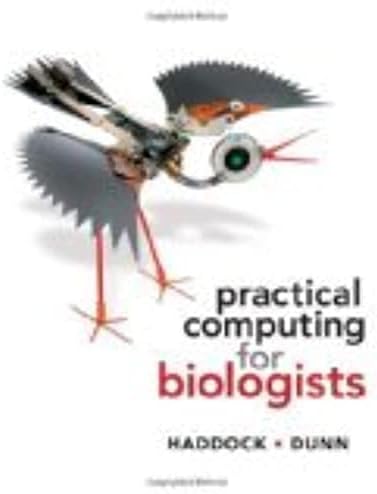

Practical Computing for Biologists
Product ID: 1699294
Buy anything from 5,000+ international stores. One checkout price. No surprise fees. Join 2M+ shoppers on Desertcart.
Desertcart purchases this item on your behalf and handles shipping, customs, and support to OMAN.
desertcart.com: Practical Computing for Biologists: 9780878933914: Haddock, Steven H. D., Dunn, Casey W.: Books Review: Highly recommend this book to every biologist. - I am a graduate student in biology and frequently feel like the learning of new skills, that are extremely useful for my present and future work, requires the commitment to that learning for a longer time period than I actually have. If these skills are in another discipline, then the commitment has to be even stronger. The main thing that should be changed about the book Practical Computing for Biologists is the title. A more suitable and informative title would be "Demystifying computing for biologists" or even "Demystifying computing for scientists". The authors clearly explain how to tackle problems that biologists in all career stages face frequently, and in doing so, introduce the fundamental concepts of computer science. By reading the book, the biologist learns that he/she can write a one line command in the terminal window (which take 30 seconds), that will save him/her hours of work. The scientist can also create a small program that will peruse archives of data (be it genomic data, ecological data, literary data) with a defined frequency to look for specific information. This way, a daily routine spent in front of a computer can be replaced by this program and time can be used in other tasks (in the case of biologists, bench work, paper writing, etc). And while writing and running these problems, the scientist gets familiarized with words and symbols such as bash, "shebang", sudo and { }. The authors lead the reader through the intricacies of computer science without the readers knowledge, and without the need to purchase software, as the one required is mostly open source. This book will not make you an expert in computer science, but you will certainly feel like you started understanding the field. For students, this may be further developed with more specialized books that are recommended by the authors, but they won't feel like they are learning a completely foreign language and will know what to look for to suit their needs (learning how to print "Hello world!" may be a good start but it is hard to feel that this command will ever be used in the more complex tasks that we have in mind related to our research). Professors and senior scientists may feel that this book gives them an understanding of the tools in computer science that can be used in their own research. They may not wish to learn further computing, but they will know how to read and interpret programs created by other parties to analyze the ever increasing amount of data that is created in their labs. In general, biologists will react to the teachings of this book with a "Awwwwwwww!" of enlightenment, and will want to further develop their skills because of the motivation associated with the successful running of the programs created. So, in summary, this book may be one of the most useful books you should have in your library (or on your desk). You will find yourself consulting it over and over again. If someone tells you they need to write a program to look for specific motifs in a bunch of sequences, you will have the notion of how that is done, and hey!, you may even be able to help out! I recommend this book to anyone working in biology. Really. H. M.-S. Review: Saves a LOT of time - This is an incredibly good book for anyone in science who wants to know how to do everything more efficiently, using free software. It's great to work through chapter-by-chapter as a tutorial, but is also a really handy reference. It covers a variety of topics, including graphics manipulation, regular expression, and a thorough introduction to python. Plus a lot of little things you never thought of doing, which add up to a lot of saved time & effort. Within weeks of starting to read through PCfB, I put together a pipeline to handle automated counting of beats per minute from 6-hour long heartbeat records. SO much more efficient than what I had been doing. It's also a very easy read; the authors do a great job of explaining and walking you through the topics in a way that's useful and easy to follow. This book is exactly what it says it is: a guide for biologists who want to work more efficiently without going back to school for computer science degrees.
| Best Sellers Rank | #1,082,033 in Books ( See Top 100 in Books ) #99 in Bioinformatics (Books) #686 in Biology (Books) #873 in Python Programming |
| Customer Reviews | 4.6 4.6 out of 5 stars (85) |
| Dimensions | 9.07 x 1.03 x 7.58 inches |
| Edition | 1st |
| ISBN-10 | 0878933913 |
| ISBN-13 | 978-0878933914 |
| Item Weight | 1.8 pounds |
| Language | English |
| Print length | 564 pages |
| Publication date | November 5, 2010 |
| Publisher | Sinauer Associates is an imprint of Oxford University Press |
H**S
Highly recommend this book to every biologist.
I am a graduate student in biology and frequently feel like the learning of new skills, that are extremely useful for my present and future work, requires the commitment to that learning for a longer time period than I actually have. If these skills are in another discipline, then the commitment has to be even stronger. The main thing that should be changed about the book Practical Computing for Biologists is the title. A more suitable and informative title would be "Demystifying computing for biologists" or even "Demystifying computing for scientists". The authors clearly explain how to tackle problems that biologists in all career stages face frequently, and in doing so, introduce the fundamental concepts of computer science. By reading the book, the biologist learns that he/she can write a one line command in the terminal window (which take 30 seconds), that will save him/her hours of work. The scientist can also create a small program that will peruse archives of data (be it genomic data, ecological data, literary data) with a defined frequency to look for specific information. This way, a daily routine spent in front of a computer can be replaced by this program and time can be used in other tasks (in the case of biologists, bench work, paper writing, etc). And while writing and running these problems, the scientist gets familiarized with words and symbols such as bash, "shebang", sudo and { }. The authors lead the reader through the intricacies of computer science without the readers knowledge, and without the need to purchase software, as the one required is mostly open source. This book will not make you an expert in computer science, but you will certainly feel like you started understanding the field. For students, this may be further developed with more specialized books that are recommended by the authors, but they won't feel like they are learning a completely foreign language and will know what to look for to suit their needs (learning how to print "Hello world!" may be a good start but it is hard to feel that this command will ever be used in the more complex tasks that we have in mind related to our research). Professors and senior scientists may feel that this book gives them an understanding of the tools in computer science that can be used in their own research. They may not wish to learn further computing, but they will know how to read and interpret programs created by other parties to analyze the ever increasing amount of data that is created in their labs. In general, biologists will react to the teachings of this book with a "Awwwwwwww!" of enlightenment, and will want to further develop their skills because of the motivation associated with the successful running of the programs created. So, in summary, this book may be one of the most useful books you should have in your library (or on your desk). You will find yourself consulting it over and over again. If someone tells you they need to write a program to look for specific motifs in a bunch of sequences, you will have the notion of how that is done, and hey!, you may even be able to help out! I recommend this book to anyone working in biology. Really. H. M.-S.
C**N
Saves a LOT of time
This is an incredibly good book for anyone in science who wants to know how to do everything more efficiently, using free software. It's great to work through chapter-by-chapter as a tutorial, but is also a really handy reference. It covers a variety of topics, including graphics manipulation, regular expression, and a thorough introduction to python. Plus a lot of little things you never thought of doing, which add up to a lot of saved time & effort. Within weeks of starting to read through PCfB, I put together a pipeline to handle automated counting of beats per minute from 6-hour long heartbeat records. SO much more efficient than what I had been doing. It's also a very easy read; the authors do a great job of explaining and walking you through the topics in a way that's useful and easy to follow. This book is exactly what it says it is: a guide for biologists who want to work more efficiently without going back to school for computer science degrees.
J**H
Git-R-Done!
I buy this book for all the graduate students coming out of biology or bioinformatics that can't hack two things together to get something working. I don't think you can publish a paper as a bioinformatician without these skills. I read the book about a decade ago now and I have given out quite a few. Wonderful and fun hacker mentality that is crucial for getting stuff done ✅--highly recommended!
R**N
Great intro book
Great book for ramping up your computational skills. It covers a lot of powerful tools in a very straightforward and easy to digest manner. As a biological researcher, this book has helped me approach raw data more efficiently and streamline redundant processes. I especially liked the sections on handling text files and command line operations. I wish the Python chapters were updated to the latest version, this is the only reason my review is not 5 stars. I would recommend this book to any researchers tired of relying on pre-packaged software suites dictating their experimental decision making.
S**E
Exceptional Resource
Update: THIS BOOK MADE ME SHINE! One of the exercises in the book involves using building a program using regular expressions to modify the format of lat/lon data into a .kml-readable format. Guess what my employer asked me to do today? Yup, manually reformat hundreds of lines of lat/lon data. It took me 20 minutes instead of tedious hours, and I was paid for completion of the job, not the hours. In science, it is all about efficiency and building a better mouse-trap. This book teaches you all the great shortcuts to stand out in a competitive field of study. THANK YOU PCfB!!!!! My Background: I am a biochemistry and molecular biology graduate who is learning BioPy and R to aid in my ability to process and understand large data sets. I've been reading books on python and bioinformatics, but they are often either too cryptic or too basic. Until I found PCfB, I couldn't find a book that got to the real meat of bioinformatics and biological data processing/management. Review: If you are pursuing higher education in science, buy this book. Seriously, put this book into your cart now. Now that advanced computer skills are in great demand by employers in scientific disciplines, I really think a course involving this material should be mandatory in any undergraduate chemistry or biology department. But it isn't, so buy this book and catch up. This is the information they should have taught you in college. PCfB is probably best for people who have a basic understanding of computers. The book is neither written for experts nor for novices and fits well at the college level. It provides sufficient detail and complex examples without interjecting excess esoteric programming theory. The only downside is that the book is catered towards OSX/UNIX, but to be fair, the authors include how to run commands on windows and linux.
L**R
A perfect guide into the field of effective programming and practical computing. Scince the first chapters on regular expressions I'm fascinated about the qualitiy of this book, although I'm not a beginner in programming.
A**R
Great book that teaches you from basics to a bit more advanced stuff. I wish it included R but it has topics in broad content as well as the basis of data organization. I can see that this book will be useful in different occasions in many years to come.
Trustpilot
1 month ago
3 weeks ago