
قم بتنزيل التطبيق



Desert Online General Trading LLC
Warehouse # 7, 4th Street, Umm Ramool, Dubai, 30183, Dubai
قم بتنزيل التطبيق
Desert Online General Trading LLC
Warehouse # 7, 4th Street, Umm Ramool, Dubai, 30183, Dubai
Full description not available
O**U
It was as good as new and arrived early.
It was as good as new.
P**L
Five Stars
Used it for my class, it was a solid book.
C**Y
the CURRENT edition is good, don't get screwed with a 33 year old copy though
The other students in class had a copy from this millenium, the one I got from an independent seller using Amazon was 33 years old! Its a good textbook, I looked at others from the last few years. Photos of the equipment were helpful to understand how disk screen, eddy current separators, etc would work.Huge sections of MSW engineering did not even exist when the 1970's textbook was published, so be cautious of which edition you are being offered. I am still waiting to see if the seller is willing to return my money.
J**S
Five Stars
Very useful in the classroom and at work
Z**N
Five Stars
good
E**N
Well Written, but Obsolete
I purchased this text for an upper-level (500-series) design course covering solid and hazardous waste management. The book is divided into two major parts, with the first 11 chapters providing an overview of waste composition, characteristics, collection, treatment and conversion, and disposal, and the remainder of the book providing more in-depth technical coverage of material recovery and conversion technologies. Overall the book is well-written and maintains a strong narrative throughout, although the homework exercises require assumptions to be made regarding background condition which are not clearly discussed in the text.The single greatest detractor to this volume is its age, as it was first published well before most current student users were born. While the methods, techniques, and formulate utilized for the first part of the text have not changed greatly in the past three decades, statistics have. Information regarding waste generation rates and composition is 20 years old at best, and modern trends, which have changed markedly in the last several years, are omitted entirely. Any instructor utilizing this text should feel compelled to provide students with up-to-date information, which may be obtained from the EPA, state departments of environmental protection, and many county governments.Furthermore, as a result of the text's age, many modern techniques are completely omitted from the latter portion. In the discussion of composting, techniques covered are limited to various windrow and in-vessel methods; any modern course covering composting should cover modern vermicomposting and larvae composting methods not invented at the time of publication. Likewise, in the discussion of material recovery facilities, modern optical sorting techniques, the rise of single-stream recycling, and Clinton-era goals on paper recycling (the origin of the ubiquitous 30% recycled copy paper we use daily) are also excluded, and all merit treatment in a course covering solid waste and/or material recovery.Coverage of hazardous waste in the text is perfunctory at best, as this is not part of the author's objectives, and thus cannot be held against the book. However, I would advise users planning to cover hazardous waste to either supplement the book substantially or look elsewhere.Overall, the narrative quality of this volume is better-than-average, although its obsolescence makes it far from optimal for utilization at present. Thus, unless users solely wish to cover theoretical aspects of solid waste, I would strongly recommend a more current volume. Current students of solid waste would be well-advised to utilize European volumes, as many cover social and technological integration superior to that of the United States, such as many Springer-published volumes.
A**N
The Authors And The Book
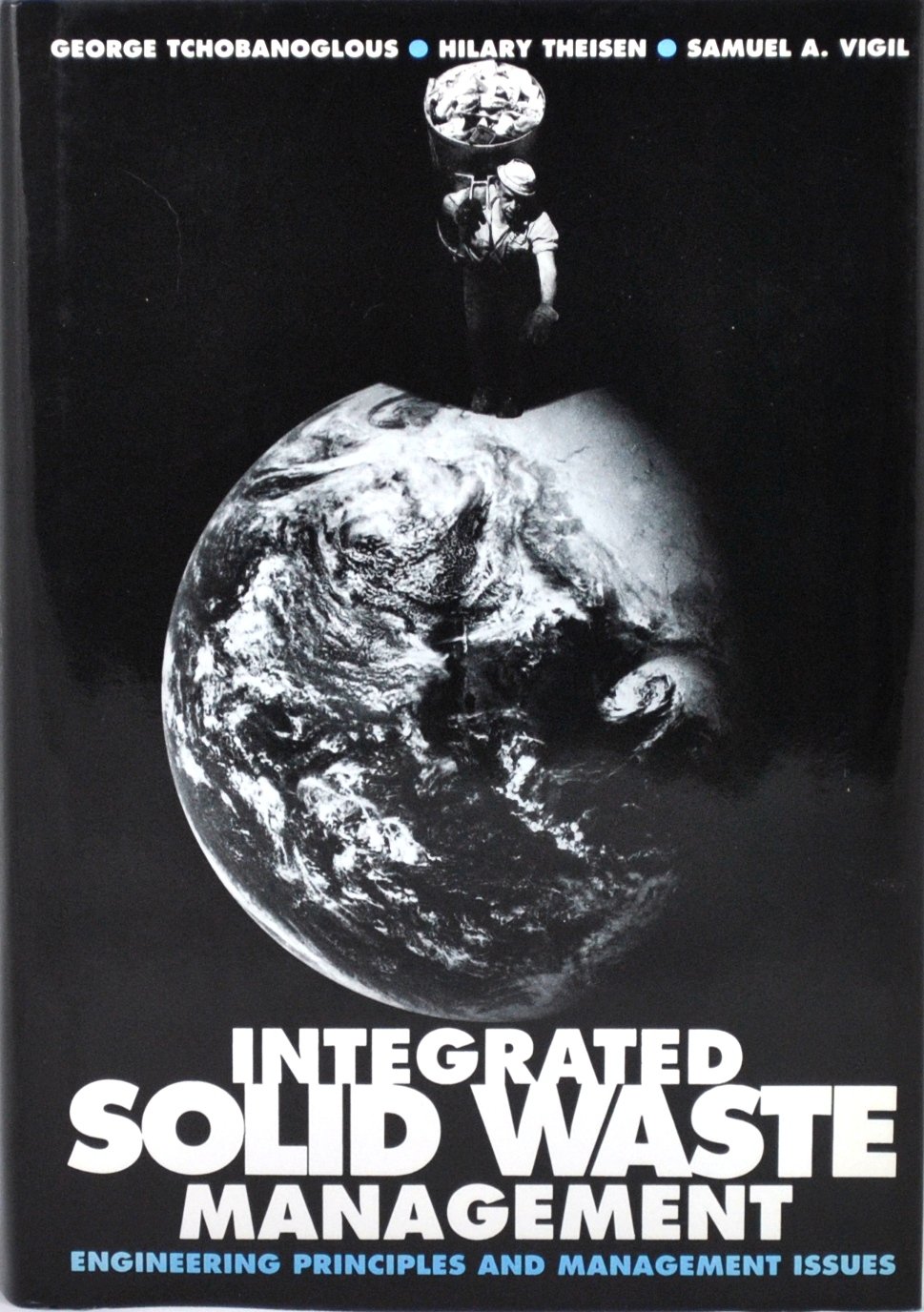
INTEGRATED SOLID WASTE MANAGEMENTEngineering Principles and Management IssuesAuthors;GEORGE TCHOBANOGLOUSProfessor of Civil and Environmental EngineeringUniversity of California, DavisGeorge Tchobanoglous is a professor of civil and environmental engineering at the University of California at Davis.He received a B.S. in civil engineering from the University of the Pacific, and M.S. in sanitary engineering from the University of California at Berkeley, and a Ph.D. in environmental engineering from Stanford University.His principal research interests are in the areas of solid waste menagement, wastewater treatment, wastewater filtration, aquatic systems for wastewater treatment, and individual on-site treatment systems.He has authored or coauthored over 200 technical publications and 10 textbooks.He is the principal author of the predecessor of this textbook. Unless otherwise noted, all of the photographs in this textbook were taken, developed, and printed by him.Professor Techobanoglous serves nationally and internationally as a consultant to both governmental agencies and private concerns. An active member of numerous professional societies, he is past president of the Association of Environmental Engineering Professors.He has served as a member of the California Waste Management Board.He is a registered civil engineer in California and a Diplomate of the American Academy of Environmental Engineers.HILARY THEISENVice PresidentBrown & Caldwell, Consulting EngineersHilary Theisen is Vice President and Director of the solid waste and resource recovery program at Brown and Caldwell Consultants.He received a B.S. in civil engineering from the University of Minnesota and an MBA from the University of Santa Clara.His broad solid waste management experience started as a consultant in 1966.In the mid 1970s he directed solid waste operations in Sacramento County, CAlifornia, which provided collection, transfer, recycling, and disposal services in a community of 380,000 people.At Brown and Caldwell Consultants, he oversees the production of studies, designs, and reports for public agencies and private industry.He has provided consulting services throughout the United States, Argentina, Taiwain, Puerto Rico, and Venezuela.He has authored numerous papers and articles on solid waste management and is the coauthor of the predecessor of this textbook, Solid Waste: Engineering Principles and Management Issues.He is a registered professional engineer in California, Hawaii, Oregon, and Washington.SAMUEL VIGILProfessor of Civil and Environmental EngineeringCalifornia Polytechnic State UniversitySan Luis Obispo, CaliforniaSamuel Vigil is a professor of civil and engironmental engineering at California Polytechnic State University, San Luis Obispo.He received a B.S. in civil engineering from the University of California at Berkeley, and M.S. in environmental engineering from Texas A&M University, and a Ph.D. in environmental engineering from the University of California at Davis.His principal research interests are in the areas of gasification of solid wastes, recycling technoloties, computer modeling of integrated waste management systems, and computer-aided engineering.He has authored or coauthored 26 publications and holds a U.S. Patent in energy conversion.Professor Vigil is active as a consultant to state and local governments and has also consulted internationally in Europe, Latin America, and Southeast Asia.He is active in the Solid Waste Processing Division of the American Society of Mechanical Engineers, the Air and Waste Management Association, and the American Public Works Association.A Navy veteran, Professor Vigil is a Commander in the Naval Reserve Civil Engineer Corps.He is a registered civil engineer in California and a Diplomate of the American Academy of Environmental Engineers.The book is 978 pages with subject index.Hardback.This book was set in Times Roman by Publication Services.The editors were B. J. Clark and John M. Morriss;the production supervisor was Friederich W. Schulte.The cover was designed by Nicholas Krenitsky.R. R. Donnelley & Sons Company was printer and binder.This book is printed on acid-free paper.Copyright 1993 by McGraw-Hill, Inc.ISBN 0 07 063237 5.[from the book]
C**N
Concise, informative and organized
The book covers almost all aspects of solid waste management with excellent presentation: regulations, waste characteristics, collection and transfer, landfill, recycling and recovery, thermal destruction, and chemical and biological transformations. Although it does not discuss all the design details of the disposal alternatives, it is one of the most comprehensive coverage in solid waste management. Strongly recommended.
ترست بايلوت
منذ أسبوعين
منذ شهر
منذ أسبوعين
منذ شهر