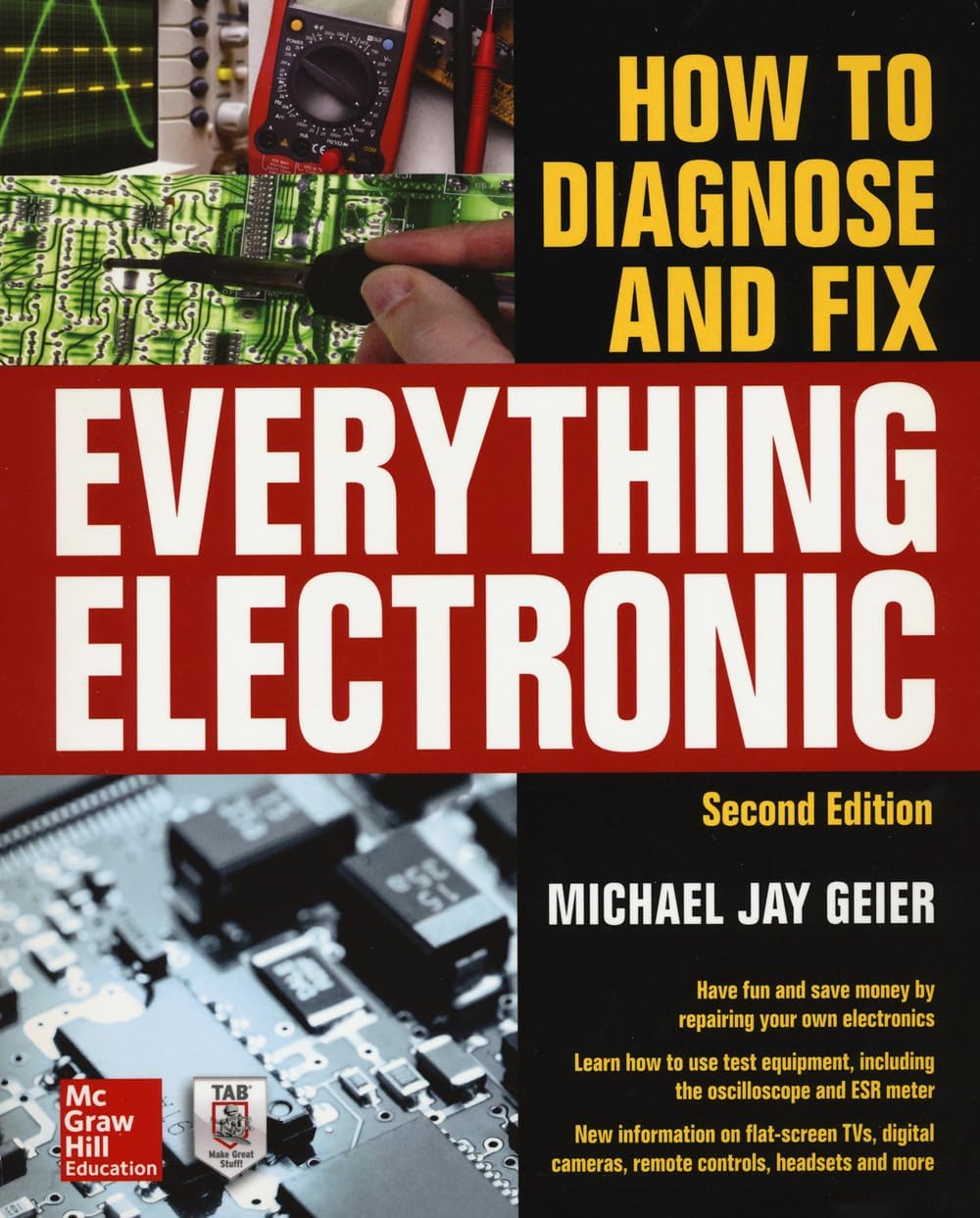
How to Diagnose and Fix Everything Electronic, Second Edition
Product ID: 18972040
Publisher's Note: Products purchased from Third Party sellers are not guaranteed by the publisher for quality, authenticity, or access to any online entitlements included with the product. A Fully Revised Guide to Electronics Troubleshooting and Repair Repair all kinds of electrical products, from modern digital gadgets to analog antiques, with help from this updated book. How to Diagnose and Fix Everything Electronic, Second Edition, offers expert insights, case studies, and step by step instruction from a lifelong electronics guru. Discover how to assemble your workbench, use the latest test equipment, zero in on and replace dead components, and handle reassembly. Instructions for specific devices, including stereos, MP3 players, digital cameras, flat panel TVs, laptops, headsets, and mobile devices are also included in this do it yourself guide. Choose the proper tools and set up your workbench Ensure personal safety and use proper eye and ear protection Understand how electrical components work and why they fail Perform preliminary diagnoses based on symptoms Use test equipment, including digital multimeters, ESR meters, frequency counters, and oscilloscopes Interpret block, schematic, and pictorial diagrams Disassemble products and identify sections Analyze circuits, locate faults, and replace dead parts Re establish connections and reassemble devices Review: Valuable knowledge written in an easy-to-read style. - I almost didn't buy this book after having read some of the reviews. They complained that it didn't really give much useful information, that is was "wordy" and it didn't really tell you how to repair "everything". I'm on my second read-through, so I've found it far from useless. It IS written in a narrative style with anecdotal tales and a touch of humor, so if what you're looking for is dry, scientific fact, then this book is probably not for you. However, I personally comprehend more when material is presented in a narrative style. The author presents numerous topics including a philosophy of why to repair broken electronics; the test equipment necessary to make the repairs and a basic guide to using each piece; the common components that make up electrical circuits and how to identify and test them; a logical approach to reading schematics (very valuable!); how to identify common failures in electronic equipment and then methodically find the component(s) to replace; and the methods for opening seemingly impenetrable cases on laptops, tablets, phones, etc. and getting them back together without destroying them. Finally, he takes the reader through a number of real-life repair scenarios to explain how he identified the problem and brought the unit back to life. So bottom line: does this book tell you how to repair 'Everything Electronic'? No and yes! Obviously, the author cannot cover every single electronic item with a blow-by-blow description of the diagnostic and repair. What he does give are the basics to understanding common circuit function, how to identify the culprit of failure in a circuit and a logical method for repairing the circuit to correctly functioning status. I went into this book with a basic knowledge of electronics, but I understand it much better now. The book has given me the confidence to attempt repairs on my own instead of paying someone to do the work. I highly recommend this book! Review: A good book to learn about diagnosing electrical issues - Michael Grier put together a very readable and thorough book about fixing electronic issues. He obviously spent a lot of time writing about a subject he knows well. His writing style makes it fun to read and this doesn’t seem like a topic that would make reading about it, enjoyable!
| Best Sellers Rank | #599,102 in Books ( See Top 100 in Books ) #15 in Teen & Young Adult Electricity & Electronics #80 in Physics of Electricity #163 in Electrical & Electronic Circuits |
| Customer Reviews | 4.5 out of 5 stars 2,537 Reviews |
M**M
Valuable knowledge written in an easy-to-read style.
I almost didn't buy this book after having read some of the reviews. They complained that it didn't really give much useful information, that is was "wordy" and it didn't really tell you how to repair "everything". I'm on my second read-through, so I've found it far from useless. It IS written in a narrative style with anecdotal tales and a touch of humor, so if what you're looking for is dry, scientific fact, then this book is probably not for you. However, I personally comprehend more when material is presented in a narrative style. The author presents numerous topics including a philosophy of why to repair broken electronics; the test equipment necessary to make the repairs and a basic guide to using each piece; the common components that make up electrical circuits and how to identify and test them; a logical approach to reading schematics (very valuable!); how to identify common failures in electronic equipment and then methodically find the component(s) to replace; and the methods for opening seemingly impenetrable cases on laptops, tablets, phones, etc. and getting them back together without destroying them. Finally, he takes the reader through a number of real-life repair scenarios to explain how he identified the problem and brought the unit back to life. So bottom line: does this book tell you how to repair 'Everything Electronic'? No and yes! Obviously, the author cannot cover every single electronic item with a blow-by-blow description of the diagnostic and repair. What he does give are the basics to understanding common circuit function, how to identify the culprit of failure in a circuit and a logical method for repairing the circuit to correctly functioning status. I went into this book with a basic knowledge of electronics, but I understand it much better now. The book has given me the confidence to attempt repairs on my own instead of paying someone to do the work. I highly recommend this book!
P**R
A good book to learn about diagnosing electrical issues
Michael Grier put together a very readable and thorough book about fixing electronic issues. He obviously spent a lot of time writing about a subject he knows well. His writing style makes it fun to read and this doesn’t seem like a topic that would make reading about it, enjoyable!
E**D
A Great Book but Misleading Title
Overall, I learned a lot from this book and I can still learn something new every time I pick it up. Geier has a great writing style and a deep knowledge of his subject. He's an Electron Whisperer. This is not a book for beginners. It requires at least a working knowledge of components and soldering; he covers them but not in any detail. There is also very little formal explanation of theory so don't buy it for that. But the book is laced with practical advice from a guy who has been in the trenches and that part is invaluable. His oscilloscope training and suggestions are very good as far as operating the device. But if you want hands-on description of how it's used for diagnosing and troubleshooting, look elsewehere. He devotes one long chapter to advice on workshop and tools: immediate essentials vs. what to put off and in what order to buy them. And there are stories. He also tells many stories of tough jobs and how he diagnosed and fixed them. These stories are entertaining and informative, and each one is there to illustrate his methodology of troubleshooting. However, including so many of them took up space that could have been put to better use. We don't all think alike and what the reader expects (based on the title) is practical advice that will help him/her develop their own knowledge base and troubleshooting style within their own field of interest. I would have been happier if the book had more directions, more rules of thumb, more flowcharts and tables. there is much good information here, just fragmented and scattered throughout the book by his folksy and (admittedly) entertaining style. But the style is too conversational. We could have used more of "Do this, then do that, etc." without having to hear so much of what went through his head as he was learning it. But I can't give it five stars because of that title. Sadly, it will NOT teach you "How To Diagnose And Fix Everything Electronic." It covers too much territory, and too many types of electronic devices. Most devices are not covered in any depth, just a few quick hints and any necessary warnings about the critter in hand. What's missing is a systematic overview of how the technician approaches a non-working device. Like Golfer's review I would have like to see a lot more tables with step by step instructions, or flowcharts showing what to test and then branches to take depending on the outcome of each previous round of tests. My main interest is in guitar amps, and how to troubleshoot amplifiers is given only superficial coverage, and scattered around the book. Whatever your main interest is, you'll probably feel the same way: a few interesting stories, a few bits of good advice, and then sent on your way without much in the way of solid skills in diagnosis or troubleshooting. I hate to be negative because in its own way, it's readable and informative and encouraging to someone trying to learn more. But in a way, it's more of an autobiography of his career fixing a large variety of products. "My Life Fixing Electrical Things" might have been a better title.
J**E
Outstanding and informative
I downloaded this book to get some additional information of basic testing. It provides a great deal of information within its pages and I found myself taking notes to keep track of the information inside. I eventually gave up on the note taking, realizing it was much easier to just search for the information as I needed it. The book is well structured so one can easily locate specific details on a specific item without jumping around to dozens of reference points. Much of the information included in this book is worthwhile for anyone who has an interest in learning about general electronics diagnostics and testing but also goes into specifics on other areas or troubleshooting and common places you can generally look while still explaining the overall diagnostic process. While discussed frequently, micro-electronics and micro-soldering are not covered in as much detail as I would have wanted. But, for most electronics, it is a valuable read and reference document and also provides detailed information on test equipment the tools recommended to set up a bench at home including notes about kids and pets and keeping your workspace safe. It is an overall good document if you spend the time to read it and have an interest in the subject matter. I find myself re-reading various sections over and over and have learned and retained more about electronics in doing so.
R**Y
Advice from a great consumer electronics tech who can explain electronic troubleshooting really well
This is an excellent book, and I am glad I bought a physical copy. I am a long-time electronics hobbyist, and many of the things in this book were not new to me, but the explanations and folksy (in a good way) descriptions made them so much clearer, even for things I mostly understood. The advice in this book is simplistic without being simplified so much that it doesn't teach, which is just right. Yes, there is an assumption you know some basic electronics terms, so it is not a book for the person starting from zero. Frankly, if you don't have the electronics experience to have gained the vocabulary necessary to get value from this book, those warning labels about "no user serviceable parts inside" are for you. For the right audience, this book and the advice was a bargain for the price, and it is a keeper.
S**S
Diagnostic book is just a place to begin and not definitive.
Beginning book that helps point you in the right direction.
F**T
Excellent, Practical Approach to Actually Fixing Electronics
This is a really great book - authoritative, interesting, and well written As an engineer and as a consumer, I've dealt with electronics products and devices for many years - just like most of you. But, I've never really delved into the diagnosis and repair aspect. Just sort of a fuzzy memory of Ohm's Law, etc, and a habit of looking for blown fuses Fortunately, Geier approaches things from this angle. There is very little physics and theory to wade through. The approach is is practical and hands on - with a sense of humor. The author does a great job demystifying things, and - by establishing common sense diagnostic procedures - provides a sound basis for actually doing repairs yourself Various chapters describe the equipment you will need (really, not that much), how to set it up, and how to begin using it. Other parts of the book deal with enclosures, mechanisms, circuit devices, and the like. Geir's experience with practical electronics repair is abundantly evident, as is his humility in sharing it I tend to be a tough critic on this type of "how to" effort. Nevertheless, I happily give five stars and big compliments to Geier. Brilliant...
J**I
A Must For Learning Electronics
WOW! This book seems to be packed with all the info you'll need to fix electronics on your own. And its content is printed in a tone that makes it easy for newbies or wanna-bes to understand. It clearly expresses everything from all the downfalls of fixing things yourself and most common mistakes that you'll want to avoid. Attempting to fix electronics can be scary, especially if you don't know what most of the small components within the unit are or what they do. However, this book sums everything up clearly for you. After reading it completely, there's no guarantee that you'll become a repairman, and even if you never do, you will take away a lot of info that you can benefit from when dealing with broken down electronics in the future. The only thing is the print is rather small as compared to most books and the ink is a bit light, making it harder to read. There are a lot of illustrations and pictures in it, but the bulk of them are in black and white. Overall, if you have great vision and want to learn more about electronics, this book is definitely a must.
M**.
A very useful book
A very useful book with valuable tips for repairing electronic appliances and components. Would be 5 stars were it not for the sometimes strange language Jay Geier uses.
V**N
Met my expectations
The book met my expectations and it was delivered to me on time
F**E
Good book on a difficult topic.
You don't have to be an electrical engineer to do a repair and you don't have to understand every detail of electronics. A very practical approach to electronics, which I liked a lot after reading usual theory books. It gave me a new view on this topic. A broken switch, a corroded trim-pot, the circuits of the power supply, the electrolytic capacitors or a shorted diode might be the problem. You need some understanding about what's going on in the circuits to find the faulty parts. Modern, new technology, with its small components and the high density of parts is, of course, difficult to repair. The author gives realistic advice how to handle these newer devices anyway, somehow, sometimes. Some devices he writes about aren't interesting anymore because of technical advance (for example mechanical parts). But this accounts only for a few pages of this book. Most of the advice in this book is universal. After all, I really like this book and I recommend it to everyone interested in electronics.
F**P
bem estruturado e explicado
gostei da organização dos temas e forma como o autor escreve.Podia ter uma parte mais prática.
C**R
Five Stars
just what I wanted
Trustpilot
2 months ago
1 month ago