We remain fully operational. Our teams are working around the clock to ensure your deliveries continue safely.

قم بتنزيل التطبيق


معلومات عنا
حقوق الطبع والنشر © 2024 Desertcart Holdings Limited
قم بتنزيل التطبيق
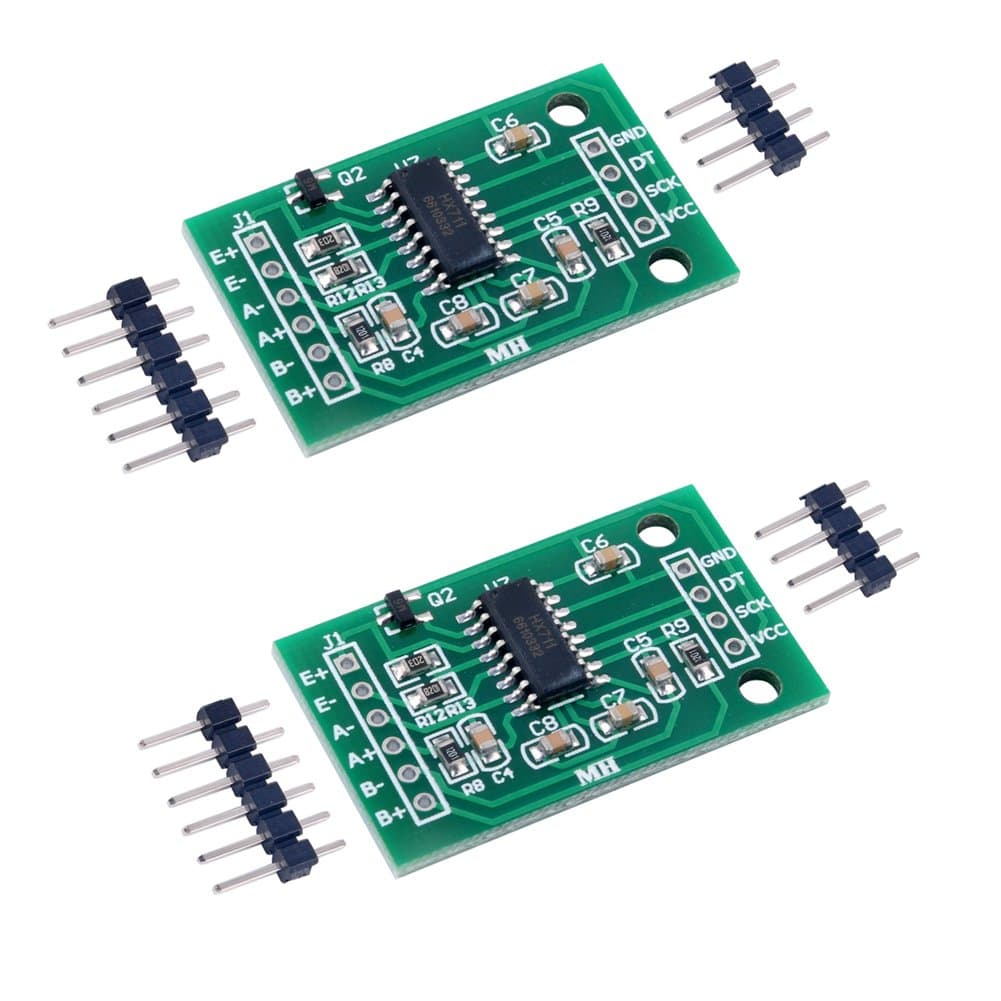
⚙️ Elevate your Arduino projects with precision weight sensing that means business!
The 2pcs HX711 Weight Weighing Load Cell Conversion Module features a 24-bit high precision ADC chip with two selectable differential input channels and an integrated 128x programmable gain amplifier. Designed for Arduino microcontrollers, it delivers accurate weight measurements with 0.1g resolution, ideal for DIY scales, industrial controls, and custom sensor applications. Lightweight and cost-effective, this dual-pack module is a top choice for makers seeking reliable, high-performance load cell amplification.


| ASIN | B010FG9RXO |
| Best Sellers Rank | #34,907 in Industrial & Scientific ( See Top 100 in Industrial & Scientific ) #4 in Acceleration Sensors |
| Brand Name | DIYmall |
| Customer Reviews | 4.3 4.3 out of 5 stars (75) |
| Display Type | LCD |
| Form Factor | Mini |
| Item Weight | 5 Grams |
| Manufacturer | DIYmall |
| Material Type | copper |
| Measurement Type | weight |
| Model | FBA_FZ0728X2 |
| Part Number | FBA_FZ0728X2 |
| Readout Accuracy | 0.1g |
| UPC | 702795763015 |
| Unit Count | 2.0 Count |
| Weigh Scale Type | Floor Scale |
W**L
Read this if using with strain gauges
These things work great. There's a ton of information about them online. I am very new to arduinos and programming but I was able to get this working pretty easily. I did not use a pre-made load cell. I created my own wheat stone bridge with single strain gauges and discovered that these will only work in a half or full bridge configuration. All I had to do was connect a dummy gauge and it worked perfectly. If you Google dummy strain gauge you can see wiring diagrams on how to connect them. The output is 0 to 2^24, there is some noise but it is negligible Would absolutely buy these again.
Y**A
Very good!!
It worked well as expected. I lifted two pins and changed the configuration to speed up the sampling rate from 10 SPS to 80 SPS as it is described in the datasheet, and it worked nicely with higher sampling ratio. I am satisfied with this product.
T**S
works as expected
it works, as expected. be careful to not get gnd and VCC flipped or you will fry the board. also pins on one side are short, making it a bit difficult to solder and get a good connection.
M**J
Good sensors
Took a bit to solder them up mainly because I was very rusty. Nice solid units tolerated my heavy hand with the soldering iron. Well packed quick delivery
E**R
Works Great-
Work very well and amazingly cheap. I had an old scale where the LCD went out. Couldn't pitch it. Hacked an Arduino and this board in and had some fun. Interface is not quite SPI but similar. Look at datasheet.
D**.
The chip on the PCB is missing a power supply ground connection, and so is the board.
There is no power supply ground pin on the IC chip according to the manufacturer's datasheet. However, their reference design shows tying power supply ground (from the digital interface's ground pin) to the analog ground pin on the chip. This can easily be done by tying the GND pin on the 4-pin header to the E- pin on the other header. Doing so makes the readings much more stable, and the digital interface much more reliable. Other HX711 board designs online make this connection.
M**V
Meets expectations
Does what it needs to do. Using with a 2T eBay load cell. Appears to be consistent across power cycles.
B**B
Not the best HX711 Board
I was sent these as a gift. Other HX711 boards I've used in the past had a simple solder pad that allowed operation between 10hz and 80hz.... this one does not. Its much more of a pita to setup for 80hz operation. You must first lift or cut the pad of pin 15, and then solder pin 15 to pin 16 See picture. I broke one of the two chips doing this, but luckily got the second one working. This chip is also pretty noisy. There are shielded HX711 boards on the market that are much less noisy for the same price.
M**A
For the users out there scratching their heads why the output is drifting or gives errors, the PCB has a defect. The pin E- is not physically connected to GND. As a result the bridge E+ pin is not regulated and floats. The fix is to connect a wire from E- to GND and no more drifting. I wasted so much time on this and almost abandoned the project. Please fix the PCBs or at least put a warning about this defect so people would not waste any more time troubleshooting.
ترست بايلوت
منذ شهرين
منذ 5 أيام