
قم بتنزيل التطبيق


معلومات عنا
حقوق الطبع والنشر © 2024 Desertcart Holdings Limited
قم بتنزيل التطبيق
![Seven Samurai (Blu-ray Edition) [1954]](https://m.media-amazon.com/images/I/51PnueSylrL.jpg)
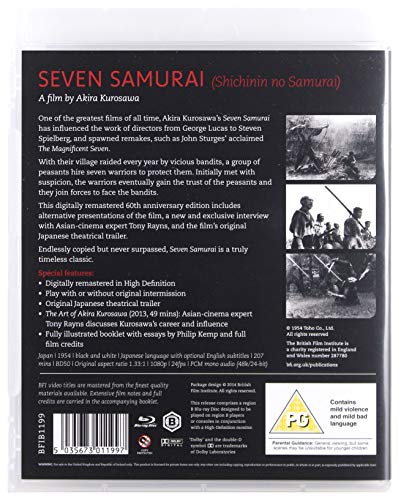


SEVEN SAMURAI (Blu-ray Edition) A film Akira KurosawaOne of the greatest films of all time Akira Kurosawa's Seven Samurai has influenced the work of director's from George Lucas to Steven Spielberg, and spawned remakes, such as John Sturges acclaimed The Magnificent Seven.With their village raided every year by vicious bandits, a group of peasants hire seven warriors to protect them. Initially met with suspicion the warriors eventually gain the trust of the peasants and they join forces to face the banditsThis Blu-ray edition includes alternative presentations of the film, a new and exclusive interview with Asian-cinema expert Tony Rayns, and the film's original Japanese trailer. Endlessly copied but never surpassed, Seven Samuraiis a truly timeless classicSpecial featuresDigitally re-mastered in High DefinitionPlay with or without original intermissionOriginal Japanese theatrical trailerThe Art of Akira Kurosawa (2013, 49 mins): Asian-cinema expert Tony Rayns discusses Kurosawa's career and influenceFully illustrated booklet with essays and creditsJapan | 1954 | black & white | Japanese language, with optional English subtitles | 207 mins | BD50 | Original aspect ratio 1.33:1 | 1080p | 24fps | PCM mono audio (48k/24-bit | Region b | Cert PG (contains mild violence and mild bad language) Review: 3 1/2 Hours of pure golden cinema! - A timeless classic with amazing cinematography, acting and direction. Anything I could say has been said, and far better. If you’re on the fence about watching this, you won’t be disappointed. Review: This classic should be given six or seven stars! - This movie is justly hailed as one of the great movies of all time. The story is wonderful, the acting is fine, the music is moody and appropriate, and the photography is fabulous in adding to the drama and emotion of the story. And though it is 3 hours and 27 minutes in length, it doesn't feel long. The time is used for interesting character development and to enrich the story by connecting us with the characters and their struggles. Just compare the richness of this film with "The Magnificent Seven" and you will have to admit that the remake, while good, is inferior largely because of the cuts that needed to be made to keep the movie to two hours. The misery of the villagers and loneliness of the samurai are palpable. The small and dusty village aches of poverty and desperation and the samurai always seem aware that they are a feared necessity to the farmers and will never be accepted or even justly thanked. The bandits are a mass force of nature about to once again take everything from the farmers but their lives. We don't get to know any of them beyond the way they dress and this mass energy makes them even more threatening and fearsome. After being beaten down by the bandits for so long, the farmers decide, at least tentatively, to fight or die. The old man of the village sends them to the city to recruit hungry but strong samurai. The recruitment scenes are a classic in introducing us to seven heroes and their varying characters. When the samurai arrive at the village and no one comes to greet them we see the beginning of the fracture and the residual fear of the peasants. The fortification of the village and the training of the farmers for battle add to the rich character development of the movie. There is even a wonderful scene on the harvest before the fields are flooded. Can you imagine the luxury such a scene in a Hollywood film? But it adds so much to our understanding of these characters that it is worth the extra time and more. Then comes the first skirmish quickly followed by the three amazing battles and the nights between. The camera work here keeps us breathless with the speed at which the fighting happens. The camera work keeps it all close and personal. Pain, fear, anguish, and courage fill the frame throughout these unforgettable scenes. There is so much to talk about in this movie that these little reviews are really not enough. This is a fabulously restored disk with a few extras (but who cares - it is this wonderful movie that makes the disk worth everything). "Seven Samurai" is a movie I never tire of watching and always lets me find new things to enjoy. Amazing.
| ASIN | B00LJ07FBC |
| Aspect Ratio | Unknown |
| Best Sellers Rank | #191,354 in Movies & TV ( See Top 100 in Movies & TV ) #51,341 in Blu-ray |
| Customer Reviews | 4.4 4.4 out of 5 stars (2,022) |
| Is Discontinued By Manufacturer | No |
| Language | English (Dolby Digital 5.1) |
| Media Format | Dolby |
| Number of discs | 1 |
| Product Dimensions | 1.57 x 1.57 x 0.39 inches; 3.17 ounces |
| Release date | August 25, 2014 |
| Run time | 3 hours and 27 minutes |
| Studio | Bfi |
| Subtitles: | English |
N**Y
3 1/2 Hours of pure golden cinema!
A timeless classic with amazing cinematography, acting and direction. Anything I could say has been said, and far better. If you’re on the fence about watching this, you won’t be disappointed.
C**N
This classic should be given six or seven stars!
This movie is justly hailed as one of the great movies of all time. The story is wonderful, the acting is fine, the music is moody and appropriate, and the photography is fabulous in adding to the drama and emotion of the story. And though it is 3 hours and 27 minutes in length, it doesn't feel long. The time is used for interesting character development and to enrich the story by connecting us with the characters and their struggles. Just compare the richness of this film with "The Magnificent Seven" and you will have to admit that the remake, while good, is inferior largely because of the cuts that needed to be made to keep the movie to two hours. The misery of the villagers and loneliness of the samurai are palpable. The small and dusty village aches of poverty and desperation and the samurai always seem aware that they are a feared necessity to the farmers and will never be accepted or even justly thanked. The bandits are a mass force of nature about to once again take everything from the farmers but their lives. We don't get to know any of them beyond the way they dress and this mass energy makes them even more threatening and fearsome. After being beaten down by the bandits for so long, the farmers decide, at least tentatively, to fight or die. The old man of the village sends them to the city to recruit hungry but strong samurai. The recruitment scenes are a classic in introducing us to seven heroes and their varying characters. When the samurai arrive at the village and no one comes to greet them we see the beginning of the fracture and the residual fear of the peasants. The fortification of the village and the training of the farmers for battle add to the rich character development of the movie. There is even a wonderful scene on the harvest before the fields are flooded. Can you imagine the luxury such a scene in a Hollywood film? But it adds so much to our understanding of these characters that it is worth the extra time and more. Then comes the first skirmish quickly followed by the three amazing battles and the nights between. The camera work here keeps us breathless with the speed at which the fighting happens. The camera work keeps it all close and personal. Pain, fear, anguish, and courage fill the frame throughout these unforgettable scenes. There is so much to talk about in this movie that these little reviews are really not enough. This is a fabulously restored disk with a few extras (but who cares - it is this wonderful movie that makes the disk worth everything). "Seven Samurai" is a movie I never tire of watching and always lets me find new things to enjoy. Amazing.
C**S
Three views of the heroic in a stratified society
Since there are over 300 reviews of this magnificent film already posted, I would like to discuss some aspects of this film that are rarely discussed. The first of these two themes is the various roles and attributes of the heroic male. The second of the two themes is the depiction of classism and a stratified society. However, before I comment on these two themes I must praise Kurosawa, the Director, for the incredible battle scenes. The level of realism, chaos, and accident is very high, giving the viewer a superb look into battle. As the layout of the village is drawn and repeatedly shown to the viewer in Kambei's maps, we fully understand the battleground and the rationale for defending specific sites and barrocading others. We understand Kambei's master strategy and its execution. We understand when it goes wrong or astray and we watch Kambei immediate correct the situation if possible. We see beserk men hacking at each other rather than an over stylized ballet posing as a battle scene. These battle scenes are masterful and rare. That being said, I would like to discuss the two themes I outlined above. First, we see three distinct ways or paths of the hero in this film. We see the character Kyuzo, the master swordsman, a completely skilled killing machine, swift as a scorpion and calm as a cool breeze. He is a craftsman, sure of his talent and skill. He is also serene, having obviously attained a detachment from emotion and day-to-day worries. He takes his skill seriously, as seen in his first scene where a dueling partner progresses from sticks to swords and Kyuzo kills him within seconds. A second revealing scene is the great sequence where wildman Kikuchoiyo and steel-nerved Kyuzo become a team to track and kill the three bandit scouts. The third scene is wisely left to our immagination. Kyuzo learns that three of the bandits hidden in the forrest around the village has a rifle. Kyuzo leaves the compound alone in the fog of night and many hours later returns with a rifle in hand. He hands the rifle to Kambei and goes calmly to sleep. We see that Kyuzo, though a self contained killing machine, can work in partnership with a wildly unpredictable partner as well as follow instructions from the wise leader, Kambei. Kyuzo is seen in all cultures and in all times. He is the totally proficient warrior. He is the warrior that all younger warriors wish to emulate. But he is incomplete because he lacks one virtue, purpose beyond himself. Yet he is wise enough to be persuaded by Kambei and to follow Kambei's wise direction. It is purposefully ironic that Kyuzo is shot in the back by one of the three rifles in the film, since no one can beat him face to face with sword technology. The character of Kikuchoiyo, the wild man who wishes to become a Samurai, the man who can not contain his energy or emotion, the force of nature, is an incredible character. He is the exact opposite of Kyuzo, the serene killing machine. He has little control of his emotions, is spontaneous and rage driven. Yet his character undergoes the most transformation in the film. He goes from being a lying drunken bully imposter to a force of great good, primarily through the strategic hands off mentoring of Kambei. We learn that he is not from a Samurai family but is the orphan of farmers killed by bandits. Kikuchoiyo first gives us a hint as to his background when he informs the samurai that farmers always have hidden resources on which to call, this secrecy being necessary for thier survival. However when the bandits attack the old miller and his family in the grist mill, Kikuchoiyo comes to the rescue and saves a baby boy from the dying arms of its mother. Kikuchoiyo breaks down in mid-action, holding the child in a stream with warfare surrounding him, and wails that this exact thing happened to him as a child. In the Jungian sense, Kikuchoiyo reclaimed his orphan child self at this point, he saves a real child but he also saves an inner psychic child within himself and thus this allows him to be a true Samurai rather than an imposter Samurai. He is a fighting force, full of emotion and power. He taps into the natural, biological forces of injustice in the final battle scenes. Ironically, this is what brings about his end, for those who fight with pure emotion exceed their bounds. When the rifleman bandit kills Kyuzo from behind a wooden screen, Kikuchoiyo is overtaken with rage and attacks the screen trying to pull it apart to reach the bandit. He takes a bullet in the belly but goes on fighting until he collapses. This brings us to the final penacle of heroism, Kambei, the mastermind Samurai leader with a vast range of intellectual, interpersonal, and warrior skills. Kambei has a range of leadership skills including; ability to make realistic assessments so as not to support unrealistic optimism, ability to use small resources to bring down much larger forces, ability to fight on the edges, the fringes, to deplete the resources and power of his enemy, ability to mentor other men by drawing out their unique talent and using that talent for the greater good, ability to judge the greater good from immediate gains, ability to change course in the middle of battle when the facts reveal that a new strategy is needed, abiltiy to recover quickly from loss and mve forward, and an ability to use humor and a personal relationship to move men toward action. Finally, he has incredible humility which allows him to make realistic assessments of conditions and resources and dynamics. Humility is an underestimated asset. Humility is essential to the leader because egotism and grandiosity cloud a man's vision. Humility keeps vision clear - an essential for survival and leadership. Now we come to the second theme of the film, which is understanding the actions of all the characters witin a context of classism and a stratified society. The meek, clownlike, foolish farmers gradually are seen as far from timid fools. They survive amidst overwhelming odds. They hire ronin, which were the masterless unemployeed samurai soldiers that roamed Japan in the 16th century. In the end, four of the seven samurai are burried with distinction in the village cemetary, but as Kambei points out, it is the farmers that won the battle, they overcame a threat to their existence, the samurai being a tool by which they overcame the threat. When the village women kill a single bandit in a chicken house using garden hoes, we see evidence of the willingness of these farmers to fight for survival. However, the farmers, like the samurai, owe much to the realistic strategic leadership of Kambei. Within this epic masterpiece are two subplots of great interest. First, young farmer Rikichi always seems to be hiding something and as the story progresses we learn that his young wife was stolen by the bandits and is now their sex slave. Rikichi volunteers to attack their camp and we learn it is to find his wife. However, as he peeps into the bandit lair, he sees her despondent and in deep grief. When she sees flames at both ends of the shack, her first instict is to scream, but her second is to remain silent in hopes that she and the bandits will all burn to death. She eventually runs from the shack but when she sees Rikichi, her overwhelming shame forces her to run back into the burning building where she is lost. The second subplot was the seduction of the young warrior Katshushiro by Shino, the daughter of Farmer Manzo. I have never seen such masterful body language as is demonstrated by Shino as she seduces the young man while maintaining the pretend role of the persued. This is a fantastic work of art that almost defies description due to its depth and mastery of storytelling. It is a film where many forces of art converge to produce a rare masterpiece.
J**K
Brilliant, but not my all time favorite
What is there to say about "Seven Samurai" that hasn't already been said a thousand times? I surely can't think of anything that hasn't become movie review cliche. Let the cliches begin: It's a singular masterpiece that is considered to be one of the most important films of all time and Akira Kurosawa has influenced generations of film makers such as George Lucas, Sergio Leone, Martin Scorsese and a host of others. Okay, end cliches (even though they are true). My take on this movie is that it has an outstanding plot (which "The Magnificant Seven" would later transpose it into a Western medium), is full of many wonderful characters, particularly Kikuchiyo, played by the amazing Toshiro Mifune, and Kambei, played by the great Takashi Shimura, and is a fun combination of action and character driven moments. Personally, I prefer Kurosawa's non-samurai masterpiece, "Red Beard," also starring the excellent Toshiro Mifune, for it's depth of story and character, but this preference does not infer that "Seven Samurai" is anything less than the great film that it is. I recommend "Seven Samurai" without reservation, particularly for those willing to take a 207 minute expediation that is well worth every minute. Criterion Collection DVD's are notoriously expensive but they often provide a wealth of extras. Sadly, the "Seven Samurai" is not as repleat with extras as later Criterion Collection DVD's but the commentary by Japanese film expert Michael Jeck is still worth listening to.
C**Y
film cultissime, un indispensable. Envoi rapide, excellent état.
H**K
To write a review about „Rashomon“ it‘s easy. This movie is a masterpiece of Akira Kurosawa and his crew, and all actors you can see in the scenes. Especially Toshirō Mifune. BluRay levels up the technical quality, ok, but the stories of Akutagawa Ryūnosuke and the marvelous camera, magic lights and shadows, the sound and music of Fumio Hayasaka make this movie a unique experience.
A**R
Classic movie redone on 4K
G**U
Langfassung (japanisch mit deutschen Untertiteln): Die Langfassung des Films "Die sieben Samurai" von Akira Kurosawa ist ein wahres Meisterwerk. Kurosawa's Vision und sein Talent als Regisseur werden in dieser Version in ihrer ganzen Pracht präsentiert. Die atemberaubende Landschaft Japans wird durch die meisterhafte Kameraarbeit in Verbindung mit den deutschen Untertiteln für die Zuseher zum Leben erweckt. Die Geschichte, die sich in diesem mittlerweile siebzig Jahre alten zeitlosen epischen Film entfaltet, ist nach wie vor mitreißend und fesselnd. Sieben tapfere Samurai kommen zusammen, um ein Dorf vor einer Bande von Plünderern zu schützen. Die Charakterentwicklung der Samurai und der Dorfbewohner ist tiefgründig und ergreifend. Man fühlt mit ihnen mit, hofft, bangt und jubelt mit ihnen. Die schauspielerischen Leistungen sind außergewöhnlich. Die Darsteller verkörpern ihre Rollen mit einer Intensität und Authentizität, die den Zuschauer in die Handlung hineinzieht. Die tiefsinnigen Dialoge, die durch die deutschen Untertitel verständlich gemacht werden, verleihen jeder Szene eine zusätzliche emotionale Dimension. Die Filmmusik von Fumio Hayasaka ist ein weiterer Höhepunkt. Sie unterstreicht die dramatischen Momente des Films und verleiht den Actionszenen einen zusätzlichen Schwung. Die Kombination aus der visuellen Pracht, den melodischen Klängen und den deutschen Untertiteln macht die Langfassung zu einem wahrhaftigen Erlebnis für die Sinne. Kürzere Version (deutsche Synchronisierung): Auch in der kürzeren Version des Films "Die sieben Samurai" mit deutscher Synchronisierung bleibt die Essenz des Films erhalten. Die großartige Story, die tiefgründigen Charaktere und die mitreißende Handlung werden weiterhin auf mitreißende Weise präsentiert. Die deutsche Synchronisation ist hervorragend umgesetzt. Die Synchronsprecher verleihen den Charakteren ihre Stimme und schaffen es, die emotionale Bandbreite der Originaldarsteller einzufangen. Dadurch wird der Film auch für diejenigen, die keine Untertitel bevorzugen, zugänglich und verständlich. Die kürzere Version behält zudem die visuelle Pracht des Originals bei. Die beeindruckenden Aufnahmen von Kurosawa werden weiterhin in ihrer ganzen Schönheit gezeigt, während die deutsche Synchronisation die Handlung und die Dialoge fließend vermittelt. Egal für welche Version man sich entscheidet, "Die sieben Samurai" von Akira Kurosawa ist ein zeitloses Meisterwerk, das sowohl in der langen japanischen Fassung mit deutschen Untertiteln als auch in der kürzeren Version mit deutscher Synchronisierung begeistert. Dieser Film offenbart die Genialität des Regisseurs und wird Zuschauer jeden Alters und jeder Nationalität mit seiner intensiven Geschichte und den brillanten Darbietungen fesseln. Ein absolutes Muss für Film-Enthusiasten und ein Juwel der Filmgeschichte.
M**L
Incredible just incredible. Incredible film and incredible transfer with hdr!
ترست بايلوت
منذ شهر
منذ 5 أيام