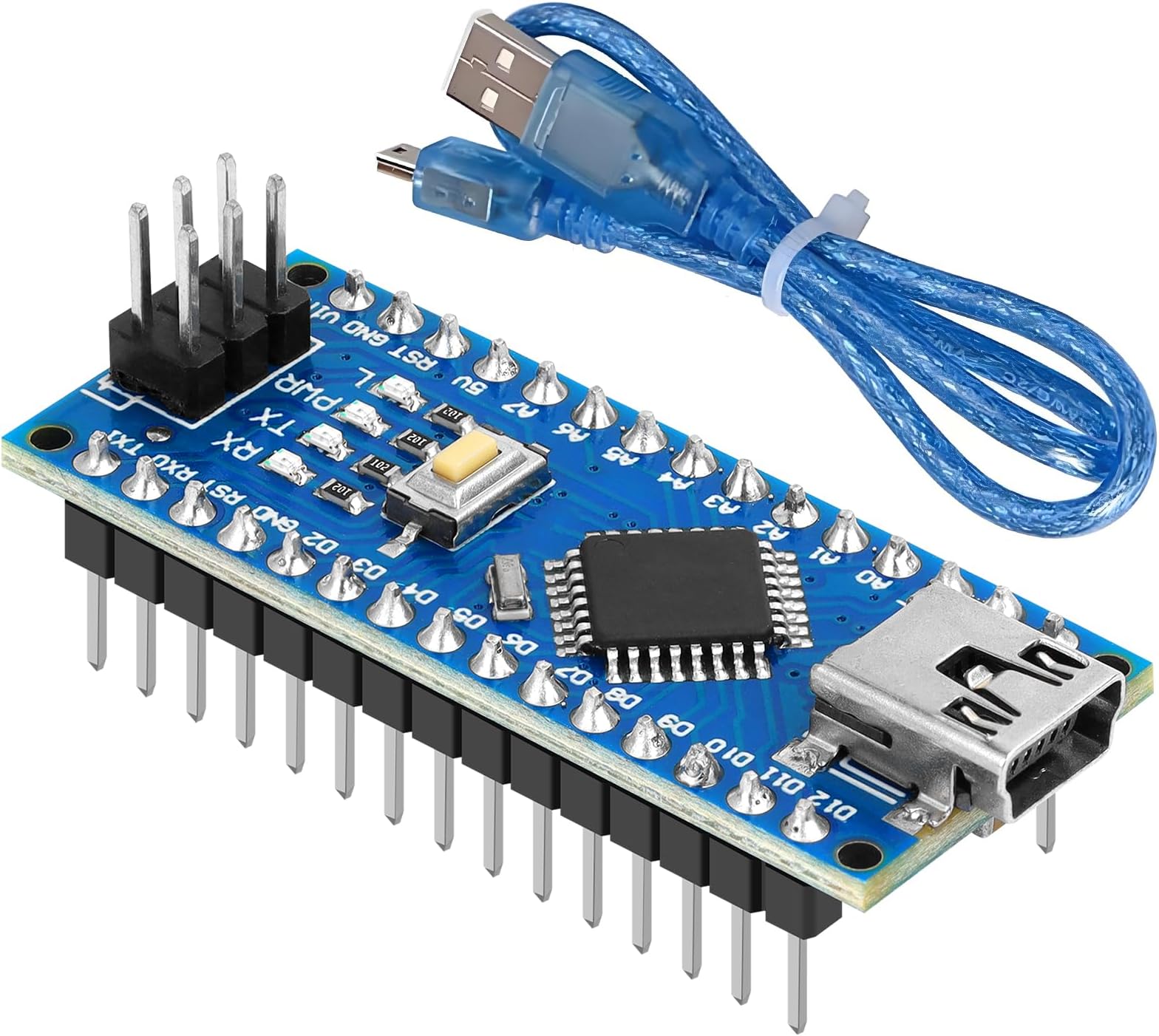
🔧 Tiny Board, Massive Possibilities — Don’t Get Left Behind!
The MakerFocus Mini Nano V3.0 is a compact, breadboard-friendly microcontroller board powered by the ATmega328P chip, featuring 14 digital I/O pins (6 PWM), 8 analog inputs, and a 16 MHz clock speed. It supports multiple power inputs (USB, 7-12V unregulated, or 5V regulated) with automatic source selection. Preloaded with a bootloader and including a USB cable, it’s fully compatible with Arduino IDE for seamless project development, making it an ideal choice for professionals and makers seeking a versatile, space-saving solution.
| ASIN | B00NLAMS9C |
| Best Sellers Rank | #6,912 in Computers ( See Top 100 in Computers ) #70 in Single-Board Computers |
| Item model number | G418920056 |
| Manufacturer | Elisona |
| Product Dimensions | 4.5 x 1.9 x 1.7 cm; 18.14 g |
W**I
Perfect and works as intended
the board comes as expected with the CH340 chip and works as intended, it is an incredible microcontroller board that packs a lot of power into a small and affordable package. Versatile, easy to use, and perfect for many projects, from robotics and automation to IoT and home automation. Overall, I highly recommend this product to anyone looking for a reliable and versatile microcontroller board.
A**.
Good
P**T
I ordered two of these, one from each of two suppliers, in China and Hong Kong. 2nd to arrive had better soldering quality. Both seem to function well for the tests I did. Both use the CH340 chip for USB to TTL which seems to load a sketch faster than the TDI232. On the humorous side, the 1st was identified as "watch tools" for customs, which seems to be a common practice with other small electronic parts I've ordered. It's less costly than putting together a functioning microcontroller with a chip & associated parts(which was my second choice) so if it works, to me it's worth a rating of 5.
J**S
I did most of my prototyping for a project on a recently purchased name brand Arduino Nano, but I wanted to buy a less expensive controller for the final project due to its physical location and potential to be damaged or stolen. This is the first non-name brand board I've used and had no issues with it. It is important to note that this board uses the old bootloader, so my first few attempts to write the project failed with a slightly unclear communication error from the IDE before the lightbulb went off in my head and I realized the bootloader needed to be switched (my name brand board uses the new bootloader). After that trivial stumbling block, I've had absolutely no issues with this board and will likely buy another for a future project.
M**H
All items in the order arrived in goos time, well packaged and all with their own cable too. All work as well.
B**N
Works great! It's definitely a great buy at this price. Using the ATmega328p datasheet, you can figure out the correct pin-outs for ports if you don't want to use the arduino library. Though, I'm curious if the pins still have the full functionality of the ATmega328p. i.e. Can I still use SPI? If anyone knows, please hit me up. I have some grandiose ideas for this tiny guy if I can. EDIT: SPI does work. Takes some playing around to figure out the pins. They are as follows: Pin D10 = PB2 = SS Pin D11 = PB3 = MOSI Pin D12 = PB4 = MISO Pin D13 = PB5 = SCLK
ترست بايلوت
منذ 3 أسابيع
منذ 4 أيام