Some deliveries may take a little longer than usual due to regional shipping conditions.

قم بتنزيل التطبيق


معلومات عنا
حقوق الطبع والنشر © 2024 Desertcart Holdings Limited
قم بتنزيل التطبيق
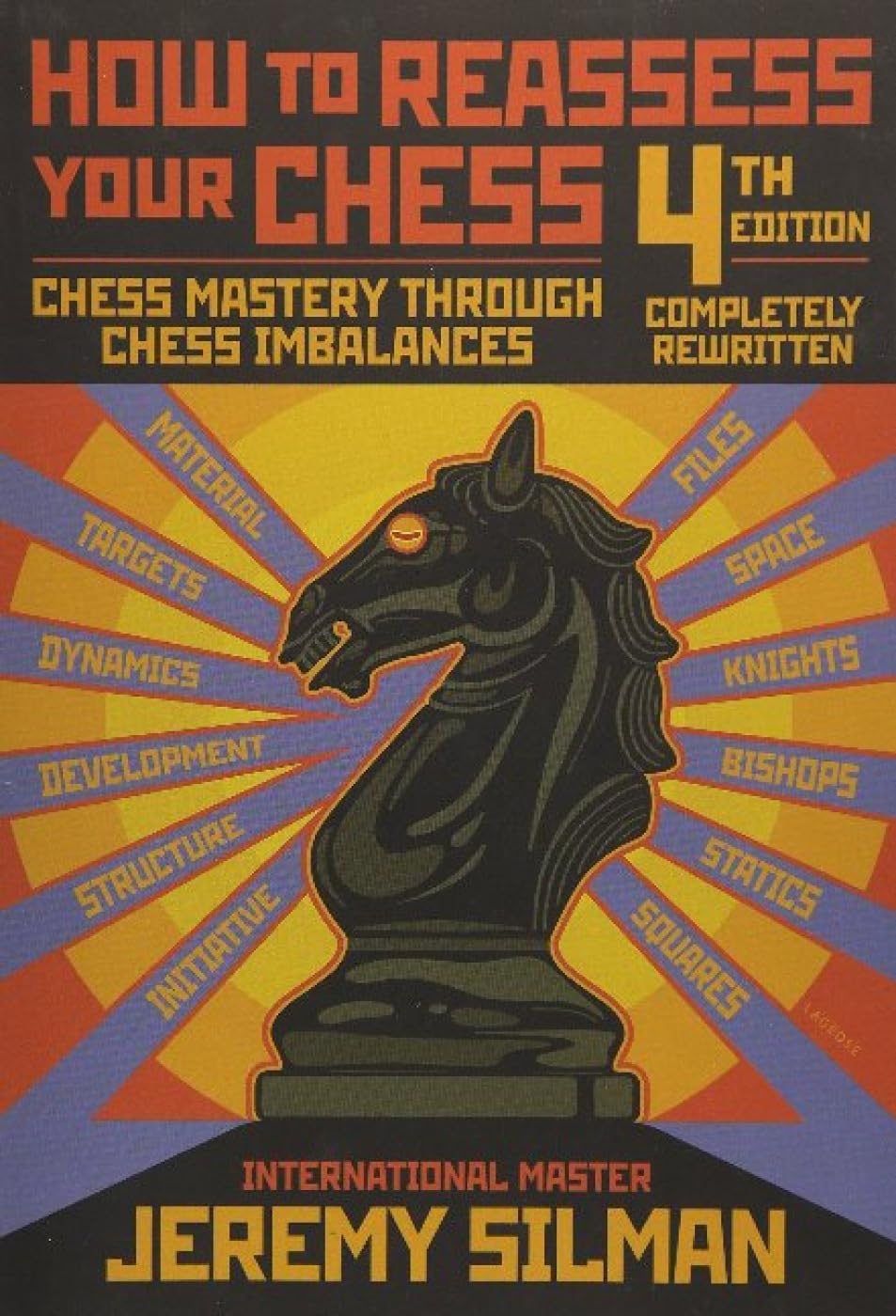
♟️ Elevate your chess IQ — Outsmart, Outplay, Outlast!
How to Reassess Your Chess by Jeremy Silman is a bestselling, highly rated guide focused on mastering positional chess through understanding imbalances. Ideal for players rated 1400-2100, it offers clear, practical lessons, real-game examples, and interactive tests to transform your strategic thinking and boost your competitive edge.
| Best Sellers Rank | #18,198 in Books ( See Top 100 in Books ) #10 in Chess (Books) |
| Customer Reviews | 4.7 4.7 out of 5 stars (1,493) |
| Dimensions | 6.75 x 1.25 x 9.75 inches |
| Edition | 4th |
| ISBN-10 | 1890085138 |
| ISBN-13 | 978-1890085131 |
| Item Weight | 2.6 pounds |
| Language | English |
| Print length | 658 pages |
| Publication date | October 15, 2010 |
| Publisher | Siles Pr |
S**Y
The Positional Chess Bible
First a little about me: I'm in the 1400 to 1600 range. I haven't read the original HTRYC, so I can't make any comparisons. I've spent over 100 hours going over this book from cover to cover. Second a little about the book: The book is on positional chess (aka the middle game). It's not about tactics or checkmates. It's about how to recognize key differences in your position versus your opponent's position and how to develop a strategy to make your position dominate your opponents. The book is divided into sections of positional principles (example: recognizing targets and fixing them as permanent a weakness). For each principle, several games are given as an example that highlights the particular topic. Silman's commentary is excellent. Often he analyzes a position by talking only about ideas without even mentioning particular moves. This was the most helpful part of the book for me. He also gives a lot of variations many of which I quickly glossed over. As a reader, you will have to study the book based on your level. At my level, the ideas are the most important, and I shouldn't get sidetracked with variations. At the end of each chapter/positional idea, there are test questions. At first, I thought the problems were really hard, and I couldn't solve many of them. But going over the answers which are explained very well both with ideas and variations was really helpful. Towards the end of the book, I was able to at least partially solve almost every problem even the ones that were rated 2000+. I didn't always find the correct moves, or the correct move orders, but I was able to evaluate the position and understand the ideas behind the position (what should be white's strategy and what should be black's strategy and what moves make sense for both sides). Sometimes I picked the 2nd best move, etc but I was still picking good moves that addressed the positional battle! Style: The writing and style are excellent. Silman uses conversational English and a coaching tone that is pleasant. It's obvious that he's passionate about positional chess and really enjoys teaching it. The book is fun to read. The book itself is large with a nice amount of white space that makes it easy to study. Is it for you? Silman recommends this book for 1400 to 2100 range. I can't speak for the upper range, but the book was definitely challenging and beneficial for me. I'm going to completely re-read it in about six months and go over each lesson much more slowly and carefully (100hrs is sprinting through this book). If aren't already very comfortable with the basics, tactics, and checkmate patterns, pick up a few books on tactics and solve 1000 tactical problems first and then get this book. Like me, you won't get everything the first time through, but you will learn to properly think about chess and develop a strategy. Could it be better? I would have benefited from more analysis in English (instead of an explanation in algebriac notation) and discussion of ideas, and fewer variations, but realize this is coming from my level. Higher level readers will need the variations. Ideas must be tactically sound and if you are analyzing master games, you must demonstrate that the idea is tactically sound. As it stands, this book is a masterpiece which I will re-read many times.
A**T
Exponential Improvement!
I have always enjoyed chess, but always played casually. I always intended to get better and study more to improve my game. Like many chess students with good intentions I found my chess library growing around me but my game staying stagnant. As the chess book pile grew so did my intentions. I would open a book and work through the lessons never quite understanding why none of it would stick. I found some improvement through Mr. Silmans 3rd edition works and began trying to use his "thinking techniques." As I practiced the lessons on imbalances my game moved from move by move chess into the realm of seeing the board more clearly and understanding what was going on in a position. Fast forward to this year... I was asked to help out with a National level High School chess program who had won a championship in 2002, 2004, 2006, and 2007. It was time for me to get serious. I noticed at this time that Mr. Silman had released a 4th edition of his work and saw on the cover that it stated that it was completely rewritten. I purchased the book and decided this was the moment I was going to work as hard as ever learning the game. Too much intro and too little review, yes I know, I know... *Cough* ok so away we go... What an amazing book!! Never in all my studies has chess been so clearly presented in a way that any student could find joy and advancement. Mr. Silman has taken his old "techniques" and found a way, not only to teach them, but to stick them solidly in your brain. During my games I can actually hear comments made in this book. Lessons are open in such a wonderful way. This rework is not only an improvement on his old information it is a teacher with years and years of implementing his lessons and over time finding just the way to make a student retain them. Since my studies began this year, I have joined a chess club as an unrated amature and beaten some solid players. Part 4 of the book Psychological Meanderings is worth the cost of this book alone. The week I studied this section I went into chess club with the lessons on stepping beyond fear, mental breakdown, macho chess, etc, fresh on my mind and found myself across the board from a 1927 rated player. Suddenly Mr. Silman was in my head saying, "Rating nothing... This guy is rubbish... Just play the board..." So off we went... I sit here looking down at the score sheet with this unrated amature winning in 25 moves. To hear the 1927 look up red faced and say, "That... That was just too much pressure... I... I just messed up." and to smile up and say, "Not bad for a beginner, huh?" was awesome. Throughout the game Mr. Silman's lessons were always coming to my mind. My mind was working through comments like, "Look if I can stop that pawn I can make that Bishop useless," His Knight would love that square I better take it away now and that would be two very useless pieces," and my favorite, "Wow if I sack that exchange look what it does for my position and look how active my pieces become!" Some other important aspects of this book are the following... Current examples for every lesson from every rating category, examples have the opening sequence of moves listed up to the important lesson for the position so you can actually see how the players arrived to the moment you are learning from, at the end of every chapter is a set of tests similar to what the workbook was to 3rd edition with answers fully explained in the back of the book (almost like having an additional book within a book), many examples per lesson to help get the material to stick, a well thought out order to the delivery of material. So much more... I guess the best way to sum this book up is, to me, "this one is it," the chess book every learning chess student should own. Mr. Silman is a fabulous teacher with a wonderful delivery. Thank you, Mr. Silman for taking the time to give us this work. With every good review should come a section of things wrong with the book I suppose, but as I sit here I struggle to find them. It is what it claims to be and nothing more. You will not get an opening repetoire, an endgame diatribe, or a brilliant tactical guide, but what you will get is an understanding of what a position is calling for and where your plan should be centered toward, where the weaknesses are on both sides of the board, a thinking method to know what advantages and disadvantages matter at this very moment, and a clear picture to help you see through what Josh Waitzkin calls the "black and white jungle." Enjoy!
L**R
Jeremy Silmans Buch ist ein ebenso gelungener wie umfangreicher Versuch dem typischen Vereinsspieler wichtige Aspekte des Mittelspiels anhand des Konzepts der 'Imbalances' nahe zu bringen. 'Imbalances' sind für Silman all das, was die Position des einen Spielers von der des anderen unterscheidet. Das kann ein Kampf zwischen guten und schlechtem Läufer oder zwischen Läufer und Springer sein, ebenso wie der Gegensatz von Bauernschwächen auf der einen Seite zu dynamischem Potential auf der anderen Seite. Nach einer kurzen Übersicht über die verschiedenen Typen von 'Imbalances' widmet er den wichtigsten dann eigene Kapitel, wo er sie detailliert und mit vielen Partiebeispielen erläutert. Das Spektrum an Partien reicht hier vom Anfänger-Internetblitz bis zum Turnierkampf zwischen Magnus Carlsen und Wladimir Kramnik. Zudem gibt es ein Kapitel namens 'Psychological Meanderings', das illustriert, wie uns oft unsere Psyche daran hindert, gutes Schach zu spielen, obwohl wir es eigentlich könnten, und wie man diese Hindernisse überwinden kann. Alle Kapitel sind mit Übungen versehen, zu denen es ausführliche Lösungen gibt. Silman benutzt einen sehr informellen Stil und schreckt selbst in Analysen nicht vor Slang-Ausdrücken zurück. Ob man's mag, ist natürlich Geschmackssache, und durch einen prägnanteren Stil wäre das Buch vielleicht auch etwas kürzer geworden. Andererseits gewinnt das Buch dadurch an Unterhaltungswert und vor allem spricht es den Menschen an, der Schach spielt, und spricht nicht nur über Schach im luftleeren Raum. Man merkt Silman bei jeder Seite, die er schreibt, seine langjährige Praxis als Trainer an. Ohne viele andere Schachbücher dieser Ausrichtung zu kennen, will ich insgesamt dem Buch von Silman eine klare Empfehlung aussprechen. Schachspielern ab 2000 DZW mag vieles etwas zu elementar sein, aber jeder (jetzt noch) schwächere Spieler wird hier Vieles lernen können.
M**N
About 30 years ago I reached the heady heights of around 1950, but haven’t played since. My ten year old son started playing competitively just over a year ago and is now playing at around 1450. I am only playing against him so it is difficult to gauge my current level, but I believe I may only be around 1550. Definitely not good enough to teach my son without any aids. After reading reviews, I bought this book a couple of months ago. I believe this book is pitched at the right level for both of us. We both find it difficult. And very thought provoking. I feel that my son could not go through this book by himself, primarily because it is too long and the language used is definitely not pitched at a 10 year old (even though he has a great vocabulary and general knowledge for his age). I find the writing interesting but feel I need to skip over some of it when I am going through this with my son. So far, we are only on about page 65, but I can see that this has definitely changed the way we are thinking about positional imbalances, knights and bishops (being all we have covered so far). I certainly wish I had this knowledge/way of thinking 30 years ago and it is now hard to imagine how I could have been a 1950 without knowing what I have learnt from this book over the last couple of months. This is certainly going to be a long slog and I doubt we will get through it in much under a year, but if we do get through it I feel it will have totally changed our game. It will also be a springboard for later books. I find it difficult to give this five stars as we have only just started it, but so far it has been great so have reluctantly done so. Looking forwards to the rest of the book.
E**O
Excelente os capítulos iniciais com a introdução de lances com cavalos e bispos. Cheguei a estudar no momento até os testes aplicando a abertura e a ação dos cavalos logo após o sumário de revisão e Knights testa _ por sinal excelente o nível de exercícios. Se o início agradou imagino o que ainda será estudado.
E**N
Discipline and Concentration and Perseverance.
N**G
Silman est très pédagogue (idem dans son manuel des finales) et enseigne des concepts stratégiques qui permettent au joueur de club de progresser dans bien des domaines.
ترست بايلوت
منذ أسبوعين
منذ يومين