


🔋 Power up smarter, recharge longer, and never miss a beat!
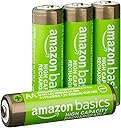
Amazon Basics 4-Pack Rechargeable AA NiMH Batteries deliver a robust 2400 mAh capacity with up to 400 recharge cycles. Pre-charged and low self-discharge, they maintain 50% capacity after one year and offer a shelf life of up to 5 years. Ideal for high-drain devices, these 1.2V batteries combine reliability, sustainability, and convenience for the modern professional’s tech arsenal.


| ASIN | B00HZV9TGS |
| Antenna Location | High power or continuous drain devices like game controllers, wireless devices, toys, and more |
| Battery Capacity | 2400 |
| Battery Cell Composition | NiMH |
| Battery Cell Type | NiMH |
| Best Sellers Rank | #7,495 in Our Brands ( See Top 100 in Our Brands ) #1,085 in AA Batteries |
| Brand | Amazon Basics |
| Customer Reviews | 4.4 out of 5 stars 21,695 Reviews |
| Global Trade Identification Number | 00841710105124 |
| Item Dimensions | 0.56 x 0.56 x 1.97 inches |
| Item Weight | 27.22 g |
| Manufacturer | Amazon |
| Model Name | Rechargeable batteries |
| Model Number | HR-3UTHA-AMZN (4P) |
| Number of Batteries | 4 AA batteries required. |
| Recommended Uses For Product | High power or continuous drain devices like game controllers, wireless devices, toys, and more |
| Reusability | Rechargeable |
| UPC | 841710105124 |
| Unit Count | 4 Count |
| Voltage | 1.2 volts |
D**D
Great for wireless gaming mouse
I use these in a Logitech G700s wireless mouse, which only takes a single AA sized battery. These batteries have massively better longevity than the "eniTime" battery it shipped with, even when the stock battery was brand new. Between gaming on the highest power consumption settings and casual use, I have never, ever gone through more than two batteries in a day. I don't usually game for more than six hours in a day though, so your mileage may vary. But I'd think a single four pack would be sufficient for any gamer, as you can always charge the spares while gaming. I don't even plug my mouse into the charging cable when not in use anymore because I only have to charge a pair of batteries once every other day. I even tried these in an old digital camera that was quite power hungry. You could get maybe 5 exposures out of a standard Duracell alkaline battery. I made it through 20 shots in that camera with these batteries before I got bored and quit. I wouldn't recommend Ni-Mh batteries in a camera if it'll take a lithium cell, but these did work in a pinch.
N**R
Identical to the Sanyo eneloop XX - at much lower cost
I have previously tested the AmazonBasics AA Pre-Charged Rechargeable Batteries (in white wrappers), and concluded that they are just rebranded Sanyo eneloop AA Batteries . When I first heard about the new AmazonBasics High-Capacity Pre-Charged Rechargeable Batteries , my immediate suspicion is that those are rebranded Sanyo eneloop XX batteries . That's why I purchased this product for testing, just to satisfy my own curiosity. I measured a set of those AmazonBasics 'high-capacity' AA batteries, using my La Crosse BC1000 Battery Charger/Analyzer . Here are my findings: - Right out of the box, the average remaining charge was 1204mAh, or 48% of the rated 2500mAh capacity. Date code on them says '2014-02', but just like other eneloop batteries, they were not fully charged when then left factory. - After just one recharge/discharge cycle, the average capacity jumped to 2547mAh. - After another two more recharge/discharge cycles, the average capacity settled at 2555mAh. The spread is very tight between 2510 and 2610mAh, which indicates good quality control. The above behavior is nearly identical to that of the Sanyo XX cell, which I have previously tested in 2011. Mechanically, the AmazonBasics high-capacity cells appear identical to the Sanyo XX. Refer to the photo I uploaded to the 'Customer Images' section, and you will see that they have exactly the same shape for positive terminals, same texture on their wrappers, even down to the same 'vent hole' design. I should note that the Duracell 'Ion Core' AA Rechargeable Batteries also have identical electrical and mechanical characteristic as the Sanyo XX and AmazonBasics High-Capacity batteries. The Duracell batteries are marketed as just 2400mAh, even though they were tested to be over 2500mAh in capacity. I believe this is done for price differentiation purpose. Bottom Line: As of this writing, you can get an 8-pack of Amazon High-Capacity AA batteries for less cost than a 4-pack of eneloop XX batteries. So obviously the AmazonBasics version is a great bargain. My advice is to grab them - before Amazon gets greedy and jacks up the price. One important note: The AmazonBasic High-Capacity AA (or Sanyo XX, or Duracell Ion Core) is fatter than a normal-capacity NiMH AA cell, which itself is fatter than a typical alkaline AA cell. So it may not fit if your appliance has extremely tight battery compartment. [Update on Dec 10, 2014] Long-term self-discharge data: Tested one pair of AmazonBasics AA high-capacity batteries after 5 months in storage. The average remaining charge is 2175mAh, or 85% of the original capacity. This is even better than my previous 5-month test result for Sanyo XX batteries which showed 2040mAh, or 78% of original capacity.
C**D
Happy with the purchase so far.
Bought these for use in my digital camera since the Canon rechargeables finally gave up the ghost after about five years of light to moderate use. Was hesitant about using an Amazon generic brand, since I didn't want to damage the camera, but so far, so good. Someone had asked whether you could use these right out of the package. Yes, you can and I did; they worked fine. The batteries seem slightly heavier than the Canon brand, but not in any significant way. I always take the batteries out of the camera when not in use, and this definitely seemed to extend the life of my previous Canon ones. Will be relying on the new ones for vacation photos on my bucket list trip to Machu Picchu later this year.
D**R
A Very, Very Good Rechargeable Battery ..
A good bit of time has passed to evaluate these batteries in my ROKU 3 (also purchased on Amazon). In the past, I've noted with alkaline batteries in the ROKU that one battery ALWAYS depletes before the other, usually by 1/4 volt. Having seen that issue several times, usually having had to replace only one of the two batteries, I'm concluding the ROKU remote keeps is continuously connected to the ROKU as long as the ROKU is turned on. This would explain why one battery frequently requires replacing. I have noted this phenomenon with two different ROKU remotes. I don't know who makes these batteries but they are very high quality. Also noted is they are about 25% heavier than the Everedy rechargeables at your local retailer. My weight scale is not digital but is still good enough to discern a difference in marking. These batteries (yes I can test voltage) seem to have significant density and hold a charge quite well for an extended period of time. The discharge time for batteries (battery) in the ROKU is over two months. Also, if I remember correctly, a fresh charge will loose only about 40% of it's charge over the course of a year. Battery technology is constantly changing (see batteryuniversity.com for a true education). To that end, these batteries far surpass the junk sold in retail stores. I've not found a 2400 mAh NiMh anywhere at the price point offered by Amazon. Also, please be advised that most rechargeable batteries do NOT (performance-based) match up to their mAh rating. So I'm not sure how these little guys rate, but I can say ... for the price point they outperform the smaller charge-capacity types found in the average retail establishment selling 1400 to 2300 (rare) rechargeables. In my opinion, they are almost worthless as they need constant recharging. These batteries are new-generation batteries and users will appreciate having them. A couple of additional notes: new generation NiMh rechargeables should not be fully discharged or anywhere close to that. The battery lifetime cycle can be extended greatly by recharging only after about half-use; there is no battery memory problem. The newer NiMh batteries are more subject to "stress" so deep discharge shortens their life. Same for cell phones .. don't deep discharge the battery. The battery lasts longer if you recharge after one or two bars. So anyway, these are really good rechargeables at the price point. I can't imagine better unless you want to put 8 or 10 hours into customer reviews and scouring best prices. Better to go for Kentucky Fried Chicken and a half bottle of Chardonnay with your wife out by the stream on a soft Autumn afternoon. Yes? And don't forget the music powered by the batteries that don't fail, even if you forgot to recharge them. :-)
A**R
Evaluate and break in Amazon batteries not made in Japan before rushing to judgement
I am fairly new to rechargeables and the first thing that jumps out at me is the cost of any brand with a decent reputation. To me that means spending the money up front to get "smart" charging and evaluation equipment. That reduces the chances of ruining new batteries, or worse yet ruining the devices being powered. I purchased a Nitecore and and an Opus bt-c3100. Quickly I learned to categorize 18650 batteries into three rough groups: total scam batteries that should never be used because they barely put out any power and cannot hold a charge. From reviews I have seen that means 400 mah hours or so from an 18650. The second category is the extremely common "knock-offs" that copy, sometimes well and many times poorly, popular top performers and sell for much less. These from what I have seen and from my own observations can have power output of anywhere from 30% to 80% or so of the power of the tried and true name brand. I thought long and hard before purchasing the newest Amazon AA nimh high-capacity knowing they were not made in the Panasonic eneloop factory and were fairly pricey. But I felt it would be a good learning experience and for now I only power led flashlights and solar walkway lights. The first thing I did was read the directions!!!!!!! and it said charge at 250 mah. The nitecore only goes down to 300 mah so I first discharged them on the Opus at 200 mah for 12 hours 20 minutes to 1-1.1 volts and all four(sorry no statistically significant data from this guy) gave off a measured 2440 or more mah , a little better than the rating of 2400 mah. Charging at 200 mah took 13 hours and the cells absorbed 2570 mah , well above the 2400 rating. I will leave the discharge and power analysis to the electrical engineers with the knowledge, expertise, and software. I will give my layman's opinion that initially these four Amazon high-capacity nimh batteries are not fakes stuffed with sand and appear more promising to deliver good service than the knock-offs that cut critical corners to keep the price down. I recommend to other newbies to take the time to charge all rechargeables conservatively with a smart charger. It is probably a good idea to first discharge and recharge these batteries even though mine came fully charged. You would not take your brand new car and redline the engine out of the showroom. Show you Amazon batteries the same care. Maybe Amazon should offer detailed break-in instructions with all new rechargeable batteries. That could help eliminate many of the bad experiences and bad reviews.
P**.
Best rechargeable batteries out there for the money. They keep their charge very well.
These are definitely the best rechargeable batteries you can't for the price. I've bought Sanyo Eneloops in the past and although they work well, you can't beat the price you get with these batteries. They definitely keep their charge even if you don't use them for a long time. I haven't had the opportunity to fully test out how much they retain their charge but at least in my experience, I've gone months without using a fully charged battery and it worked great when I finally needed them. The batteries come in a brown box package which is great. No more dealing with the hard to open packages. If you need batteries and can wait a day to get them, these are a no brainer. I have an Amazon locker near me and I was able to do same day shipping for free with my prime membership. Other note: I've purchased these batteries at least 3 times. One time they sent AAA batteries instead but Amazon was quick in correcting this error.
S**O
Excellent choice for wireless microphone use, with a little common sense.
I have been really impressed with the AmazonBasics Hi-Cap AA Rechargables. I am an audio professional of 10+ years and have been using these with our wireless microphones (Shure, AKG, Sennheiser) for about 6 years now. Like all rechargeable batteries these will not last forever so if you use them for critical items, like microphones during an event, you should replace then before they get to their end of serviceable life. So how long do they last? Well i can't tell you how long they go till they die because I'm not willing to take it that far and sacrifice my events reliability but here is our use case. We have 2-3, 1.5 hour long church services every week and a few events during the year that are 2 services per day for a week and I average about 2 years of use before I feel compelled to replace these but keep in mind that doesn't mean i NEED to replace them. I just can't allow them to get to the point of failure. That's around 580 uses before i replace them! I can tell you I've run the calculations on this vs disposable batteries and the numbers aren't even close. We save around $1200 a year at my church alone using these and that includes the replacement after 2 years. After using these for so long I feel confident and comfortable recommending these for our type of application. You won't regret it if you are smart about how long you keep them in service and you will love the money saved from disposables or other "pro" rechargeable batteries!
D**A
Better than regular batteries, but serious quailty issues.
I have bought 4 of these batteries and used them in remotes to hobbies to controllers to toys. In low energy usage items they are okay, however when the demands are higher they tend to fail.... regularly. The batteries performance is not matched from battery to battery. So if you put 2 in a device, 1 may work fine while the other gives out earlier than it should and you throw them on the charger again. To compensate for the issue I bought more batteries so I could have multiple charged replacements on hand at any given moment. Unfortunately over a year several of them would no longer take a charge. The Amazon Basics batteries work..... and if you want a rechargeable battery at a cheaper price, they will fit the bill so long as the demands are not too high for a long period of time. You can get a couple months of good performance out of them before you start seeing diminished output and lifespan. NOTE: I decided to purchase Eneloop Pro rechargeable batteries as replacements instead and they have performed much better. They cost more but I feel the dollar to value is definitely there.
A**.
Su precio bajo
Las pilas AA recargables de Amazon Basics son una opción práctica y económica para dispositivos de uso frecuente, como controles remotos, cámaras, linternas, y juguetes. Con una capacidad de alrededor de 2000 mAh (para el modelo estándar), ofrecen una buena duración de carga, y se destacan por su ciclo de vida prolongado, soportando cientos de recargas sin una pérdida significativa de rendimiento. Ventajas: • Buena capacidad: Tienen una capacidad respetable que proporciona una duración adecuada para la mayoría de los dispositivos. • Ciclos de recarga: Su durabilidad permite recargarlas hasta 1000 veces. • Costo: Son asequibles y tienen una buena relación calidad-precio en comparación con otras marcas. • Bajo efecto memoria: Mantienen su carga incluso cuando no se usan por periodos prolongados. Desventajas: • Pérdida de carga en almacenamiento: Aunque son de baja autodescarga, después de varios meses sin uso pueden perder parte de su capacidad. • Tiempo de carga: Dependiendo del cargador, pueden tardar varias horas en recargarse completamente. En resumen, son una opción sólida para quienes buscan pilas AA recargables confiables y de bajo costo para dispositivos de uso diario.
D**I
As described
As described
S**E
Batterie Amazon
Rapporto qualità/prezzo molto buono. Consigliate.
J**R
Baterías de Buena Calidad y Durabilidad
Las pilas AA recargables Amazon Basics han sido una excelente compra. Vienen precargadas, lo que es muy conveniente, ya que puedo usarlas de inmediato sin necesidad de cargarlas previamente. Tienen una buena capacidad y durabilidad, lo que las hace perfectas para dispositivos que consumen más energía, como controles remotos, cámaras y otros aparatos electrónicos. En cuanto al rendimiento, las pilas funcionan muy bien. Ofrecen una duración más que adecuada en comparación con otras pilas recargables que he probado, y la recarga también es eficiente. El hecho de que sean de NiMH (Níquel-Metal Hidruro) las hace una opción ecológica y económica, ya que puedo reutilizarlas muchas veces sin perder eficiencia. Lo único que me impide darles las 5 estrellas es el aspecto estético; aunque esto no afecta el rendimiento, las pilas tienen un diseño sencillo que puede no ser tan atractivo visualmente, pero para mí, lo importante es la funcionalidad y durabilidad, y en eso cumplen con creces. En resumen, las pilas recargables Amazon Basics son una excelente opción por su relación calidad-precio. Si buscas una alternativa confiable y económica a las pilas desechables, estas son una opción recomendada.
F**E
Zählen zu den guten, aber nicht zu den besten Akkus
Meine Bewertung bezieht sich auf die Variante AA. Es handelt sich hierbei um die ehemals schwarze Variante der AmazonBasics. Inzwischen hat Amazon das Design umgestellt. Sie sind nun grau. Ich sage es schon mal vorab: Ich habe beide Modelle hier und konnte bis auf das Design keinerlei Unterschiede feststellen. Es handelt sich hierbei um Nickel-Metallhydrid-Akkus mit geringer Selbstentladung und einer Nennspannung von 1,2 V. Sie kommen vorgeladen und können sofort verwendet werden. Das Gegenstück bei den Eneloop wird Pro genannt. Das liegt daran, dass diese Akkus eine sehr hohe Kapazität garantieren. Was man sich mit einer erhöhten Kapazität erkauft, ist eine geringere Anzahl an Ladezyklen. Amazon gibt 500 Ladezyklen an. Zudem ist die Selbstentladung etwas höher als bei der normalen Variante. Bei Geräten, die einen geringen Stromverbrauch haben und lange ungenutzt herumliegen, lohnen sich die Akkus daher eher nicht. Ich setze sie im Haus dort ein, wo sie schnell entladen werden (in Spielecontrollern, teilweise in Taschenlampen, Kameras etc.). Hier spielen die Akkus ihre Stärken aus. Sie verkraften (auch bedingt durch die höhere Kapazität) etwas höhere Entladungsströme als die Standardvariante der AmazonBasics. Die AmazonBasics sind aktuell noch Made in Japan. Ebenso sind es bisher noch alle meine Eneloop Pro. Es ist aber vermehrt zu hören, dass die Produktion bei den Eneloops auch auf China umgestellt wird. Alternativen für diese Akkus kann ich auch benennen. Das größte schwedische Möbelhaus verkauft eine sehr ähnliche Variante unter dem Namen LADDA (ebenfalls Made in Japan). In den Discountern werden teilweise auch solche Akkus vertrieben. Der zweitgrößte deutsche Discounter verkauft beispielsweise Akkus der Marke TRONIC. Diese Akkus habe ich alle getestet. Da es hier aber primär um die AmazonBasics geht, möchte ich erst einmal auf diese eingehen. Sie versprechen mindestens 2400 mAh und typischerweise bis zu 2500 mAh. Dies liegt daran, dass es eben Streuungen in der Produktion gibt. Am besten testet man die Kapazität bei sehr geringen Entladeströmen, da die Akkus hier am meisten leisten können. Dies habe ich daher mit 200 mA gemacht (der Entladevorgang dauert dann über 12 Stunden) und die Akkus bis 0,9 V entladen (zu Beginn haben sie etwa 1,4 V Ruhespannung). Was dann im Ergebnis herauskommt, ist im Prinzip die maximale Kapazität. Bei noch geringeren Entladeströmen wären vielleicht ein paar mAh mehr drin, aber das ist nicht wirklich relevant. Gemessen habe ich bei 200 mA für vier Akkus folgende Werte: 2479 mAh 2409 mAh 2472 mAh 2476 mAh Die Werte gefallen mir eigentlich sehr gut. Drei von vier Akkus erreichen fast die maximale Kapazität. Das garantierte Minimum von Amazon wird deutlich überschritten. Die Spannung liegt im Prinzip bis kurz vor Ende des Ladevorgangs deutlich über der Nennspannung von 1,2 V. Leider hat ein Akku eine ungewöhnliche Schwäche gezeigt und ist zum Ende hin stark in der Spannung abgesackt. Kann passieren, aber hier hätte ich mir ein besseres Ergebnis gewünscht. Wenn man die Akkus zusammen verwendet, kann dies zum Problem werden. Bei etwas höherer Entladung mit 1000 mA zeigen die vier Akkus folgende Ergebnisse: 2413 mAh 2409 mAh 2405 mAh 2392 mAh Man sieht, dass die abgegebene Kapazität aufgrund des höheren Entladestroms schon deutlich zurückgeht. Wenigstens sind die Entladekurven in diesem Fall sehr ähnlich. Einen Ausreißer wie beim ersten Test gab es nicht. Ein kurzes Zwischenfazit: Die Akkus leisten unter geringer Belastung definitiv das, was von Amazon versprochen wird beziehungsweise überschreiten es sogar deutlich. Aber auch andere Akkus sind gut, deshalb habe ich wie eingangs erwähnt einen Vergleich durchgeführt. Auf dem Datenblatt stehen also folgende Werte: Eneloop Pro: 2500 mAh LADDA: 2450 mAh AmazonBasics: 2500 mAh TRONIC: 2300 mAh Bei kleinen Entladeströmen zeigen alle Akkus keine Schwächen. Deshalb habe ich sie direkt mit 2 A getestet, was schon eine vergleichsweise hohe Entladung ist. Die besten Akkus haben einen sehr geringen Innenwiderstand und können dann auch problemlos bei hohen Entladungsströmen noch eine ordentliche Kapazität bereitstellen. Entladen habe ich bis 0,9 V und dabei jeweils vier Zellen getestet. Die Ergebnisse sind Mittelwerte: Eneloop Pro: 2446 mAh LADDA: 2432 mAh AmazonBasics: 2398 mAh TRONIC: 2299 mAh Alle Akkus liefern ordentliche Ergebnisse. Ich füge dieser Rezension Grafiken an, in der man jeweils die gemittelte Entladekurve der AmazonBasics im Vergleich zur Konkurrenz sieht. Die AmazonBasics liefern mehr Kapazität als die Discounter-Akkus und das auch bei höherer Spannung. Im Vergleich zu den anderen beiden Kandidaten (LADDA und Eneloop Pro) schwächeln sie aber etwas. Gerade die Eneloop Pro liefern dann doch noch mal ein gutes Stück mehr Kapazität und das zudem bei stets höherer Spannung. Dieser Trend setzt sich dann bei noch höheren Entladeströmen fort. Wenn ich alle vier Akkus mit 4 oder sogar 5 A belaste (was dann wirklich sehr hoch ist), brechen die Discounter-Akkus dann gänzlich in der Spannung ein. Die Eneloop Pro halten die Nennspannung von 1,2 V hingegen am längsten. Das ist insbesondere dann wichtig, wenn man die Akkus zum Beispiel im Kamerablitz verwenden möchte. Als Geheimtipp und gute Alternative sind sicherlich noch die Fujitsu X zu nennen. Diese habe ich im Test bewusst ausgeklammert, da sie den Eneloop Pro in nichts nachstehen. Die Entladekurven sind dort quasi identisch. Meine abschließende Empfehlung: Discounter-Akkus haben ordentliche Entladekurven, aber zeigen hier schon leichte Schwächen. Bei diesen habe ich auch langfristig bisher keine guten Erfahrungen gemacht, gerade was die Selbstentladung und die langfristige Haltbarkeit angeht. Man macht hier sicherlich erstmal ein Schnäppchen, aber wird es früher oder später eventuell bereuen. Bei den anderen Testkandidaten kann man zugreifen. Die AmazonBasics sind gute Akkus, aber gehören nicht zu den besten. Sie sind aber recht häufig im Angebot und die Unterschiede zu den besten Akkus sind so gering, dass man im Angebot bedenkenlos zuschlagen kann. Noch eine abschließende Bemerkung: Bitte nehmen Sie die höhere Kapazität dieser Variante nicht zum Anlass, diese als bessere Alternative zu den normalen AmazonBasics zu sehen. Es sind eben, wie eingangs erwähnt, auch Nachteile vorhanden: weniger Ladezyklen, etwas höhere Selbstentladung. Kaufen Sie diese Akkus nur gezielt für energiehungrige Geräte. Ich hoffe, dass ich mit dieser Rezension etwas weiterhelfen konnte. Falls Sie Fragen zu diesen Akkus haben, können Sie gerne einen Kommentar hinterlassen. Die Grafiken müssen eventuell separat in einem neuen Tab geöffnet werden, damit sie gut leserlich sind.
Trustpilot
3 weeks ago
1 month ago