Buy anything from 5,000+ international stores. One checkout price. No surprise fees. Join 2M+ shoppers on Desertcart.
Desertcart purchases this item on your behalf and handles shipping, customs, and support to OMAN.
🔋 Power your lifestyle with longevity and lightness — never settle for less!
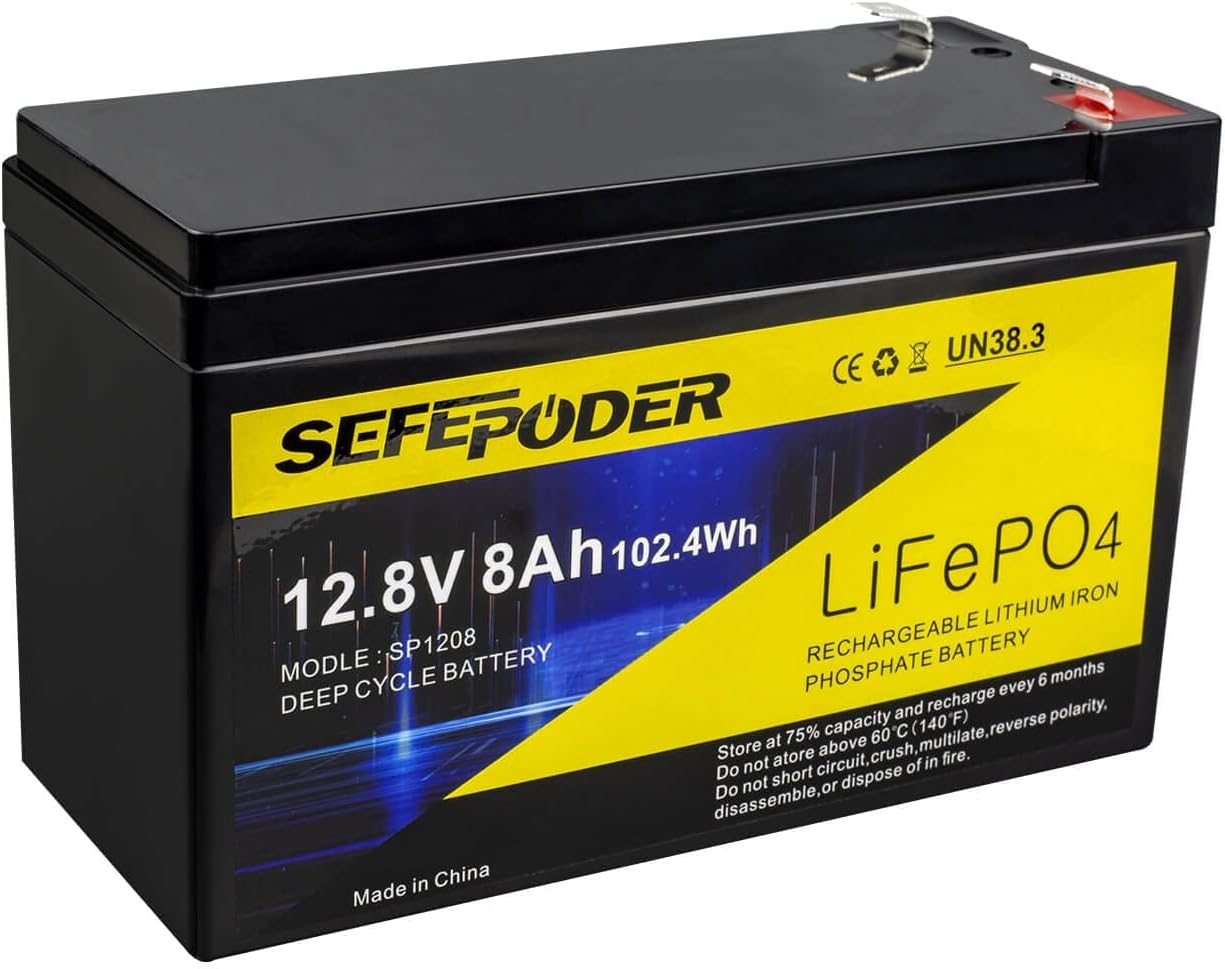
The SEFEPODER 12V 8Ah LiFePO4 Lithium Deep Cycle Battery offers over 2000 recharge cycles, built-in 8A continuous discharge with 3C pulse capability, and weighs just one-third of comparable lead-acid batteries. Featuring an integrated Battery Management System (BMS) for enhanced safety and reliability, it’s designed for diverse applications including solar and wind power setups, recreational vehicles, lighting, and more. This rechargeable battery combines cutting-edge lithium technology with eco-conscious design, making it the smart choice for professionals seeking durable, lightweight, and versatile power solutions.


| ASIN | B09M2ZLQ8N |
| Amperage | 8 Amps |
| Antenna Location | Power wheel, Fish finder,12V router,Lighting, Camping,Ride on toys |
| Battery Capacity | 8 Amp Hours |
| Battery Cell Composition | Lithium Ion |
| Battery Cell Type | Lithium Ion |
| Battery Weight | 1000 Grams |
| Best Sellers Rank | #59,389 in Health & Household ( See Top 100 in Health & Household ) #117 in 12V Batteries |
| Brand | SEFEPODER |
| Built-In Media | 1*12V 8Ah LiFePO4 Battery |
| Customer Reviews | 4.4 out of 5 stars 704 Reviews |
| Item Dimensions | 5.94 x 2.36 x 3.7 inches |
| Manufacturer | SEFEPODER |
| Model Name | SP1208 |
| Model Number | SP1208 |
| Number of Batteries | 1 Lithium Ion batteries required. (included) |
| Recommended Uses For Product | Power wheel, Fish finder,12V router,Lighting, Camping,Ride on toys |
| Reusability | Rechargeable |
| Unit Count | 1.0 Count |
| Voltage | 12.8 Volts |
| Warranty Description | 1 Year |
H**B
Cheap battery extender.
I extended my 12v car battery with this. Despite the comments not to do it, a battery balancer costs anywhere upward of $200. So I made my own for under $10. I may be wrong in some assumptions, and am still testing my setup, and will update in the future on more actual results. In the meantime, I theorize: My lead acid car battery charges at 14.4V (11A), and discharges at 12.65V (800CCA). This battery charges at 14.4V (4A), and discharges at 13.35V (8A, 20A burst). I connected this lithium battery in series to a 100W 3ohms resistor. Then I connected the lithium battery + resistor unit to the lead acid battery in parallel. After about 60 minutes of driving, the resistor was slightly warmed up, but still less than hand temperature, and the Li battery was cold to the touch, and both batteries balanced out. The resistor was added to lower the balancing currents between both batteries, and to protect the Li battery from over charge currents. From online: A lead acid battery has an internal resistance average of 20 mOhms. A lithium battery has an internal resistance average of 100 mOhms. Assuming this information is correct, and if my charging circuit provides 10A charging current (which is on the high side), the lithium battery without resistor should charge at approx 1.6A, while the lead acid should charge at 8.666A. So a resistor may not even be necessary for active (being charged) operation. More than likely the actual charge current is lower, as the charging circuit may only provide 5 to 6A of charge current,thus lowering the lithium charge current below the nominal. With added 3 ohms resistor, the 14.4 charge voltage drops to 13.75V, as a further protection against shorts, overcharges and over discharges. The main 2 reasons I have the resistor installed is: 1- High current draw protection (eg: when the battery wants to start the engine, and a voltage sag happens). 2- Battery balancing when charger circuit disconnects. Number 2 is the main reason, as the 14.4V charge voltage over the lead acid battery (13.75V on the Li battery side after resistor) disconnects, and the Lead acid battery drops to its nominal 12.50V, and the lithium to its 13.5V. That's a 1V differential between both, and with only 20mOhms on resistance, the current draw of the Lithium trying to charge the Lead acid would be about 50 amps (ignoring wiring resistances, probably closer to 25A in real life), well above the max the Li can handle. With the 3 Ohms resistor, the current draw from the Li to the Lead Acid should be closer to 0.333mA. A better suited 1Ohms resistor should allow for balancing currents of 1A. The resistor isn't the most efficient way to limit current, but considering that it was a very cheap solution, IMHO it was the best solution for an average Joe. The cons of this resistor setup, is that after shutting off the car, both batteries will self balance for a time, until the 13.50V voltage of the Li battery, matches the 12.50V of the Lead acid. Consider that the car also has parasitic losses, drawing energy from the lithium battery first; and all that balancing and parasitic losses all go through the resistor which basically converts roughly 1 to 3W in heat loss.... The second con, is that when the starter motor is engaged, drawing up to 200A (400A peak); and the Lead acid voltage drops to 10V, the Li battery will be taxed heavily. It can provide a max of 20A for a duration of 3 seconds. If we presume that the LeadAcid has an internal resistance of 10mOhms, and the Li+3Ohms resistor is 3100mOhms, then about 200A/3110*3100= 199.35A goes to the Lead Acid, and about 0.64A goes to the Lithium (provided both batteries leveled out to 12.50V). If the engine is started immediately after it was shut down (start-stop system at a red light), the Li still has 13.5V, making the amp rating ~0.83A The rest of the power gets drawn from the lead acid. For that reason, I believe a 1 or 0.5 ohm resistor may be more suited for regular cars allowing higher balancing, and higher starter discharge currents. In my case however, I own a hybrid car, and the starter only gets power from the 12V battery, if the high voltage battery is depleted. So it basically never draws power from the 12v. So the Li battery is merely there to extend the life of the 12V battery, and take care of the parasitic losses of the car (sensors, remote unlock, etc...). So far it also seems to work just fine. I'll update when something goes wrong or fails.
K**F
Great replacement option.
Great batteries so far. I bought them to replace the AGM batteries in a mobility scooter. I'm saving a lot of weight and getting more power for about $3 more per battery. Well worth the price!
A**R
Good batteries
I had one of the batteries die and the scooter was not starting. I replaced the batteries with these two and they have been lasting the whole day and working great so far
L**.
Batteries seem to work great. I'll see how long these last.
Ordered on the 9th, delivered on the 11th, installed and charged evening of 11th. On the 12th, 6 miles on the mobility scooter. The original batteries were lead-acid, 12 ah. They had been replaced with lead-acid, 15 ah. 5.5 miles max, and only lasted 4 months. (Manufacture said 9 miles with 12 ah) Now, after 6 miles, the battery level indicator has not started to go down. I don't know what the range is with these batteries yet. I know it's in excess of 6 miles. I'll have to update this when I find out. A little concerned about ithium battery fires, but I'm not going to replace batteries every 4 months.
A**Z
Great buy
Great batteries for the money!! Light but powerful.
N**I
Won't hold a charge for long
Bought these for a disabled friend's scooter. It fully charged, and he was able to use it for about an hour. The next time he went to use it, it was dead. Even after trying to charge again, they won't charge. To be fully honest, I cannot be sure it is the batteries. Could be something else, although I can't find anything else wrong.
L**O
Go go scooter
I bought two sets of these batteries to replace the batteries in my go go scooter. They went right into my small battery box and had to move the wires a little bit to get them to work. I used a lithium ion charger to charge them and they work great. Very strong. I have had no issues but I have only had them for a few weeks. You have to purchase a lithium ion charger for these to work. I bought bigger ones for my big battery box and they work great also.
P**G
Longer lasting than regular lead acid batteries
Perfect replacement for heavier batteries
Trustpilot
3 weeks ago
3 weeks ago