Some deliveries may take a little longer than usual due to regional shipping conditions.

قم بتنزيل التطبيق


معلومات عنا
حقوق الطبع والنشر © 2024 Desertcart Holdings Limited
قم بتنزيل التطبيق
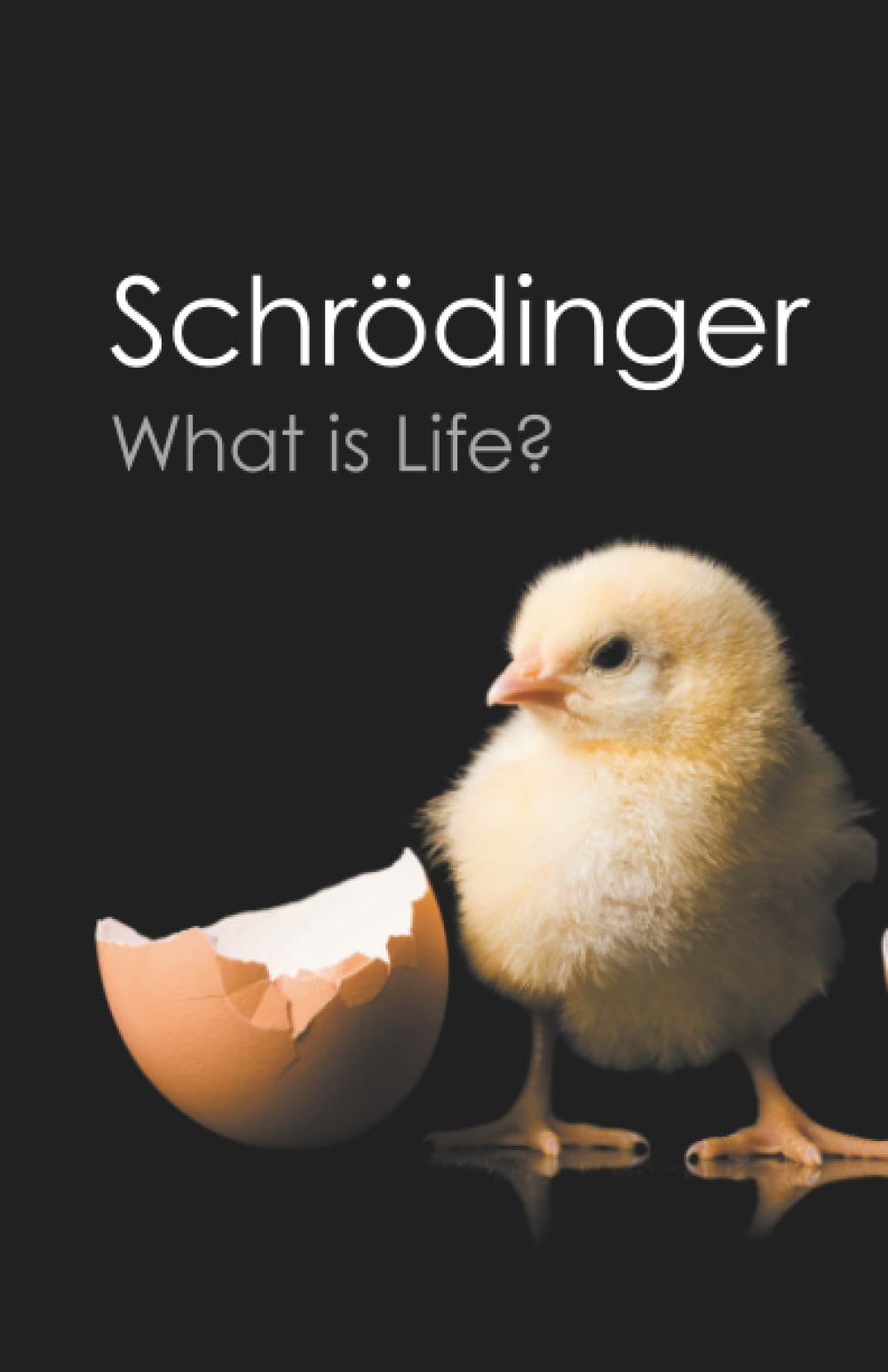
⚛️ Unlock the quantum secrets of life — don’t miss the book that shaped modern science!
‘What is Life?’ by Erwin Schrödinger is a seminal work that bridges physics and biology, pioneering the concept of quantum biology and exploring how life defies entropy. This used copy in good condition offers a compact yet profound dive into genetics, consciousness, and the philosophical boundaries of science, backed by high acclaim and enduring influence.
| ASIN | 1107604664 |
| Best Sellers Rank | #28,009 in Books ( See Top 100 in Books ) #16 in Religious Studies (Books) #196 in Inspirational Spirituality (Books) #2,275 in Biographies (Books) |
| Customer Reviews | 4.6 4.6 out of 5 stars (1,153) |
| Dimensions | 5.5 x 0.45 x 8.5 inches |
| Edition | Reprint |
| ISBN-10 | 1107683653 |
| ISBN-13 | 978-1107604667 |
| Item Weight | 9.9 ounces |
| Language | English |
| Part of series | Canto |
| Print length | 184 pages |
| Publication date | March 26, 2012 |
| Publisher | Cambridge University Press |
D**H
FROM DISORDER TO ORDER
CLEARLY IMPORTANT In his 1991 foreword Roger Penrose ranks the small booklet of Schrödinger 'among the most influential of scientific writings in this century' and mentions --besides others-- especially J.B.S.Haldane and Francis Cricks as examples of young men, which have been strongly influenced by Schrödinger's ideas, and Ernst Peter Fischer gives 1987 in his introduction of a German translation of Schrödinger's booklet a good readable historical account of the situation before Schrödinger's lectures 1943 and the development since that time until1987. This places Schrödinger very well in the center of the encounter between modern physics and biology. HOW IS LIFE POSSIBLE AGAINST ENTROPY? The many reviewers until now have pointed out many important aspects related to this book. Thus I have not to repeat this here. My personal interest in this booklet was caused by my own questions while trying to understand the phenomenon of life against the background of physics. Being myself a computer scientist and philosopher as well I was puzzled by the fact that even at the beginning of the 21.century 'everyday knowledge' regarding the question why life is possible in a physical world is not easily available (and you will not find any answer to this question in the modern books about genetics with 900 and more pages!). While I have learned from Boltzmann something about entropy and the general tendency of a physical system to increase the entropy, this introduced the riddle why living organisms seem to work 'against' entropy by increasing order. FROM DISORDER TO ORDER In his lectures Schrödinger follows the nice strategy to show why and how genetic information is rooted in the chromosome molecules and illustrates then step by step why such a molecule from the point of physics seems to be highly exceptional. While the general laws of thermodynamic would lend a structure to dissolve it's bindings to increase the atomistic disorder (and thereby to increase entropy) the biological systems demonstrate a strong 'resistance' instead; they keep the order of the molecules and even more they are able to increase these orders steadily. Not only generates disorder here order, but order even generates more order (p.80). From the point of physics does this mean that biological systems are 'consuming' order (which can be called 'negative entropy' or 'free entropy' or the like) from their environment (a concept which leads back to Josiah Willard Gibbs). Thus to 'keep order' in the physical universe presupposes the availability of already existing order (some form of energy). NON-PHYSICAL LAWS Schrödinger recognizes that the 'explanation' with the consumption of available order (energy, neg-entropy...) gives a minimal account of the phenomenon of biological systems, but this does not 'really explain', why there is this tendency of a continuous increase of order against disorder. The availability of order (energy) is necessary, but not sufficient to explain these phenomena. While Schrödinger allowed himself the question whether physics has to accept 'new kinds of laws' --'non-physical' or 'super-physical' (p.80)-- he did not answer this question. I do not know any text who gives a sufficient answer to this question. I remember some texts from Eigen and Prigogine years ago which dealt with the special principle of biological systems, but I have to read these again whether they really offered some useful arguments. This story is not finished at all...... I recommend everybody to read this wonderful booklet of Schrödinger.
A**R
Into the mind of a giant
I had already savoured a bit of Schrodinger’s writing as I came to this book after first reading Ken Wilber’s “Quantum Questions” and Samuel Guo’s “Quantum Memoirs”. (Reader alert, by the way: the “Autobiographical Sketches” section is identical in both this book and the one edited by Guo.) I still derived great pleasure in reading this book as it gave me a more considered and sustained perspective into what one of the giants of science thought about how science influenced and shaped our lives and also science’s limitations. Schrodinger does not claim to have answers to all the questions he raises (although the title of this collection may sound unintentionally grandiose. Moreover, even if Schrodinger had all the answers, it is a good bet that some would have been “falsified” - as is the nature of science - over the last sixty or seventy years since this collection was first published). On more than one occasion, Schrodinger refers also to his limitations in subjects other than quantum physics and apologises for “the dilettante character of [his] summary.” None the less, his knowledge of biology and issues in neuroscience and philosophy as expressed in this collection are so deep, one feels that there is no need for such contrition. Schrodinger begins “What is Life” by trying to use Newtonian physics to explain chromosomes, life’s road maps. Such an attempt is effective to some extent as chromosomes comprise of millions of atoms (thus forming a single substantial entity) and the laws of classical physics are able to a large extent explain the behaviour of objects at such a macro level. However, it is now well-known that classical laws hit some restrictions when we try to describe events at an atomic level. Schrodinger feels that this is where quantum physics could be applied to explain how genetics works. He equates, for instance, genetic mutations to quantum jumps. Schrodinger contends furthermore that organisms use quantum mechanical effects to combat entropy by continually drawing “negative entropy” from their environment. This is another case where Schrodinger’s arguments here would turn out to be so prescient, as this book laid also the foundations of quantum biology. While “What is Life” touches only incidentally upon such mystical questions as the limitations of science in explaining life and its purpose, “Mind and Matter” deals with such issues in much more depth. Schrodinger covers here a whole gamut of related questions such as the theory of evolution and its philosophical underpinnings, how consciousness and the mind arise, why we feel the need to believe and the place of God in a scientific world-view. Schrodinger argues that as science is circumscribed by the parameters of space-time, it is not adequate to explain the mind as the “mind is always now. There is really no before and after for mind.” You suspect that he would certainly not have subscribed to a functional theory of the mind.
P**O
Great book.
J**E
With today’s rapid developments in molecular biology and the increasing possibilities in biotech Engineering some basic knowledge of genetics seems to be more and more important. Although the DNA helix was not discovered at the time Schrödinger‘s lecture covers the very fundaments of our modern days understanding of genetics. For today’s reader it may connect the dots or, what may be more important, it can offer insight into a way of thinking about the subject.
P**.
What is life story was to good.
P**O
What Is Life? es el trabajo de divulgación más famoso de Erwin Schrödinger. Se trata de un libro corto, pero de valor incalculable, en el que el físico especula sobre algunas de las características que distinguen a la materia viva de aquella a la que consideramos inerte. Escrito en la primera mitad del siglo pasado, muchos de los conceptos manejados por Schrödinger han sido esclarecidos en la actualidad, y algunos incluso, desmentidos, sin embargo, la claridad de pensamiento del autor se sobrepone siempre a sus limitaciones tanto temporales como de formación (ya que las investigaciones dedicadas a generar conocimientos sobre aspectos como la naturaleza del proceso hereditario y la búsqueda de la molécula maestra de la herencia eran llevadas a cabo, principalmente, por biólogos y bioquímicos, de manera que Schrödinger aportó a estos temas desde su particular punto de vista de físico de partículas); sus ideas son sólidas y la mayoría ciertas, para sorpresa de muchos biólogos de la época. El libro comienza con una explicación breve pero concisa sobre la naturaleza estadística de la física: las llamadas leyes siempre son obedecidas en nuestra experiencia porque la posibilidad de que algo distinto suceda se acerca cada vez más a cero conforme más átomos participen en el fenómeno. Schrödinger especula sobre la naturaleza posiblemente molecular de un gen (una deducción absolutamente brillante tomando en cuenta la poca información que tenía) y mediante algunos cálculos (se podría decir que hechos "a ciegas") determina el probable número máximo de átomos involucrados en su estructura. Un número muy bajo como para sentirse cómodo lo lleva a invocar el extraño mundo de la teoría cuántica, cuyas leyes le permiten explicar la "permanencia" de los genes, no sin antes exponernos al principal generador de variación entre los organismos y mecanismo por el cual los seres vivos evolucionan: las mutaciones. El capítulo referente a las mutaciones, donde Schrödinger argumenta sobre su posible naturaleza (¿un evento de excitación de escala atómica?), es en mi opinión la mejor parte del libro, ya que las ideas expuestas valen oro. La parte final del texto alude a las posibles implicaciones biológicas y filosóficas derivadas de la inclusión de un modelo cuántico en el campo del estudio de la vida; esta parte final dista del brío del resto del libro, pero concluye con seguridad y optimismo un texto que ya es considerado clásico por la mayoría de los científicos y divulgadores actuales. Se agradece también la inclusión de uno de los textos compañeros del físico titulado "Mind and Matter", en el cual se discute un tema mucho más elusivo: la naturaleza de lo que llamamos "conciencia". Ambos textos se reproducen en su versión original en inglés, pero el carácter técnico empleado por Schrödinger facilita su posible lectura por hispanohablantes que estén medianamente inmersos en el quehacer científico. La edición que presenta Canto Classics es impecable, y el precio es bajo en comparación con la riqueza del texto que se ofrece. Enormemente recomendado, un clásico de la literatura científica de todos los tiempos.
C**N
Absolutely amazing, as a physicist I would recommend it to any other physicist with a minimum interest in biology
ترست بايلوت
منذ شهر
منذ شهر