
قم بتنزيل التطبيق


معلومات عنا
حقوق الطبع والنشر © 2024 Desertcart Holdings Limited
قم بتنزيل التطبيق
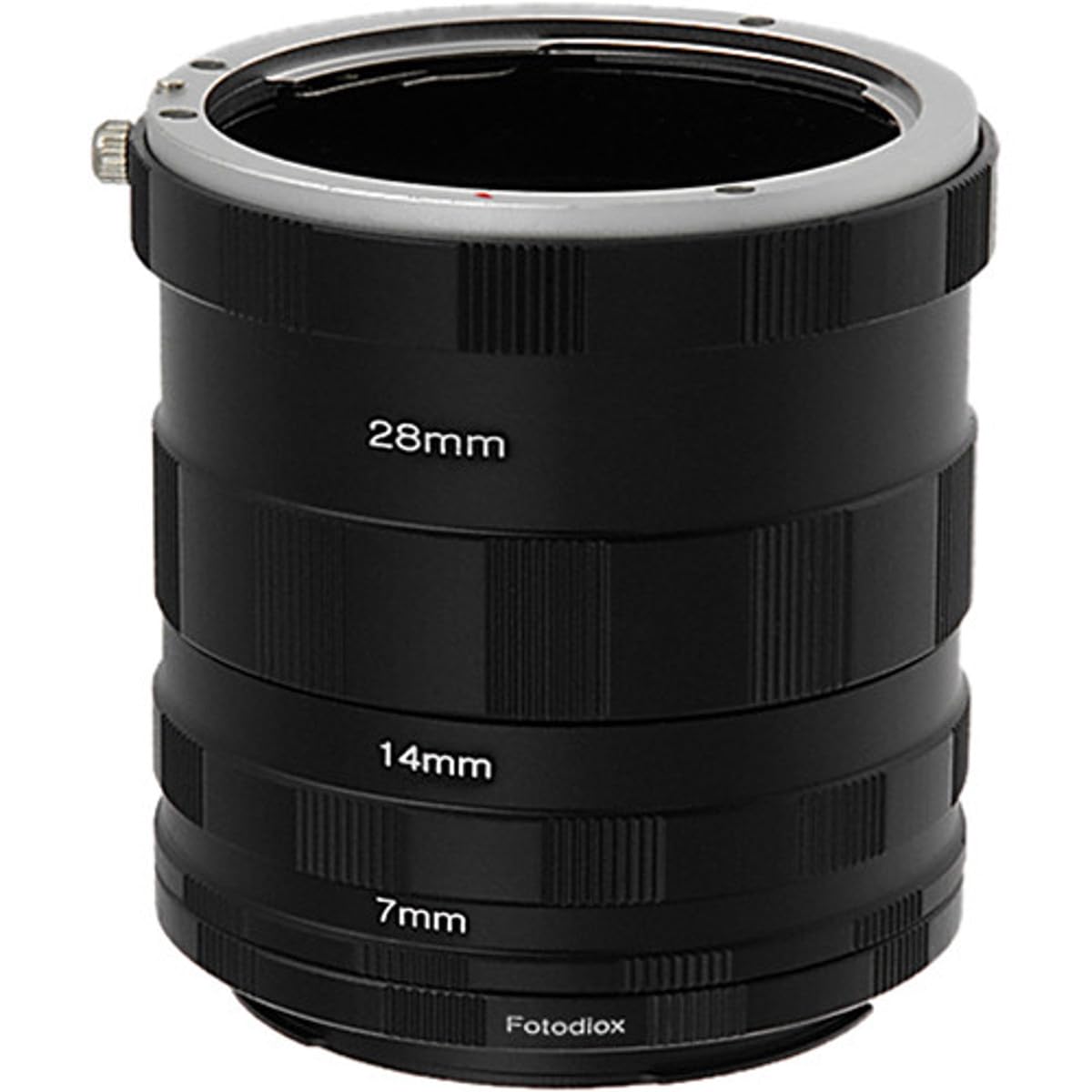
🔍 Elevate your macro game—capture the unseen in stunning detail!
The Fotodiox Macro Extension Tube Set is a durable, all-metal accessory designed for Canon EOS EF/EF-S cameras, enabling extreme close-up photography without compromising optical quality. With multiple tube combinations and a 24-month warranty, it offers versatile, professional-grade macro capabilities.


| ASIN | B003Y60DZO |
| Best Sellers Rank | #8 in Lens Extension Tubes |
| Customer Reviews | 4.1 4.1 out of 5 stars (2,916) |
| Date First Available | August 3, 2010 |
| Item Weight | 3.53 ounces |
| Item model number | EF-MCR |
| Manufacturer | Fotodiox |
| Product Dimensions | 6 x 6 x 6 inches |
T**R
Fantastic item at an even better price!
Five Stars for what you get for such a low price. These tubes are made sturdy and look to hold up for years. For those that gave bad reviews, let me explain a few things. Macro really requires a tripod. For really close-up macro photos, you want tack sharp. For those that said these tubes do not work... it is simply you don't understand the purpose of the tubes, or you do not know how to use your camera outside of Auto, or you do not understand the concept of a focal plane. First of all, there is no way for the tubes to not to work. Their sole purpose is to move your lens further away from your camera. That is it. If your lens attaches to the tubes and your camera attaches to the other end - they WORK! If you can't get a focus, it is operator error. There are many, many instructional videos on Youtube, check them out. B&H, Tony Northrup and Scott Kelby have some really great ones. Secondly, you must understand what you are essentially doing with the tubes. They move your focus plane so a camera lens with a, for example, minimal focus of 3 feet can get much closer. But also understand, you can actually move the focus plane inside the lens itself where you will never get a focus. Those having trouble using these tubes, try using the smallest tube first, by itself. See where your item focuses at ( if using a fixed lens, move back and forth to find where it tries to come into focus). Then as you get use to the smallest tube, move up the line trying each tube. When comfortable, then start adding them together. A lot of the problems I see with these tubes, I would bet, is trying to throw all three tubes on at once and not realizing that your focus plane is probably only an inch from your lens. Also, when using these tubes and getting really close to the object you are photographing, your depth of field will become ridiculously shallow. Watch some instructional videos on 'Focus Stacking' to address this problem. I had to focus stack a nickle because when the nose was in focus, the eyes were not. This isn't the tubes malfunctioning, it is due to the depth of field. I took these tubes out of the box, "Read the instructions" for nothing more than how they attach and how to remove the lens from the adapter. Popped them on my camera as I suggested above, one at a time, and got some fantastic photos. But of course, I studied the process and science of how they work so I wouldn't blame a simple tube for me not getting a picture in focus. And lastly, the complaints on aperture is baffling to me. You would want a wider open for best detail and speed at a close range - a stopped down lens could take a few seconds which you may not have. With an open aperture you will get a very shallow depth of field though but the previously mentioned focus stacking technique takes care of that. But if a different aperture is needed then Canon cameras have a fix, as mentioned previously in other reviews. Simply set your aperture with your lens first, then hold in your depth of field button and remove your lens. Your aperture will stay at whatever you set it on. Then attach your tube(s) and put everything back on your camera. Other camera owners, if you have a similar solution, please post it for the non-Canon users. These are a fantastic item for a great price to get your foot in the door with macro photography. It certainly beats flipping your lens around backwards like I use to do in film days. But just like the first time you took your camera off of Auto... you had to practice, study and shoot to get proficient with the tool. You must do the same with these tubes. Put in the time for practicing and researching, because the result is definitely worth it! Enjoy and good shooting!
R**N
Cheap way to get started with macro photography
I have really enjoyed using these rings to experiment with macro photography. I have been using them on my Canon T4i with the 40mm pancake lens. This combo seemed to work great for me, but it took me a little while to figure out how to use them properly since the rings have no electronic contacts. I'm not sure why people have had problems removing their lenses from the rings. The little metal release switch works great for me. Maybe they didn't realize it was there? I do want to try close up filters one day to see how they compare to these rings.Some notes on usage:* Aperture: Since none of my lenses have manual aperture adjustments, I have to mount my lens directly to the camera body, adjust my aperture, and then remove the lens and mount it on the rings before I begin taking my pictures. This isn't a big deal (once I figured that out), since I don't frequently change my aperture while shooting macro. If you don't configure your aperture before hand, then your lens will just shoot wide open which creates an extremely small depth of field.* Focusing: When I first received the rings, I couldn't see anything through the camera. I didn't realize how close up you need to be to the subject before it comes into focus, and this distance varies based on the focal length of the lens. With my 40mm lens I have to be around an inch from the subject before I can see anything.* STM lenses: I learned that my STM lenses cannot manual focus without being connected directly to the camera. It apparently requires power to focus. My non-STM lenses can manually focus just fine when not attached to the camera. Either way, I have begun the practice of physically moving the camera closer or farther away from the subject to focus instead of trying to adjust the focus on the lens.Once you understand how to use the rings, they aren't too difficult to use. They produce the great macro shots that I wanted at a price that anyone can afford. Overall, I'm please with this purchase.
ترست بايلوت
منذ يوم واحد
منذ 3 أسابيع