
قم بتنزيل التطبيق


معلومات عنا
حقوق الطبع والنشر © 2024 Desertcart Holdings Limited
قم بتنزيل التطبيق


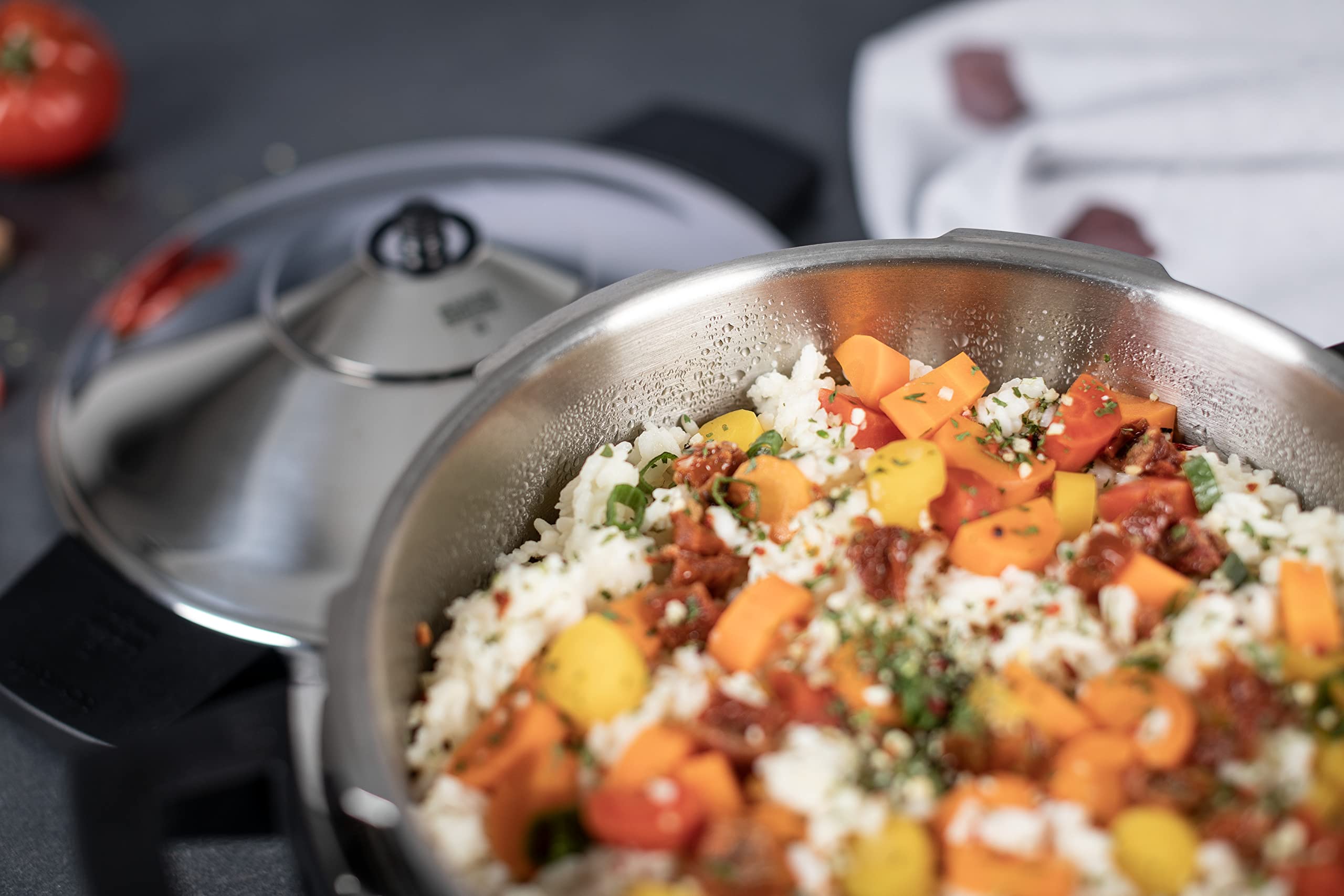


⏳ Cook smarter, not longer — join the pressure cooker revolution!
The Duromatic 6.3-qt pressure cooker by Kuhn Rikon combines Swiss engineering with eco-friendly innovation to reduce cooking time and energy use by up to 70%. Featuring a spring-loaded pressure indicator, quick-release steam knob, and triple safety protections, it ensures precise, safe, and efficient cooking. Its super thermic sandwich base guarantees even heat distribution, while the included steaming trivet expands versatility. Ideal for busy professionals seeking fast, flavorful, and nutrient-rich meals with minimal environmental impact.


| Best Sellers Rank | #217,446 in Kitchen & Dining ( See Top 100 in Kitchen & Dining ) #199 in Pressure Cookers |
| Brand | Kuhn Rikon |
| Capacity | 6 Liters |
| Color | Silver |
| Customer Reviews | 4.2 out of 5 stars 792 Reviews |
| Finish Type | ceramic |
| Material | Stainless steel |
| Product Dimensions | 9.5"D x 13.25"W x 10"H |
N**N
5 Reasons to buy this pot
Summary of reasons to like this pot: 1. Regardless of its being a pressure cooker, the pot itself is high quality; 2. It is easy to clean; 3. It is easy to use; 4. It can make cooking go faster; and 5. It forces flavor into meats and beans better. 1. I was surprised by the quality of the actual pot itself. I cook real food almost every day and have a nice pot set. The aluminum sandwich bottom for this pot is better than any I've tried before. When you're browning meats to enhance flavor and taking them off to brown onions and garlic, it is not uncommon to have scorched spots in the bottom of your pan because of where the flame hits it. The heating on this pan is so even, that the browning effect (where so much flavor is!) is even as well. 2. Because the browning is even, it's easier to clean, plus there are not too many parts to remove and clean. 3. Although it works a little differently than some pressure cookers, bringing items up to temperature first and then putting the lid on is easy. Wait for the first or second red line to appear (as directed in the accompanying cook book), and turn down the flame to very low. You'll get the hang of it quickly. 4. Cooking real food takes time. Chopping onions, vegetables, meat, etc. is a chore and there's way around this fact. Browning in the pan adds flavor, but also prep. time. Where a good pressure cooker can help you is to reduce the time needed to simmer and enhance flavors. Because so little steam escapes from this unit, all the flavors are forced together and intensified. Example: I have a bean recipe I got from a friend I've made regularly since 1998. It's simple, flavorful, has few ingredients, and everyone loves it. I make extra so that I can render the fat out of chorizo to make refried beans, which my kids love even more. If you did not soak the beans the night before, you have to boil them hard for 1 hour, pour the water out, rinse the beans, put them back in, add the other ingredients, and wait 1-1/2 to 2 hours. If you want beans tonight, you need to know in advance and start early. BUT, with this pan you can "pre-soak" in 10 minutes time and have the beans ready, from start to finish, in under 1/2 an hour. Stews, soups, broths all go ridiculously quickly and easily. Even when preparing ingredients to add to a casserole, using this pot makes the entire process shorter. 5. I'll admit, I really don't understand why, but somehow using this pot intensifies flavors. The first time I made the bean recipe I referenced above, both of my kids (14 & 16) like them better--and so did I. Same ingredients, same amount of water (I could have used a lot less), better result. That's been the case for just about every trusted recipe I've cooked in this thing. But in less time. Yep. This item's a little spendy. It's worth it.
D**N
Pressure cookers have come a long way since Denis Papin invented them in 1681.
This is the best pressure cooker I've ever had. The thick, heavy bottom makes it difficult to burn anything. the visual and auditory feedback it gives at the different pressure levels is indispensable. The fact it uses a fraction of the energy to cook things versus a normal pot is just icing on the cake. When the pressure is first building up, and you close the cover, the spring loaded indicator rod in the middle is down all the way. As pressure builds up, you can hear an increasingly loud sound as steam starts to get past it, until you hear a quiet "flump," which is when the pressure has become strong enough to cause the indicator valve to close and this rod to start to protrude from the cover. There is almost no noise at all until you get to the first red ring on the indicator (1/2 atmosphere extra pressure), and at that point there is a subtle change and you can hear an extremely quiet hissing sound. When it reaches the 2nd ring (one atmosphere extra pressure), this hissing increases ever so slightly. If you are going over the pressure level that is indicated by the 2nd ring, the hissing increases in intensity and urgency. as the pressure continues to increase, if you haven't attended to it, the hissing becomes more and more loud as one safety feature after another of the many that this pot has, starts to engage. All this feedback makes it very easy both visually and by sound to know exactly what's going on. That being said, when the pot is in normal operation, it is very quiet, and there is almost no smell of the cooking food at all. There are only tiny occasional very subtle wisps of steam. The vast majority of the steam stays in the pot. One other nice feature of the indicator knob is that you could pull it up before it would have closed by itself, thus closing it and capturing enough steam to allow it to engage immediately. If you press it down, while under pressure, steam rapidly escapes, but immediately stops if you let it go... this is a great feature, because it allows you to smell the food inside, using a puff of steam, that gives you an instant indication on how cooked the food is. This essential feedback saves a lot of time that would have to be spent taking down all the pressure, opening the pot, and seeing what's going on. So when I'm caramelizing bananas, carrots, or apples, a whiff of that puff of steam gives me an instant reading on how much longer I have to go for. Did I mention how fast things cook in the duramatic? many times faster than normal. I have even used this pot to make pasta in about 1-2 minutes, which is really cool. When it's time to depressurize the pot, you can either turn off the heat and let it slowly cool, or you can bring it to the sink and run cold water around the sides, which rapidly relieves the pressure. Again, the terrific indicator is with you all the way, as you can see it going down, and there is a loud sigh of steam that comes out of it when the pressure has become low enough for you to be able to open the pot. By the way, I suggest getting the pot under the turned-on vent hood for opening, because a bunch of steam will come out as you remove the cover. I had taken all of these features for granted, sort of like the way a BMW owner gets to commune with the road in ways a chevy owner could never comprehend, so I bought a supposedly high quality competing brand, just to see how that went. On the competing brand, there was an indication of pressure, but their indicator was not designed to be pulled up and so that really nice feature about allowing it to engage earlier than normal was missing. I had taken that for granted and didn't realize how much I used it... These other pots also consistently burned stuff I had... I cannot say why that is, but I guess the engineers who designed the other one just weren't as good as the ones at Kuhn Rikon.
E**S
Worth the price
We purchased this to replace a decent, less expensive pressure cooker when it started having issues sealing and holding pressure. We had had mixed experiences with the first one and had problems with burning on the bottom, but the convenience of pressure cooking was appealing so we decided to try another one. This pressure cooker has been absolutely wonderful. We have had no problems with things burning, even cooking a lentil and barley veggie stew that ALWAYS burned in the cheaper cooker. I believe the construction of this cooker helps distribute the heat better, and it seems easier to regulate the pressure. My husband loves the quick pressure release, just press the button on the top down and watch the steam come out! Our other one had a quick release too, but this one is more fun to use. It is perfect for cooking for the two of us and having leftovers for lunch. In addition to the dish above, we have made fantastic beef stews (multiple recipes). Just brown the beef in the pressure cooker, then sweat the veggies, add the beef back in with some potatoes and liquid of your choice and pressurize! The meat is flavorful and you can break it up easily with a fork even using the standard stew beef from the market. I was hesitent to spend this much on a pressure cooker since we don't use it that much. But it appears to be the model used on some of the shows on the food network with top notch chefs (the style is pretty distinct, so I am pretty sure it is the same), and we wanted a quality product as I am a little nervous about hot things under pressure. After almost a year there are no problems. It seems like it will last for a long time, and I can't wait to try it out on the induction range we are getting this winter. I would not hesitate to recommend this to anyone looking for a quality pressure cooker. It does have some specific storage recommendations to ensure the gasket remains functional, but as long as you read and follow the easy directions you should have no problems. The recommendations are pretty standard for pressure cookers from what I have seen. UPDATE: Still loving this item! And it works beautifully with the induction range. Btw, induction is absolutely awesome and we highly recommend that too.
P**R
I wish I had found this pressure cooker when I bought my first one
This is my second pressure cooker. My first was a Fagor of the same size that I bought about 10 years ago and finally started to not work well. This one is so much easier to use. It's easy to see when the proper amount of pressure is built up and I like the fact that it isn't as heavy as my first one. This allows it to cool down naturally within a reasonable amount of time. It's also easier to open and close. I can see why people love this brand. I just ordered and received my second Kuhn Rikon cooker, a 4 quart version so that I can cook two things at the same time that require different cooking times. I made perfect brown rice in 20 minutes and it didn't stick to the bottom like it does in my rice cooker. Since it takes about 45 minutes in the rice cooker, I doubt that I'll ever use that appliance again. It really turned out better in the pressure cooker. Update 9/29/08 - I've been using this and the 4 quart Kuhn Rikon pressure cooker at least a couple times a week since I purchased them. With high energy costs these really save a bundle. I find once the pressure is built up, I can turn the heat on my electric stove down just about to simmer to finish the cooking as opposed to having it on medium or high for a much longer period of time. They still look great after all this use and are very easy to clean. I often make my dogs food in them using chicken, vegetables and rice. It cooks so quickly! Update 7/5/12 - I'm still loving this pressure cooker. It's great in the summer when we're trying to keep the house cool because we can turn the stove down so low once the pressure is built up. I also use the pot without the cover for making everything from soups to pasta.
W**T
Overly Sensitive Valve
A finely made Swiss pressure cooker that should last forever. The two stage pressure valve let's one choose between 5.8 and 11.6 psi. A couple of warnings: 1. The lid fits only 1 way. I marked the handles with a small dot to show how the lid lines up with the pot. 2. The valve is too sensitive a part. I did not use the cooker for about a year and the valve leaked. The pot would not come up to pressure. I tightened the nut to the valve but this did not help. I then took the valve off the lid and washed it in case there was food or dried matter in it. There was none. I did notice a little crust of minerals under the valve on the inside of the lid. I washed this off. After re-assembly the pot came up to pressure. I believe 2 things were going on. First there was the crust of minerals from where the hard water evaporated under the valve. The rubber gasket could not seal properly because of this crust. Second, the rubber gasket of the valve was dry when I first used it. By washing the valve the rubber rehydrated a little and became more pliable. In the future I will take this valve apart and scrupulously clean the surfaces on the valve and on the lid where it seats. I will also let it soak in water for a few minutes to let the rubber rehydrate. A warning on tightening the valve. It should be a little more than hand tight but not over tightened or the rubber gasket will deform too much. I hope the above saves someone sending their cooker back for repairs when it is just a finicky valve.
C**2
Not Up To The Swiss Engineering Reputation
I am on my second Rikon. The first I got for my cruising sailboat. They were having some kind of sale and I got a 6 qt for under $100. It worked OK on the alcohol stove. So I got one for my home, same model but with the short handles. This time it was $160. It worked OK until the seal went. Then it was $29.86 for a new seal. Really? For a silicone seal? And the old one wasn't used that much. I won't whine about the lifetime because hey, it might have gotten nicked by a knife during washing in the sink. But I will whine about the absolutely ridiculous pressure control setup. First, It has this weird snap-on cover that *always* gets broken so that it won't snap on securely. I replaced it once and it was extremely overpriced. Then, there is a depression in the top of the lid that collects water, and when the pressure is released, say with a cold water rinse, the thing sucks that outside water back down into the pressure cooker! OMG! Oh, and by the way, the price is now $218. That is with the strong dollar. I'm sorry, but there simply is zero justification for this price. It is definitely solidly made, though the lid material seems kind of thin, but the whole concept has not changed a bit in at least 15 years, and that stupid little cover is still the same. When you can get a nice stainless steel pressure cooker for $100 or less that is the same size and does the work better, why would you pay $218 for this??? Some people are worried about explosions and stuff, but really, the pressure here just isn't that high. These things are overpriced. They are not garbage, but they have some strange problems and it appears the company is just resting on it's laurels and using this as a cash cow, rather than putting money into improving it on a periodic basis. The cost of most of the other decent pressure cookers on the market is about the same as what I have paid in parts so far. Just move on.
L**I
this is a terrible product. I have replaced this with a Fissler ...
Cheap materials, and doesn't seal the vent. It made tons of noise (metal type noise, probably spring?), and also vented steam the entire time, even when not at max pressure. When the vent is not sealed and steam is released, the contents boil. Hard. Kuhn Rikon pressure cookers are supposed to be vent sealing. In my opinion, this is a terrible product. I have replaced this with a Fissler vitaquick, it is better in that it seals the vent, feels heavier, and seems to be of better quality. But again, while the quality is better, it still isn't great. Judging by the reviews I've read of kuhn Rikon, fissler and others, it seems like the newer models are all of much lower quality than their reputations, gained by great quality over many years, predict. I'm keeping the Fissler, but I'm not happy. I know that I'll have to take great care to keep the handle well attached and the euromatic functioning over any amount of time. And for that price... Update: I ordered the German Fissler Vitaquick from Germany on Amazon.de. It was completely different from the made-for-USA Vitaquick that I bought at Bed Bath and Beyond. The quality was much, much better. I kept it (the German version) and am happy with it, but am not happy that Fissler, and possibly Kuhn Rikon, make low-quality products for export to the US.
K**R
LOVE this pressure cooker. Would marry it if I were also a pressure cooker.
This pressure cooker is amazing. Get one. Please! Get one, and you'll never regret it. (And I'm not even paid to say this!) Frankly, I was terrified to use a pressure cooker for years, assuming that of course it would explode and kill me while I was just trying to make soup, and that's why I hesitated to get one until the ripe age of 42. Never mind that people all over the globe have been using them for decades, and never mind that I have an engineering degree...I was scared of them. No longer. This one is easy to use, not very scary, certainly not explosive, and it cooks like a sweet metal dream. I've made my famous chicken stock/soup about 10 times already and it cooks faster and with no loss of water...and the bone broth gels every time now! I've also steamed veggies (trust the manual; if it says broccoli in 4 minutes, don't second guess the book and leave it in for 10, and then end up with green mush, like I did the first time.). And rice. And stew. It's easy to clean, and I use it on an electric stove. At first it took a little playing around; when the pressure got too high I had to move the pot to a cool burner for a few minutes to wait for it to calm down before putting it back on the burner. I hate my electric stove (but that's for another review, I suppose.) But if I - a lifelong pressure-cooker-fearer, can cook with a pressure cooker over and over again on an electric stove, you can too! Seriously, this thing is well made, kind of like a sexy streamlined metal tank. I'm not afraid of it. Give it a try.
ترست بايلوت
منذ 3 أيام
منذ 3 أسابيع