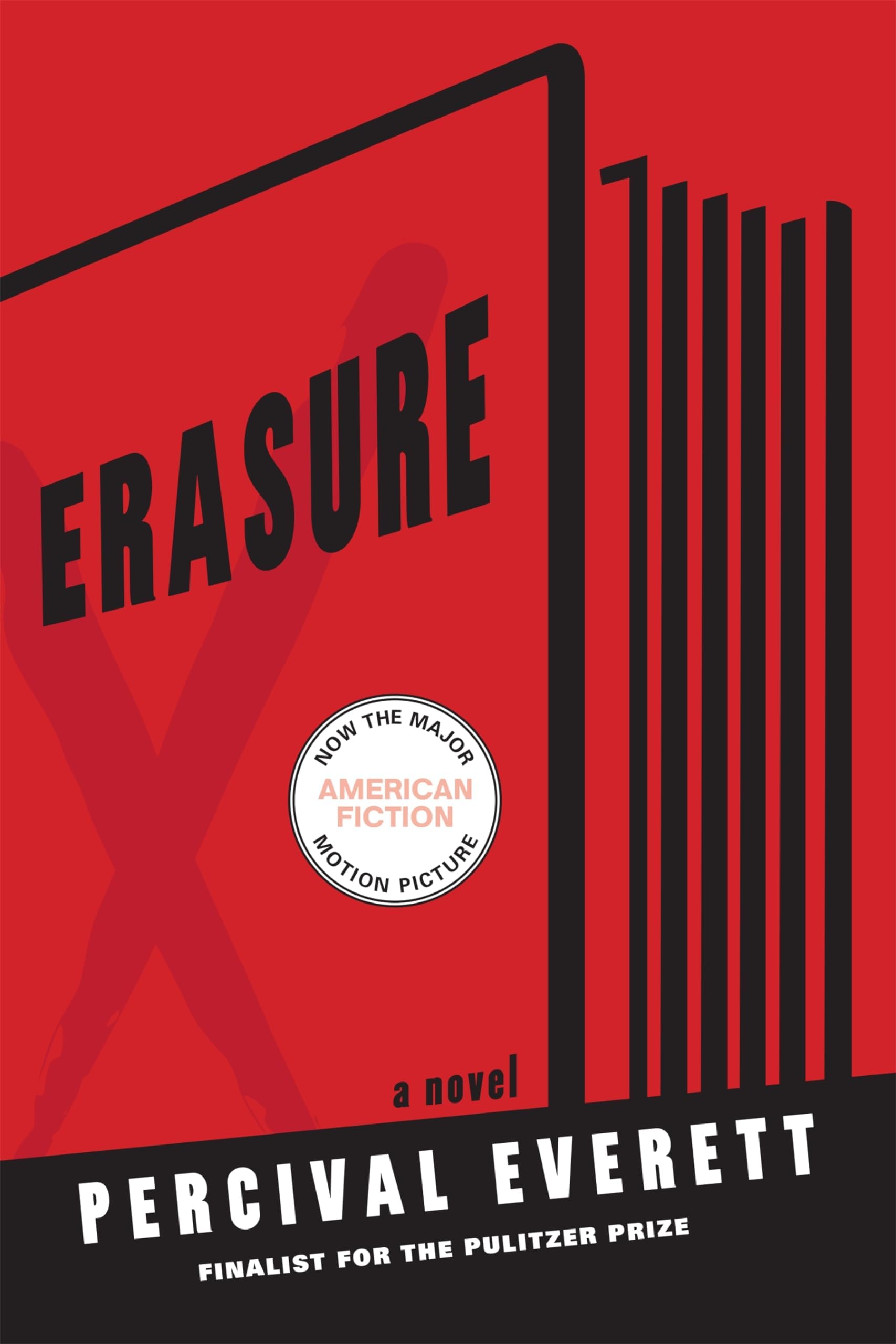
Erasure: A Novel
Product ID: 4893084
🎬Adapted into major film
📚Critically acclaimed satire
🔥Top 250 in Fiction Satire
Desertcart purchases this item on your behalf and handles shipping, customs, and support to OMAN.
📖 Dive into the satire everyone’s talking about — don’t get left behind in literary culture!
Erasure by Percival Everett is a sharp, satirical novel that skewers racial stereotypes and the publishing industry’s narrow definitions of Black literature. Praised for its intellectual depth and biting humor, it inspired the film AMERICAN FICTION and holds a strong position in fiction satire rankings. This used copy is in good condition, perfect for readers craving a provocative, thought-provoking literary experience.
| Best Sellers Rank | #22,565 in Books ( See Top 100 in Books ) #228 in Fiction Satire #889 in Black & African American Literature (Books) |
| Customer Reviews | 4.4 out of 5 stars 4,636 Reviews |
J**X
Powerful satire- a cultural and academic diss
This is probably one of the best pieces of satire that I've read since Catch-22. It's clever, hilarious and VERY unapologetic about its outspoken boldness. I think Percival Everett should be proud of this novel (although this isn't the book that won him a Pulitzer), and I think it should be required reading in somebody's literature class (not sure who's but somebody's). Erasure is a novel about an African-American English literature professor and academic, Thelonius "Monk" Ellison. He was the youngest child in a family of highly educated doctors and he regularly gives speeches and presentations of VERY dense and complicated literary criticism at academic conferences. He has also written several novels (some published) that make references to Greek mythology, fables and other points of reference he has learned over his academic career. In spite of this, however, the traditional publishing industry often rejects his work, mainly because they find it dense and too complicated for the market, which frustrates him. To add insult to injury, many suggest that he, as an African American author, try writing some "Black literature", a term which seems to be universally defined as stories of stereotypical lower educated African Americans struggling in poverty, intentionally written with bad grammar and spelling. This disgusts Monk, especially when he starts hearing about a new author finding an unprecedented amount of success for her debut novel, which seems to embody everything he hates about what "Black literature" keeps getting universally redefined as. After a perfect storm of personal tragedies, where his sister is murdered, forcing him to move to Washington DC to take care of his widowed mother (who is beginning to suffer from dementia) and he can't find a decent teaching job in the area, Monk finally sits down and writes a specimen of "Black literature" in a very flippant act of malicious compliance. He adopts an "ironic" pen name and writes a novel about a high school dropout in the ghetto that is basically a dumbed down and much trashier version of Richard Wright's "Native Son", complete with intentionally bad grammar and spelling to accentuate the hood element of his novel. He makes his literary agent push it, he is deliberately uncooperative with the publishers and promoters interested in the novel, and even insists on changing the title to a single obscene word at the last minute. In spite of all of this, his new "ironic" novel receives immediate and very unironic commercial and critical acclaim, further being heralded as a new staple of "Black literature" for others to read, much to Monk's surprise and eventual dismay. I thought Erasure was a brilliantly written novel that not only made me laugh, but also raised some uncomfortable questions about what it means to be "Black", what makes literature good, what helps or hurts a culture, how the publishing industry and general public prefer their literature. It was fun to see a more unique, complicated character challenge the status quo in the obnoxious way he did, and I found the story engrossing, even the parts outside of the novel within the novel being published, like Monk interacting with his family. I think what was most entertaining to me, though, was just how semi-autobiographical the novel was, Percival Everett himself being an English literature professor who is African American and comes from a family of doctors. I don't think he's ever said this publicly or in any interview that I've found, but it's pretty clear that the female author's debut novel in the story is a reference to Sapphire's "Push" (the novel adapted into the movie "Precious"). While Erasure is a work of fiction, it feels like the frustration and disgust of the protagonist of the novel toward this literary and cultural trend of allowing dumbed down literature to be exemplified as "REAL African American literature" is coming from not only the protagonist but also the author himself, packing that much more of a punch in the satire of this novel. My only complaint is that the very end of the novel has a very "Charlie Kaufman" flavor of blurring the line between real life and art when life begins to imitate art. I was honestly expecting the story to end on a more ambitious note than that, but it didn't, so there's the flaw in an otherwise excellent novel.
D**J
Edgy, raw, and complex in ways that Everett’s novel “James” is not
“I decided to see if the store had any of my books… I went to Literature…to Contemporary Fiction… I found a section called African American Studies and there…were four of my books including my Persians of which the only thing ostensibly African American was my jacket photograph… Someone interested in African American Studies would have little interest in my books and would be confused by their presence in the section. Someone looking for an obscure reworking of a Greek tragedy would not consider looking in that section any more than the gardening section. The result in either case, no sale. That [!&#%@] store was taking food from my table.” (p28) Monk, the protagonist of this extraordinary novel, doesn’t generally write “Black” books. Nor should folks expect him to. So why is he so upset that a woman from Akron wrote a best-selling novel about Black life in Harlem? Well, it’s complicated. You may know Percival Everett from his more recent bestseller “James”. If so, you won’t be surprised to learn that “Erasure” challenges assumptions, expectations, stereotypes. No, let me amend that. This novel doesn’t just challenge – it skewers, eviscerates, and destroys. Everett’s list of targets is long: it includes racism, cultural appropriation, commercialism, post-modernism, and elitism. Much of the book is quite funny, with mountains of irony and biting satire. Fair warning, though – “Erasure” is a more difficult read than “James”. It’s edgy, raw, and disorienting in ways that “James” is not. It’s structurally and emotionally complex; you’ll need to expend some elbow grease to hold on to the thread. It simultaneously shouts and whispers, and it oscillates between lyrically poignant and consciously offensive. Expect a multilayered story, abrupt transitions, enigmatic asides (sometimes in French, Latin, or German), subtle metaphors, and shrill dog whistles. All in all it’s rough going at times. But it’s worth the effort.
M**S
Black or White
Someday, like a lot of things, we’ll figure this all out. No, it’s not the biggest issue out there. Yes, it’s a good thing the publishing business went through this substantive self-reflection. Went? No. It’s still going on. It’s still being calibrated, I believe, in the summer of 2024. And that’s good. More voices are being encouraged, more effort is being put into finding those voices, and there’s healthy discussion about who gets to tell what stories. My belief is any writer should be permitted to tell anyone’s story. That’s one guy’s view. One white guy’s view. One white writer’s view. But there’s one big caveat with that permission. Writers need to put in the work, do the research, and avoid clichés. Do I know precisely what all that means? No. But I know it when I read it. And if writers are limited to writing about their own kind, well, we’re in for a very dull world when it comes to reading novels. All that said, Percival Everett’s Erasure is a pitch-perfect send-up of the publishing industry during these hand-wringing times of trying to correct decades—er, centuries—of white editors publishing and celebrating white writers. Erasure is a spoof of agents, publishers, and literary critics and their phony posing and precious handwringing over diversity. The novel was published in 2001 (that’s amazing in and of itself, long before the issue reached a fever pitch). I listened to the audio book of Erasure, narrated by Sean Crisden, on a drive last winter and I was transfixed the entire time. The movie version (American Fiction) is wonderful but two things are better about the book. First, the ending. And, second, the book-within-book My Pafology by Stagg R. Leigh. In the written version, My Pafalogy runs a full 80 pages. In the movie, it’s almost an afterthought. My Pafology is the heart of the matter. Stagg R. Leigh is Thelonius “Monk” Ellison’s briefly adopted pseudonym so he can write a novel that is trashier and blacker than his more typical literary fare. He writes My Pafology in disgust at the crap that is drawing praise. Until My Pafology, Monk Ellison had only written smart literary stuff. He is “widely unread.” An agent tells him: “I could sell many books if I’d forget about writing retellings of Euripides and parodies of French poststructuralists and settle down to write the true, gritty real stories of black life. I told him that I was living a black life, far blacker than he could ever know … The hard gritty truth of the matter is that I hardly ever think about race. Those times when I did think about it a lot I did so because of my guilt for not thinking about it. I don’t believe in race. I believe there are people who will shoot me or hang me or cheat me and try to stop me because they do believe in race, because of my brown skin, curly hair, wide nose and slave ancestors. But that’s just the way it is.” And then, in response to the publication of the runaway bestseller We Lives in Da Ghetto by Juanita Mae Jenkins, Monk has is compelled to respond. Juanita Jenkins? The photograph of Jenkins’ face on the cover of Time magazine causes Monk physical pain. He’s got to write. The result is My Pafology. The result is, cha-ching, a hit. And movie deal. And soon Monk winds up on a national critics’ committee picking best novels of the year and finds himself arguing against picking My Pafology. Er, well, it was no longer called My Pafology because Monk had argued that the title should be changed to the simple word F***, most likely to see if the publishers could be pushed around in order to have their name on the precious piece of literature they think they’ve discovered. The layers of skewering and ribbing here are manifold. And then Monk is asked to sit on a committee of writers choosing ‘The Best Novel’ we can see it coming. Of course. Monk must consider his own work, written as Stagg R. Leigh, and there are scenes where “Leigh” must be seen in public and Monk must make sure he’s not unmasked as author of F***. Erasure is rich. Around the thread with My Pafalogy/F***, Monk is dealing with his mother’s mental decline, his sister’s financial stresses caring for their mother, and a brother who is divorced and coming out as gay. Monk will learn about his late father’s duplicity and deceit, too. Monk’s own journey, outside the My Pafalogy/F*** business is, well, the stuff of any main character’s search for identity and a sense of belonging. And those threads, alone, are amply compelling in Everett’s hands. Could a white guy have written Erasure?In a perfect world and with someone very talented, I’d like to think so. But Erasure is so good and so full of subtle observations about race—even though Monk doesn’t believe in race—that it’s a damn good thing that a white guy didn’t try. Someday, like a lot of things, we’ll figure this out.
C**R
no no no stagolee
or start with the title, a word much in vogue these days, though this novel was written in 2001. in 1967, the french critic and theorist, roland barthes wrote his essay, The Death of the Author, a glance backward at the philosophical concept of erasure. for barthes’ purposes, a finished book no longer belongs to the author inasmuch as the text is open to the reader’s interpretation, the absent author, in a sense, is dead, erased, but present as is the author, that is, not cancelled as the word erasure is used these days. everett’s protagonist, the author, thelonius ellison, writes fiction influenced by french literary theory of the 1960s and 70s and what was known as the ‘new novel’. early in the story, ellison reads a paper on one of barthe’s books at a conference held in washington dc, the place of ellison’s birth, his mother and sister still living there. as expected, few readers buy the kind of fiction ellison writes. ellison accepts his calling with a zen like mien, working with his hands, doing carpentry, constructing chairs while thinking of philosophy and, as an angler, tying flies while thinking of abstract artists. stress shakes his tranquility when his mother slips into dementia and another black novelist pens a book about black urban life as stereotypical and becomes a literary success, the latter sending ellison into a near rage. he writes the most demeaning novel he can conceive under a pen name, here’s that erasure, gives the manuscript to his agent who wonders if he’s lost his mind along with his integrity, and the rest, well, you have to read the book. it’s a brilliant piece of metafiction, of a story within a story, a parody of ralph ellison’s Invisible Man, of language as theory and culture and how language might look for someone inside dementia, and of what influences writing, the literary influences and non-literary influences.
M**7
interesting novel.
This book was interesting to read. I mostly read it before I watched the movie. I think the movie will be better. I didn’t understand why the Hitler references, and all the boring English gobbledygook. I felt sad for the main character who was suddenly successful but had no more family in his life and he was alone. If he would have just written books about what was going on in his life or made characters from the people in his own life I’m sure he’d have been much happier and less suicidal feelings than being a hermit. Honestly, I wouldn’t buy this book again if I knew how bad it was. As a disclaimer I’m white, and really think that blacks have the same chance to living a good life the same as a white person does but it’s the decisions one makes in their lives and if you associate with losers you’ll be a loser. You associate with a winner till be a winner. Winning in life is about the choices you make and the life you want to live.
T**M
An interesting and though provoking story
The story and message are thought provoking. The side quests into the characters thoughts, while initially illuminating as to who he is, became a distraction.
M**N
The Movie Was Great, But This Book is AMAZING!
If you enjoy a great story, you'll love this book. If you liked the movie, you'll love the book. If you are like me and truly enjoy a literary challenge, you will be astounded by this book and this writer. Percival Everett is a complete GENIUS. I could read this book 100 times and get more and more deeply into the narrative techniques (formidable and fascinating( as well as the linguistics and many, many threads on the loom. If you are NOT into literary stuff like that, you can STILL enjoy this story 100% without pain or weirdness of any kind. And perhaps that is another level to this genius writer. Most books that challenge me intellectually are very abstract and most people would define as "too avant garde" or "incomprehensible." That is NOT the case with Percival Everett. Interestingly, I did not look up every single thing I did not understand because there were many things I did not understand. Usually I do a lot of looking up, but I just wanted to enjoy the main narrative. But about 3/4 of the way through, I got really interested in one of his several narrative tropes -- the conversations between visual artists -- the bit was SO outlandish, I thought, this can't be real. But since the artist aside had to do with erasing, I had a feeling it was important to the construction of the meaning(s). So I researched the matter and got my brain completely woven into his narrative in a very very deep and satisfying way. Honestly, if I were an English major or a writer, I would do everything in my power to have this man as my mentor. Bravo! I see also that he has many books, including "James" which I am reading now. I am going to read every book he has ever written.
M**S
A great discussion book
"Erasure" is a complex look at race,identity and publishing. The novel is narrated in first person by Thelonious "Monk" Ellison. Monk is the youngest of three children from a prominent east coast black family. He is a Harvard educated writer and holds most favorite son status within his family. Although Monk has published previous novels ranging from a rework of Aeschylus' "The Persians" to a novel featuring black characters, settings and experiences, none of them resulted in top seller status in the way "We's Lives in Da Ghetto" has. "We's Lives in Da Ghetto" was written by a first time novelist and is accepted by the publisher as the "truth" of the black experience. In fact, the success of "We's Lives in Da Ghetto" has caused Monk's publishers to encourage him to abandon his writings on any topic the publishers view as "not black enough". Of course as a black writer Monk can only write about black things. Frustrated by that erroneous notion Monk pens, under the pseudonym Stagg R. Leigh, a novel that highlights just about every black stereotype known to man. The novel was to be an affront to publishers and readers. The book is immediately picked up by a publisher and touted as the most authentic novel of the black experience ever written. The film rights are sold for a handsome amount and Stagg R. Leigh's work is positioned for early release and guaranteed best seller status. At times funny and always insightful, "Erasure" serves not only as an indictment of how racism influences publishing but also as a reminder that there is no such thing as "the" black experience. The writing is sharp, well paced and poignant. This is the first novel I've read by Everrett but it won't be the last. Highly Recommended.
K**M
Romanzo attualissimo, sarcastico e divertente
Una vera sorpresa! L'ho comprato per il film "American Fiction", ma, come spesso accade, il libro è ancora migliore. Un ritratto satirico del mondo intellettuale americano.
N**R
映画「アメリカン・フィクション」原作
アカデミー脚色賞を受賞した「American Fiction」の原作です。 アマプラ等で映画見た人向けの補足になります。 主人公の名前「Thelonious Ellison」はジャズピアニストの「Thelonious Monk(古いマンガファンには「複葉機の男」で通るか?)」と小説「見えない人間」の作者「Ralph Ellison」を合わせたものと思われます。 姉のリサが車中で飛ばしたギャグ「漕ぐか歩くか」は、妊娠中絶を認めた1973年の最高裁判決の事で、原告と被告の名を取って「Row vs Wade」と呼ばれます(Rowは「漕ぐ」、Wadeは「浅瀬を歩く」という意味)。 受精をもって人間の始まりとする保守派にとって認められることではなく、長らく政治問題と化しており、トランプ大統領が保守寄りの最高裁判事を3人送り込んだ(定数9人)時点で覆ることは時間の問題でしたが、2022年の「ドブス判決」により正式に破棄され、以後中絶の法律上の可否は州ごとの問題になっています。 姉のリサは原作では中絶反対派に射殺されていますが、中絶クリニックの医師の殺害事件は実際にも起こっていることです。 主人公の書いた問題の小説「My Pafology」は全文掲載されており、268ページ中66ページを占めています。 あらすじは以下の通り。 主人公「Van Go Jenkins」は4人の女の子にそれぞれ赤ちゃんを産ませながら、誰とも結婚せず実家暮らしをしているクズ男。 ある時、ひょんなことからそのVan GoにTV出演の話が舞い込みます。 ところが、意気揚々とステージに向かったVan Goを待っていたのは赤ちゃんを抱いた4人の女の子。 一斉にVan Goを口撃し始めます。 それに加えて女の子達の内一人の今彼が登場し攻撃に加わるという、昔懐かし「ジェリースプリンガーショー」的展開。 そこから別件で最近のレイプ事件を暴露され、ステージを多数の警官に囲まれてしまう(映画のラストはこのシーンの再現と思われる)。 なんとかTVスタジオから逃げ出し、偶然銃を手にしたVan Goはメキシコへの逃亡を決意し、ついには銀行強盗まで働いてしまうというカオスな話で、全編もの凄く読みづらい黒人訛りで書かれています(askがaxとか)。 前半、主人公Monkは文学会議のようなものに参加しますが、映画では省略されているものの、その際Monkの行った講義は、ロラン・バルトがバルザックの小説「サラジーヌ」を過剰に分析した「S/Z」と言う作品を、その「S/Z」の方法論で過剰に分析するという、衒学的としか言いようのないもので、それも全文掲載されていますが、正直何のことか良く分かりません。 学を衒って、人を煙に巻くような講義。 まだ産まれていない命のために生きている人間を殺してしまう、中絶を巡る議論。 本来はスポットライトを当てるためだったと思われるが、いつの間にか閉じ込めるためのゲットーと化した「黒人文学」というジャンル。 極め付けは、当てつけのようにやけくそで書いた「My Pafology」がバズってしまうという、冗談みたいな状況。 主人公Monkを巡る知的状況は、全体的に本末転倒というか、誰のための何なのかが良く分からなくなってしまっています。 ・・・・・・・・・・・・・・・・・・・・ ここからネタバレを含みますので、ご注意下さい。 ・・・・・・・・・・・・・・・・・・・・ 映画のラストは、場面が映画スタジオに移ることにより、これまでの話は脚本の可能性の一つだったということになり、我々がここまで追ってきたMonkという人間は「消しゴム」で消したかのようにいなくなってしまうというものでした。 では原作ではどうだったかというと、先に述べたようにふわふわとして実質の無い知的状況、映画と違って完全崩壊してしまう家族、元々著名人ふたりの名前を足して割っただけの名前も相まって、Monkはアイデンティティの危機に瀕します。 最後、授賞式では現実と妄想の区別がつかなくなり、目の前に少年の姿をした自分の幻が鏡を持って現れ、その鏡には「Stagg Leigh(「My Pafology」執筆に使った偽名)」である自分が映っており、「How does it feel to be free of one’s illusions?」とMonkに問いかけます。 「鏡を通して見る」というのは聖書の一節にあり、Ralph Ellisonの「見えない人間」でも引用されており(押井守さんの攻殻機動隊でも使われているそうです)、今は一部しか見えないが、その内全てが見えるようになるという含意があると言われています。 更にStagg Leighの「How does it feel to be free of one’s illusions?」というセリフは「見えない人間」からの直接の引用です。 「見えない人間」ではこの後、主人公は透明になり光学的に「消えて」しまいます(これだけ聞くと何のことか分からないと思いますが…)。 ロバート・ラウシェンバーグによる「消されたデ・クーニング」と言う作品は、何も書いてない白紙のキャンバスを飾ってあるだけのものですが、実はデ・クーニングというアーティストにドローイングをしてもらい、それを「消しゴム」で丹念に消したものなのです。 作中に挿入されたこのエピソードにより、「消えた」からといって、そこに何もない訳ではないということを語っていると思われます。 ずいぶんと色んなことが示唆されましたが、で、一体Monkは最後どうなったのかというと… 分かりません。 原作は授賞式でMonkが無理やり登壇したところで終了します。 最後にアイザック・ニュートンからの「hypotheses non fingo(われは仮説をつくらず)」という引用を残して… にもかかわらず、原作のラストにダメ出しをした挙句、仮説を3つも立てて見せた映画のラストって一体… ぺロッって舌を出して見せて、それでいて「消える」という原作のモチーフをコミカルに映画的に処理しているようで、冷静に考えると秀逸な気がします。
G**K
Excellent
Very good
S**N
A crackup that finishes too soon
Theolonius “Monk” Ellison is a Professor of Literature, an amiable man who writes cerebral novels that are not widely read. His siblings Lisa and Bill are doctors, as was his father. On going home to Washington DC, (where he gives an impenetrably academic address) he finds his mother descending into dementia. Lisa is shot dead at her women’s health clinic. Disgusted by popular novels that play up the tropes of poor, violent, dim witted gangsta type ghetto Blacks he knocks one out himself under the pseudonym Stagg R Lee. It takes off in a major way, which is handy, because his family is facing financial difficulties. It’s also not handy, in that he’s horrified, as one of the newly appointed judges of a literature prize, to see his parody taken seriously. (It’s included as a novel within a novel.) This is a hugely enjoyable read, with asides about fly fishing, woodworking, imaginary conversations between famous artists, Latin tags etc. It needs a better brain than mine to get all the references - a book to be pored over again and again. It ends abruptly at the literary prize award night and I suppose I’m not the only person who wishes it was longer. Race of course is a major theme. It was first published in 2001 and it will be interesting to see its “major motion picture” version.
S**U
A Great Book
I picked up the books after reading the book James, and surely this is a great book. If you ask me to describe this book in one word, I will say it is a unique piece of literature. I am not going to give you spoilers about the storyline but one thing I want to say is the author has deleneated characters which are real life. It also successfully put forward the life of Americans tormented by racialism. Read this book surely you will have a unique experience
Trustpilot
3 weeks ago
2 weeks ago