🔭 Own the night sky — see what others miss!
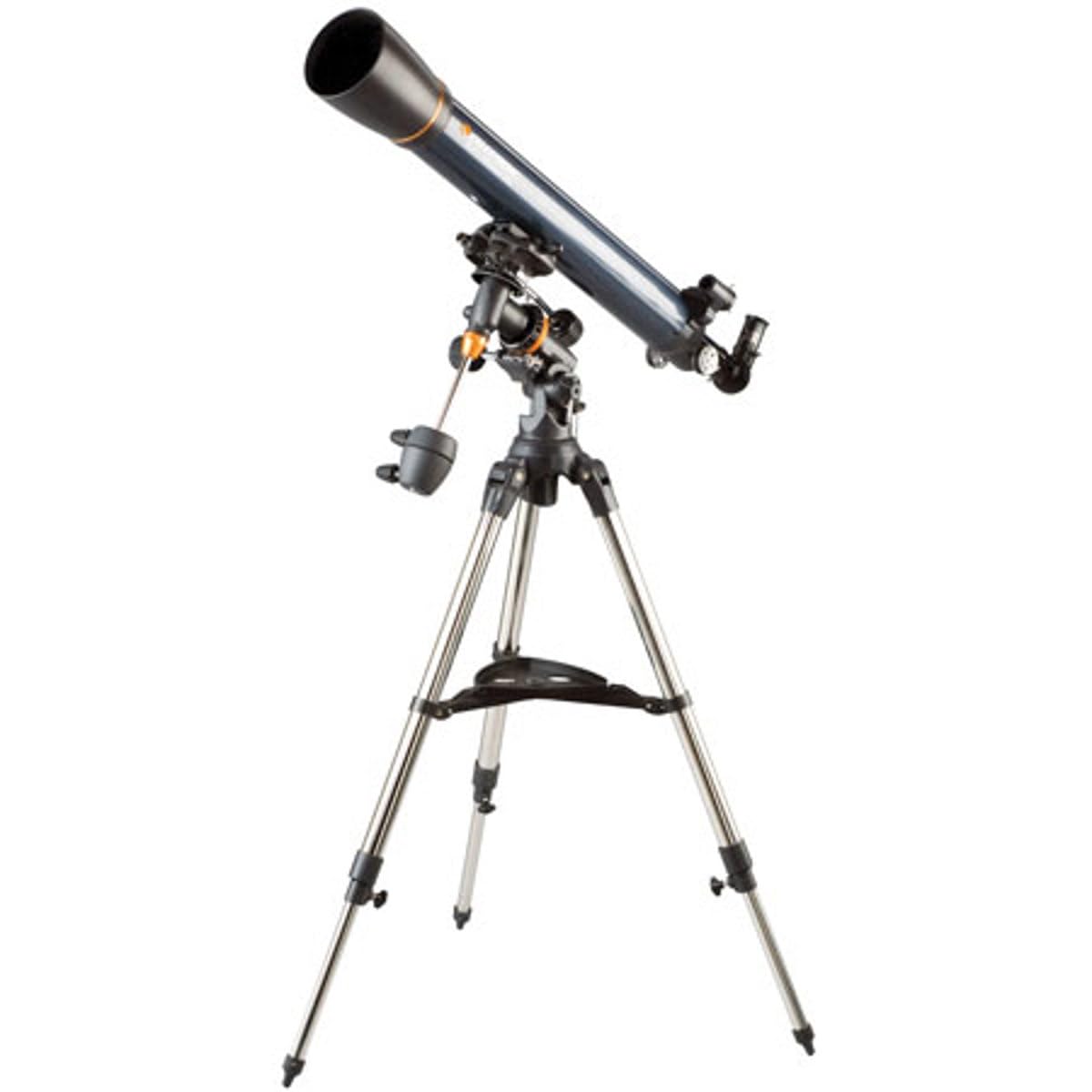
The Celestron AstroMaster 90EQ is a powerful, user-friendly refractor telescope featuring a 90mm fully-coated objective lens and a precision German equatorial mount with slow-motion controls. It comes complete with two eyepieces, a StarPointer red dot finderscope, an erect image diagonal, and a height-adjustable tripod for quick, tool-free setup. Ideal for both terrestrial and celestial viewing, this lightweight yet sturdy telescope is perfect for beginners and enthusiasts alike, supported by Celestron’s trusted 2-year warranty and decades of expertise.


| ASIN | B000MLHMBM |
| Batteries | 1 Lithium Metal batteries required. (included) |
| Best Sellers Rank | 3,070 in Electronics & Photo ( See Top 100 in Electronics & Photo ) 7 in Telescopes |
| Brand | Celestron |
| Colour | Multi Colored |
| Customer Reviews | 4.3 4.3 out of 5 stars (7,871) |
| Date First Available | 11 Mar. 2015 |
| Delivery information | We cannot deliver certain products outside mainland UK ( Details ). We will only be able to confirm if this product can be delivered to your chosen address when you enter your delivery address at checkout. |
| Focus type | Manual Focus |
| Guaranteed software updates until | unknown |
| Included components | 90mm (3.5") diameter refractor, 1000mm focal |
| Item Weight | 6.21 Kilograms |
| Item model number | 21064-CGL |
| Max Focal Length | 1000 Millimeters |
| Min Focal Length | 1000 Millimeters |
| Model year | 2010 |
| Objective Lens Diameter | 90 Millimetres |
| Package Dimensions L x W x H | 109.2 x 38.4 x 24.2 centimetres |
| Package Weight | 14.72 Kilograms |
| Part number | 21064-CGL |
| Product Dimensions L x W x H | 76.2 x 38.1 x 129.5 centimetres |
| Size | 90EQ Refractor |
| Style | AstroMaster 90EQ Refractor |
| Telescope Mount Description | Equatorial Mount |
A**N
Recommended
Review of Celestron AstroMaster 114EQ Reflector Telescope: Update (July 2018): I've spent a lot of time with this telescope now, perhaps 100 hours, and have an even better opinion of it than before. As a cheap small telescope it is ideal for beginners like me and I couldn't ask for a better experience for the right-above £100 price I paid. It is one of the most cost effective pastimes I've enjoyed. With the telescope, I've observed: The Moon Venus Mars and its ice cap Jupiter, its cloud lines, and its big red spot Saturn and its rings Satellites Many open clusters Many globular clusters A few nebulas (The orion nebula is amazing!) The Andromeda Galaxy Over the past months I have gathered some tips for getting the most out of this telescope: * The 114EQ has a corrector lens built into the eyepiece tube that also acts like a 2x barlow lens, essentially "zooming in" by 2x power by default. This works well for planetary viewing, but for objects like open star clusters and the andromeda galaxy it can be too much magnification to get a wide enough view with a 20-24mm eyepiece. Also, for faint objects like nebulas it can reduce the exit pupil of the telescope to a very small size, which limits the ability of your eye to gather light. A solution I found is to use a 0.5x barlow lens to reduce the overall power to 1x. I recommend the Solomark 0.5x Focal Reducer available on Amazon, which screws into the bottom of your eyepiece. * I tried a number of different eyepieces, including moderately expensive ones. My favorite experience was the Seben 7.5-22.5mm Zoom Eyepiece. While being one of the least expensive eye pieces I used with the telescope also offered the most adaptable experience. I rarely use the other eyepieces now because the seben zoom allows me to spend more time viewing and less time fiddling. When paired with a 0.5x barlow, it gives the telescope a wide range of configurations that allow it to be a nice platform for viewing all objects below absolute magnitude 10. * The mount has a cheap bearing for the equatorial axis which has a bolt that both acts as the axle and as the tightener. This is where most of the vibration in the mount comes from. In order to make it work well, it is critical that the washers go in the correct order and that the bolt is torqued such that it is tight but not binding. The correct order is the metal washer first and the rubber washer second on the bolt. If they are reversed, the bolt will back its way out when turning the equatorial axis and lead to a lot of wobbling. * I removed the locking screws for the collimation knobs on the primary mirror. The telescope keeps its collimation well without the screws, and the knobs are much easier to adjust in the field without having to take the screws out first. Speaking of which, accurate collimation is critical for all reflector telescopes, so if you are not comfortable learning how to do this time consuming process, you should buy a refractor telescope instead, which does not require collimation. After learning the process, it is painless to do. Reflectors like the 114EQ are cheaper for better image quality than refractors, but collimation is the price you pay. * I switched to using Stellarium for my session planning instead of the included Starry Night. I find Stellarium easier to use, and it also allows me to plan which eyepiece configurations are appropriate for a particular object. The mobile version of stellarium is way better than the mobile version of starry night -- more stars included, and easier interface. Really love this telescope! While viewing feint objects like nebulas begs for a larger telescope, I have found my time with this scope highly rewarding at a fraction of the price. I highly recommend this telescope for budding astronomers. Original Review (March 2018): I spent some of my teenage summers with a cousin who loved astrology and introduced me to many of the concepts. Many years later I decided to invest in my own small scope, nothing like the big one my cousin had. After reading reviews and studying specs I picked the Astromaster 114eq for it's nice blend of small size, price, and performance. On our first night viewing, my girlfriend and I caught views of the Orion nebula and beehive cluster right out our apartment window. Wow! It made me realize what I had been missing out on! I am far from an astrological expert, but I can see that the EQ114 can go far, especially with the right adjustment. Collimation is difficult with the stock screws, but after spending several hours over multiple sessions I got it pretty darn good and the picture is nice to my uneducated eyes. The included software helped a lot to find things to view and to track them down in the sky. I don't want a big telescope due to storage, but I'd like to see how far my eq114 will go. To that end I bought a better eye piece than the cheap ones it comes with to see how far the little guy can stretch. The eye piece cost almost as much as the telescope, but I hear they make a huge difference so I am looking forward to trying it out. It's the kind of thing that will last for 50 years so I'm not worried about the investment. You shouldn't be either! Don't hesitate if you're on the fence, this is a good little scope I can fully recommend.
V**3
Very good for the price. Recommended for first telescope. Lots of fun.
This review is based on the cost of this telescope after using it for about a year now. The review is for 130EQ-MD. First, to put things into perspective: * A good eyepiece costs more than half of the price of this telescope * A good mount starts at 4 times the cost of this telescope and exceeds 20 times the price The telescope is an excellent starter telescope. Based on forum review, it is probably not the best, but quote close to that. It has all the bits and pieces that you need to learn about while taking the first steps into amateur astronomy: * Equatorial mount: you'll learn about the types of mounts, how to do polar alignment, what is RA/DE and Hour Angle * It's Newtonian: you'll learn about reflector telescopes and collimation. You don't have to bend to look at the stars, which is important when spending an hour or so * Large focal length (you *do not* need more than that): allows you to toy with eyepieces and discover the limits of the telescope. You will realise the effects of the atmosphere and the limits they impose and you will also realise that in high magnifications the stars move too fast and go out of view in seconds. * Decent aperture: You won't be limited by the ability of the telescope to collect light. You will learn what dark adaptation is and how important it is. * Two eyepieces (20mm erect, 10mm): You'll learn what an erect eyepiece is. You'll get used to seeing things upside down. You'll learn to divide the focal lengths to get the magnification. You'll also inevitably learn about apparent field-of-view, eye relief, multicoating, what plossl is and that there is a variety of eyepieces but that you don't need many of them. * A motor: you'll learn the importance of it at higher magnifications. Eventually you'll also try to take pictures, either with a phone or with a camera, in which case you'll start attaching things to it. It's more trouble than you think but the good thing is that the telescope is very sturdy and can take it. Its pieces: * The telescope itself is of good quality * The mount is a *very* good mount for the price. It's sturdy, accurate to adjust and reasonably stable. I can't stress enough the importance of the mount. It's *the* most important part of a telescope. If you're not convinced, take a look at amateur astronomy forums for advice given to others. * The sky pointer is easy to use and very accurate once adjusted (the first time) * The eyepieces are good for the first days. At some point you will probably replace them with something better and possibly add a barlow lens. Look at forums about recommendations. I had very good results with a celestron omni 15mm. I have a celestron omni 5mm which is not useful 99% of the time and can't recommend because of the high magnification and the bad eye relief. An onni celestron barlow works well too. I also recommend getting a 30-40mm plossl eyepiece with good eye relief. * The motor (for the MD model) is painfully basic. Unfortunately it doesn't allow manual micro-corrections when it's attached, even if it's off. It also limits the rotation of the telescope which creates some blind spots (boooo). I had to remove it in some occasions. Overall , it's lots of fun for the price. IMO, you should not try something more expensive as a first telescope because you won't know what to look for. You'll realize that if you're going to invest then it's better to invest on a mount than a telescope. Expect to be able to see Saturn's rings and Jupiter's moons when they are close to Earth. See attached The bads: * The motor is basic and limits the movement of the telescope when attached. Fortunately, it's easy to remove and reattach. * The included eyepiece are very basic, although a good starting point and expected for the price of the telescope
H**R
Il pacco è arrivato con un giorno di ritardo, avevo pagato la spedizione 1 giorno ma qualcosa non ha funzionato, poco male Amazon mi ha restituito la differenza. Assemblato in un oretta buona senza problemi, il quick start e il manuale sono in inglese ma sul sito Celestron trovate anche il pdf in italiano, il tubo è arrivato collimato dalla fabbrica e sembra ok ma comprerò un tool di calibrazione. Mediocri gli oculari specie quello da 10mm (lo stesso in dotazione al Travelscope70), il 20mm è utilizzabile anche per la visione terrestre ma il raddrizzatore incorporato si mangia luce se comparato ad un mio oculare Celestron 20mm budget puro (20mm in dotazione al Travelscope70). In questa fascia di prezzo è comunque normale dover sostituire gli oculari con prodotti di maggiore qualità. Vi ricordo che state comprando un telescopio a riflessione quindi l'immagine appare capovolta, questo non è considerato un difetto in astronomia poichè nello spazio non esiste l'alto-basso, potreste comprarvi un raddrizzatore (come quello incorporato nell'oculare da 20mm) ma così facendo perdereste luce poichè aggiungereste un sistema di specchi o un prisma e questo si che viene considerato un difetto. Avendo alcuni oculari compresa una Barlow 2x Celestron Omni non ho avuto nessun problema e vi consiglio caldamente di procuravi una Barlow se non volete vedere puntini o poco più. Un riflettore decente ad un prezzo ottimo se preso sotto i 200euro, certo hanno risparmiato sullo specchio primario che non è parabolico bensì sferico come precisato nella scheda del prodotto alla voce "support" sul sito Celestron ma per comprarvi un modello analogo dotato di specchio parabolico spendereste quasi il doppio, il lato negativo è che questo specchio perde luce e potrebbe introdurre un pochino di aberrazione sferica. Il trepiedi EQ2 è abbastanza stabile se lo montate bene e con i pesi ben distribuiti, unico vero neo il distanziatore in plastica non mi fa sentire sicuro quindi siate delicati quando lo aprite o lo chiudete . Un consiglio, io uso il telescopio seduto su uno sgabello regolabile quindi non ho bisogno di estendere i tubi telescopici rendendo il trepiedi estremamente stabile, Eq2 base ma fa il suo lavoro. Qualcuno ha lamentato problemi di collisioni delle manopole o col motore, beh questo succede solo se montate male il trepiedi oppure se pensate di utilizzarlo come se fosse un trepiedi azimutale, con l'equatoriale vi bastano piccoli movimenti per alzare o "girare" il tubo e se tocca qualche manopola è perchè lo state usando male. Aggiornamento: Ho avuto l'astromaster 130 per un'anno ora ho qualcosa di meglio come un Maksutov 127mm e posso dire questo, se preso intorno ai 180 euro va bene , ha lo specchio sferico e non parabolico e non è propio il massimo e raramente potrete apprezzare stelle puntiformi ed alto contrasto che un Maksutov è in grado di regalare, tralasciando il mediocre cercatore e sostituiti gli oculari davvero pessimi il resto potrebbe andare ma è solo questione di prezzo, se volete un riflettore cercate di prenderlo con specchio parabolico i prezzi sono decisamente scesi, i difetti che lo sferico introduce si notano eccome quando si passa a qualcosa di meglio, come primo telescopio ovviamente non si può che esserrne entusiasti ma con l'esperienza si capisce che non è granchè.
F**Z
Çok iyi bir teleskop. Başlangıç için 50AZ modelini almıştım ama arasında çok fark var. Andromeda, jüpiter, saturn ve niceleri telefonumda var ama "AMAZON TÜRKİYEDE RESİMLERİ AÇSA GÖSTERECEM!" Eğer çok üst segment alıp para basmayacam diyorsanız ideal. Çok ekmeğini de yedim ürünün ;) 2 eksisi var el ile taşınmaz çok ağır. Ekstra lens alıp geliştirmek lazım. Jüpiterin 2 büyük çizgisi ve büyük kırmızı gözü lens yardımı ile gözüküyor. Ayrıca fotozeynep ile 1 günde kapınızda.
R**A
5 estrellas banda, viene completo y cuidadosamente empacado, observe júpiter por primera vez y se ve hermoso (pequeño pero hermoso) aunque mi celular no capta bien se ve muy bonito y nítido :0
C**6
I wanted to get my feet wet in backyard astronomy, after getting bitten by the bug using a pair of Nikon 8x42 binoculars. The binoculars still are a must have item, but far to shaky and low magnification to get views of planets. So I researched telescopes, and decided on a refractor, due to having small children and little time to fiddle with collimation. My budget was low, to keep my wife happy. The 70EQ stuck out due to the sturdier CG-2 equatorial mount and tripod, and far more sensible and better eyepieces (Kellner) compared to the powerseeker models. I was able to assemble it in about 20min, got it outside, and found both Jupiter and Saturn in a few minutes. Absolutely amazing seeing both the Galilean Moons and Saturn's rings within minutes of getting it outside. The moon itself is spectacular through this scope at both 45X and 90X. The 10mm has considerably more chromatic aberrations than the 20mm, but it's not bad. After that first night, I got the mount set to my latitude, and polar alignment consists of setting the tripod up with the mount approximately facing North. For generally keeping Saturn in the viewfinder that's good enough. The EQ mount is a must have though. I love it. I have run into a problem with the red dot finder scope, it stopped working after about a week. I swapped in a couple of new batteries and still broken. So I quickly ordered a replacement for $14 and am back up and running. So far the new one hasn't faltered. I'd recommend this scope to anyone. It is usable right out of the box. I've seen all 8 planets through it. Uranus and Neptune are still tiny dots, but you can tell they're blueish color and that they are round, but that's about it. Saturn is my favorite, it's also tiny at 90X, but the rings are clearly visible and separate from the planet itself. Jupiter, I can faintly make out the cloud bands, the planet is small and contrast is low, but with patience and persistence they are visible. I haven't been able to make out the giant red storm, but I'm hoping to get a decent 7mm or possibly 5mm eyepiece to push into the very limits of this scopes capabilities and make it out, along with the Cassini division. But, if not, it gives me a reason to beg for an upgraded scope someday. I've also been mesmerized by the faint grey fuzzies that are up there. I've seen the Andromeda Galaxy, the Dumbbell Nebulae, and the Orion Nebulae, these are faint as the scope is a slow f/12.9, but again, with patience they are there yo see. Have fun, and get something, you can't see Saturn's rings without some sort of scope. 73
K**.
Fungerade precis som jag hade förväntat mig, bra produkt
ترست بايلوت
منذ 3 أيام
منذ شهر