![A Hard Day's Night (The Criterion Collection) [DVD]](https://m.media-amazon.com/images/I/41qtPKAGf4L.jpg)
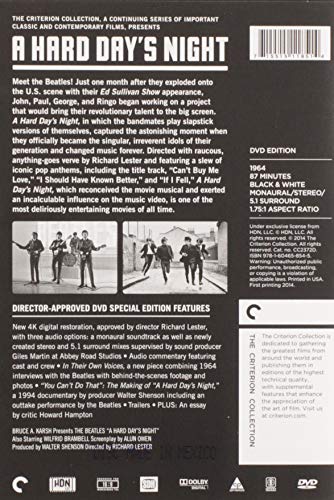
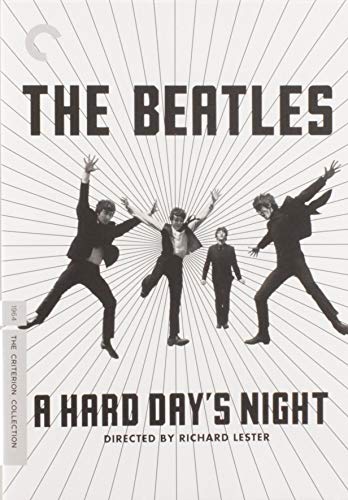

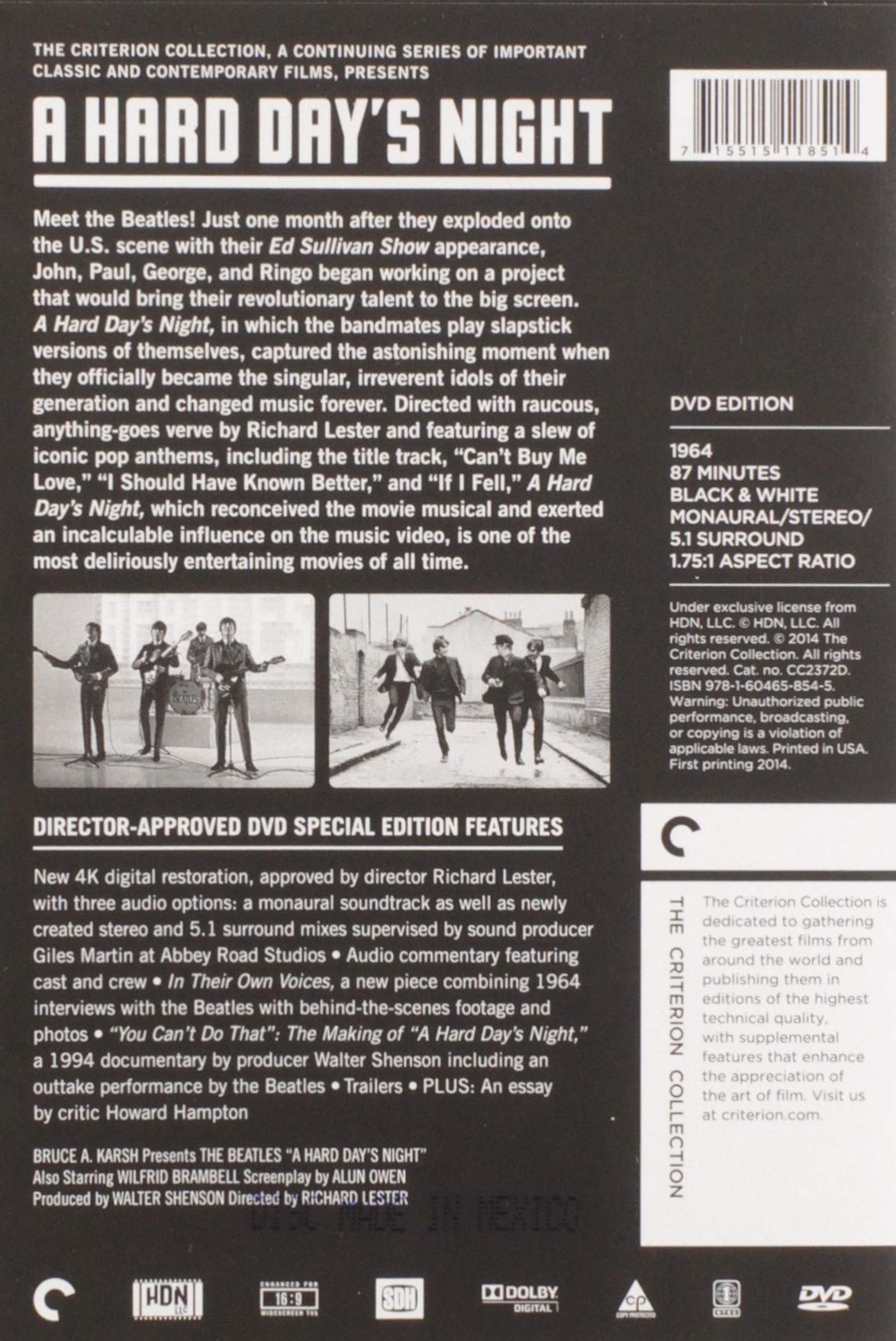


Product Description John, Paul, George and Ringo spend 36 wild hours in London. desertcart.com Beatlemania is sweeping the Criterion Collection! This year marks the fiftieth anniversary of the Beatles’ beloved musical comedy A Hard Day’s Night,and to commemorate it we’re releasing a jam-packed special edition of the film, featuring a new 4K digital restoration, a newly remixed 5.1 surround soundtrack, and hours of incredible supplements. We’re also pleased to present two other gems of sixties cool: Georges Franju’s Judex, an inventive and elegant French kidnapping caper that’s ripe for rediscovery, and Michelangelo Antonioni’s quintessential modern-age romance L’eclisse, with the gorgeous duo of Monica Vitti and Alain Delon. Then go back to the fifties for Douglas Sirk’s stunning Technicolor tearjerker All That Heaven Allows,newly restored, and ahead to the seventies for Peter Davis’s Oscar-winning documentary about the Vietnam War, Hearts and Minds, and Australian auteur Peter Weir’s mysterious breakthrough masterpiece, Picnic at Hanging Rock. These are all essential and unforgettable works of cinema. Review: A Big Surprise in 1964 - It’s absolutely true that United Artists made “A Hard Day’s Night” simply to be able to release what would be a guaranteed soundtrack album, expecting to lose money on the film. Lose money? Well, in their defence, the deal was made in 1963, before the Beatles took over America and the rest of the world. Rock and roll movies had a terrible reputation, usually being a string of performers playing between bits of a minimal romantic plot played by low-budget actors. Elvis’ films were a predictable product cranked out every year. The Beatles had already rejected offers to be in those kinds of films, considering them trash and were suspicious about UA’s movie offer at first. It’s not true, the frequently told story that the band picked Richard Lester to direct their film from a list of potentials. They weren’t cinema fans to the extent that they could identify directors and their work on a list. Producer Walter Shenson had picked director Richard Lester and the boys approved once they heard he was working with the Goon Show guys and had directed “The Running, Jumping and Standing Still Film”, a short film of surrealistic comedy of which the band was a big fan and which obviously would have appealed to John Lennon (It’s usually somewhere online). It’s a case of just the right people forming around the Beatles that at times seems uncanny. The resulting film was the second biggest surprise of 1964, the biggest being the Beatles themselves, whose massive success in America exceeded any possible expectations and seemed to herald a whole new era. As an American who was fourteen at the time, I focus on the story in the U.S. They had already conquered Britain in ‘63, creating a hysteria that began to be featured on news reports by Huntley and Brinkley and a feature on the Jack Paar Program near the end of that year. By January Beatlemania was in full force, the next month accompanied by a “British Invasion” of performers who together wiped out most of the previous pop scene, especially the American Bandstand acts. Only the newer performers survived, the Four Seasons, Beach Boys, Jan & Dean, Leslie Gore, Gene Pitney and early Motown. After their Ed Sullivan appearance (just before making the film), Beatlemania went ballistic with the band famously occupying the entire Top 5 the week of April 4, 1964. Their overwhelming presence was greatly assisted by the fortuitous fact that previously Capitol Records had rejected the band’s singles because no British act had ever been big here and auctioned them off to regional indie labels like Swan, Tollie and Vee Jay. Suddenly these labels had gold in their vaults and they all released everything they had. The result was by mid-April there were 14 Beatles songs on the Hot 100, all played on the radio along with every album track. It had a tidal wave effect. The movie itself was a surprise, as it was expected to be the usual exploitation fare but instead was a kind of British/French New Wave film in a cinema verite style that made it seem like a documentary of a couple days in the life of the band. Even establishment critic Bosley Crowther of the New York Times called it ‘a whale of a comedy” and critics all over the country fell over themselves in delighted surprise, praising the film for its freshness and originality. United Artists. didn’t care what Lester turned in as long as there were new songs and let him do whatever he wanted within a not so big budget, but it worked spectacularly. Of course he had the right people. Screenwriter Alun Owen was from Liverpool and the band was familiar with his television play, “No Trains To Lime Street”, set in Liverpool. He spent time with them in Paris and London and immediately experienced how much they were prisoners of their own success, unable to go out for the most mundane things without causing a potentially dangerous crowd of fans to appear. This he made into the claustrophobic first part of the film, or as Grandfather McCartney describes it “From a car to a room to a train to a room to a room to a room”. The cinematographer, Gilbert Taylor (“Dr. Strangelove”, “The Omen”, “Star Wars”) used several cameramen, lots of hand held cameras, and used helicopter views and sped up motion on the Thornbury Playing Fields. Lester did everything in a semi-guerilla filmmaking style, incorporating street scenes and pedestrians without regard to official rules. The resulting film is a marvel of jump cuts of little comic bits strung together by the presence of the Beatles. Though everything seems spontaneous, it was almost all planned and scripted, with the Beatles given a bunch of one-liners to deliver, as they could not be expected to be trained actors. The use of handheld cams gave them the freedom to move around as they actually did without worrying about hitting their mark. Opening with the resounding and electrifying first chord of the theme song, the Beatles are seen running down a London street pursued by a mob of exultant fans and it goes on from there one moment after another without let up. The Beatles are portrayed as funny, fun loving and rather insouciant and cheeky, especially toward stuffy authority types like the gentleman on the train: “I fought the War for your sort” Ringo:”I bet you’re sorry you won”. John is hilarious when pretending to be a convict to a bunch of schoolgirls on the train, he exclaims as he’s carried off, “I bet you can’t guess what I was in for”. In Britain, there was a strict class system which dictated that working class Northerners like John, Paul, George and Ringo, simply didn’t talk this way to those above, so their very attitudes struck a big note there that Americans might have missed. It’s on the train that we first meet the little surrealistic elements that occur in the film when the Beatles, leaving their compartment, are suddenly seen running beside it, an element which peaks when Ringo is being Sir Walter Raleigh to a woman walking on a muddy path. There are two especially memorable moments. The “ We’re out ! ” scene that kicks off “Can’t Buy Me Love” when they run, romp, dance and play on the fields, momentarily freed from their captivity. Then there’s the touching scene when Ringo goes off on his own and just gets to be himself with a boy he meets who is skipping school to hang out with his friends. The boy doesn’t recognize him as such and Ringo gets to be just human for a bit. The film is full of wonderful things and bears watching more than once to catch it all. Director Lester became known for filling in his backgrounds with things going on that you just wouldn’t catch the first time. He also filled it with excellent British supporting actors and even bit players. I know they felt they needed a negative element in the script, but I find the Grandfather a bit too much overall. One of the best things is, of course, the music. The standout theme song with its stunning use of a 12-string Rickenbacker guitar by George was written in a single day once a Ringo-originated quip was decided as the title. It went on to influence rock and pop music and the following year’s breakout Folk-Rock. The Beatles presented a new sound in the film, with the only callback being the concert finale, “She Loves You”.It was a far cry from the loud Beat Sound R&B of songs like “Twist and Shout” and girl group covers like “Please Mr. Postman”. Their sound went from rockers like “Can’t Buy Me Love” to a more acoustic, folk sound in “I’m Happy Just To Dance With You”. I wish they had been able to include “Things We Said Today” which was written only weeks after the film wrapped on April 22nd and ended up the B-side of the title song single in Britain and included on the U.K. version of the.“Hard Day’s Night” album. Most notable were the two most quiet songs, Lennon’s “If I Fell” and McCartney’s “And I Love Her” which brought in many new fans who were impressed that the “Yeah, Yeah, Yeah” boys could write beautiful songs like these. Capitol released three singles simultaneously from the film but they couldn’t duplicate April’s Top 5 dominance and only the theme song and “And I Love Her” made the Top 20. Everybody was buying the album. Review: "A Hard Day's Night" - the way it was meant to be - The Beatles' first - and best - movie has had a checkered history on home video. First issued on VHS by MPI Home Video in 1984, that label reissued the same title in a Special Edition VHS (with bonus footage) in the mid-'90s, followed by a LaserDisc , and finally, an early DVD of the film in 1997. Those releases were based on the 1982 Universal Pictures re-release, with a Dolby Stereo soundtrack. In 2002, Beatles "expert" Martin Lewis released a new version on VHS/DVD, through Miramax, and preceded to ruin it, with a muddy soundtrack and washed-out picture. I paid big bucks for an out-of-print copy of the MPI DVD, and always watched AHDN that way. Until now. The Criterion Collection - a collector's film label - who had released a short-lived LaserDisc version of AHDN in the early '90s - has now reissued the film, just in time for its 50th Anniversary, in both a single-disc DVD edition , and this three-disc set (two DVDs and one Blu-ray disc, both with the same content). The picture is crystal-clear, and the sound quality - stereo, 5.1, and mono - is superb. Some of the movie song mixes are noticeably different, particularly "And I Love Her," which appears for the first time in a complete true-stereo version with a single-tracked Paul McCartney vocal. The stereo album version is double-tracked, as is the U.K. mono version; original U.S. releases have the single-tracked mono version and the double-tracked stereo version. The collection includes a nice collector's book with an appreciative essay by Howard Hampton (though I did not appreciate his cheap shot at The Monkees), and a lengthy 1977 interview with director Dick Lester. Most, but not all, of the bonus features from the previous reissues are included in this new version, including Lester's 1959 Oscar-nominated short, THE RUNNING, JUMPING, AND STANDING STILL FILM, which appeared on the MPI DVD; THINGS THEY SAID TODAY, a 2002 documentary that was on the Miramax release (the supplemental material on the second disc of the Miramax release, GIVE ME EVERYTHING!, was not included); The Making of A Hard Day's Night , a 1994 documentary with Phil Collins; and several new documentaries - one about Lester's style and influence, another one featuring The Beatles in their own words (set to archival footage), some of which also appeared as "Fab Four On Film," the original unreleased B-side to the 1982 single "The Beatles' Movie Medley" (Capitol B-5100, replaced on the commercial release by the mono mix of "I'm Happy Just To Dance With You" [Capitol B-5107 and Parlophone R 6055]), and new 2014 interviews with Lester and Mark Lewisohn. There is also a commentary track with members of the film crew, assembled by Martin Lewis in 2002. Initially, I was disappointed that the "I'll Cry Instead" prologue from the MPI DVD was not included, but then I read online that Universal Pictures added that prologue to the 1982 Dolby Stereo theatrical re-release without the consent of Dick Lester, producer Walter Shenson, or The Beatles themselves. Lester - who rejected "I'll Cry Instead" as a song selection for the original film - insisted that the prologue be deleted from all future video releases. Interestingly, A HARD DAY'S NIGHT is the only Beatle film not owned by Apple Corps. Bruce and Martha Karsh - the managers of Walter Shenson's estate - own the film, and licensed the rights to Janus Films, who will distribute the film in limited theatrical re-release; Criterion Collection has the home-video rights. On July 5, 2014, I saw the theatrical version of the film at the West End Cinema in Washington, D.C. It was fantastic. Since 2007, there have been restored reissues of Help! (Deluxe Edition) , Magical Mystery Tour Deluxe Box Set (Blu-ray/DVD/double-vinyl EP) , and Yellow Submarine ( previously reissued in 1999 ). Now it's time for Apple Corps to finally upgrade LET IT BE to a proper DVD/Blu-ray release - and I don't want to hear excuses about "damaging the brand" from Paul, Ringo, or anyone else in The Beatles' camp.
| ASIN | B00J2PQYYK |
| Actors | George Harrison, John Lennon, Paul McCartney, Ringo Starr |
| Best Sellers Rank | #4,518 in Movies & TV ( See Top 100 in Movies & TV ) #37 in Musicals (Movies & TV) #487 in Comedy (Movies & TV) |
| Customer Reviews | 4.8 4.8 out of 5 stars (2,743) |
| Director | Richard Lester |
| Item model number | CRRN2372DVD |
| MPAA rating | G (General Audience) |
| Media Format | Black & White, Multiple Formats, NTSC, Widescreen |
| Number of discs | 1 |
| Product Dimensions | 0.7 x 7.5 x 5.4 inches; 2.72 ounces |
| Release date | June 24, 2014 |
| Run time | 1 hour and 27 minutes |
| Studio | Criterion Collection (Direct) |
J**F
A Big Surprise in 1964
It’s absolutely true that United Artists made “A Hard Day’s Night” simply to be able to release what would be a guaranteed soundtrack album, expecting to lose money on the film. Lose money? Well, in their defence, the deal was made in 1963, before the Beatles took over America and the rest of the world. Rock and roll movies had a terrible reputation, usually being a string of performers playing between bits of a minimal romantic plot played by low-budget actors. Elvis’ films were a predictable product cranked out every year. The Beatles had already rejected offers to be in those kinds of films, considering them trash and were suspicious about UA’s movie offer at first. It’s not true, the frequently told story that the band picked Richard Lester to direct their film from a list of potentials. They weren’t cinema fans to the extent that they could identify directors and their work on a list. Producer Walter Shenson had picked director Richard Lester and the boys approved once they heard he was working with the Goon Show guys and had directed “The Running, Jumping and Standing Still Film”, a short film of surrealistic comedy of which the band was a big fan and which obviously would have appealed to John Lennon (It’s usually somewhere online). It’s a case of just the right people forming around the Beatles that at times seems uncanny. The resulting film was the second biggest surprise of 1964, the biggest being the Beatles themselves, whose massive success in America exceeded any possible expectations and seemed to herald a whole new era. As an American who was fourteen at the time, I focus on the story in the U.S. They had already conquered Britain in ‘63, creating a hysteria that began to be featured on news reports by Huntley and Brinkley and a feature on the Jack Paar Program near the end of that year. By January Beatlemania was in full force, the next month accompanied by a “British Invasion” of performers who together wiped out most of the previous pop scene, especially the American Bandstand acts. Only the newer performers survived, the Four Seasons, Beach Boys, Jan & Dean, Leslie Gore, Gene Pitney and early Motown. After their Ed Sullivan appearance (just before making the film), Beatlemania went ballistic with the band famously occupying the entire Top 5 the week of April 4, 1964. Their overwhelming presence was greatly assisted by the fortuitous fact that previously Capitol Records had rejected the band’s singles because no British act had ever been big here and auctioned them off to regional indie labels like Swan, Tollie and Vee Jay. Suddenly these labels had gold in their vaults and they all released everything they had. The result was by mid-April there were 14 Beatles songs on the Hot 100, all played on the radio along with every album track. It had a tidal wave effect. The movie itself was a surprise, as it was expected to be the usual exploitation fare but instead was a kind of British/French New Wave film in a cinema verite style that made it seem like a documentary of a couple days in the life of the band. Even establishment critic Bosley Crowther of the New York Times called it ‘a whale of a comedy” and critics all over the country fell over themselves in delighted surprise, praising the film for its freshness and originality. United Artists. didn’t care what Lester turned in as long as there were new songs and let him do whatever he wanted within a not so big budget, but it worked spectacularly. Of course he had the right people. Screenwriter Alun Owen was from Liverpool and the band was familiar with his television play, “No Trains To Lime Street”, set in Liverpool. He spent time with them in Paris and London and immediately experienced how much they were prisoners of their own success, unable to go out for the most mundane things without causing a potentially dangerous crowd of fans to appear. This he made into the claustrophobic first part of the film, or as Grandfather McCartney describes it “From a car to a room to a train to a room to a room to a room”. The cinematographer, Gilbert Taylor (“Dr. Strangelove”, “The Omen”, “Star Wars”) used several cameramen, lots of hand held cameras, and used helicopter views and sped up motion on the Thornbury Playing Fields. Lester did everything in a semi-guerilla filmmaking style, incorporating street scenes and pedestrians without regard to official rules. The resulting film is a marvel of jump cuts of little comic bits strung together by the presence of the Beatles. Though everything seems spontaneous, it was almost all planned and scripted, with the Beatles given a bunch of one-liners to deliver, as they could not be expected to be trained actors. The use of handheld cams gave them the freedom to move around as they actually did without worrying about hitting their mark. Opening with the resounding and electrifying first chord of the theme song, the Beatles are seen running down a London street pursued by a mob of exultant fans and it goes on from there one moment after another without let up. The Beatles are portrayed as funny, fun loving and rather insouciant and cheeky, especially toward stuffy authority types like the gentleman on the train: “I fought the War for your sort” Ringo:”I bet you’re sorry you won”. John is hilarious when pretending to be a convict to a bunch of schoolgirls on the train, he exclaims as he’s carried off, “I bet you can’t guess what I was in for”. In Britain, there was a strict class system which dictated that working class Northerners like John, Paul, George and Ringo, simply didn’t talk this way to those above, so their very attitudes struck a big note there that Americans might have missed. It’s on the train that we first meet the little surrealistic elements that occur in the film when the Beatles, leaving their compartment, are suddenly seen running beside it, an element which peaks when Ringo is being Sir Walter Raleigh to a woman walking on a muddy path. There are two especially memorable moments. The “ We’re out ! ” scene that kicks off “Can’t Buy Me Love” when they run, romp, dance and play on the fields, momentarily freed from their captivity. Then there’s the touching scene when Ringo goes off on his own and just gets to be himself with a boy he meets who is skipping school to hang out with his friends. The boy doesn’t recognize him as such and Ringo gets to be just human for a bit. The film is full of wonderful things and bears watching more than once to catch it all. Director Lester became known for filling in his backgrounds with things going on that you just wouldn’t catch the first time. He also filled it with excellent British supporting actors and even bit players. I know they felt they needed a negative element in the script, but I find the Grandfather a bit too much overall. One of the best things is, of course, the music. The standout theme song with its stunning use of a 12-string Rickenbacker guitar by George was written in a single day once a Ringo-originated quip was decided as the title. It went on to influence rock and pop music and the following year’s breakout Folk-Rock. The Beatles presented a new sound in the film, with the only callback being the concert finale, “She Loves You”.It was a far cry from the loud Beat Sound R&B of songs like “Twist and Shout” and girl group covers like “Please Mr. Postman”. Their sound went from rockers like “Can’t Buy Me Love” to a more acoustic, folk sound in “I’m Happy Just To Dance With You”. I wish they had been able to include “Things We Said Today” which was written only weeks after the film wrapped on April 22nd and ended up the B-side of the title song single in Britain and included on the U.K. version of the.“Hard Day’s Night” album. Most notable were the two most quiet songs, Lennon’s “If I Fell” and McCartney’s “And I Love Her” which brought in many new fans who were impressed that the “Yeah, Yeah, Yeah” boys could write beautiful songs like these. Capitol released three singles simultaneously from the film but they couldn’t duplicate April’s Top 5 dominance and only the theme song and “And I Love Her” made the Top 20. Everybody was buying the album.
S**S
"A Hard Day's Night" - the way it was meant to be
The Beatles' first - and best - movie has had a checkered history on home video. First issued on VHS by MPI Home Video in 1984, that label reissued the same title in a Special Edition VHS (with bonus footage) in the mid-'90s, followed by a LaserDisc , and finally, an early DVD of the film in 1997. Those releases were based on the 1982 Universal Pictures re-release, with a Dolby Stereo soundtrack. In 2002, Beatles "expert" Martin Lewis released a new version on VHS/DVD, through Miramax, and preceded to ruin it, with a muddy soundtrack and washed-out picture. I paid big bucks for an out-of-print copy of the MPI DVD, and always watched AHDN that way. Until now. The Criterion Collection - a collector's film label - who had released a short-lived LaserDisc version of AHDN in the early '90s - has now reissued the film, just in time for its 50th Anniversary, in both a single-disc DVD edition , and this three-disc set (two DVDs and one Blu-ray disc, both with the same content). The picture is crystal-clear, and the sound quality - stereo, 5.1, and mono - is superb. Some of the movie song mixes are noticeably different, particularly "And I Love Her," which appears for the first time in a complete true-stereo version with a single-tracked Paul McCartney vocal. The stereo album version is double-tracked, as is the U.K. mono version; original U.S. releases have the single-tracked mono version and the double-tracked stereo version. The collection includes a nice collector's book with an appreciative essay by Howard Hampton (though I did not appreciate his cheap shot at The Monkees), and a lengthy 1977 interview with director Dick Lester. Most, but not all, of the bonus features from the previous reissues are included in this new version, including Lester's 1959 Oscar-nominated short, THE RUNNING, JUMPING, AND STANDING STILL FILM, which appeared on the MPI DVD; THINGS THEY SAID TODAY, a 2002 documentary that was on the Miramax release (the supplemental material on the second disc of the Miramax release, GIVE ME EVERYTHING!, was not included); The Making of A Hard Day's Night , a 1994 documentary with Phil Collins; and several new documentaries - one about Lester's style and influence, another one featuring The Beatles in their own words (set to archival footage), some of which also appeared as "Fab Four On Film," the original unreleased B-side to the 1982 single "The Beatles' Movie Medley" (Capitol B-5100, replaced on the commercial release by the mono mix of "I'm Happy Just To Dance With You" [Capitol B-5107 and Parlophone R 6055]), and new 2014 interviews with Lester and Mark Lewisohn. There is also a commentary track with members of the film crew, assembled by Martin Lewis in 2002. Initially, I was disappointed that the "I'll Cry Instead" prologue from the MPI DVD was not included, but then I read online that Universal Pictures added that prologue to the 1982 Dolby Stereo theatrical re-release without the consent of Dick Lester, producer Walter Shenson, or The Beatles themselves. Lester - who rejected "I'll Cry Instead" as a song selection for the original film - insisted that the prologue be deleted from all future video releases. Interestingly, A HARD DAY'S NIGHT is the only Beatle film not owned by Apple Corps. Bruce and Martha Karsh - the managers of Walter Shenson's estate - own the film, and licensed the rights to Janus Films, who will distribute the film in limited theatrical re-release; Criterion Collection has the home-video rights. On July 5, 2014, I saw the theatrical version of the film at the West End Cinema in Washington, D.C. It was fantastic. Since 2007, there have been restored reissues of Help! (Deluxe Edition) , Magical Mystery Tour Deluxe Box Set (Blu-ray/DVD/double-vinyl EP) , and Yellow Submarine ( previously reissued in 1999 ). Now it's time for Apple Corps to finally upgrade LET IT BE to a proper DVD/Blu-ray release - and I don't want to hear excuses about "damaging the brand" from Paul, Ringo, or anyone else in The Beatles' camp.
E**D
Got it quick and in mint condition. Great film as well that I would highly recommend.
F**R
The Beatles play themselves in a fictionalized look at a typical day or two in their crazy lives. From the opening chord of the title song and the accompanying image of three of them running away from a mob of fans, to their live television show finale, A Hard Day's Night is 87 minutes of unadulterated bliss. Richard Lester, who had previously worked on British radio and television, made his feature film directing debut with this picture, and he doesn't disappoint. He fares equally well with both the acting sequences and the musical numbers. The raucous style with which he directs is perfectly suited to the zany lives of the Fab Four themselves. Screenwriter Alun Owen based his script on what he and Lester observed from hanging out with the boys. And the editing by John Jympson, with Lester of course, is sensational. The shots contain much detail, with repeated viewings revealing something new each time. Just as memorable as The Beatles characterizations are the delightful supporting cast, particularly Wilfrid Brambell as Paul's dotty grandfather. Also quite memorable are Norman Rossington and John Junkin as manager and assistant to the Fab Four, Victor Spinetti as the television director, and Kenneth Haigh as an ad-man. Of course, the highlights of the picture are The Beatles performing many of the tracks from their third album A Hard Day's Night. All of the songs were written by John and Paul and were their best work to date. Even today, they are still among The Beatles best. My only quibble is with the filmed performance of "I Should Have Known Better", which is on record a solo vocal by John but which on film has Paul singing as well, which he didn't do. All of the other tracks, however, are musically accurate. Beatles producer George Martin composed and recorded several instrumental versions of Beatles songs, which are heard throughout the film and are also worth listening to.
J**E
Great film for Beatles fans. Lived up to my memories of seeing it when it was first released.
S**S
Primeiro filme dos caras. Histórico!
G**L
Llego en perfecto estado, Version restaurada en 4k tanto imagen como sonido muy diferente a otras versiones de blu ray y dvd
ترست بايلوت
منذ أسبوعين
منذ شهر