Some deliveries may take a little longer than usual due to regional shipping conditions.

قم بتنزيل التطبيق


معلومات عنا
حقوق الطبع والنشر © 2024 Desertcart Holdings Limited
قم بتنزيل التطبيق
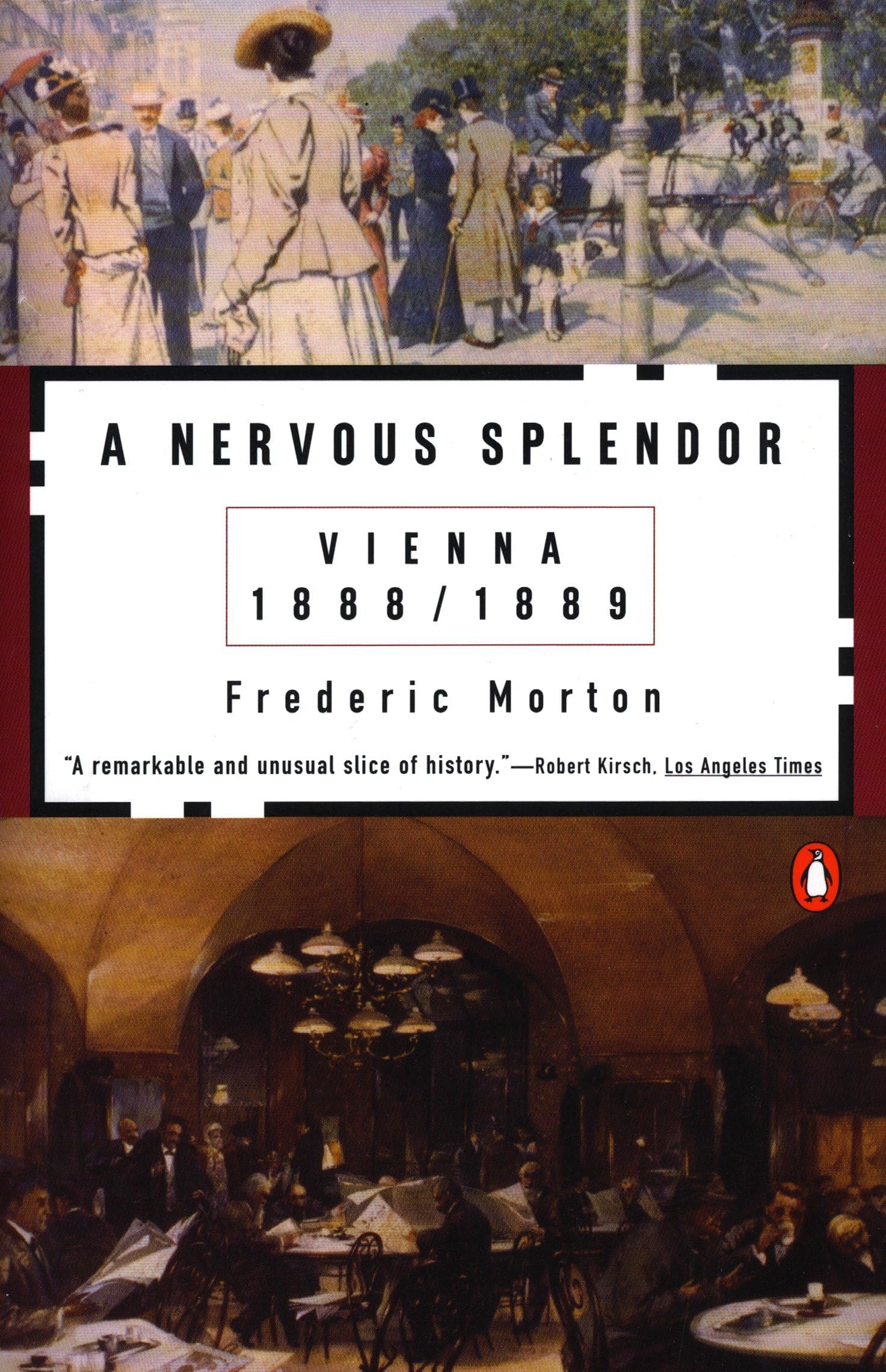
desertcart.com: A Nervous Splendor: Vienna 1888-1889: 9780140056679: Morton, Frederic: Books Review: yet reads like a novel - This book pulls together all the threads, cultural, political, social, and more, and ties them all together in a neat bow, yet reads like a novel. It furnishes us with a window into every level of the new thinking of which Vienna was the hub. We get to see the origin and development of what eventually became our own reality. Every art form, painting, music, architecture, literature, etc., with a dose of psychology added for good measure, gets a deeper meaning for us. We see the beginning of the attitude that was to culminate in the atrocities against Jews during WWII; the attitude that brought on the whole femme fatale movement that reached as far as movies like the Blue Angel; and a direction in architecture that is still visible not only Vienna, but Prague, Budapest, and New York, just to mention a few. And, of course, the tragic as well as tittilating Mayerling drama does not make detract from the readability of this very well researched and documented piece of literature on the fin-de-siecle. Review: A good survey book for the waning years of the Austria-Hungarian Empire through the eyes of its capital. - This book does a pretty good job of throwing you back into the waning years of the Hapsburg dynasty and the capital of the Empire. The approach of taking a snapshot of one year (oh but what a year!) and discussing the lives of some of the Empire's most famous people at that time, some just beginning their careers, others toward the end, is an interesting approach that he could have exploited better, as some of the "characters" felt less fleshed out. Overall an interesting book, informative, engaging. I read it in preparation of seeing Vienna soon and I believe it will give me a good background and insight into what I will be seeing.
| Best Sellers Rank | #220,891 in Books ( See Top 100 in Books ) #171 in Royalty Biographies #1,528 in Military Leader Biographies #1,560 in United States Biographies |
| Customer Reviews | 4.2 4.2 out of 5 stars (427) |
| Dimensions | 7.76 x 5.1 x 0.68 inches |
| Grade level | 12 and up |
| ISBN-10 | 014005667X |
| ISBN-13 | 978-0140056679 |
| Item Weight | 8.8 ounces |
| Language | English |
| Print length | 352 pages |
| Publication date | October 30, 1980 |
| Publisher | Penguin Books |
| Reading age | 18 years and up |
Y**O
yet reads like a novel
This book pulls together all the threads, cultural, political, social, and more, and ties them all together in a neat bow, yet reads like a novel. It furnishes us with a window into every level of the new thinking of which Vienna was the hub. We get to see the origin and development of what eventually became our own reality. Every art form, painting, music, architecture, literature, etc., with a dose of psychology added for good measure, gets a deeper meaning for us. We see the beginning of the attitude that was to culminate in the atrocities against Jews during WWII; the attitude that brought on the whole femme fatale movement that reached as far as movies like the Blue Angel; and a direction in architecture that is still visible not only Vienna, but Prague, Budapest, and New York, just to mention a few. And, of course, the tragic as well as tittilating Mayerling drama does not make detract from the readability of this very well researched and documented piece of literature on the fin-de-siecle.
K**R
A good survey book for the waning years of the Austria-Hungarian Empire through the eyes of its capital.
This book does a pretty good job of throwing you back into the waning years of the Hapsburg dynasty and the capital of the Empire. The approach of taking a snapshot of one year (oh but what a year!) and discussing the lives of some of the Empire's most famous people at that time, some just beginning their careers, others toward the end, is an interesting approach that he could have exploited better, as some of the "characters" felt less fleshed out. Overall an interesting book, informative, engaging. I read it in preparation of seeing Vienna soon and I believe it will give me a good background and insight into what I will be seeing.
H**R
Chained Prince Charming
In 1888, author Morton's grandfather Mandelbaum founded the family company in Vienna (which ran until the deluge of barbarians swept over Austria in the 1930s). A few months later, January 1889, Crown Prince Rudolf committed suicide. The book is about a few months in 88/89; the author's family plays no part in it, other than as an anchor of personal interest. Vienna was the centre of the Habsburg Empire. It was a cultural capital of the world, and at the same time a hotbed of backwardness and anti-modernity. The book is an entertaining walk through the time. It gives us a short summary of the Habsburg history and a short biography of the unfortunate Crown Prince, Sisi's son. We also meet a wealth of cultural players, some of whom have become icons: Klimt, Hugo Wolf, Schoenberg, Bruckner, Schnitzler, Herzl, Mahler, Freud, Brahms, Johann Strauss are put into the frame of the time and in the stage of their careers at the time. The ruling class is the aristocracy, while the bourgeoisie never managed to acquire the status that it did in other metropolises. There is a nascent movement of fervent Anti-Semitism, associated with a man called Schönerer, clearly a precursor to the movement later led by Hitler, who is about to be born at this time, elsewhere in Austria, and whose manifesto Mein Kampf will show clear traces of influence. Other political trends of the time: the growing nationalisms of the empire's components, i.e. the Czechs, the Croats, the Slovenes etc etc. This added fire to the latent conflict between the liberal Crown Prince and the young German Kaiser, who despised his Austrian peers as sissies, while he courted Russia and prepared to axe experienced Bismarck as his chief aide... (It may not be widely known that a country called Austria with the current boundaries never existed until after WW1. What was called Austria in the Austrian and Hungarian Double Monarchy was not a country but the ruling dynasty, the Habsburgs, the House of Austria. As a territory, Austria meant the whole of Kakania minus Hungary. Austria also existed as Upper or Lower Austria, provinces which did not add up to the total of what became the Republic of Austria. What is now Austria was known as the territory of the Germans in Austria. A latent conflict between the ruling houses of Habsburg and the Hohenzollern of Prussia included the specter that the German speakers would choose to accede to the German Empire.) Rudolf was a colorful and ambitious man. He was at the threshold of high office, yet rendered entirely powerless by emasculating controls and by a cold father. He was a closet liberal, who wrote anonymous newspaper articles. He was unhappy. His father was distant, his mother Sisi not interested, his wife Stephanie neither. His fateful encounter was Mary Vetsera, an ambitious social climber, for whom the author has nil sympathies. In the end, Rudolf will kill her and then himself. Vienna was the suicide capital of Europe at the time. This particular suicide had immeasurable consequences for European alliances. The book is beautifully illustrated, and the illustrations work well even in the pocket book edition (Penguin) that I am using. My mission in life is finding errors. Here is one by Morton: when Kaiser Wilhelm II visits Vienna in 1888, Morton has the black-red-golden flag raised. Wrong. That was the flag proposed by the failed parliamentarian revolution of 1848. It became official in Germany only with Weimar and then with the Bundesrepublik after WW2.
D**N
Spendid, yes ... but nervous?
I am a big fan of Morton's Thunder At Twilight: Vienna 1913/1914 and his ability to capture the zeitgeist of the Dual Monarchy before the First World War. On the recommendation of Amazon reviewers, I picked up his _Nervous Splendor_, anticipating a similar treat. I was mildly disappointed. As with _Thunder at Twilight_, (and Budapest 1900: A Historical Portrait of a City and Its Culture for that matter), the contrast and interplay of the wealthy, powerful and cultured with the faceless masses is used to give readers a sense of place and time. Between 1888 - 1889, Vienna was dynamic city just entering the modern, industrial age (its old city walls having been torn down barely a generation earlier), and therefore was home to the famous (Mahler) and the soon-to-be-famous (Klimt, Freud. Morton uses these personalities to give a pulse to the city. Yet Vienna was, for all its culture, opulence and power, was despondent. And perhaps it was this sense of depression made the book so difficult for me to maintain my interest. The focus on the Habsburgs (and the drama that always seems to accompany royal families) was a topic I couldn't care less about; the internal dissatisfaction of the Dual Monarchy would have been more powerful, I think, had it been shown more from the street-level rather than from the hallways of power. Even the murder-suicide of Rudolf and his mistress was almost anti-climactic and spiritless Morton is a solid writer, so I was particularly frustrated by the lack-luster treatment of Vienna; perhaps my criticisms lay more with his choice of time than with his writing. (A more crucial and dramatic period would have been the ascention of Franz-Josef in 1848, rather than the celebration of his reign fourty years later.) If you are interestedin a history of the city or a glimpse in time of central Europe in the late 19th century, I cannot recommend this.
M**Y
Enjoyable
Someone recommended this book on Reddit. It was a quick read once you get used to the writing style, which has a very advanced vocabulary, even for someone with a college degree. However, i really enjoyed it, and it as a great way to learn about history leading up to WWI. P
A**S
This was a fascinating and amazing look through the windows of history. Morton brings the era to life and examines an incredible set of political and social circumstances. If he is to be criticized for anything it is that his profound depth of research sometimes interferes with the impact of the story's detail and flow. Would heartily recommend this for any lover of history and politics.
A**R
Item arrived quickly and in excellent condition
M**N
Great book! Arrived in good conditions. Super happy with my purchase.
A**O
I was in deep love with every single chapter of this book. The story gave me chills on the skin. But also it was amazing to get to know more about Vienna and Austria during the end of the 19th century, its artists, political personalities, famous people. Once you start reading this book you can't stop.
D**T
A Nervous Splendor was a very intriguing historical novel. I was astonished to learn how deeply rooted the social issues of the 20th century were. The interconnection between the people of the times, without the internet, was mind blowing. Everything in the book seemed current and relative to today although merely a small slice of the 19th century.
ترست بايلوت
منذ شهر
منذ أسبوعين