
قم بتنزيل التطبيق


معلومات عنا
حقوق الطبع والنشر © 2024 Desertcart Holdings Limited
قم بتنزيل التطبيق
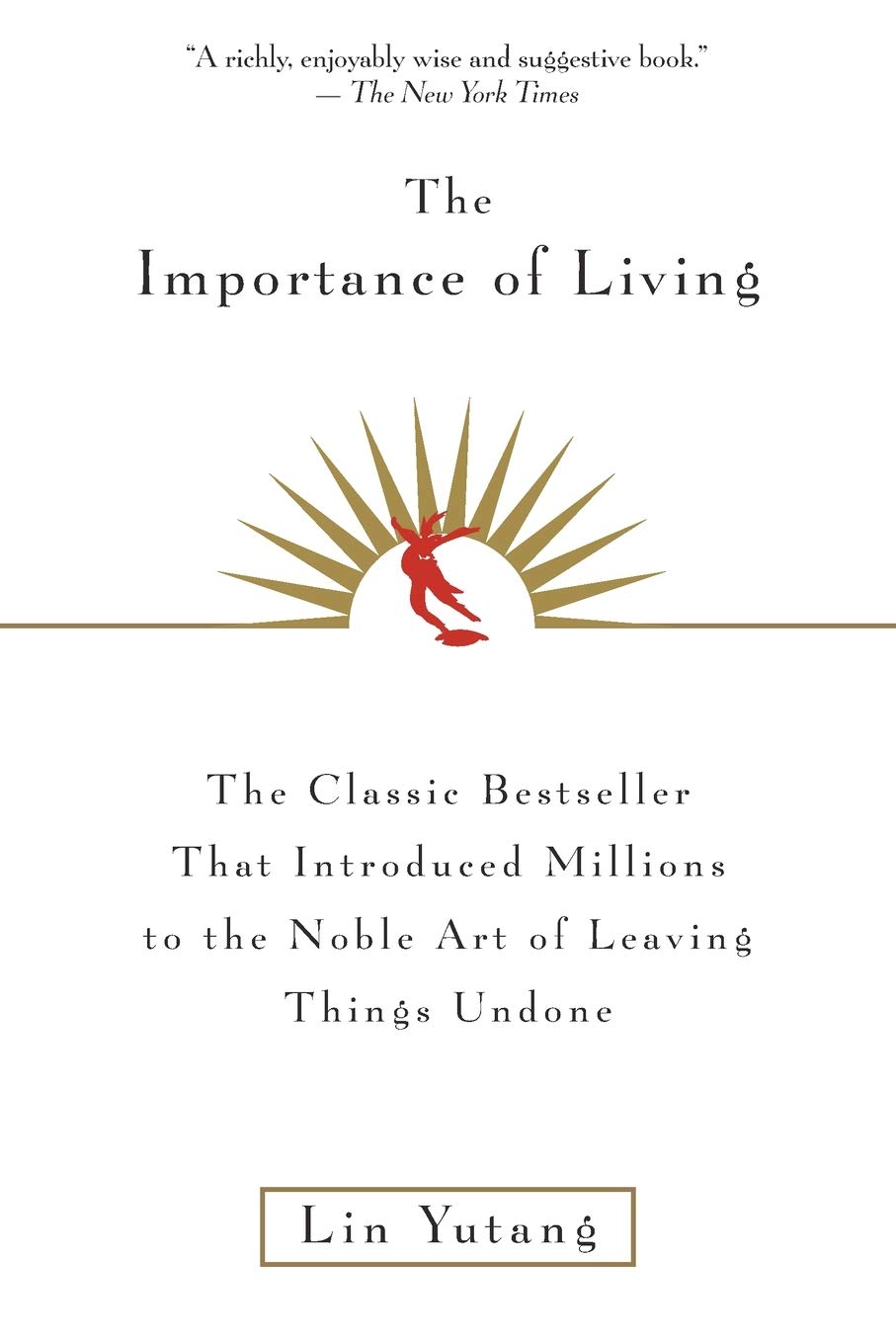
The Importance Of Living: The Classic Chinese Philosophy of Simple Pleasures and Inaction―A Playful Antidote to Modern Life [Yutang, Lin] on desertcart.com. *FREE* shipping on qualifying offers. The Importance Of Living: The Classic Chinese Philosophy of Simple Pleasures and Inaction―A Playful Antidote to Modern Life Review: A TRULY GREAT INSIGHT INTO LIVING A GOOD LIFE - If your bookshelf can take the weight, get a hardbound edition circa the 1930's. This is the kind of book you'll want to revisit again and again; just open and read anything and you'll say 'yesss'. . . If you like what's written, learn about 'Wabi-Sabi' too, the Japanese equivalent to the Chinese philosophic values of simplicity and essential living. This Japanese rendition orients (untended pun) Wabi-Sabi to graphics... then carries it through to life. Wabi-Sabi: for Artists, Designers, Poets & Philosophers . Their famous tea ceremony exemplifies the beauty of purity and simplicity, as does Yutang in this fine book. desertcart offers three pages of books regarding Wabi-Sabi; some are 'decorative' coffee-table books and most of those are rather superficial. Shop carefully. Another Wabi-Sabi book I much appreciate is In Praise of Shadows . Delving into both Chinese and Japanese perspectives is not redundant; the differences just go to give further depth and understanding. Oh: The only Western take on 'less is more' thinking which occurs to me is via Mies Van Der Rohe, a noted architect; that 'less is more' line is his. Americans especially, with their yen (another pun, intended) for embellishment/ego-centric fashions aimed at impre$$ing others would benefit greatly by the concepts of Lin Yutang and Wabi-Sabi. Another point: Elsewhere at desertcart, the author credited is 'John Day'; actually, the reference is the John Day Company; publishers (maybe of this fine book in the 1930s; hope that misinformation will be straightened out... LIN YUTANG should be credited with this masterpiece. Review: Lin Yutang enfatiza que el humor es fundamental para una vida plena, ya que permite la reflexión, la crítica y una comprensión más clara de las ideas, evitando la intransigencia y la gravedad.
| Best Sellers Rank | #127,360 in Books ( See Top 100 in Books ) #52 in Taoism (Books) #64 in Humanist Philosophy #78 in Taoist Philosophy |
| Customer Reviews | 4.4 4.4 out of 5 stars (318) |
| Dimensions | 5.5 x 1.2 x 8.25 inches |
| Edition | Reprint |
| ISBN-10 | 0688163521 |
| ISBN-13 | 978-0688163525 |
| Item Weight | 15.2 ounces |
| Language | English |
| Print length | 462 pages |
| Publication date | September 16, 1998 |
| Publisher | William Morrow Paperbacks |
R**K
A TRULY GREAT INSIGHT INTO LIVING A GOOD LIFE
If your bookshelf can take the weight, get a hardbound edition circa the 1930's. This is the kind of book you'll want to revisit again and again; just open and read anything and you'll say 'yesss'. . . If you like what's written, learn about 'Wabi-Sabi' too, the Japanese equivalent to the Chinese philosophic values of simplicity and essential living. This Japanese rendition orients (untended pun) Wabi-Sabi to graphics... then carries it through to life. Wabi-Sabi: for Artists, Designers, Poets & Philosophers . Their famous tea ceremony exemplifies the beauty of purity and simplicity, as does Yutang in this fine book. Amazon offers three pages of books regarding Wabi-Sabi; some are 'decorative' coffee-table books and most of those are rather superficial. Shop carefully. Another Wabi-Sabi book I much appreciate is In Praise of Shadows . Delving into both Chinese and Japanese perspectives is not redundant; the differences just go to give further depth and understanding. Oh: The only Western take on 'less is more' thinking which occurs to me is via Mies Van Der Rohe, a noted architect; that 'less is more' line is his. Americans especially, with their yen (another pun, intended) for embellishment/ego-centric fashions aimed at impre$$ing others would benefit greatly by the concepts of Lin Yutang and Wabi-Sabi. Another point: Elsewhere at Amazon, the author credited is 'John Day'; actually, the reference is the John Day Company; publishers (maybe of this fine book in the 1930s; hope that misinformation will be straightened out... LIN YUTANG should be credited with this masterpiece.
V**R
Lin Yutang enfatiza que el humor es fundamental para una vida plena, ya que permite la reflexión, la crítica y una comprensión más clara de las ideas, evitando la intransigencia y la gravedad.
K**N
returned
returned, seemed like a interesting book but i changed courses so i didn't need this anymore and returned it.
M**E
Ancient secrets for healthy living
My dad loved this book and it offers a lot of great ideas to keep yourself on the straight and narrow
G**H
Some wisdom and folly from 1939
Lin Yutang was unlucky in his choice of the year to publish "The Importance of Living" -- 1939. This was the period of "The Gathering Storm," yet the author chose to make a "witticism" about the money Britain was spending on rearmament. He also seems to have felt that Russia was doing just fine, although it had a minor problem with Stalin. And he thought that Chinese wisdom and humor would see them through the years of crisis. The horror of what happened surpassed his imagination. Britain was not spending ENOUGH on rearmament, Stalin had yet to be revealed as the monster he was, and the Chinese fell victim to a megalomaniac, mass-murdering peasant named Mao, despite their wisdom and humor. Putting all this to one side, there is a lot of stuff in here to consider, and consider seriously. The Chinese philosophical and poetic tradition largely considers "wealth" and "fame" to be giant humbugs. And here we arrive at the importance of living. LIVING! So many people decide to work 14 hours a day, 7 days a week, in the hopes of gaining wealth or fame, that they never have time for themselves, where they can actually be lazy, smell the roses, and enjoy the real pleasures of life: raising children, a good meal, and drinking wine with friends. Later on, the author has a long section on marriage and raising children, which is obviously one of the most important things any society can do. But he does not seem to put his two halves together: women will not typically marry a penniless poet who enjoys drinking wine with friends. They may not want the man working 14 hours a day, but they will insist on a man who will stick with them and their children, and put food in their mouths. In any case, I hope I have given you a taste of the many topics covered in this book. Some of the discussions can be instantly dismissed because of history, but a number of them call for serious thought.
C**R
Great book about how to examine one's life and enjoy what is truly important!
Great book about how to enjoy the simpler things in life and how not to let life pass you buy without being fully immersed and active in it. Allows/encourages one to inspect what one does to earn a living, and how much time is spent doing this without true enjoyment of what is truly important. Great advice for surviving and prospering in today's modern, very hectic lifestyle.
A**Y
Lin Yutang de bunks a lot of our silliness while affirming what we knew all along: the best things in life are free.
This is not a quick read. It is something like the Bible in that you can read a few pages and chew on the yummy substance of it for a day or so. Lin Yutang de bunks a lot of our silliness while affirming what we knew all along: the best things in life are free.
J**4
Was ok
Lin Yutang was no doubt an interesting fellow, but very long winded. After reading Tom Hodgekinsons books about idleness and freedom, I was interested in this book because it was mentioned a lot by Tom. Not nearly an easy read and I wish it could be shortened by at least a half. Much of what he said makes sense but I wish it was more of how one should live and less of ramblings not pertaining to living. All in all, its ok. Would definitely recommend Freedom manifesto and How to be idle by Tom hodgekinson
A**2
if you are into chinese culture or into philosophy then i recommend to read this book atleast the one time. i really enjoyed reading it the first time, and when i have some spare time i will read it again.
J**E
El autor opina sobre diferentes temas destacando las diferencias entre oriente y occidente de una manera desenfadada, libro entretenido y curioso.
V**N
Have been looking for this Book for past 50 years - had read partly in college days from a borrowed copy. Glad it still being printed and available. A very plain and simple anthology on how to lead a nice, decent and more importantly an enjoyable life! A must read for teens and youngsters !!
M**O
Nei primi anni novanta, su una bancarella nei pressi dell'Università, trovai una ristampa degli anni '40 di questo libro. Lo considero ancora oggi un diamante da conservare e da cui prendere ogni tanto la luce. La lettura di questo libro mi ha cambiato la vita molto più di tanti testi di filosofia che mi hanno fatto studiare. Semplice, immediato, pieno di buon senso e con uno sguardo disincantato verso la vita. Sembra scritto da un uomo del Rinascimento ed è difficile non trovarsi in sintonia con il suo modo di pensare. Ricordo ancora la prima lettura, subito dopo un esame veramente pesante. Mi sentii nuovamente leggero, appagato. Non toccai altri libri (se non universitari) per molti mesi, come se quello soltanto avesse riempito tutto il vuoto. Confucio e gli altri saggi cinesi vi aiuteranno a capire molto dell'uomo, "l'unico animale che lavora". Se leggere in inglese vi mette ansia, passate serenamente alla versione italiana ma ricordate (con il filosofo tedesco) che i libri vanno letti nella lingua in cui sono stati scritti!
S**K
Lin Yutang - The Imprtance of Living is the story of a Chinese boy who is raised in China with western values. Trouble is, as an adult he knows little of his own culture. Lin Yutang's deep search for the Chinese soul, told with great gentleness and sensitivity to two worlds, is to see both through new eyes. Very well and wisely written.
ترست بايلوت
منذ شهرين
منذ شهر