Desert Online General Trading LLC
Dubai, United Arab Emirates
Desert Online General Trading LLC
Dubai, United Arab Emirates

Full description not available
D**M
Excellent Book on Science of Time Travel
This is good reading for people who have a casual interest in particle physics, quantum theory and Einstein's general and special theories of relativity as they pertain to the possibilities for time travel and messaging through time. It is very well written and in understandable language. It reflects the current state of real science as pertaining to time travel. It is an excellent book for anyone that is curious about time travel and for those who are also curious about UFOs and alien encounters.
C**R
Good Fast Read - Well Presented Material
Good fast read...no ground breaking material here though, just a consolidated arrangement of work by many astro and theoretical physicist leaders throughout history presented in language the average person can understand.
R**Y
Very informative.
Lots of information on what is possible in the future and the history of time travel. Very enjoyable book.
J**H
Highly recommended.
Very informative book on time travel! An enjoyable read. Highly recommended.
F**K
A Scientist Has to Know His Limitations
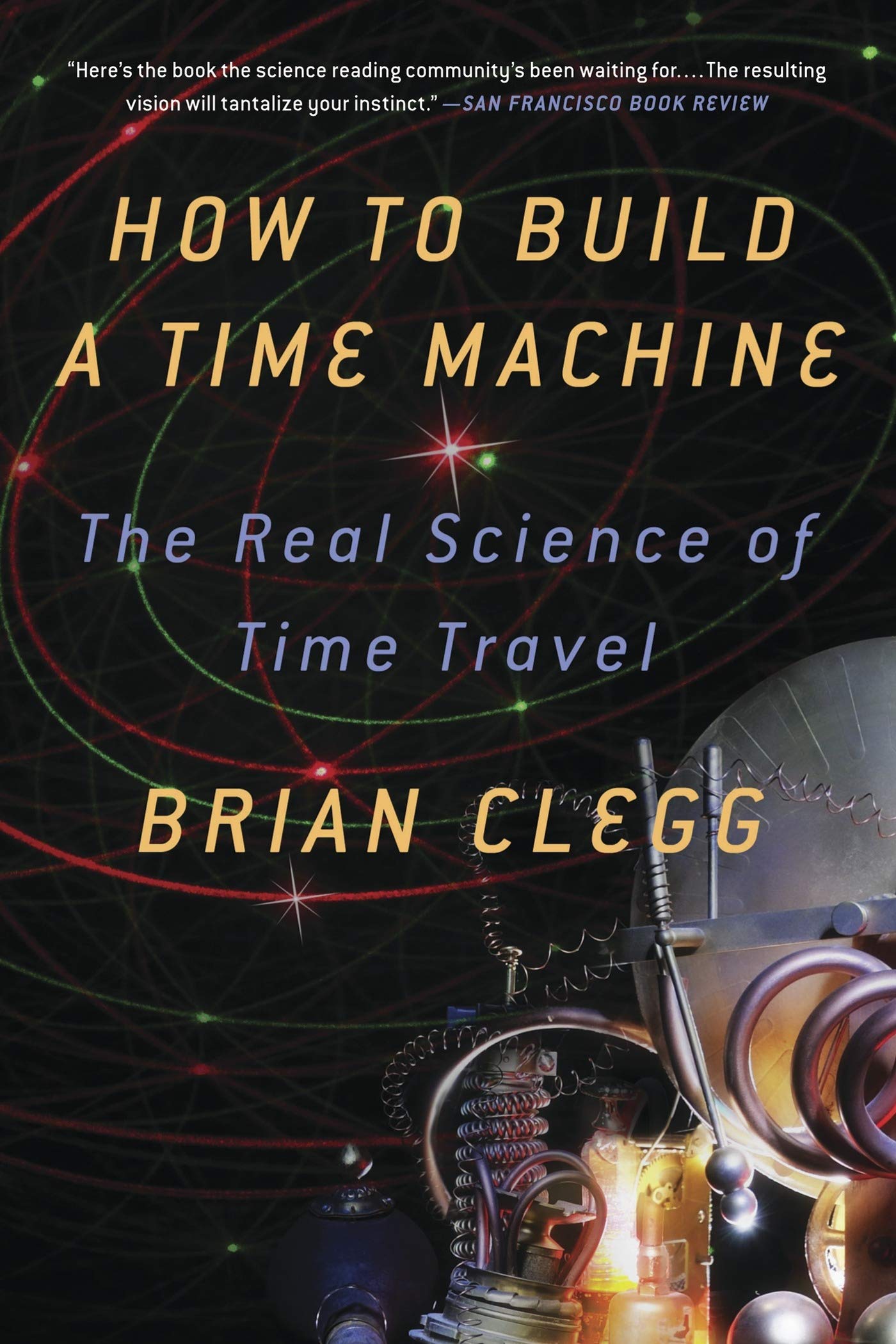
Clegg's title, How to Build a Time Machine, is essentially tongue-in-cheek. He doesn't really tell us how to build a time machine; he gives us a history of what famous thinkers have thought about the nature of time, and an overview of current physics theory concerning it. There are no steps given as to how to build an actual machine. This is because Clegg is a mainstream scientist, and mainstream science is limited by the orthodox parameters it sets for itself. No "fringe" speculation here. Clegg dutifully plods through the known to reach a "maybe-if" outcome. If anything needs some woo-woo, outside-the-box, imaginative free-thinking, it is time travel. But in Clegg we have a thorough-going conformist. He briefly snipes at Reiki as a pseudoscience so as to establish his credentials as a "real" scientist (all real scientists recognize a pseudoscience when they see one). He credits Russian researcher Vadim Chernobrov with doing some potentially interesting experiments with slowing time, but notes that Chernobrov is a UFOlogist and then hastens to label his research as "very much a fringe activity without accepted scientific backing or verification." In other words, Chernobrov is a loon operating outside of official scientific consensus reality. If he were actually to discover a method of time travel, he would remain a loon and his work relegated to the dark abyss of pseudoscience. To me, the prospects of creating a method of time travel are enormously restricted by Clegg's (and other mainstream scientists') "I'm OK, but you're not" approach to such exploration.Further, Clegg ignores the whole question of how consciousness itself might be a critical factor in the development of time travel. Mainstream science guys always assume that their particular left-brain way of perceiving reality is a given. I call it "default consciousness" because it is the most pervasive form of consciousness we experience, ergo, it is the only quality of consciousness there is--particularly if it is being used for "serious" purposes such as scientific investigation. Whenever a science guy rattles on and on about something like time travel without noting the influence of his own state of consciousness on his thinking process (especially the role of the observer effect on possibility waves, etc.), you are in the mainstream to the max.In sum, the book can be useful as a reference source for major figures in the development of scientific thought and as a summary of current quantum physics theory, but as a practical builder's manual for a time machine, it pales next to the Harry Potter books.
T**L
good read
This is a well written book and I enjoyed it very much
D**M
Good Science
Brian Cl egg knows how to explain hard Science. I have read all of his books. A must read for all those interested in these subjects.
D**.
Five Stars
Great book. Arrived as described.
ترست بايلوت
منذ أسبوعين
منذ شهر
منذ شهر
منذ 3 أيام