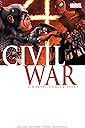
Civil War
Product ID: 110786655
Collects Civil War (2006) #1-7. Whose side are you on? A conflict is brewing that threatens to pit friend against friend, brother against brother and all it will take is a single misstep to cost thousands their lives and ignite the fuse! As the war claims its first victims, no one is safe as teams, friendships and families begin to fall apart and the Marvel Universe super heroes go to war against each other. Review: Superb writing & engrossing storytelling - Civil War opens with a horrific event. A team of teen heroes, working on a reality tv show, go after some villains way beyond their capability. A school full of children is destroyed when the Nitro unleashes an enormous explosion. In the wake of the tragedy, the US government responds to public pressure by passing the Superhero Registration Act (SHRA) - all superpowered people must now register with, work for, and be accountable to, the Federal government. This Act divides the heroes for and against the law: Tony Stark's Iron Man in support of it, and Captain America in opposition to it. The creators of Civil War tried keep the story from being black and white. There's supposed to be no "villain," just two groups divided over opinion. However, I don't think they fully succeeded in doing so. Tony is not evil, but he is WRONG. Cap's people are technically criminals, breaking the law. But, just because a law exists does not make it right or just. The government sanctioned internment camps for Japanese citizens during WWII, and Prohibition seemed like a good idea. But, people are trading freedom for security (something the Civil War writers specifically mention in the commentary). Though Cap is on the wrong side of the law, it is Tony's pro-SHRA side that makes the morally questionable decisions - like cloning Thor and forcing/using supervillains to hunt down Cap and his colleagues. The writers tried to paint Tony as making a difficult choice because he believes in it. Instead, it was more like acting out of guilt and ego; losing the adulation of the public was as horrific for him as the innocent deaths. Tony, unlike many heroes, is shielded from the more severe consequences of the SHRA. He's still rich; he'll not be the hero on street that has to be licensed to break up a mugging. He (and Reed) will run things from inside the ivory tower; they will still exercise power. I don't think Tony came off as a villain, but I do think he came across as weak and cowardly. He's a futurist, but it is always a future he builds and controls. For Cap, popularity has never been a goal, or even a benefit. He fights for what is right, and it is wrong to force people to work for the government because of gifts/skills they possess. Should all expert marksmen have to join the military? Or geniuses forced to work in government labs? Taking away freedom may provide security, but then you have the House of M. I do feel the writers stayed true to the characters. Cap and Tony's thoughts and actions make sense, as do their allies (even to some side-switching). Further, the conclusion was the only one that could work. ***SPOILER*** Registration has to prevail, or the crossover would have been meaningless; the status quo would not have changed. Civil War is downright depressing at moments, seeing these heroes fight their friends, but it is also a superb piece of writing. I look forward to seeing how the chips fall in the Marvel Universe. The first half of the Civil War hardcover collection is the main event. The second half of the collection has bonus materials which include: an interview with the creators, some fake newspaper articles and headlines covering the Registration act, as well as the full script of Civil War. The script section was especially enlightening as it includes commentary from the creators interspersed throughout. Readers learn why certain things unfolded as they did, why some panels were drawn the way they were, and more importantly, what the creators feel Cap and Tony were thinking during the story. Overall, this event was downright amazing and I look forward to reading the tie-ins. Highly recommended! Review: This book is still my favorite Marvel "event book" of all time! - This book collects one of Marvel's most-loved, most famous, and best-selling "event" comics of all time - Civil War. In the main story, a super hero registration act is passed by the US government and all crime fighters and persons with special abilities and powers must register with the government and reveal their secret identities. Some heroes (primarily those who are already publicly known) have no issue with this and comply. Many heroes, though, are strongly opposed to this idea and the threats it would bring against their loved ones and family if their identities were public knowledge. With two coalitions of heroes forming on both sides of the issue and one forced into making the other side comply with the new law, a civil war among the heroes ensues. This book is chock-full of shocking scenes and climactic battles - all gorgeously rendered by the talented hand of Steve McNiven -one of the best pencillers in the biz. Steve gives his illustrations a very life-like and realistic appearance. His characters have a powerful presence on the page, and (I know this sounds strange, but it's true!) the clothing and costumes they wear look more credible and true-to-life than any I've seen drawn by any other comic book artist! He's very, very good at what he does, and the colorists on the book just knock it out of the park, too. This book is a fun story to read, is beautiful to look at, and has long-lasting repercussions that affect the entire Marvel universe in hige ways for the next several years that followed this event. This is an excellent book to read (a must-read for comic fans), and this particular format is the best available. The hardcover edition comes with many reprinted bonuses, including a cover gallery, sketches, a press release surrounding the event, and a script of the story. I am very happy to own this book and I never hesitate to recommend this to friends of mine that enjoy comic book stories. It is one of my all-time favorite Marvel books, and I strongly suggest you check it out some time!
| Best Sellers Rank | #34,878 in Kindle Store ( See Top 100 in Kindle Store ) #5 in Military Graphic Novels #28 in Marvel Comics & Graphic Novels (Books) #119 in Superhero Graphic Novels |
J**D
Superb writing & engrossing storytelling
Civil War opens with a horrific event. A team of teen heroes, working on a reality tv show, go after some villains way beyond their capability. A school full of children is destroyed when the Nitro unleashes an enormous explosion. In the wake of the tragedy, the US government responds to public pressure by passing the Superhero Registration Act (SHRA) - all superpowered people must now register with, work for, and be accountable to, the Federal government. This Act divides the heroes for and against the law: Tony Stark's Iron Man in support of it, and Captain America in opposition to it. The creators of Civil War tried keep the story from being black and white. There's supposed to be no "villain," just two groups divided over opinion. However, I don't think they fully succeeded in doing so. Tony is not evil, but he is WRONG. Cap's people are technically criminals, breaking the law. But, just because a law exists does not make it right or just. The government sanctioned internment camps for Japanese citizens during WWII, and Prohibition seemed like a good idea. But, people are trading freedom for security (something the Civil War writers specifically mention in the commentary). Though Cap is on the wrong side of the law, it is Tony's pro-SHRA side that makes the morally questionable decisions - like cloning Thor and forcing/using supervillains to hunt down Cap and his colleagues. The writers tried to paint Tony as making a difficult choice because he believes in it. Instead, it was more like acting out of guilt and ego; losing the adulation of the public was as horrific for him as the innocent deaths. Tony, unlike many heroes, is shielded from the more severe consequences of the SHRA. He's still rich; he'll not be the hero on street that has to be licensed to break up a mugging. He (and Reed) will run things from inside the ivory tower; they will still exercise power. I don't think Tony came off as a villain, but I do think he came across as weak and cowardly. He's a futurist, but it is always a future he builds and controls. For Cap, popularity has never been a goal, or even a benefit. He fights for what is right, and it is wrong to force people to work for the government because of gifts/skills they possess. Should all expert marksmen have to join the military? Or geniuses forced to work in government labs? Taking away freedom may provide security, but then you have the House of M. I do feel the writers stayed true to the characters. Cap and Tony's thoughts and actions make sense, as do their allies (even to some side-switching). Further, the conclusion was the only one that could work. ***SPOILER*** Registration has to prevail, or the crossover would have been meaningless; the status quo would not have changed. Civil War is downright depressing at moments, seeing these heroes fight their friends, but it is also a superb piece of writing. I look forward to seeing how the chips fall in the Marvel Universe. The first half of the Civil War hardcover collection is the main event. The second half of the collection has bonus materials which include: an interview with the creators, some fake newspaper articles and headlines covering the Registration act, as well as the full script of Civil War. The script section was especially enlightening as it includes commentary from the creators interspersed throughout. Readers learn why certain things unfolded as they did, why some panels were drawn the way they were, and more importantly, what the creators feel Cap and Tony were thinking during the story. Overall, this event was downright amazing and I look forward to reading the tie-ins. Highly recommended!
N**R
This book is still my favorite Marvel "event book" of all time!
This book collects one of Marvel's most-loved, most famous, and best-selling "event" comics of all time - Civil War. In the main story, a super hero registration act is passed by the US government and all crime fighters and persons with special abilities and powers must register with the government and reveal their secret identities. Some heroes (primarily those who are already publicly known) have no issue with this and comply. Many heroes, though, are strongly opposed to this idea and the threats it would bring against their loved ones and family if their identities were public knowledge. With two coalitions of heroes forming on both sides of the issue and one forced into making the other side comply with the new law, a civil war among the heroes ensues. This book is chock-full of shocking scenes and climactic battles - all gorgeously rendered by the talented hand of Steve McNiven -one of the best pencillers in the biz. Steve gives his illustrations a very life-like and realistic appearance. His characters have a powerful presence on the page, and (I know this sounds strange, but it's true!) the clothing and costumes they wear look more credible and true-to-life than any I've seen drawn by any other comic book artist! He's very, very good at what he does, and the colorists on the book just knock it out of the park, too. This book is a fun story to read, is beautiful to look at, and has long-lasting repercussions that affect the entire Marvel universe in hige ways for the next several years that followed this event. This is an excellent book to read (a must-read for comic fans), and this particular format is the best available. The hardcover edition comes with many reprinted bonuses, including a cover gallery, sketches, a press release surrounding the event, and a script of the story. I am very happy to own this book and I never hesitate to recommend this to friends of mine that enjoy comic book stories. It is one of my all-time favorite Marvel books, and I strongly suggest you check it out some time!
D**A
Primer for the MCU's Captain America: Civil War
Civil War should serve as a primer for the upcoming Marvel Cinematic Universe's Captain America 3: Civil War, with all the appropriate changes reflecting the differences between the Marvel Comics and Marvel Studios films. Time will tell to see which story beats make the cut and which (The New Warriors' reality TV publicity stunt) will be ignored. As a disclaimer, I must state that I haven't been a regular reader of Marvel comics since the late 90s/early 00s so all the the shifts and changes over the last decade to the Marvel Universe are new material to me. Like the majority of the casual MCU audience, my interest in the Marvel Universe centers around the films, which present a unified, coherent collection of related characters, films and story arcs. Civil War at times felt as though it belonged to the What if? series of Marvel comics thanks to the flexibility the comic medium provides (no Marvel Universe character ever stays dead unless said character is irrelevant/obsolete), but the story arc did have lasting effects on the Marvel Universe, with the notable backtracking of the subsequent death of Steve Rogers, who reappeared alive and well so that he could lose his Super Serum, become a senior citizen and pass the mantle of Captain America to Sam Wilson. I did not read the explanation for how Steve Rogers was brought back after being assassinated; I only read Civil War as a primer for the upcoming film. But the underlying conflict of ideology between personal freedom, represented by Steve Rogers and national security, represented by Tony Stark appears to remain the central focus of Civil War, with Peter Parker in moral conflict over which side to support. The heroes representing the US Federal Government eventually resort to recruiting super villains out of a morally dubious inter dimensional super vault with Lo Jacks installed in them to keep them from running or reneging on their agreement to arrest (yes, super powered criminals tasked with the apprehension of super powered heroes turned vigilantes) the renegade heroes, removing some of the moral grey area of the original concept. Eventually, Civil War regresses into a basic two super teams conducting a slugfest brawl in public (Manhattan, NYC), right at home in any comic book, and ends with a time out called by Captain America speaking as the voice of reason when he realizes the fight over the argument for personal freedom has become nothing more than heroes fighting, resulting in massive collateral damage and distrust and fear by the ordinary people they are supposedly fighting to protect. Civil War brings up similar themes to what was previously explored both in the Marvel Comics and in Marvel films (not the MCU) with the Mutant Registration Act from the X-Men, with the key difference being that "Hero Registration" is presented as a prerequisite for being a super hero, whereas mutant registration amounts to racial profiling. In this sense, Civil War has more in common with DC's Watchmen and the Keene Act that effectively outlawed costumed adventurers/vigilantes barring those who made their identities public and became agents of the Federal Government. Well worth reading for those who like to have some background knowledge of upcoming MCU films.
C**N
The story that ruined the Marvel universe
Collects Civil War issues # 1-7 A fight between a team of young amatuer superheroes and some minor supervillians lead to the deaths of 600 innocent civilians, including an elementary school. This leads the US Congress to pass the Superhero Registration Act, requiring all superheroes to register with the government. Sounds reasonable, right? But this is comics, folks. Whatever super-duper firewall you create to hide this information can be broken into by a super-duper criminal hacker. "Become a federal employee, or get thrown into jail" simply because you have super-powers? The Marvel heroes split down the middle, led by Iron Man on the pro-registration side, and Captain America on the anti-registration side. DC and Marvel are always creating these crossover events that "will change our entire universe forever!" For once, they told the truth. And many Marvel fans hated it. I have to admit, it's hard for me to respect Iron Man or Reed Richards after this, and as for anyone else who took their side like She-Hulk, well, I just have to pretend they didn't. In spite of the controversy, I think this is a great, Watchmen-esque story that looks at superheroes from a more realistic point of view (which may be why some people hate it). Although this book gives you a complete story that more or less works, you won't really get the full story unless you get some of the better tie-ins. For example, you won't really get what's going on with Spider-Man unless you read The Amazing Spider-Man: Civil War . I'm solidly on Captain America's side, and Straczynski's Spider-Man book put me there. Edit to add: I'm not that familiar with Captain America, but it's probably a fair criticism of this book that its portrayal of Cap is out of character. (This may go for Tony Stark and Reed Richards as well.)
C**N
An original. A True Comic Book Classic.
In this seven issue series humans have become fearful of super powered types even seeking legislation to get them under control. When a young group of heroes destroys a school and kills many civilians while trying to save them all hell breaks loose. The government issues the "Superhuman Registration Act" a law forcing all super humans, heroes and villains, to reveal their true identities to the government and basically become employees of the U.S. military or else go to jail. The act splits the superhuman community down the middle with Captain America leading the heroes against the act and Iron Man leading the heroes that support it. The main arguments are that the heroes against the act feel that revealing who they are will put their loved ones in danger. While the heroes in support of it promise the identities will only be made available to the government. So the government tasks Iron Man and the supporters of the act to work with SHIELD, the governments' top military branch to bring those that don't support the act to justice. Those that don't abide the new law must go to a top secret prison built by Iron Man and Mr. Fantastic of the Fantastic Four that's tucked away in another dimension. Not only do we get some beautifully drawn art, but we get stories and interactions never before seen in the marvel universe. The story is built to parallel our own current situation in the United States and is ultimately an integral part of comic history. The ending is beautifully handled by Mark Millar. It does not end with fancy explosions or scenes of glory and triumph that most comic fans are used to. It really gets you thinking.
R**P
Grand restart for the marvel universe...
This event is brilliant, the art is even better...truly the best art ever seen in a mainstream comic. Steve McNiven deserves a lot of credit for this, eventhough it did cause some delays in the event slowing it down somewhat and lessening anticipation. Now that it is combined in a single collection it reads like a charms though. Also I like the clever ending, credits to Joss Whedon for that one! Mark Miller delivers a great story, although it feels slightly less cohesive then most of his other work. This might be because it had to work with a lot of tie-in issues taking some of the spotlight away from this series. The most important part though is that this story leaves the marvel universe in a changed state, opening the door for lots of new and fresh stories. Great jumping on point for new marvel readers. All in all though, a must read! p.s. Read captain america civil war aswell, it puts the final touches on this story...
J**Y
Very good, but has one fatal flaw. Or does it?
I love the concept behind Civil War. The comic isn't perfect, but it's still a pretty good one if you know the majority of the characters. The Good: The scale and size of Civil War is insane. The amount of personalities and powers coming together in the story make it so fun. The artwork really does a great job at illustrating the intensity and size of each battle. Even with all these characters, the story flows very well. It's not too touchy feely, nor is it Michael Bay explosions and WTF moments all the time. The action and emotion of the story work together very well to keep the reader invested in the story. The Bad: There really isn't too much, but a big problem (while also being a good thing) is the scale. There's so many characters with so much exposition you won't really understand if you start reading this story with no knowledge of other previous Marvel backstories. There's also a lot of character that kind of just come and go for a few pages. They do their job, then get out. It makes me wish they made the story on a smaller scale so we could spend quality time with certain characters rather than cramming in all these other characters the story doesn't really spend enough time with. The Verdict: It's a solid story, but it'll probably make more sense if you have an understanding of who a good portion of all these characters are.
H**E
Excellent Art, Average Story
"Civil War", Marvel Comics' most controversial story ever published is collected here in its entirety. Originally a seven-issue mini-series, Civil War was a multi-pronged storyline that actually was dealt with in several of Marvel Comics serial publications, but the core story is here. It begins as a group of college-aged superheroes, The New Warriors, discover and ambush a group of escaped super-criminals who were in hiding in Stamford, Connecticut. The New Warriors are the stars of a superhero-based reality TV series, and for some of the Warriors (Speedball in particular), ratings are as much a motivation as civic duty. Unfortunately for the Warriors, one of their quarry is Nitro: a villain who can literally explode himself with the force of an H-bomb, then re-form himself with no ill effects. The Warriors' fight meets a tragic end when Nitro uses his bomb-power right next to an elementary school--the high-level explosion ends up killing roughly 800 or so people, including the heroes and Nitro's confederates. When news of the tragedy hits the media, a firestorm of public opinions places the super-hero community under unprecedented scrutiny. Due in part to the political activism of the mother of a Stamford victim, U.S. Congress passes a new Super Human Registration Act (SHRA), which effectively requires all would-be crime fighters (and essentially, anyone with a super-power) to register with the federal government--subsequently, they would be eligible for formal training and deputization as an officially sanctioned super-hero. Leading the pro-registration initiative are Tony Stark, a.k.a. Iron Man, himself a former Secretary of Defense for the White House. His top lieutenants in this endeavor are Reed Richards (Mr. Fantastic) of the Fantastic Four and Hank Pym (Yellowjacket) of the Avengers. Between the three of them, they conceive dozens of potential strategies to use in the execution of the new status quo for costumed adventurers. Among them is `42'--a trans-dimensional prison where super-criminals--and potentially, unregistered superheroes--will be placed. The abruptness of the passing of the act, as well as the apparent militarization of its enforcement via the espionage/counter-terror outfit SHIELD doesn't sit well with WWII veteran and longtime iconic crime fighter Captain America. When he balks at registering, he is labeled an enemy of the state, and hunted by government forces as well as the newly registered heroes under Iron Man. `Cap' begins recruiting fellow dissenters among the super-hero community, and they form an anti-resistance partisan movement. The SHRA basically splits the American super-hero element in half--some see it as a natural evolution to make superheroes a `legitimate' arm of law-enforcement. Others see it as big-government interference, with super-heroes as `Good Samaritans' who help people when standard law enforcement can not--or will not--intervene. During the course of the saga, some heroes die, some switch sides, some make choices that will have drastic consequences for the future, whatever the outcome. Artist Steve McNiven is an excellent draftsman; his photo-realistic artwork helps maintain the conceit that all the characters are real people, which is appropriate, given the dark themes explored in the book. Author Mark Millar attempts a deconstructive analysis of the role of the `super-hero' in a post-911 America: Most, by traditional legal definitions would be considered vigilantes; he seems to ask the question- is it truly oppression to create legal safeguards for superheroes, to weed out the reckless and the unstable? Is the U.S. government really prepared for the ethical and legal consequences of having a virtual army of superhumans at their beck and call? The political subtexts exposed here are self-evident, and depending on the reader's political alignment, they may find themselves elated or infuriated with them. While several events throughout the story are exciting, the resolution is somewhat anti-climactic. Also, as mentioned above, several parallel stories were told throughout other Marvel comic book series-- Spider-Man, New Avengers, and more---so purchasing them will give readers a much more thorough examination of this saga, but may prove annoying for readers who don't want to buy multiple volumes for a `single' story.
J**B
Awesome!!!
Loved the quality and storyline. It took me a journey with heros like never before. Just wonderful!! Can't wait to read more
C**N
Juste INCROYABLE
À l'approche du film très bientôt en salles j'ai voulu lire le comic de base. Il est juste génial. L'histoire est captivante et recherché avec une vraie morale. Je préfère lire en anglais parce que ça fait plus vrai et aussi tout simplement parce que ça me fait progresser. Sans vous cacher que je suis du côté d'IRON MAN, je suis vraiment satisfait.
J**S
¡¡¡Que no te eche para atrás el idioma!!!
Me llamo la atención, en primer lugar, el precio del producto. Cierto es que estaba en inglés, pero en español ronda sobre el doble. Era la primera vez que compraba este tipo de novelas en inglés y creía que iba a estar la mayoría del tiempo buscando en el diccionario, ya que en este tipo de novelas son muy dadas a las abreviaciones de las expresiones. Para mi sorpresa, he entendido a la perfección cada viñeta y si estás dudando en comprártelo por el idioma, te aconsejo que lo hagas. Está presentado en un formato de pasta blanda que, para mi gusto, lo hace más versátil. En cuanto al envío, rápido y en perfecto estado. Recomiendo esta novela. Confío que se establezca como obra magna de Marvel apoyada por el estreno la nueva película.
A**O
semplicemente splendido
bellissimo e consigliassimo. per gli appassionati di fumetti è un must. storia splendida e disegni perfetti per raccontare una storia nuova e interessante fin dalle prime pagine. a.
B**D
Amazing storyline
Better than the movie!
Trustpilot
1 month ago
5 days ago