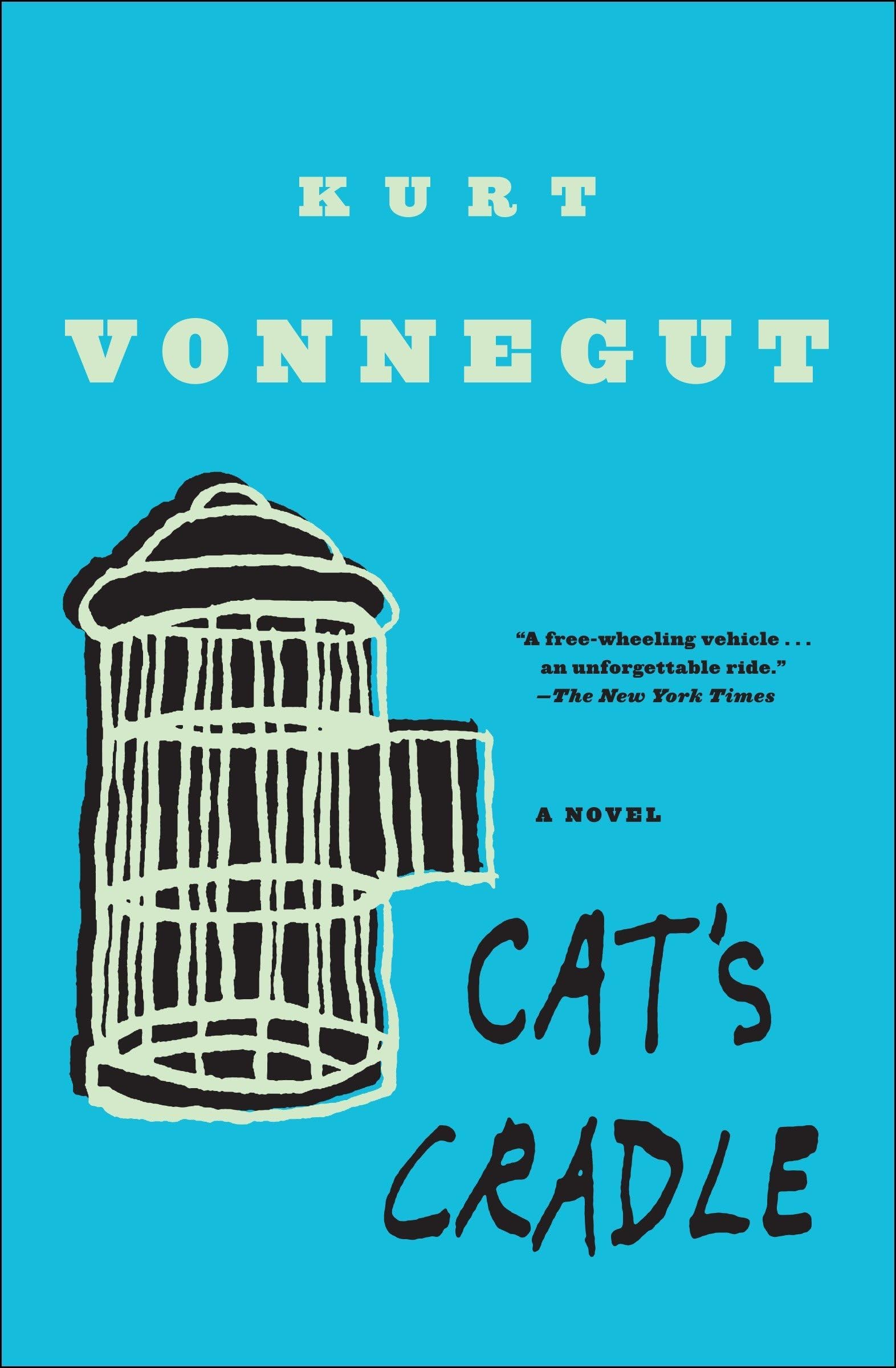
Cat’s Cradle
Product ID: 1312673
🌍Apocalyptic satire on humanity's fate
📚127 short chapters for quick, engaging reads
🧊Ice Nine: fictional element with world-freezing power
Desertcart purchases this item on your behalf and handles shipping, customs, and support to OMAN.
📖 Unlock the cult satire that’s freezing the world in its tracks!
Cat’s Cradle by Kurt Vonnegut is a seminal satirical novel featuring 127 short chapters that explore the absurdity of modern man through a darkly comedic apocalyptic narrative. Centered around the fictional Ice Nine, a substance capable of freezing the world, the book blends sharp social critique, original theology, and unforgettable characters. Highly rated and widely celebrated, it remains a must-read classic for discerning literary enthusiasts.


| Best Sellers Rank | #7,343 in Books ( See Top 100 in Books ) #11 in Fiction Satire #294 in Literary Fiction (Books) #366 in Classic Literature & Fiction |
| Customer Reviews | 4.4 out of 5 stars 13,141 Reviews |
C**6
A Parable For The End of Time
Cat's Cradle is arguably Vonneguts greatest work, although I haven't read them all. It's about the end of the world, and starts on the anniversary of the end of the world for the Japanese, the day the atom bomb was dropped on Hiroshima. Our protagonist, Jonah, is writing a book about the end of the world. He ends up interviewing the offspring of the father of the atom bomb, Dr. Felix Hoenikker, an eccentric, seemingly uncaring father who, unbeknownst to most, also makes "Ice Nine" before he dies. Ice Nine causes everything to freeze. It precipates the end of the world. Before Ice Nine takes over, and freezes the world, Vonnegut takes us on a whirlwind tour of the hearts and minds of a slew of zany characters, from Newt the midget, son of The Father of The Atom Bomb, to a secretary who disdains anyone who "thinks too much," to a philanthropist who turns out to be the complete opposite, to a zillion others (almost too many) in between. We are taken to the island of San Lorenzo, a Carribean banana republic run by a paranoind, eccentric dictator that is totally at the beck and call of the USA, and that is where things really get weird. This book is divided into 127 very short chapters, which makes it not only easier to read and remember, but also made it easier, I'm sure, for Mr. Vonnegut to write. One of the main points of this story, if I understand correctly, is that religion, in this case "Bokonism," is pretty much a hodge-podge/hocus-pocus bed of spectacular lies. In the end, the founder of Bokonism, Bokonen, admits himself that it was all a complete joke, not to be taken sersiously (how can anyone take seriously a religion where people make love by rubbing their feet together?), but I won't spoil it by telling you what happens in between. Mad scientists and their nervous secretaries, midget kung-fu, foot sex, countless hungry, skinny, stupid natives, one beautiful, "healthy" native, fat businessmen here to save the world, steep jungles, waterfalls, underground bomb shelters, earthquakes, tornadoes, fire and brimstone (don't tell Vonnegut I said that), horse faced flute playing enfent terribles, and much, much more. Oh, and I almost forgot. Ice Nine. How could I forget Ice Nine? This book is a parable for the end of time.
A**R
Good read second time even better
Read all Vonnegut books in college English class. Second reading gives more understanding of his humor, satire, and political criticism. Great for a book club read.
P**O
Great price & performance
This isn't about the contents of this book. Plenty of other places you can get that info. This review is about this version/printing. Good student version. Uncoated paper for pages, decent font size, lightweight binding. It'll last the semester. You won't wince at the price if you need to recycle at the end of school year.
W**Y
A classic dark satire on the Cold War
Back when I was in high school and college (shortly after the dinosaurs died off) Kurt Vonnegut was probably the most read author among my peers, followed closely by J.R.R. Tolkein and Hermann Hesse. Of these three, Hesse's novels addressed the spiritual restlessness of the 1960s, Tolkein was like a few hits off a bong that allowed the reader to experience an entirely different world, and Vonnegut, well he was the one who best expressed the frustration and lack of faith in our leaders and government. Vonnegut, followed closely by Mark Twain, was the greatest satirist this country ever produced. He took on all the topics of the day with a wit that was as sharp as a rapier's edge. He had the ability to make you laugh and squirm at the same time. His passing a few years ago left a void in American literature. ("So it goes," to quote another of his books.) Cat's Cradle is one of a handful of Vonnegut's books that rank among the best of 20th century literature. Re-reading it after a couple of decades is to immerse oneself again into a familar stream. I'm glad I had the chance to read Cat's Cradle years ago. To read it for the first time now, in the post-9/11, post Cold War era, must seem a bit daunting. Without the background of living through a time when nuclear missiles were poised to reign down annihilation on mankind, some of Vonnegut's bitter humor is lost. Put it remains a powerful voice. In a mere 300 pages and 100+ very short chapters, Vonnegut manages to construct a novel that pulls together the threads of a uniquely dysfunctional family, an outlawed religion, a banana republic dictatorship on a small Carribean island, a secretly created substance that can destroy the world, and ... well, so much more that you wonder how he will ever pull it off without unraveling all the various threads. Somehow he does it and, in the process, turns those threads into a tapestry of human folly. That's the true genius of Vonnegut. That his unique voice and vision will still be around a century from now seems inevitable!
R**.
Classic Satire
Okay -- three stars. That's what I think OTHER readers will think of this book. I think it is worth four stars. But this review is supposed to try and be helpful to you, dear reader, so I do not wish to inflate how good YOU might think this book is. But let's face it: It's Vonnegut. Satirical. Whimsical. Deadly earnest in a half-joking kind of way. Not particularly optimistic about the future of us People, and not, apparently, particularly fond of us either. Three stars of Vonnegut is worth maybe four stars of Wolfe, maybe five stars of Koontz. Just three stars of Twain, though. So about this book: it's a quick read. There are like 127 chapters in the story, but they all fit (in my edition) into just 287 pages. 287 very spacious and roomy pages. The chapters tend to be about a page-and-a-half long, some just a couple of paragraphs. Vonnegut bounces right along, telling the story of John, as John seeks to write a biography of one of the father's of the atom bomb. (A fictional father.) The work no doubt contains some of Vonnegut's more creative ideas: ice-9; Bokononism; Mona Aamons Monzano, the most beautiful girl ever; a completely incomprehensible dialect of what might have once been the English language; and, of course, the end of the World. The story starts out innocently enough, but one thing just leads to the next and the next and before you know it, you will find yourself enmeshed in a world of utter ridiculousness, but you had better take it seriously or you may end up on "the hook." Pronounced "hy-u-o-ook-kuh." So, not too deep, but deep enough. Not too, too funny, but totally, irreverently so. Not too long, but not too short. You will most likely enjoy this book.
R**E
Review of the Rosetta Books e-book Kindle edition
I don't want to spend too much time writing a review of what is, in essence, a classic novel. This is my first reading of Cat's Cradle, and my first time reading anything of substantial length by Kurt Vonnegut. The simple reason I don't want to spend too much time reviewing this book is that it has already been reviewed countless times, especially by people far more familiar with it than I am. SPOILER ALERT! This is a short book, and it's almost impossible to avoid spoiling even the ending while trying to discuss significant aspects of the work. Also, this book has been around a while, meaning it's highly unlikely you won't have heard at least a capsule summary of the plot. That said, the following two paragraphs reveal details near the end of the book. There were only two things I found disappointing in the story: First, there was no speculation nor explanation given as to why there would suddenly be purple-mouthed tornadoes all over the place. Perhaps that was just the author's speculation about the knock-on effects of all the Earth's water suddenly converting to ice-nine. Second, there was mention of a strange nimbus ("lavender corona") surrounding the "weird plug" of rock sitting on the back of Mt. McCabe, and it wasn't clear if this was some strange phenomenon or not; the narrator spoke of his desire to visit this formation, to climb it, but he never reports doing so. It's an unexplored detail, and in such a slender volume, such things make me wish for more. The writing was excellent: literate, trenchant and witty. This is my first foray into Vonnegut, so I have no other points of reference to go by. The Rosetta Books edition of this Kindle e-book seems to fall somewhere between the ultra-cheap e-books (free or $0.99) and the premium e-books (with list prices close to those of the print editions) sold by Amazon -- both in terms of price and in terms of general quality. This edition was mostly decent, but had some typesetting issues with punctuation (wrong type of quote or apostrophe used -- open quote instead of close quote, for instance). Further, there were several cases where it was obvious that the text was obtained using OCR of a print edition, and this manifested frequently as the wrong letter in a word, or a letter like "m" being replaced by "rn." I was never unable to determine what was truly meant in any passage, but the handful of flaws in this e-book could be easily corrected.
D**R
My all time favorite
My favorite book since the first of many reads. It never ceases to comfort me; especially in times like now.
S**T
Kurt Vonnegut is a wonderful part of our American Heritage.
I encountered AN ENGLISH MAJOR with a graduate degree who had NEVER read any of Kurt Vonnegut's masterful works. None. Vonnegut's first novel, Player Piano, was so far ahead of its time that people still have not digested its message that unbridled complexity is beyond the control of humans, and it will eventually get us if we don't watch out! This novel is the starting point to enter Kurt's virtual reality. It's where he gives birth to a number of his recurring characters. And it's a fun fun fun and entertaining read. And you accidentally learn deep truths about the human condition that you don't even notice as you are exposed to them -- especially as applies to religion. Everyone should read this book. If they are normal -- or at least human -- they will want to go on and read more of Mr. Vonneguts fine works. Praise Bokonon, and may you all escape being crucified on The Hook!
C**N
Fabulous
I have nothing to add, is a classic, easy to read, in a perfect penguin edition
A**S
“History!” writes Bokonon. “Read it and weep!”
A lady whose name I cannot recall suggested this reading after I blabbered my opinion on our species. Three years later I stand dipped in gratitude toward her. Maybe the notion of Rochester’s “Imperfect enjoyment” suits the emotion this book has delivered. An exquisite and irreversible imperfect enjoyment. I am not the same after reading this. I am now eager to indulge in my brand new vice and read everything Vonnegut ever wrote.
一**民
世界の終わる音はAH-WHOOOM
どことなくジャマイカを思わせるカリブ海に浮かぶ南の島が舞台のSF小説。 島では怪しげな現世否定の新興宗教ボコノン教が殷賑を極めていた。この宗教は 作者ヴォネガットのニヒリズム思想の代弁でもありユーモラス。 肝心のストーリーはこの宗教に特に関係なく、たまたまやってきたアメリカ人一家が 偶然に次ぐ偶然で、あっけなく世界を滅亡させてしまう、という話。世界の終末、という テーマはサイエンスフィクションのド定番中のド定番だが、科学的説明つけながらも、 本作ほど脱力感のある、どうしようもない終わり方をする作品を私は知らず、いつ 読んでもあっけにとられて笑ってしまう。 ちなみに世界の終わる音は、巨大な”AH-WHOOOM”という音だそうだ。 その音の正体が何なのか、は、ぜひ読んで確かめてみてほしい。 世界が終わった後も少しだけ終末後の世界の描写が続くのだが、これがどことなく心地よさそう。 ゾンビ映画でショッピングモールに立てこもって、嬉々とするシーンを思い浮かべてしまう。 こんな終わり方をする世界なら、ぜひ立ち会ってみたいものだ。
S**H
Oooh oui c'est bon ! :)
Kurt Vonnegut est un écrivain hyper intelligent, garde le suspens dans ses oeuvres. Je commence à peine à découvrir mais il est en train de rentrer dans mon top 5 de mes auteurs préférés de tous les temps :)
R**R
Probably on Kurt's top 5
Probably on Kurt's top 5 -- not as good as Slaughterhouse Five and Sirens of Titan, but definitely good
Trustpilot
1 month ago
4 days ago