
Desertcart purchases this item on your behalf and handles shipping, customs, and support to OMAN.
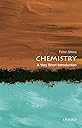
In this Very Short Introduction Peter Atkins inspires us to look at chemistry through new eyes. Considering the remarkable achievements chemistry has made, he presents a fascinating, clear, and rigorous exploration of the world of chemistry - its structure, core concepts, and contributions to the material comfort and culture of the modern world. Review: This is a GREAT very short Intro/Review of Chemistry! - THE BOOK: The Book that I am reviewing is available in two different titles, in two different eBooks from desertcart – they both have the same guts, but different titles and covers: 1)Chemistry: A Very Short Introduction (Very Short Introductions) [Kindle Edition] - $9.90 - Library of Congress Control # 2014948110 ISBN 978-0-19-968397-0 eBook ISBN 978-0-19-150812-7 File Size - 554Kb 144pages - Enabled: text to speech, word-wise, lending NOT Enabled: X-ray Available at extra cost: Audible audio-book $3.99 AND 2)What is Chemistry? [Kindle Edition] - $8.44 – Library of Congress Control Number: 2014948110 ISBN 978–0–19–968397–0 Call Number: QD 37 .A85 2013 File Size – 1787Kb 129 pages - Enabled: text to speech, word-wise, lending NOT Enabled: X-ray (If you need an audiobook format, you can get the Audible listed above, since is same content) CHAPTERS: • Preface 1. Its origins, scope and organization 2. Its principles: atoms and particles 3. Its principles: energy and entropy 4. Its reactions 5. Its techniques 6. Its achievements 7. Its future • Periodic Table • Glossary • Further Reading • Index REASONING: I chose this book to help remember Chemistry and what it is about, since I am following the Great War in real time. The first (successful) gas attack occurred on 22 April, 1915: Around 5:00 p.m. on the 22nd of April, the Imperial German Army released 168 long tons (171 t) of chlorine gas over a 6.5 km (4.0 mi) front, on the part of the line held by French Territorial and colonial Moroccan and Algerian troops of the French 45th and 87th divisions. The Imperial German Army had used poison gas (unsuccessfully) at the Battle of Bolimov on the 31st of January, but the gas liquefied because it was extremely cold – and this made it ineffective as a chemical weapon. The first use of chemical warfare was uneventful… unfortunately, the second use of chemical weapons resulted in over 7,000 casualties and deaths. “The French troops in the path of the gas cloud had c. 6,000 casualties, many of whom died within ten minutes, primarily from asphyxiation and tissue damage in the lungs, many more were blinded. Chlorine gas forms hypochlorous acid when combined with water, destroying moist tissues such as lungs and eyes. The chlorine gas, being denser than air, quickly filled the trenches, forcing the troops to climb out into heavy enemy fire.”[6] There were just as many casualties on the German side of the front due to the way that the gas was released “German troops carried 5,730 gas cylinders, weighing 90 pounds (41 kg) each, to the front by hand. The cylinders were opened by hand, relying on the prevailing winds to carry the gas towards enemy lines. Because of this method of dispersal, a large number of German soldiers were injured or killed in the process of carrying out the attack.[5]” In order for me to understand what all this means, I need to understand Chemistry and the Chemicals (in this case, the element Cl or Chlorine) that were used. I also want to understand how those chemicals affect people and the battle operations on the Western Front. REVIEW: This book was perfect for this purpose. It makes no assumptions about what your background is and therefore begins at a place that everyone can understand. It uses plain English to explain the basic concepts and reactions of Chemistry. The author (Peter Atkins) uses language that is easy to understand, describes things well, and gives many examples to explain his point. He also shows how important Chemistry is and what it has contributed to our modern lives – so much of what we do and use each day is affected by or is because of Chemistry! This is important to me because it helps me to feel like I am gaining knowledge that is useable and applies to my everyday life. It begins by stating what the science of Chemistry is and what it does for people today. I was really impressed that it affects so much of our lives today, and how much of the changes that happened in the early part of our century is because of this particular branch of science. Many of the innovations that we think of when we think about World War One (and also World War Two) are either because of engineering or chemistry – and many are thanks to both! Next the book explains what the Periodic Table is, how it works, and why it has the shape/design that it does. He then goes on to explain (fully for those of us who are just wanting to know the basics or people looking to review) about atoms, and how the structure of the nucleus and the electron clouds are important not just only in chemistry, but in life in general. Next up is bonding, with him explaining the different kinds of bonds, why and how they form. Chapter three explains energy, basic thermodynamics, and entropy in a way that is accessible for people of all levels. I found this part particularly useful as today one can hear popular explanations about energy and thermodynamics, but with the knowledge gained in this chapter, I can now tell if these arguments and explanations are accurate or not. It was also in this chapter that Atkins explains about the “Haber-Bosch process” which “lies at the head of processes that include the manufacture of much of the world’s agricultural fertilizer”. It is also the process which allowed for the production of nitrogen and other elements that the German Empire needed for producing ammunition and other materiel during the Great War. The next three chapters cover Chemistry’s reactions, techniques and its achievements. These chapters are the place where we see the most evidence of what Chemistry can do for people in everyday life. Atkins lists both the “good” and “bad” things that Chemistry can do. He covers medicine, food, and even negative things like pollution and chemical warfare. It was these chapters that made me want to know even more about Chemistry and what it does – I have found that Atkins has other books available in the Kindle store, and I am going to read them in the future, because I really want to know more now. CONCLUSION: I would recommend it to anyone who wants to know 1)what chemistry is 2) what the basic concepts of chemistry are 3) the good and bad of how chemistry has changed our lives and the planet and 4) areas that you find interesting to explore further. The books covers everything from atoms to chemical warfare (yes, he does include a brief summary about Fritz Haber and the Battle of Ypres). It is good for all ages and reading levels (if you don’t know a particular word that he uses, you can look it up in the glossary of the book or use the kindle feature where you click on the word and it gives you the definition). It is also just the right size so you can read all of it in a short time, or if you just want to read about a particular topic, you can just read that part. It is not dry or boring, which is important when reading about something like science. Review: You won't learn chemistry, but a framework on which to hang further learning. - A well written introduction, if too short. There is very little detail here so the amount of technical material one needs to absorb is small. But, the book does an excellent job of creating a framework under which to hang further chemistry knowledge if the reader decides to learn more. I understand little of chemistry, limited as I am to the mandatory high school chemistry course and one course in college, some 50 years ago, having learned chemistry mechanics without any chemistry concepts. The book gave me several ahah moments, and concepts. Enthalpy vs entropy vs energy. That if a chemical formula begins with H, it's an acid. An acid transfers protons. Where the terms oxidation and reduction come from. The framework of only four kinds of chemical reactions: acid-base, redox, radical reactions, and Lewis acids. When an electron cloud is pulled to another atom it may bring along the rest of its atom. The other framework is the few basic techniques that go on in the chemical laboratory. The book is certainly worth more than the few dollars being asked for. The silliness of the first review can be safely ignored.


| Best Sellers Rank | #114,093 in Books ( See Top 100 in Books ) #120 in Chemistry (Books) #148 in General Chemistry |
| Customer Reviews | 4.5 out of 5 stars 188 Reviews |
R**L
This is a GREAT very short Intro/Review of Chemistry!
THE BOOK: The Book that I am reviewing is available in two different titles, in two different eBooks from Amazon – they both have the same guts, but different titles and covers: 1)Chemistry: A Very Short Introduction (Very Short Introductions) [Kindle Edition] - $9.90 - Library of Congress Control # 2014948110 ISBN 978-0-19-968397-0 eBook ISBN 978-0-19-150812-7 File Size - 554Kb 144pages - Enabled: text to speech, word-wise, lending NOT Enabled: X-ray Available at extra cost: Audible audio-book $3.99 AND 2)What is Chemistry? [Kindle Edition] - $8.44 – Library of Congress Control Number: 2014948110 ISBN 978–0–19–968397–0 Call Number: QD 37 .A85 2013 File Size – 1787Kb 129 pages - Enabled: text to speech, word-wise, lending NOT Enabled: X-ray (If you need an audiobook format, you can get the Audible listed above, since is same content) CHAPTERS: • Preface 1. Its origins, scope and organization 2. Its principles: atoms and particles 3. Its principles: energy and entropy 4. Its reactions 5. Its techniques 6. Its achievements 7. Its future • Periodic Table • Glossary • Further Reading • Index REASONING: I chose this book to help remember Chemistry and what it is about, since I am following the Great War in real time. The first (successful) gas attack occurred on 22 April, 1915: Around 5:00 p.m. on the 22nd of April, the Imperial German Army released 168 long tons (171 t) of chlorine gas over a 6.5 km (4.0 mi) front, on the part of the line held by French Territorial and colonial Moroccan and Algerian troops of the French 45th and 87th divisions. The Imperial German Army had used poison gas (unsuccessfully) at the Battle of Bolimov on the 31st of January, but the gas liquefied because it was extremely cold – and this made it ineffective as a chemical weapon. The first use of chemical warfare was uneventful… unfortunately, the second use of chemical weapons resulted in over 7,000 casualties and deaths. “The French troops in the path of the gas cloud had c. 6,000 casualties, many of whom died within ten minutes, primarily from asphyxiation and tissue damage in the lungs, many more were blinded. Chlorine gas forms hypochlorous acid when combined with water, destroying moist tissues such as lungs and eyes. The chlorine gas, being denser than air, quickly filled the trenches, forcing the troops to climb out into heavy enemy fire.”[6] There were just as many casualties on the German side of the front due to the way that the gas was released “German troops carried 5,730 gas cylinders, weighing 90 pounds (41 kg) each, to the front by hand. The cylinders were opened by hand, relying on the prevailing winds to carry the gas towards enemy lines. Because of this method of dispersal, a large number of German soldiers were injured or killed in the process of carrying out the attack.[5]” In order for me to understand what all this means, I need to understand Chemistry and the Chemicals (in this case, the element Cl or Chlorine) that were used. I also want to understand how those chemicals affect people and the battle operations on the Western Front. REVIEW: This book was perfect for this purpose. It makes no assumptions about what your background is and therefore begins at a place that everyone can understand. It uses plain English to explain the basic concepts and reactions of Chemistry. The author (Peter Atkins) uses language that is easy to understand, describes things well, and gives many examples to explain his point. He also shows how important Chemistry is and what it has contributed to our modern lives – so much of what we do and use each day is affected by or is because of Chemistry! This is important to me because it helps me to feel like I am gaining knowledge that is useable and applies to my everyday life. It begins by stating what the science of Chemistry is and what it does for people today. I was really impressed that it affects so much of our lives today, and how much of the changes that happened in the early part of our century is because of this particular branch of science. Many of the innovations that we think of when we think about World War One (and also World War Two) are either because of engineering or chemistry – and many are thanks to both! Next the book explains what the Periodic Table is, how it works, and why it has the shape/design that it does. He then goes on to explain (fully for those of us who are just wanting to know the basics or people looking to review) about atoms, and how the structure of the nucleus and the electron clouds are important not just only in chemistry, but in life in general. Next up is bonding, with him explaining the different kinds of bonds, why and how they form. Chapter three explains energy, basic thermodynamics, and entropy in a way that is accessible for people of all levels. I found this part particularly useful as today one can hear popular explanations about energy and thermodynamics, but with the knowledge gained in this chapter, I can now tell if these arguments and explanations are accurate or not. It was also in this chapter that Atkins explains about the “Haber-Bosch process” which “lies at the head of processes that include the manufacture of much of the world’s agricultural fertilizer”. It is also the process which allowed for the production of nitrogen and other elements that the German Empire needed for producing ammunition and other materiel during the Great War. The next three chapters cover Chemistry’s reactions, techniques and its achievements. These chapters are the place where we see the most evidence of what Chemistry can do for people in everyday life. Atkins lists both the “good” and “bad” things that Chemistry can do. He covers medicine, food, and even negative things like pollution and chemical warfare. It was these chapters that made me want to know even more about Chemistry and what it does – I have found that Atkins has other books available in the Kindle store, and I am going to read them in the future, because I really want to know more now. CONCLUSION: I would recommend it to anyone who wants to know 1)what chemistry is 2) what the basic concepts of chemistry are 3) the good and bad of how chemistry has changed our lives and the planet and 4) areas that you find interesting to explore further. The books covers everything from atoms to chemical warfare (yes, he does include a brief summary about Fritz Haber and the Battle of Ypres). It is good for all ages and reading levels (if you don’t know a particular word that he uses, you can look it up in the glossary of the book or use the kindle feature where you click on the word and it gives you the definition). It is also just the right size so you can read all of it in a short time, or if you just want to read about a particular topic, you can just read that part. It is not dry or boring, which is important when reading about something like science.
L**R
You won't learn chemistry, but a framework on which to hang further learning.
A well written introduction, if too short. There is very little detail here so the amount of technical material one needs to absorb is small. But, the book does an excellent job of creating a framework under which to hang further chemistry knowledge if the reader decides to learn more. I understand little of chemistry, limited as I am to the mandatory high school chemistry course and one course in college, some 50 years ago, having learned chemistry mechanics without any chemistry concepts. The book gave me several ahah moments, and concepts. Enthalpy vs entropy vs energy. That if a chemical formula begins with H, it's an acid. An acid transfers protons. Where the terms oxidation and reduction come from. The framework of only four kinds of chemical reactions: acid-base, redox, radical reactions, and Lewis acids. When an electron cloud is pulled to another atom it may bring along the rest of its atom. The other framework is the few basic techniques that go on in the chemical laboratory. The book is certainly worth more than the few dollars being asked for. The silliness of the first review can be safely ignored.
T**M
Good Introduction to a very complex subject
I particularly liked the descriptions of where chemistry will lead in the future. The reason I gave the book four stars is the lack of illustrations of some of the basics, and my recollection of being laughed at by a lab instructor during analytical chemistry because of my horrible lab technique. Many of the difficulties of chemistry can not be understood without having a better understanding of the absolute requirement to be proficient in the lab and the amount of time that the lab demands, and the potential dangers while learning, and during experiments. Much time and energy can be wasted. I agree with the positive attitude about chemistry in the book, but feel it needs more cautionary material.
K**R
I had heard many times: "Chemistry is hard, smelly, and pollutes" I answer (having worked my whole life doing Chemistry)
I had heard many times: "(1)Chemistry is hard,(2) smelly,(3) and pollutes" I answer (having worked my whole life doing Chemistry): (1)Not if you have a good teacher, (2) sometimes, but less so with safer handling (3) sometimes, less so all the time with progressive laws and industry willingness to comply. If you are curious a good teacher is Peter Atkins,
M**N
Good introduction to Chemistry
This book is good introduction material to the given subject.
D**L
More of very brief stream of consciousness about chemistry
You can tell Atkins really knows his stuff and is very passionate about chemistry. So much so that he feels the need to explain how all other branches of science depend on his. Usually it's low-confidence physicists who do this, but I guess some low-confidence chemists want to put themselves over others, too. The book itself is a jumble of his thoughts about chemistry that covers a lot of aspects of chemical philosophy, without very much chemical science. Three stars because there are a few excellent sections on the science bogged down in a lot of other fluff.
K**R
Five Stars
This is a very good introduction to the field of chemistry.
H**L
A new light on chemistry
An informative and positive review of how chemistry affects the world and its inhabitants. Though there are negatives to chemistry — as there are in many thing around us — there are also many benefits. In the end, one is given a new perspective of this double-edged subject.
D**E
Excellent writer with outstanding " book like " presentation and ...
Excellent writer with outstanding " book like " presentation and economical coverage with useful references and definitions . I would however suggest expansion in terms of tables and explanatory illustrations .
M**4
good basics
my son wanted more insight into the subject as considering it for Yrs 11 & 12. He got what he wanted from it and did study chemistry.
A**N
Nice for educational purposes
@**3
Gut fürs Abi
Gut fürs Abi
T**Z
Illuminating
This very brief overview provides the material to catalyze interest in the fundamental building blocks of our existence and all that surrounds us.
Trustpilot
2 weeks ago
1 month ago