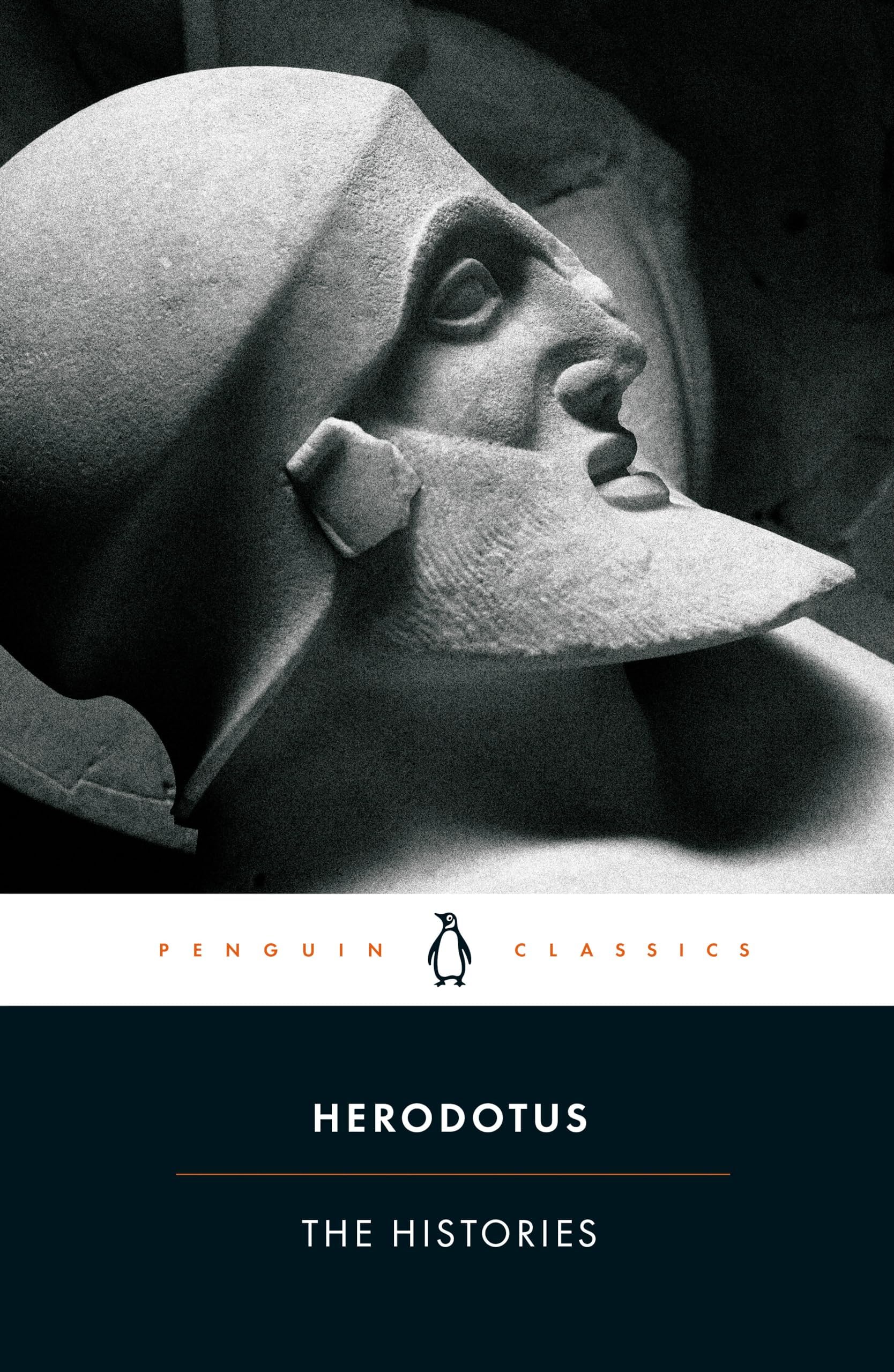
PENGUIN The Histories
Product ID: 266651799
🌍Global cultural insights
📚Classic foundational text
🏛️Ancient Greek historiography
Desertcart purchases this item on your behalf and handles shipping, customs, and support to OMAN.
🏛️ Own the original story of history—because knowing the past is the ultimate power move.
PENGUIN The Histories is the seminal work by Herodotus, often called the 'Father of History,' offering a masterful blend of fact and legend about ancient Greece and its world. This edition features Aubrey de Sélincourt’s acclaimed translation, enriched with notes by John Marincola, making it an essential read for anyone passionate about the roots of historical inquiry and classical literature.




















| Best Sellers Rank | #29,712 in Books ( See Top 100 in Books ) #7 in Historiography #43 in History of Ancient Greece #81 in Ancient & Medieval Literature |
| Customer Reviews | 4.7 out of 5 stars 841 Reviews |
M**S
Wow
Good book
S**R
Classic
A classic from ancient times.
D**I
Amei
Livro maravilhoso!
J**S
A Worthy Tome
A book perfect for reading in the shade. Not too dense, easy to understand, reading between the lines is a good thing.
T**G
Encyclopedia Hellenica
Although Herodotus' Histories is ostensibly the story of the Great Persian War fought early in the 5th century BCE it covers so much territory in the fields of geography, ethnography, history, climate, etc., etc. that it might well be considered to be the world's first encyclopedia. Herodotus' interests were wide ranging and he tells us that he has personally travelled to many foreign countries such as Egypt and Babylonia in order to collect data for his book. As he states himself, the purpose of his journeys was so that "human achievements may not be forgotten in time". So Herodotus was perhaps the first world traveler and he set us on the path of all the tourists who were to come in later ages. Although the main period of interest in the Histories is from the establishment of the Persian Empire by Cyrus the Great in 559 BCE until the Battle of Plataea in 479 BCE where the Persian forces were utterly routed and although he covers this historical period in depth I got the feeling when reading the book that he was a bit bored by the topic and he never missed an opportunity for a diversion. So there are lots of anecdotal stories thrown into the main plot. The earlier of the nine books deal with the history and geography of the main countries during Herodotus' day. There is extensive coverage of Egypt along with Babylonia and Persia. Frequently Herodotus just reports the stories which he has been told during his travels and he seldom expresses any incredulity. He has been faulted for that by later authors but we must remember that in most cases Herodotus had no way to validate the stories he was being told. In some cases the stories are so unbelievable that even Herodotus refuses to believe them and he says so. For example, he doesn't believe in the race of one-eyed men called the Arimaspians who are said to live in the far north. At other times he expresses gullibility such as when he claims to have actually seen the remains of winged snakes who fly across the Red Sea to Egypt. But there were a lot of things he got right such as his claim that the inland desert regions of Libya (i.e., Africa) stretch all the way to the Pillars of Heracles (i.e., Strait of Gibraltar) as we know the Sahara desert does. He knows that the Caspian Sea is a lake bounded on all sides, something that later Greek and Roman geographers forgot about. Those things he doesn't know and couldn't find any information about, Herodotus flatly states outright such as his ignorance concerning the source of the Nile River. So for his era, and given the paucity of good information, he got more things right than he got wrong. Herodotus' coverage of the Persian War is interesting in itself. There are certain facts that have been greatly exaggerated such as his claim that the army of Xerxes that invaded Greece in 480 BCE had 1.7 million soldiers which is ten times the amount of Allied soldiers who landed on D-Day in World War II. There is simply no way that an army of that size could have been fielded in antiquity although scholars are not certain of the army's true size. ~100,000 seems like a more reasonable estimate. At the final battle of Plataea, Herodotus says that the Persians lost 297,000 men while the Spartans lost only 91 and the Athenians only 52. I think we can take those statistics with a big grain of salt. The details of the major battles are surprisingly thin. One would have thought that Herodotus would have had access to more eyewitness testimony than actually shows up in his book. For example, for the Battle of Marathon in 490 BCE Herodotus simply has the Athenians rushing the Persians and overwhelming them, capturing 7 of their ships. I'm sure it must have been more complicated than that, but we are left with few of the nitty gritty details. Herodotus also takes, what to modern sensibilities, seems like a peculiar attitude towards oracles and divinations. All parties in the book seem to use oracles and other methods of divination in order to determine the will of the gods. Herodotus instinctively believes in the correctness of oracles, especially the Oracle at Delphi. He makes it seem like all of the Delphic oracular pronouncements turned out to be correct. The Delphic responses may be obscure or even ambiguous but Herodotus seems to have an unshakeable belief that they are always correct. Perhaps their recipients misinterpret their meaning such as in the case of the Lydian king Croesus, but they always can be interpreted correctly to predict actual future events. Thus, when the Athenians are told that safety lies behind a wooden wall it is Themistocles who correctly interprets this Delphic pronouncement to mean they should rely on their navy. Even the Persians are portrayed as intensely superstitious with King Xerxes launching his invasion of Greece only because he has been told to do so by a figure in a dream. Today billions of people pray daily to some deity but imagine a world in which the deity communicates back to you. Such was the world of the Oracle at Delphi and both the Greeks and the barbarians took it very seriously. This was the case despite the fact that Herodotus informs us that on a number of occasions the high priestess at Delphi accepted bribes to respond in some specified fashion to certain questions. It's difficult for us to assess what influence these various oracles had on the outcome of history but it may have been sizable. Herodotus tells us that both sides delayed the final Battle of Plataea for more than a week because the portents of divination were not favorable. Thus, gods, goddesses, and their predictions have their fingerprints on most historical events of the period. This is a far different world than the modern one. Herodotus takes these customs as a matter of course and he has a steady faith that God is on the side of the Greeks. So this is not an impartial history written by a neutral observer but rather the report of a biased writer who was against the Persians even though his home town of Halicarnassus fought on the side of Xerxes. There are many places in the book where Herodotus quotes long speeches by various characters supposedly verbatim. In most cases there is probably not much chance that Herodotus could have known exactly what was said. Perhaps he heard the gist of the conversation and filled in the details using his own imagination. In any case, this practice of inventing speeches and filling their content based on the imagination of the writer was commonly used by contemporary Greek historians and even Thucydides who came decades later (e.g., the Melian dialogue). We revere Herodotus today as the "Father of History" and that title is much deserved but Herodotus was much more than that. He was the first one, so far as we know, who attempted to collect in one place the sum total of the geographic, ethnographic, linguistic, and historical information of the entire world that was known to him. Thus, his Histories are in a sense the "Encyclopedia Hellenica" and despite their many flaws they form the foundation of the Greek pursuit of knowledge which in subsequent centuries would create the Great Library of Alexandria. Herodotus stands at the beginning of that Greek intellectual journey which is still having repercussions in our world 2,500 years later. The Histories are a must read for anyone interested in the foundation of Western culture. I highly recommend them.
R**L
Gran libro
Gran libro, ed bastante denso, recomiendo dosificar cuanto lees, sino puedes satruarte
S**B
An excellent modern translation of an important text.
Herodotus writes of tales told and personal experience and testimonials gathered by travel. He regales us with the mundane regularity of human war right along side the amazing depths of ancient faith and imagination. If you have any interest in the day-to-day regard the ancient Greeks had for their belief, history and battle ethics this text is for you. An entertaining and educational book even for casual readers.
Trustpilot
4 days ago
3 weeks ago