


Buy anything from 5,000+ international stores. One checkout price. No surprise fees. Join 2M+ shoppers on Desertcart.
Desertcart purchases this item on your behalf and handles shipping, customs, and support to OMAN.
🔧 Empower Your Projects with Precision Control!
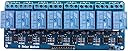
The JBtek 8 Channel DC 5V Relay Module is a versatile interface board designed for seamless integration with various microcontrollers, including Arduino and Raspberry Pi. It supports high-current applications with robust relay specifications, ensuring reliable performance for your electronic projects.
| ASIN | B00KTELP3I |
| Best Sellers Rank | #26,738 in Computers ( See Top 100 in Computers ) #358 in Single-Board Computers |
| Brand | JBtek |
| Brand Name | JBtek |
| Coil Voltage | 5 Volts |
| Connector Type | Through Hole |
| Connector type | Through Hole |
| Contact Current Rating | 10 Amps |
| Contact Material | Silver |
| Contact Type | Normally Open |
| Contact material | Silver |
| Contact type | Normally Open |
| Current Rating | 10 Amps |
| Current rating | 10 Amps |
| Customer Reviews | 4.5 out of 5 stars 488 Reviews |
| Manufacturer | JBtek |
| Maximum Switching Current | 10 Amps |
| Maximum Switching Voltage | 250 Volts |
| Minimum Switching Voltage | 5 Volts (DC) |
| Model | FBA_pcb board |
| Mounting Type | DIN Rail Mount |
| Mounting type | DIN Rail Mount |
| Operation Mode | Automatic |
| Part Number | FBA_pcb board |
| UPC | 520361134546 |
| Unit Count | 1 Count |
| Wattage | 50 watts |
M**D
Excellent
Well make,, I give 4 stars due to many pins were bended so I had to adjust, luckily not broken. but in general the product is great.
S**R
Works with "ST Nucleo F411RE" and "Raspberry Pi Model 2 B V 1.1"
I purchased this relay module to do some prototyping. It has worked well with the boards I have in house at the moment: * Raspberry Pi Model 2 B V 1.1 * ST Nucleo F411RE. Both of these have 3.3V GPIO pins, but the array worked fine when wired correctly. Please keep in mind the maximum current your micro-controller can drive. Both the PI and the Nucleo can operate a few of the relays, but you'll probably need a separate 5V supply to operate all 8. There are a number of good tutorials on how to utilize a relay array with the pi. There's a little less documentation for the nucleo 411 RE, still everything worked on the first try. I wired the following pins from the relay board to the pins in the CN7 connector on the nucleo: * VCC to pin 18 (+5V) * GND to pin 22 (GND) * IN1 to pin 17 (aka PA_15) * IN2 to pin 15 (aka PA_14) * IN3 to pin 13 (aka PA_13) Then I wrote the following code: #include "mbed.h" DigitalOut myled(LED1); DigitalOut relay1(PA_15, 1); //high is off DigitalOut relay2(PA_14, 1); DigitalOut relay3(PA_13, 1); int main() { set_time(1436486851); while(1) { time_t seconds = time(NULL); myled = !myled; relay1 = (seconds % 3 == 0 ? 0 : 1); relay2 = (seconds % 3 == 1 ? 0 : 1); relay3 = (seconds % 3 == 2 ? 0 : 1); wait(1); } } Sure enough, the nucleo kept 1 out of the 3 relays I had wired on each second, and cycled between them.
S**.
Bed products all relay is not work
Not good
I**Y
Good relay board
This 8 channel relay board works as expected. Note in order to take advantage of the isolators, you need a separate 5V dc power supply. In my application that was most certainly required. Otherwise the back EMF and or noise was coupled back to the Arduino and would crash it. An important thing to note is the connections on the bottom are exposed. If you are using AC, you must insulate them. In my case, the case that this went into does that. If not, its seriously dangerous to have exposed mains AC. DC is less of a concern if its low voltage low amperage. Still I would insulate either way.
P**N
Small, cheap, easy to interface to a Raspberry Pi
I bough a few similar modules, all work fine. The unit can be interfaced using 5V or 3.3V I/O, depending on which VCC voltage is used (JD-VCC must always be 5V: it feeds the relays). It actually works fine with 3.3V I/O when fed 5V VCC, but I don't want to risk damaging the Raspberry Pi CPU chip with applying 5V. To be fair, I have a Raspberry Pi B wired this way since 2014, and the equipment still works.
Trustpilot
3 weeks ago
2 weeks ago