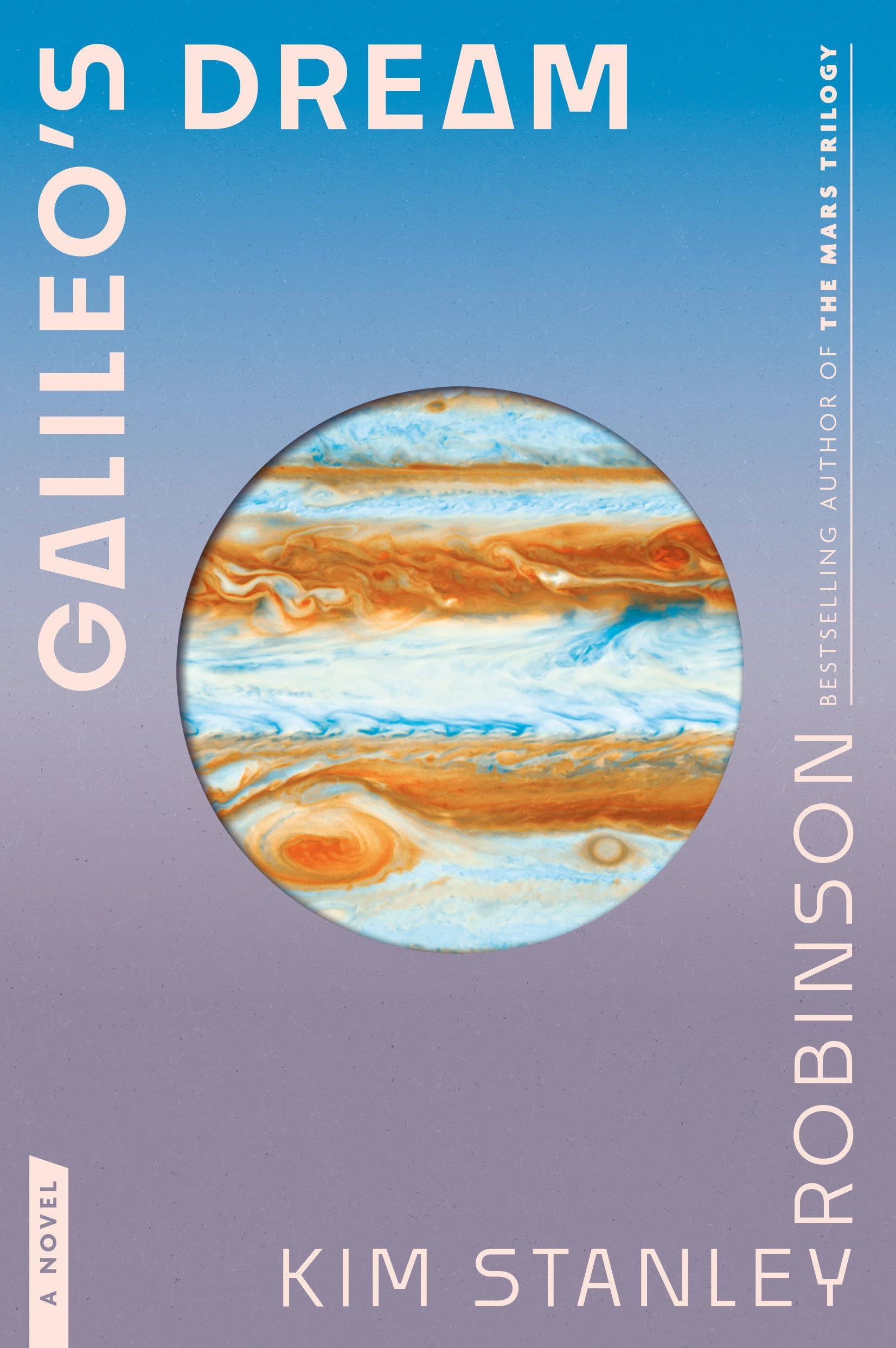

Galileo's Dream: A Novel
Product ID: 28025971
Desertcart purchases this item on your behalf and handles shipping, customs, and support to OMAN.
Nominated for the Arthur C. Clarke and Locus Awards • In this brilliant novel that spans centuries and planets, the bestselling author of the Mars trilogy melds Galileo’s life with the colonization of the moons he discovered. At the heart of this provocative narrative that stretches from Renaissance Italy to the moons of Jupiter is the father of modern science: Galileo Galilei. To the inhabitants of the Jovian moons, Galileo is a revered figure whose actions will influence the subsequent history of the human race. From the summit of their distant future, a charismatic renegade named Ganymede travels to the past to bring Galileo forward in an attempt to alter history and ensure the ascendancy of science over religion. And if that means Galileo must be burned at the stake, so be it. From Galileo’s heresy trial to the politics of far-future Jupiter, Kim Stanley Robinson illuminates the parallels between a distant past and an even more remote future—in the process celebrating the human spirit and calling into question the convenient truths of our own moment in time. Review: One of my favorite KSR books! One of my favorite books about Galileo! - I think I've rwad at this point everything by Kim Stanley Robinson except for one of the "Three Californias", and there are many that I really love. While this one stands apart due to it's time-travel and historical-fiction aspects, it is also well-ensconced in the Robinsonian "future history" and contributes to the whole universe of his works. In some ways, it is most similar to his first novel, "Memory of Whiteness", for its fish-out-of-water-encountering-a-strange-mysitical-world qualities, as well as being, as far as i can tell, closest in "time" (to the Jupitery parts of Galileo's Dream). But it has many years of added polish, and a great character in Galileo, with the added thrill of him being a historical figure that we're getting new insights into. There is a lot of humor, a lot of depth, a lot of intrigue, as with most of KSRs books. Quite a number of scenes stand sharp in memory even long after reading. There seems to be some criticism of the book for being unbalanced in detail between the "Historic" and "Jupiter" scenes. I think that this may be true, but is not a negative; not only is this being primarily told from Galileo's point of view, as a bewildered carmudgeon of sorts who is transported mysteriously to a complete foreign world (where what he sees and does is carefully controlled), but it is also uncertain, especially to Galileo, if the whole Jupiter aspect is real or a dream... and even if either, his memory of it is supposed to be sketchy at best. Hence, umm, the title of the book. The way the two worlds are presented is to me beautifully balanced and toned. As a book about Galileo, I'll say that I've read quite a few books - histories and historical novels - about Galileo, and this one brings him to life in a way that no others do, while providing great historical information about his life and work. If the "dream" were removed, and we were left with the parts firmly set in Galileo's time, this would still be a great book. The combination of this and the Robinsonian universe is wonderful for fans of either - and even better for fans of both. Review: Flawed Humanity, Dark History, Deep Time & Limitless Space-scapes - The thing about the book Galileo's Dream is that it continued to confirm one of the archetypal patterns of my own personal research and deep areas of interest... which I didn't know it would be as much of a match about going into it. It's a combination of a very grounded real and encouraging perspective on a flawed human being (it's a biography of sorts of G.Galileli) who had the internal drive to behave, observe and learn about reality as a scientist. In some ways it's an unapologetic treatise about the flawed nature of being a single-minded scientific outlier in a culture that didn't understand him; as well as the social order, family system and an economic under structure that thwarted his ability to thrive as a scientist. An era in which he found himself adrift and in pain and inflicting pain on others as well. In any case the main point I would make is back to the deeper level of personal research that I can only find to be enlightened through fiction: it's the pursuit of understanding how the multiple dimensions of reality can be construed when different authors take their approaches to help their readers ascertain an experience of the 4th, 5th, 6th all the way through the 10th or 11th dimension of the reality of the universe. Robinson does an amazing job of overlaying a time traveling multi-dimensional structure of reality that is an excellent guide to describing parallel universes and the ability to incrementally affect history through the flow of multiple patterns of existences. I would put that book on one end of the spectrum that I appreciated re: the multi-dimensional fictional descriptions of the universe and on the other end of the spectrum I will put the Remembrance of Earth's Past trilogy by Cixin Lui. He delivers much more hard science fiction ala Arthur C. Clark and others. He takes on the challenge of trying to represent how the human experience could be extended beyond our comprehension when engaged with extra-terrestrial, super intelligent life forms & the shift of time & space via travel of people into the solar system and the remainder of the universe through light speed. It's lays out a more clinical, natural potentiality of the discover-able nature of the cosmos unfurled & unparalleled in my experience. It's the standard bearer of how hard science fiction is being done in the 21st century. Thus those two books dovetail together nicely one being grounded in historical fiction with different threads of commentary on what it might mean to be in the multiple dimensions of the universe (Robinson). Cixin does a better job allowing the reader to get a deeper engagement with the potentialities of the other dimensions that have a more logical or super logical construct. KSR is more fantastical or even poetical in his imaginative kinds of devices i.e. the 10 dimensional manifold on manifolds as he calls it.


| Best Sellers Rank | #1,605,600 in Books ( See Top 100 in Books ) #3,082 in Science Fiction Short Stories #8,520 in Science Fiction Crime & Mystery #10,185 in Science Fiction Adventures |
| Customer Reviews | 4.3 out of 5 stars 758 Reviews |
U**A
One of my favorite KSR books! One of my favorite books about Galileo!
I think I've rwad at this point everything by Kim Stanley Robinson except for one of the "Three Californias", and there are many that I really love. While this one stands apart due to it's time-travel and historical-fiction aspects, it is also well-ensconced in the Robinsonian "future history" and contributes to the whole universe of his works. In some ways, it is most similar to his first novel, "Memory of Whiteness", for its fish-out-of-water-encountering-a-strange-mysitical-world qualities, as well as being, as far as i can tell, closest in "time" (to the Jupitery parts of Galileo's Dream). But it has many years of added polish, and a great character in Galileo, with the added thrill of him being a historical figure that we're getting new insights into. There is a lot of humor, a lot of depth, a lot of intrigue, as with most of KSRs books. Quite a number of scenes stand sharp in memory even long after reading. There seems to be some criticism of the book for being unbalanced in detail between the "Historic" and "Jupiter" scenes. I think that this may be true, but is not a negative; not only is this being primarily told from Galileo's point of view, as a bewildered carmudgeon of sorts who is transported mysteriously to a complete foreign world (where what he sees and does is carefully controlled), but it is also uncertain, especially to Galileo, if the whole Jupiter aspect is real or a dream... and even if either, his memory of it is supposed to be sketchy at best. Hence, umm, the title of the book. The way the two worlds are presented is to me beautifully balanced and toned. As a book about Galileo, I'll say that I've read quite a few books - histories and historical novels - about Galileo, and this one brings him to life in a way that no others do, while providing great historical information about his life and work. If the "dream" were removed, and we were left with the parts firmly set in Galileo's time, this would still be a great book. The combination of this and the Robinsonian universe is wonderful for fans of either - and even better for fans of both.
L**E
Flawed Humanity, Dark History, Deep Time & Limitless Space-scapes
The thing about the book Galileo's Dream is that it continued to confirm one of the archetypal patterns of my own personal research and deep areas of interest... which I didn't know it would be as much of a match about going into it. It's a combination of a very grounded real and encouraging perspective on a flawed human being (it's a biography of sorts of G.Galileli) who had the internal drive to behave, observe and learn about reality as a scientist. In some ways it's an unapologetic treatise about the flawed nature of being a single-minded scientific outlier in a culture that didn't understand him; as well as the social order, family system and an economic under structure that thwarted his ability to thrive as a scientist. An era in which he found himself adrift and in pain and inflicting pain on others as well. In any case the main point I would make is back to the deeper level of personal research that I can only find to be enlightened through fiction: it's the pursuit of understanding how the multiple dimensions of reality can be construed when different authors take their approaches to help their readers ascertain an experience of the 4th, 5th, 6th all the way through the 10th or 11th dimension of the reality of the universe. Robinson does an amazing job of overlaying a time traveling multi-dimensional structure of reality that is an excellent guide to describing parallel universes and the ability to incrementally affect history through the flow of multiple patterns of existences. I would put that book on one end of the spectrum that I appreciated re: the multi-dimensional fictional descriptions of the universe and on the other end of the spectrum I will put the Remembrance of Earth's Past trilogy by Cixin Lui. He delivers much more hard science fiction ala Arthur C. Clark and others. He takes on the challenge of trying to represent how the human experience could be extended beyond our comprehension when engaged with extra-terrestrial, super intelligent life forms & the shift of time & space via travel of people into the solar system and the remainder of the universe through light speed. It's lays out a more clinical, natural potentiality of the discover-able nature of the cosmos unfurled & unparalleled in my experience. It's the standard bearer of how hard science fiction is being done in the 21st century. Thus those two books dovetail together nicely one being grounded in historical fiction with different threads of commentary on what it might mean to be in the multiple dimensions of the universe (Robinson). Cixin does a better job allowing the reader to get a deeper engagement with the potentialities of the other dimensions that have a more logical or super logical construct. KSR is more fantastical or even poetical in his imaginative kinds of devices i.e. the 10 dimensional manifold on manifolds as he calls it.
O**S
The Earth Moves.
This was an amazing, challenging book to read. Robinson's books all require a broad experiance and a solid education to enjoy. This one takes that to a higher level. When Robinson writes he expects you to have a certain degree of familiarity with the topic, he cuts his readers no slack. Sadly, few of us are scholars of 17th century Italy and so this wonderful book is often work to read. Satisfying, fulfilling work. In the end I truly had the feeling of how life was in the Italy of Galileo's time. One challenge is the names. I suggest you read this on an eDevice, with wikipedia close at hand. Trying to keep the historical cast straight and who is friend or foe is difficult. Looking them up provides context and aides in understanding Galileo's story. I loved the combination of historic novel and hard core science fiction. It was necessary to understand the threat that Galileo posed to the Catholic Church and how that threat persists to this day. Willfull, deliberate, hateful ignorance sadly still troubles us today. The almost hidden narration by Cartophilious is an artful, inspired process. His hidden life, his final fate was a sacrifice to humanity, and, like Galileo's, both infinite and unavoidable. Truly a masterpiece. I envy those who have yet to read it. It made me love and mourn the brilliance of Galileo.
P**D
More than the Heavens Through Galileo's Eyes
This is something of a sprawl of a book, attempting to meld two stories, that of the life and times of Galileo and one of a far future battle around the Jovian moons. To connect the two, Galileo is `transported' to the future time and place via an `entangler', and returned after his visits with his memories and knowledge gained from his trip mainly erased via drugs, though with some residual `déjà vu' effects. It's an uneasy balance between the two stories. On the one hand, we follow Galileo and get to see him as a great scientist, but also as a very fallible, hard-headed, and somewhat obnoxious person, along with thematic messages of where science should leave off and faith prevail, or perhaps meld in a type of synthesis that would have greatly altered the course of history as we know it; and on the other we observe (along with Galileo, who rarely takes any active part in the action) the efforts of the future civilization to resolve their own factional disputes while at the same time try to change the past to achieve a less horrifying path of humanity from Galileo's time to theirs. The trouble is that these two parts are unequally balanced; Galileo's story is immediate and readily understandable, while the future society never seems to be concrete, never crystallizes into a `you are here' environment, despite strong descriptive material and some excellent scientific exposition of the known features of the Jovian moons and current theories about space-time and ten dimensional manifolds. In addition, the reason Galileo was brought to this future is never given a strong reason (the reason that is given of Galileo's advice being sought is almost immediately refuted as nobody really listens to him, and his understanding of the situation is naturally very limited). The story of Galileo himself is rich and finely detailed, although not told in entirely linear order, and at the beginning the reader may find many of the references to people in his orbit rather opaque. But by the end of the book a very fine portrait of the man can be seen, warts and preeminence both proudly displayed. Most of the secondary characters are only sketched in, and there is a little bit of a problem keeping track of which Cardinal or Duke this is and whether they are friendly or not to Galileo's position. But as we track Galileo's life, the entire historical period and the vagaries of politics and the Catholic church also come to life. Given the weakness of the second, future world story, and the strength of the historical one, I think I would have much preferred that Robinson would have written this as a pure biography. The end result would have been much better. --- Reviewed by Patrick Shepherd (hyperpat)
L**D
It arrived very quickly
I have enjoyed reading Kim Stanley Robinson's Mars series So, you could say I am a fan. As an author he did very well with mixing story and environment with well developed characters and there relationships to one another. If great science fiction could be defined as inspiring and challenging the next generation than he has done a great job. Sept. 2013 I finished reading it this summer. first we are introduced to Galileo in his time. The book dramatizes Galileo and takes us through what it would be like to live his life including work and family life while inventing the first long range telescope. About the time he discovers the moons of Jupiter a stranger from the future takes him there for a few visits. In the future he meets other scientist and has a lot of adventures while in between visits he struggles to maintain his life and income which I assume are true historically based events. I really enjoyed the whole story and feel that I got to know Galileo. Robinson is a truly gifted writer and does not disappoint.
J**N
A nice mix of science fiction, science and history
There are 3 things that I really enjoy reading: science fiction, science and history. Kim Stanley Robinson's latest novel, Galileo's Dream is a terrific fusion of all three. It took me a longer than usual time to read this book, which I started in late December. But despite the interruptions, I kept coming back to the book because it intrigued me. It is a fascinating, fictionalized look at Galileo's life, and his struggle with the Catholic Church, a struggle which in some ways parallels the struggle taking place in the future with a newly discovered intelligence on the moons of Jupiter. The novel has something for everyone: time travel, historical fiction, space ships, far future societies, first contact, high technology. But the main thrust of it centers around Galileo's life in Italy, his friends and family, and his evolution as the "first scientist". Interestingly, the copyright page on the Kindle edition calls the book a "work of historical fiction". Indeed, but both past and future history must be included in that broad categorization. This is not the fun type of time-travel novel as say, Jack McDevitt's Time Travelers Never Die or Joe Haldeman's The Accidental Time Machine . It is a thoughtful, philosophical novel that uses time travel in much the same manner as H.G. Wells in The Time Machine --to reflect on the past and explore the possible places we are going. It's an enjoyable read for anyone who likes science fiction, and the history of science. 3-1/2 stars.
D**D
One of the best!
I'm really mystified by the low grade reviews of this book. I think it may be because it is misclassified as science fiction. It would be more accurately called historical fiction (I'm starting to sound like Polonius in Hamlet). Rather than argue the point I will just offer the alternative that the "science fiction" portions are intended to be allegorical in nature. Not unlike Dante's work that was referred to in the text several times. It can also be seen as an updated version of the discourses Galileo himself used. The turmoil faced by Galileo in his argument that science and religion are not necessarily antagonistic in their nature but can be turned to the antagonistic ends of the humans who profess them for their own ends applies equally to both 17th century Europe and 35th century Jupiter as it does today. The issue is, can man be true to his own destiny when faced with the fact that he is not the supreme product of nature? That others are far more powerful than he. Can we dwell in our own genius when others may outshine us? On another level Robinson deals with the fruits of a strictly patriarchal society. Galileo's mother was an extremely intelligent women who because of her gender and her status could not engage that intelligence in a meaningful way. Her experiences drove her insane and made all those around her, including Galileo, feel inadequate, unloved and meaningless. This shaped Galileo's life and in the end he becomes aware of the damage that was done. This does not excuse his self-serving and sometimes brutish actions which he came to deeply regret. Nor does it excuse his lack of relationships with any of the women in his life. It does, however, give some insight into the "why" of these actions and traits. Fortunately for Galileo he come to realize this in time to appreciate the love of his daughter Virginia before her untimely death. Cory Doctorow has said that science fiction authors do not write about the future but about their own time. The chronological disconnect permits them to more freely voice that which none may utter. If the Jupiter segments of "Galileo's Dream" can be viewed in that context we can see that the torment of Galileo is with us today and will be for some time to come. Will we be able to stifle the devils of our lesser nature and give flight to the angles of our better nature? Time will tell.
A**R
Great Book
This is a great book that allows the reader to experience the unimaginable confrontation of the world's 'first modern scientist' with the unimaginable extrapolation of his ideas. The book starts off by using an incredible amount of historical research to give the reader a sense of what an intellectual giant Galileo was and the world in which he lived. The author has taken some liberty to shape Galileo's character, by 'crawling' into his daily life and rituals to help the reader understand that Galileo was also extremely complex, quarrelsome and stubborn. What makes this book really special is that it allows the reader to imagine what it might have been like for Galileo to be confronted with the results of his pioneering research into astrophysics, which literally 'exploded' in the centuries after his death into the non-linear, counter-intuitive world of modern physics and quantum science. If you like Renaissance history, modern physics and are interested in finding out how may have interacted, then you will enjoy this book. A. Richter
K**4
Bravo!
I've always been cautious about Kim Stanley Robinson, given that people praise the Mars trilogy, which for me was tedium broken only by wondering how often once could use the word 'regolith'. He redeemed himself with 'The Years of Rice and Salt', which was still a bit too mystical for me, but it made me think about the science we take for granted. No such worries with 'Galileo's Dream' though. It works at every level. If you're RC, please read it, if you're a materialist, please read it, if you want a novel that makes a nod to biography or history, read it. I cried at the end, and I'm proud to say so. It's a masterpiece, so "Bravo' seemed the right title for this review, KSR is a maestro with this book. Thought experiment: Do you *know* how a telescope works?
F**R
fastreader
All you history buffs will love this book. Not only do you have the science fiction story line but you also learn about what was going on during Galileos time. Between his personal life, which is a shambles, and the political machinations of that time, plus his "dream"; it all makes for a highly entertaining read
P**A
Per gli appassionati di storia, e/o di fantascienza
Kim Stanley Robinson è una certezza: la sua serie sulla colonizzazione di Marte (trilogia + altre opere accessorie) è sicuramente una delle meglio scritte negli ultimi anni. In questo libro, per metà opera di finzione e per metà di ricerca meticolosa, racconta un Galileo Galilei che pochi conoscono, e da un'interpretazione tutta sua su alcune delle invenzioni e trovate del grande genio scientifico. Consigliato vivamente!
J**M
Two Stars
While I really enjoyed the biographic aspects of Galileo's life, the sci-fi chapters of the book annoyed me.
S**N
Entertaining
A thought provoking book, a look at history and a pivotal figure in science. A well woven story of future and past, and consequences.
Trustpilot
1 month ago
2 months ago