We remain fully operational. Our teams are working around the clock to ensure your deliveries continue safely.

DOWNLOAD THE APP


Customer Services
Copyright © 2025 Desertcart Holdings Limited
DOWNLOAD THE APP
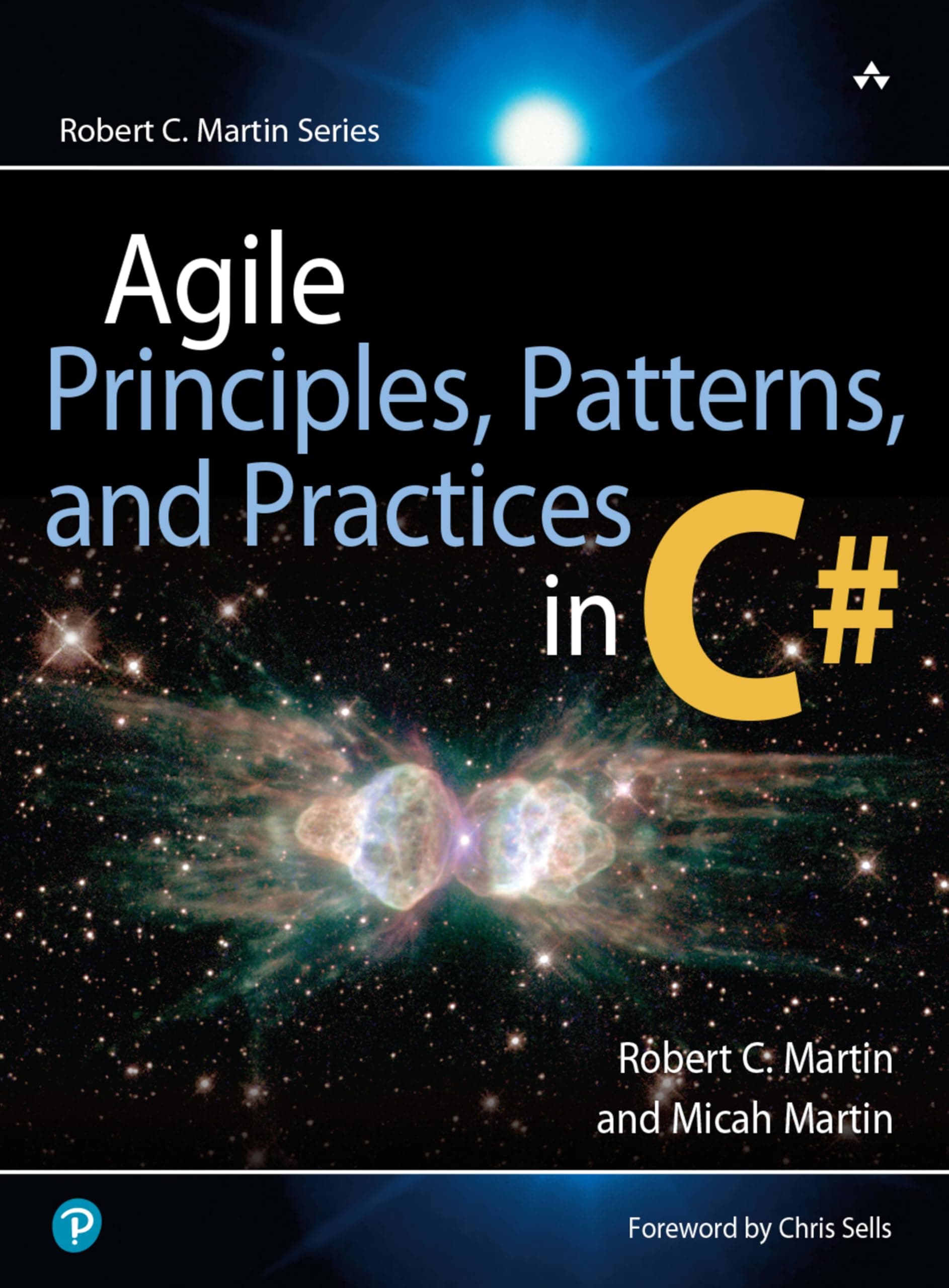
Agile Principles, Patterns, and Practices in C# (Robert C. Martin Series) [Martin, Robert, Martin, Micah] on desertcart.com. *FREE* shipping on qualifying offers. Agile Principles, Patterns, and Practices in C# (Robert C. Martin Series) Review: great book, title a bit misleading - There are two things I would've changed about this book: 1) remove "in c#" from the title and 2) make it clear that all code examples are pseudo-code in a made up language that kind of looks like C++/Java/C#. I've read just about every review of this book and all the people who rated this book low (3 and lower) completely missed the entire essence of why this book was written. Their complaints were "not enough C#" and "how dare you not use generics, C# programmers should know better!" This book is not about teaching you how to program in C#; there's a ton of print out there to do that. This book is about teaching you how to approach coding, and what they teach can be applied to just about any language out there (well, OO is probably more suitable). I've been coding professionally for 13 years and 8 more as a hubby before that. I've written some really, really horrendous code, and I got to where I am today by always reflecting back on all of my work. Over time I learned what to do and what should be avoided and when I first discovered Gang of Four's design patterns book, every single pattern I've already used somewhere in my own code. Currently being a technical team lead on the project, I'm now brushing up on a lot of material regarding design, agile practices, architecture and so on. My goal is not to teach the team solely from my self-taught know-how. Instead, I'm reading all these books because I want to combine my experience with more authoritative voices on the subject and the views of other, more-experienced engineers. Most of this book was nothing new to me. I've been already practicing a lot of the techniques and habits that the author recommends. However, having said that, there are still quite a few things that authors helped me see in a different light and I've already taken these lessons back to the team. No matter how much experience you have, if you read this book (keeping open mind and not with goal of learning C#), you will learn at least one valuable thing which will make you a better software engineer. They also helped me because their wording and examples are at a perfect level. Intermediate to experienced programmers (i.e. those with enough experience to know how much bad code really costs, in terms of money, time and blood pressure) can easily relate to what is being said and the examples they use are not standard, fictional, non-realistic "animal, cat, dog". Their examples helped me communicate with other team members to whom I wanted to convey some of the concepts behind agile, OOD approach and SOLID principles. Review: Absolutely required reading for every[...] - Robert Martin is one of the smartest people I've ever talked with, and he is one of the best technical writers I've ever read. This book is *the* most comprehensive and most valuable introduction and guide to Agile programming, with a full discussion of Agile principles, the "fourteen practices of eXtreme programming," full discussion of "spiking, splitting, velocity, iteration, test-driven development, refactoring, pair programming, five types of UML diagrams," and how to use all of this in real world .NET development. There is no doubt in my mind that this book will make you a better programmer, will challenge you, will teach you, will take you beyond what you already know, and will entertain you along the way. Robert is as good as it gets. This book is required reading. Do not hesitate.


| Best Sellers Rank | #1,236,281 in Books ( See Top 100 in Books ) #148 in C# Programming (Books) #313 in Object-Oriented Design #1,391 in Software Development (Books) |
| Customer Reviews | 4.5 4.5 out of 5 stars (195) |
| Dimensions | 7.1 x 1.8 x 9.5 inches |
| Edition | 1st |
| ISBN-10 | 0131857258 |
| ISBN-13 | 978-0131857254 |
| Item Weight | 1.95 pounds |
| Language | English |
| Part of series | Robert C. Martin Series |
| Print length | 768 pages |
| Publication date | July 20, 2006 |
| Publisher | Pearson |
D**N
great book, title a bit misleading
There are two things I would've changed about this book: 1) remove "in c#" from the title and 2) make it clear that all code examples are pseudo-code in a made up language that kind of looks like C++/Java/C#. I've read just about every review of this book and all the people who rated this book low (3 and lower) completely missed the entire essence of why this book was written. Their complaints were "not enough C#" and "how dare you not use generics, C# programmers should know better!" This book is not about teaching you how to program in C#; there's a ton of print out there to do that. This book is about teaching you how to approach coding, and what they teach can be applied to just about any language out there (well, OO is probably more suitable). I've been coding professionally for 13 years and 8 more as a hubby before that. I've written some really, really horrendous code, and I got to where I am today by always reflecting back on all of my work. Over time I learned what to do and what should be avoided and when I first discovered Gang of Four's design patterns book, every single pattern I've already used somewhere in my own code. Currently being a technical team lead on the project, I'm now brushing up on a lot of material regarding design, agile practices, architecture and so on. My goal is not to teach the team solely from my self-taught know-how. Instead, I'm reading all these books because I want to combine my experience with more authoritative voices on the subject and the views of other, more-experienced engineers. Most of this book was nothing new to me. I've been already practicing a lot of the techniques and habits that the author recommends. However, having said that, there are still quite a few things that authors helped me see in a different light and I've already taken these lessons back to the team. No matter how much experience you have, if you read this book (keeping open mind and not with goal of learning C#), you will learn at least one valuable thing which will make you a better software engineer. They also helped me because their wording and examples are at a perfect level. Intermediate to experienced programmers (i.e. those with enough experience to know how much bad code really costs, in terms of money, time and blood pressure) can easily relate to what is being said and the examples they use are not standard, fictional, non-realistic "animal, cat, dog". Their examples helped me communicate with other team members to whom I wanted to convey some of the concepts behind agile, OOD approach and SOLID principles.
J**Y
Absolutely required reading for every[...]
Robert Martin is one of the smartest people I've ever talked with, and he is one of the best technical writers I've ever read. This book is *the* most comprehensive and most valuable introduction and guide to Agile programming, with a full discussion of Agile principles, the "fourteen practices of eXtreme programming," full discussion of "spiking, splitting, velocity, iteration, test-driven development, refactoring, pair programming, five types of UML diagrams," and how to use all of this in real world .NET development. There is no doubt in my mind that this book will make you a better programmer, will challenge you, will teach you, will take you beyond what you already know, and will entertain you along the way. Robert is as good as it gets. This book is required reading. Do not hesitate.
K**R
Enlightening, albeit Slightly Stale
After finishing this book and thinking about how useful its contents would be for me in the workplace right now in the (almost) final quarter of 2014, I have concluded that this book is a valuable addition to my programmer bookshelf, albeit a mixed bag of good and stale bits. The good aspects of this book will remain useful. However, the stale parts are... well... a little too stale and beg for a new edition, which it seems Uncle Bob doesn't plan to undertake. The good points: The book has aspects that will keep this book on the shelf, ready to crack open at a moment's notice: justification for denouncement of excessive documentation and diagramming, encouragement of realistic / sustainable work hours, explanations of design patterns in a (loosely) C# context, explanations of agile PPPs from an angle I had not previously considered, demonstrations on how to produce reliable software development estimates, emphasis on test-first design / development as the foundation on which this book is written, the list could go on (but not much further). The stale points: To be fair, any language specific examples will become stale pretty quickly, as technology is always advancing at breakneck speeds. The Author(s) do state early on that they're not telling you "how to do C#!"; rather, they're extending a lofty olive branch to the .NET developer community (thanks....?) and wanting to discuss more language agnostic topics (refer to the good points listed above). A lot of reviewers point out that C# is really just a namesake in this book. Therefore, let's just go ahead and say it: the C# is really stale; there are such amazing things C# can do now that have made the language much more expressive, maintainable, dynamic, and capable. Funnily enough, some of these advancements were called for in Jack Reeves' article included in Appendix B of this book when he was referring to C++'s success at its onset. In a nutshell: This book is worth having around. I will refer back to this book often for inspiration on various design patterns. However, I would like a more modern C# publication on implementing these patterns in a way that actually leverages the language and avoids (now) known anti-patterns. It would be grand if someone took the content of this book to the next level with more modern insight. After having finished Agile C#, I experienced enlightenment in some ways, but at the same time, I need a C# palate cleanser.
M**R
Excellent book from the Robert Martin series. Worth the price!
This is a terrific book. I'm a big proponent of the Robert Martin library of books, as I think he really knows his stuff. This is listed as just him and his son, but I do believe there are "guest contributors" as well. One of the things I like about this is that it not only discusses Agile in C#, but it also has real, honest to goodness code examples. It also has more real-world examples of SOLID and non-SOLID code, with explanations of how to fix the non-SOLID code. If I were to note one critical thing, I would like to see how SOLID ties in with Design Patterns. All in all, if you're a programmer at any level, I would seriously recommend adding this to your library. Not necessarily for the version of C# (since that changes), but for the concepts therein.
M**O
Excellent resource I keep it close
A**Z
Testo che pur nella sua essenza di materiale tecnico si lascia leggere con piacere.
N**N
This is the go to book if you want to learn SOLID principles. Considering the fact that I am a C# developer, I found it useful.
R**H
I have a bookshelf groaning with books on C# and agile software development. This is without doubt the best I've read. Robert Martin has somehow managed to distil his experience of many years into one cohesive tome, which is easy to read and provides practical advice on all aspects of development - agile, TDD, UML and design patterns. As for the previous reviewer who gave this a ludicrous 1 star review and suggests the GOF as a better alternative, I would suggest that he is either an abstract genius, or has never actually read the GOF stuff and is just name-checking this in a poseur like fashion! For the rest of us, this is probably as good as it gets.
G**E
Ótima leitura
Trustpilot
2 months ago
2 months ago