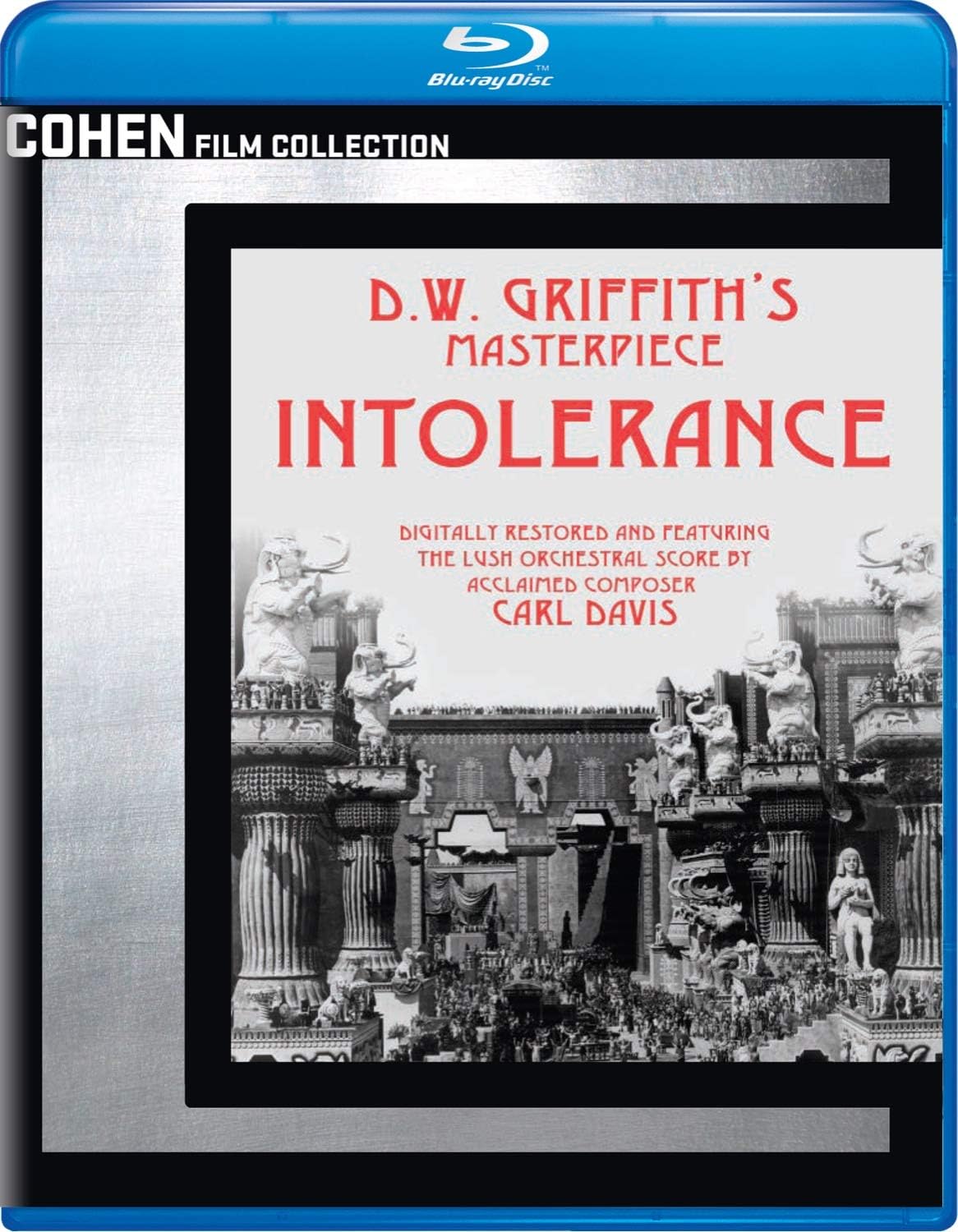
Intolerance (Silent)
Product ID: 5372115
Desertcart purchases this item on your behalf and handles shipping, customs, and support to OMAN.
In this cinematic milestone, director D.W. Griffith utilized enormous sets and thousands of extras in order to stage his cinematic exploration of Intolerance and its terrible effects throughout history from Ancient Babylon and Biblical Judea to Medieval Paris and Modern America. Review: GRIFFITH'S TALE OF LOVE'S STRUGGLE THROUGH THE AGES DAZZLES IN HD - When D.W. Griffith's massive epic INTOLERANCE was released in 1916, it was a commercial failure. This was due in part to its pacifist stand on war at a time when America was at the brink of entering the European conflict, and also because of its complex narrative structure which many people found difficult to follow. Griffith himself spent the rest of his life paying off the debts INTOLERANCE had incurred. None of these perceived failings matter when viewing the film, which retains all of its power to amaze and move an audience as it did the day it premiered. Originally planned as a much shorter film that Griffith called THE MOTHER AND THE LAW which dealt with a contemporary setting, the story was expanded to include three other episodes taken from history: the fall of Babylon, the crucifixion of Christ, and the Huguenot massacre. Griffith's innovative plan was to intercut the stories and jump back and forth between them, showing how the same themes of human injustice and intolerance have persisted from earliest times to our modern day. Not only was the narrative structure unconventional and ambitious, but the entire production was mounted on a scale unprecedented in American cinema at that time. Costumes were authentic in every detail, while the sets - particularly the Babylonian wall, gate, and courtyard - were the largest ever built for a movie. INTOLERANCE features excellent performances by the entire cast which includes Mae Marsh, Robert Harron, Miriam Cooper, Walter Long, Constance Talmadge, Alfred Paget, Seena Owen, Tully Marshall, Margery Wilson, Eugene Pallette and Howard Gaye. Lillian Gish plays the key role of the mother who endlessly rocks the cradle of time, linking all four stories. The film is alternately beautiful, compelling, and disturbing in its vivid imagery and never ceases to fascinate in the way it combines intimate drama with opulent spectacle. As broad as it is in its scope, INTOLERANCE pulsates with passionate emotion. In many ways it is unsurpassed in its attempt to cinematically depict humanity's struggle throughout history. No other film tried to tackle again what Griffith gives us in INTOLERANCE, and that alone is something to admire. Cohen Media Group's newly restored Blu-ray of this silent masterpiece is a revelation. Scanned at 2K/1080p, the images leap off the screen with remarkable clarity for a movie that's nearly a century old. Over those decades INTOLERANCE has had a frustrating existence with numerous cuts, snippets, alternate takes, and varying projection speeds so that it's virtually impossible to pin down a "definitive" version. This edition has by far the best overall combination of extant footage and image quality consistency, and includes the original tints as per its initial roadshow engagement. The magnificent Carl Davis music score in 5.1 and 2.0 audio adds a new, epic dimension that makes us appreciate even more the power of this film. Extras include the shorter features THE MOTHER AND THE LAW and THE FALL OF BABYLON both with new scores by the Mont Alto Orchestra, a retrospective by historian Kevin Brownlow, the restoration trailer, and a booklet with essays by Richard Porton and William M. Drew. This extraordinary, influential classic is mandatory viewing for every cinema lover, and I give this outstanding Blu-ray my highest recommendation. Review: A MASTERPIECE REBORN! - I discovered this film many years ago as a teenager when I purchased a 8mm copy of the entire film from Blackhawk Films. I could hardly change the 200 foot reels of film fast enough. The film is in a masterwork of early cinema that still thrills and amazes the viewer with Griffith's editing and direction telling four different stories dealing with intolerance through the ages. Cutting back and forth from one story to the other and building to its amazing climax wherein all four stories come to their conclusion. Later years I purchased INTOLERANCE on a Laser Disc and then on DVD. Now the Cohen Blu-ray transfer brings this almost 100 year old masterpiece to new life with a restoration that is nothing short of amazing! And the Carl Davis orchestra score is perfect. Not only that but we now have an opportunity to see THE MOTHER AND THE LAW, which Griffith released after INTOLERANCE failed to return its vast production cost. This is the modern story of INTOLERANCE and it features more material then that included in the four story film. I had known about this film for many years but this is the first time that it has been made available to actually see and appreciate. There is also a hour version of THE FALL OF BABYON section of the film that doesn't work quite as well as it was intended to be shown in conjunction with live stage performances intermixed with the showing of the film. But the Mountain Girl (played by Constance Talmadge) who dies in INTOLERANCE is given a happy ending for this version. This is a major Blu-ray release (their DVD release would be excellent also) and one that I would give the highest rating to.
| Contributor | D.W. Griffith, Fred Turner, Lillian Gish, Mae Marsh, Robert Harron |
| Customer Reviews | 4.6 out of 5 stars 118 Reviews |
| Format | NTSC |
| Genre | Blu-ray Movie, DVD Movie, Drama |
| Language | English |
| Runtime | 3 hours and 17 minutes |
A**H
GRIFFITH'S TALE OF LOVE'S STRUGGLE THROUGH THE AGES DAZZLES IN HD
When D.W. Griffith's massive epic INTOLERANCE was released in 1916, it was a commercial failure. This was due in part to its pacifist stand on war at a time when America was at the brink of entering the European conflict, and also because of its complex narrative structure which many people found difficult to follow. Griffith himself spent the rest of his life paying off the debts INTOLERANCE had incurred. None of these perceived failings matter when viewing the film, which retains all of its power to amaze and move an audience as it did the day it premiered. Originally planned as a much shorter film that Griffith called THE MOTHER AND THE LAW which dealt with a contemporary setting, the story was expanded to include three other episodes taken from history: the fall of Babylon, the crucifixion of Christ, and the Huguenot massacre. Griffith's innovative plan was to intercut the stories and jump back and forth between them, showing how the same themes of human injustice and intolerance have persisted from earliest times to our modern day. Not only was the narrative structure unconventional and ambitious, but the entire production was mounted on a scale unprecedented in American cinema at that time. Costumes were authentic in every detail, while the sets - particularly the Babylonian wall, gate, and courtyard - were the largest ever built for a movie. INTOLERANCE features excellent performances by the entire cast which includes Mae Marsh, Robert Harron, Miriam Cooper, Walter Long, Constance Talmadge, Alfred Paget, Seena Owen, Tully Marshall, Margery Wilson, Eugene Pallette and Howard Gaye. Lillian Gish plays the key role of the mother who endlessly rocks the cradle of time, linking all four stories. The film is alternately beautiful, compelling, and disturbing in its vivid imagery and never ceases to fascinate in the way it combines intimate drama with opulent spectacle. As broad as it is in its scope, INTOLERANCE pulsates with passionate emotion. In many ways it is unsurpassed in its attempt to cinematically depict humanity's struggle throughout history. No other film tried to tackle again what Griffith gives us in INTOLERANCE, and that alone is something to admire. Cohen Media Group's newly restored Blu-ray of this silent masterpiece is a revelation. Scanned at 2K/1080p, the images leap off the screen with remarkable clarity for a movie that's nearly a century old. Over those decades INTOLERANCE has had a frustrating existence with numerous cuts, snippets, alternate takes, and varying projection speeds so that it's virtually impossible to pin down a "definitive" version. This edition has by far the best overall combination of extant footage and image quality consistency, and includes the original tints as per its initial roadshow engagement. The magnificent Carl Davis music score in 5.1 and 2.0 audio adds a new, epic dimension that makes us appreciate even more the power of this film. Extras include the shorter features THE MOTHER AND THE LAW and THE FALL OF BABYLON both with new scores by the Mont Alto Orchestra, a retrospective by historian Kevin Brownlow, the restoration trailer, and a booklet with essays by Richard Porton and William M. Drew. This extraordinary, influential classic is mandatory viewing for every cinema lover, and I give this outstanding Blu-ray my highest recommendation.
E**E
A MASTERPIECE REBORN!
I discovered this film many years ago as a teenager when I purchased a 8mm copy of the entire film from Blackhawk Films. I could hardly change the 200 foot reels of film fast enough. The film is in a masterwork of early cinema that still thrills and amazes the viewer with Griffith's editing and direction telling four different stories dealing with intolerance through the ages. Cutting back and forth from one story to the other and building to its amazing climax wherein all four stories come to their conclusion. Later years I purchased INTOLERANCE on a Laser Disc and then on DVD. Now the Cohen Blu-ray transfer brings this almost 100 year old masterpiece to new life with a restoration that is nothing short of amazing! And the Carl Davis orchestra score is perfect. Not only that but we now have an opportunity to see THE MOTHER AND THE LAW, which Griffith released after INTOLERANCE failed to return its vast production cost. This is the modern story of INTOLERANCE and it features more material then that included in the four story film. I had known about this film for many years but this is the first time that it has been made available to actually see and appreciate. There is also a hour version of THE FALL OF BABYON section of the film that doesn't work quite as well as it was intended to be shown in conjunction with live stage performances intermixed with the showing of the film. But the Mountain Girl (played by Constance Talmadge) who dies in INTOLERANCE is given a happy ending for this version. This is a major Blu-ray release (their DVD release would be excellent also) and one that I would give the highest rating to.
D**M
A Controversial Milestone in Cinema in a Crystal Clear Version
In 2017, D.W. Griffith is back in national news concerning his controversial 1915 epic Birth of a Nation, now considered both a landmark in world cinema and—as some historians have described it in a PBS documentary in early 2017—"racist pornography." There's a new film with the same title, deliberately chiding the original film by Griffith. Overall, Griffith's public reputation a century after Birth of a Nation is pretty dismal and as a life-long journalist who has written about film for many years, I agree with that analysis. Birth of a Nation had a terrible impact. That's relevant, because this epic—Intolerance—arrived in 1916 and these two films, taken together, represent the infamous zenith of Griffith's career. When I first saw Intolerance half a century ago at the University of Michigan in film studies, we were told that this represented Griffith's apology for Birth of a Nation. In fact, today, we learn that Griffith never repudiated his horrific vision of race relations in the earlier film. Rather than an apology, this multi-million-dollar epic was Griffith's heart-felt claim that he had been wronged himself by "do-gooders." He felt that he had been wounded by intolerance. And, the dark side of this movie is that Griffith has put on the big screen some truly hateful assumptions about what, in that day, would have been known as Progressives. In particular, Griffith targets women's groups as evil cabals of battle axes intent on tearing families apart. Having said all of that, Intolerance still ranks high on global lists of milestones in world cinema. It's still on the master list of greatest films ever made published by Sight & Sound, for example. That's a list voted by film professionals and film critics. Or, consider the more tabloid-style overview of this film in Kenneth Anger's equally infamous classic: Hollywood Babylon: The Legendary Underground Classic of Hollywood's Darkest and Best Kept Secrets . I tend to agree with Anger's assessment. The outrageous excesses of Intolerance (which contributed to the decline in Griffith's fortunes in subsequent years) was a major milestone in what Anger calls Hollywood's "Purple" age—an era of over-the-top excess. I think that's why Sight & Sound and other groups of film historians still list this silent classic as a "great" moment in world cinema. And, ultimately, that's why you should invest in this superb-quality Cohen Blu-ray of the film if you plan to tackle its nearly three hours today. There are countless other versions of Intolerance available online from streaming video to cheap DVD knock offs. Most of them are poor quality. I will point out here that I also own the Griffith Masterworks series DVD of this film: Intolerance (1916) . If you are looking for a DVD version of the movie, it's a fine choice as well. But, having seen both now, I urge you to get this Cohen edition. In this review, I wanted to acknowledge the controversy swirling around these two classics. The heart of that controversy is the 1915 film and, if you want to know more about that, get a copy of Dick Lehr's excellent history: The Birth of a Nation: How a Legendary Filmmaker and a Crusading Editor Reignited America's Civil War . That was the basis of the January 2017 PBS documentary about that chapter in Griffith's career. If you want to dive into this 1916 epic, you won't find as much written about it unless you look back to Anger's book or perhaps others that mention Griffith's building of Babylon in Hollywood. It's an eye-popping peak in silent cinema. If you've never seen it and care about the history of film, this is definitely a "must see" milestone. And, for your first viewing, see it in this crystal-clear Cohen version.
L**.
Excellent film of the silent era.
Exactly as described!
K**1
Cohen Media Blu-ray looks and sounds the best, but still not as complete as Image DVD
D.W. Griffith's 1916 historical epic weaves four stories of intolerance that occur in the past and present: the fall of Babylon in ancient times, the crucifixion of Christ, St. Bartholomew's Day Massacre in the 16th Century, and class struggle and injustice in the modern times. Running about 3 hours in most editions, this ambitious, pioneering American silent classic not only has plenty of big-scale set pieces -- a shootout during a labor strike, violent Babylonian battles, a car-train chase scene, etc. -- but it is also a groundbreaking artistic triumph in its bold intercutting of the 4 stories that serves to enhance each story and compliment one another. The film's final 30 minutes is a rapid intercutting of the 4 climaxes of the stories that is thrilling to watch. Not to mention, the film has possibly the most famous shot in all of silent cinema, an aerial view of the palace of Belshazzar. "Intolerance" is one of the earliest and also one of the best films ever made, by a director who is often called "The Father of Film". The new region-free Blu-ray and DVD editions by Cohen Media present the best picture quality ever for this film on home video. The Blu-ray's 1080p picture is remarkably clean, stable, and free of flickers. Some footage still looks worse than others. But the good-looking scenes look quite stunning in terms of details and clarity. Originally restored by Kevin Brownlow and David Gill in 1989, the film was given a further restoration by Cohen Media, resulting in this new Blu-ray and DVD. The music accompaniment by Carl Davis is also, in my opinion, the best score ever used for the film. Davis' majestic orchestral music is a great fit for the epic scenes, and it does a great job highlighting a lot of the dramatic nuances in more personal moments as well. There have been many revisions made to "Intolerance" over the years, some by director D.W. Griffith himself up until 1926, and some by unauthorized foreign distributors. Nowadays, many believe that the 1926 version represents Griffith's final cut. In 1990, restorer David Shepard created a version of the film based on this 1926 version, plus footage from older versions when necessary. This restored version was released on DVD by Image in 1999 (ASIN: B00003TKZ9), and is currently the most complete version of the film in terms of the amount of footage available. Unfortunately, the new Blu-ray/DVD by Cohen Media is less complete than the Image DVD. The Cohen Media edition is largely identical to the 2002 Kino DVD edition (ASIN: B00007CVS8) in terms of the footage available. Even though the Kino DVD runs the longest at 197 minutes, it is actually less complete than the Image DVD. Its longer running time is mainly due to its slower, perhaps erroneous film speed. The Cohen Media disc seems to run at a correct speed, thus running shorter at only 168 minutes due to less footage. Below is a list of some of the footage missing on the Kino and Cohen editions, but is found on the Image DVD: (1) A closeup shot of the words Jesus wrote on the ground after he rescued the prostitute by saying "he who never sins may cast the first stone." The Kino & Cohen editions show a long shot of him writing something on the ground, but we don't see what exactly he wrote. (2) A 2-minute scene where Belshazzar rescues the Mountain Girl from being killed by the High Priest of Bel. This scene is found on the Image DVD at 00:46:37. (3) A long shot of the Babylon castle wall being attacked by Cyrus's towers (found on Image DVD: 1:35:50). (4) A closer shot of Cyrus's army climbing up to the Babylon castle (Image: 1:37:23). This shot improves continuity of the shots before and after. (5) An extra shot of Babylonians praying in front of the statue of Ishtar, the Babylonian goddess (Image: 1:37:50). This shot shows a larger group of prayers than the existing, similar shots found on Kino & Cohen editions. (6) A scene of an old lady offering 3 turnips and a carrot to Ishtar (Image: 1:38:03). This scene is followed by grisly killings of Babylonian soldiers, showing the futility of the old woman's prayer. (7) Another shot of Babylonians in front of Ishtar's statue (Image: 1:38:30). This shot is similar to No. (5) above. (8) A closeup of a severed head of a dead soldier (Image: 1:40:30). This corresponds nicely with a later shot of a soldier getting decapitated. (9) A closeup of The Mountain Girl looking terrified during the battle (Image: 1:42:26). This shot shows the horror of the battle is finally getting to the previously fearless woman. (10) A shot of an exhausted woman worker collapsing and dying (Image: 1:43:03). The Image disc also has a title card identifying the "Woman aid worker". The Kino & Cohen editions are missing both the shot and the title card. (11) A somewhat comical shot of a Babylonian soldier getting speared in his buttocks after he decapitated an enemy (Image: 1:44:12). Here, Griffith might have intended to "soften" the horror of the decapitation with a little comedy. (12) The "justice and restoration" segment that shows a happy ending involving The Dear One's baby (Image: 2:53:41). Some believe Griffith's final intention was to NOT have the happy ending. My feeling is that I prefer to have a loose end tied up. Note that most of my observations occur in the first Babylon battle. There may be a lot more missing shots that I missed. All this missing footage may help explain why the Image DVD runs 178 minutes and the Cohen edition only 168 minutes. Also, these missing shots are not just extraneous footage that can be discarded. They serve useful purposes in the storytelling. On the Image DVD, there is a "visual essay" by film historian Russell Merritt, who writes that a lot of thought has been put into the inclusion and exclusion of footage. Based on my viewing, the Image edition is indeed more satisfying in terms of content. Unfortunately, the Image DVD, first released in 1999, has the worst picture quality of the 3 editions since it was sourced from 16-millimeter material. The picture is also quite severely cropped on the edges, to the point that the director's initials "DG" at the bottom of each title card are sometimes partially cut off. The 2002 Kino DVD was made from a 35mm print and therefore looks much better as a result. The Cohen edition shows greater visual improvement still. Despite the missing footage, both the Kino and Cohen editions have one crucial scene that is NOT on the Image disc. It occurs when the Friendless One is about to fire a gun at the Musketeer due to jealousy. The Kino and Cohen versions show that she suddenly has a flashback to the time she met The Boy, making her hesitant to fire the gun. We see her trembling hands and nervous expression, showing that she clearly struggles with the idea of committing a murder. This dramatic moment is NOT on the Image DVD, ironically, even though the Image disc is otherwise more complete. The Image edition simply shows her firing the gun mercilessly and without hesitation. Incidentally, Cohen's version also has some footage that is not found on either Image or Kino disc. Early in the film, the Cohen disc shows one of the reformers saying (via a title card), "We must have laws that make people good!" This is followed by a couple of shots of the workers drinking and dancing. The Image and Kino discs don't have this title card nor the shots of the workers. During the film's epilogue segment, I notice a couple of shots not present in other editions as well. In 2007, Danish Film Institute had its own restoration of "Intolerance", and that resulted in yet another DVD edition, released in Region-2 PAL format in 2010 by French publisher Diaphana. Even though this DVD has terrific picture quality (second only to Cohen's edition), this edition is the least complete of all the editions, and is even less complete than the Kino and Cohen discs. Unforgivably, it bungles up the editing during the climax of the modern story. But remarkably, it also has footage not present in other editions. I have seen the DVD, and noticed quite a few alternate takes, such as the scene where the Boy "sets his steps on the straight road", which shows him praying more sincerely than he does in other editions. So, in short: (1) The Image DVD from 1999, while having the worst picture quality, is the most complete of all versions in terms of the amount of footage available. (2) The French DVD from 2010, while having terrific picture quality (2nd only to the Cohen Blu-ray), is the least complete of all versions in terms of the amount of footage available. (3) The Kino DVD from 2002, while having the longest running time, is not as complete as the Image DVD, but not as INcomplete as the French DVD. (4) The Cohen edition from 2013 has largely identical footage as the Kino DVD. (5) Each edition has footage not found in other editions. --- The Cohen Media edition comes with a second disc containing bonus features. There is a 19-minute interview with restorer Kevin Brownlow, who is too modest to point out that his 1989 restoration of the film was the basis of Cohen Media's edition. Brownlow touches on the significance of the film, the extraordinary making of an epic, and recalls from first-hand knowledge his meetings with those who worked on the film, such as film editor James Smith. The interview is also sprinkled with production photos and film clips as well. Also included are two "spin-off" movies made by Griffith in 1919, shown for the first time ever on home video and presented in 1080p to boot. Both spin-off films are sourced from unrestored prints with print damages, flickers, and unsteady frames. "The Mother and the Law" is a re-edited and expanded version of the modern story in "Intolerance". This untinted 100-minute film looks like upconverted HD at times. By my estimate, it has almost half hour of extra footage compared to the version in "Intolerance", and that is not all good news. Some of the extra stuff feels like filler material. We see a scene of The Dear One visiting The Boy at the prison. Then another scene of her visiting him at the prison. We see an extended scene of her practicing the "sexy walk". Then another scene of her practicing some more. Notable added footage includes a courtroom scene of her fighting for her baby's custody. We also learn of the fate of the baby at the end (the lack of which leaves a loose end in Kino and Cohen's presentations of "Intolerance"). The 63-minute "The Fall of Babylon", also untinted, is much better-looking in 1080p, with more visible details and finer grain. Sadly, it is also an inferior version to the one shown in "Intolerance". It opens with an alternate take of the Boy flirting with the Mountain Girl, a scene that is so soft and sedate that it strips the Mountain Girl of any personality (perhaps an attempt to make her more feminine?). The battle scenes also lack some of the same missing footage I mentioned earlier in my review: the severed head shot, the old woman's offering to Ishtar, etc. Most disappointingly, it doesn't even have the signature aerial shot of Belshazzar's palace where the camera descends from the air all the way to ground level. Added footage includes a much improved scene of the Mountain Girl peering into the palace to catch a glimpse of Belshazzar; we see a frontal closeup of her staring longingly and winking at her beloved king. This cute moment is totally missing in the Image, Kino, and Cohen's edition of "Intolerance". Like "The Mother and the Law", there is added footage that seems like filler. We also get a "happy" ending for The Mountain Girl that may seem a touch less poetic than the one in "Intolerance".
D**I
This is the version I always wanted.
I recall I rented a Betamax tape in the mid 80s, and it had the BBC Brownlow and Gill restored version with Carl Davis score. All the other times I tried to watch Intolerance since, they were different versions and didn't even complete watching. Finally we have with Masters of Cinema, the Blu Ray version of film historian Brownlow and Gill with the Carl Davis score. It only works on region 2 Blu ray, had to buy a low cost one on Amazon for a $100 bucks but was able to watch it again. Loved this version.
K**D
Did...did I just see full frontal nudity in this film?
As God is my witness, I think one scene showed one of the Babylonian harem girls spread her legs to show her private area for the camera. I know Blu Ray is supposed to give a crisper, sharper image, but I did not see this coming. Anyway, "Intolerance" is a classic and worth any film lover's time. See this movie, and see it in this format, with the amazingly sharp image. Just watch out for the Babylonian slave girl who pulls a Sharon Stone in "Basic Instinct".
K**3
The Definitive Version of DW Griffith's Greatest Film
Unbelievably gorgeous restoration of the DW Griffith 1916 classic. I have seen many prints of this film, from many countries, and I even spent two years with the copyright frames submitted to the Library of Congress, preserving them so the tints and tones could be imitated in a restoration someday, and so that the early construction of the film (which was subsequently so badly cut, several times and in several different ways) could be figured out. So I know this film practically frame by frame. The great Kevin Brownlow (a big hero of mine) did this work, and after his lifetime achievement of resconstructing Abel Gance's NAPOLEON probably earns his angel's wings for a second time for this reconstruction. This disk also contains, as bonus features, the original derived films that came from INTOLERANCE -- THE MOTHER AND THE LAW and THE FALL OF BABYLON, so that one can see how two of the four historical episodes became linear films. And as if all this wasn't enough, the greatest scorer of silent films, Carl Davis, has written an orchestral score that -- again -- perhaps is only topped by his score for NAPOLEON. If you are a Griffith fan, or want to see how the first few American feature films of the silent era developed, you must get THIS VERSION of INTOLERANCE and no other DVD or Blu-ray. This is the definitive presentation of this landmark film. THANK YOU Cohen Collection for releasing it!
D**H
Pour ma collection
Je connaissais déjà ce film et je suis heureuse de l’avoir sous la main
A**R
The first Great cinematic masterpiece.
Considering this silent was made 100 years ago, it still remains a masterpiece. The splicing of several different plot-lines from different eras is a tour-de-force that modern movie directors would find hard to emulate. Beautifully restored. A pity that the extra "Fall of Babylon" could not receive the same quality of restoration.
K**L
103 years old, simply astonishing scenes and much still resonates today
Review of the Eureka Blu Ray 2 disc set. I assume this is Region B locked but have no easy way of proving it. The picture quality is very good, plenty of detail here and only light damage is visible in a couple of places, seems like it has a sympathetic restoration. The two main story lines in ‘Intolerance’ are presented again on Disc 2 as films in their own right and with some additional scenes and some changed scenes. It’s interesting to compare these B&W scenes with the equivalent tinted ones on the main feature, to me they look a little clearer but that is no criticism of the tinting on the main feature. The main feature soundtrack is a Carl Davis orchestral one and it’s predictably grand and unsurprisingly excellent. Intolerance really is an epic with it’s 4 interwoven story lines taking up almost 3 hours. The two main story lines are set in ancient Babylon and the contemporary USA, the supplemental ones in 16th century France and Jerusalem at the time of Jesus. The Babylonian sets are huge and breath taking, no CGI here, these were actually constructed and the thousands of extras adorning the sets provide further scale. Much work went in to getting the Babylonian details right and it shows, this is a labour of love and it shows. Almost every scene is packed with detail and people, I was often reaching for the pause button just to take it all in. The battle scenes are epic are quite gory in places, a spear is slowly inserted into a torso, looks most convincing, less convincing but quite startling are a couple of decapitations. On top of this we have a few scenes of various young ladies in completely see through tops and for no good narrative reason. Just shows Hollywood has been selling gratuitous sex and violence for its entire existence! Constance Talmadge is a delight as the stroppy tomboy turned warrior woman and she lights up every scene she is in. Mae Marsh (‘the dear one’) is also fantastic in the contemporary story, she is a decent kid who has rotten luck at every turn some of which is supplied by self-appointed reformers. These holier than thou types are very much in Griffith’s sites (later confirmed by Kevin Brownlow’s excellent interview) and boy does he let them have it. One title card quotes ‘When women cease to attract men they often turn to Reform as a second choice’ Yikes! These days we have all manner of overpaid health ‘gurus’, nannies and food scientists lecturing us about the evils of alcohol, red meat and the like, delivering their dire and often contradictory warnings. Would that a modern director set his sights on these crushing bores. Mae Marsh has great support from Miriam Cooper as the hugely conflicted ‘friendless one’ and Robert Harron convinces as ‘the boy’. The tension in this story line builds and builds to a great climax. Excellent stuff. Religious intolerance is of course the main theme throughout the film. Depressingly little has changed in the 103 years since and I suspect never will whilst so much of the human race is still defined by such beliefs. This is a 5* film all the way, but it’s not perfect. The French story line doesn’t get enough time for us to build a rapport with the characters and thus the fate of them loses dramatic impact compared to what is going on in the main stories. Jerusalem gets even less time and for me the only effective scene was the ‘Let he is without sin cast the first stone one’. The crucifixion is marred by some dodgy special effects. The two films on Disc 2 provide some extra narrative for both stories. For ‘the dear one’ those extra scenes should have been left in the main feature they answered the burning questions I had when watching it. For the Babylon story – the extra scenes change the pace and feeling of the narrative and there is a radically different ending. For me the Babylon story in the main feature is superior. An absolute essential for silent films fans, film students and aficionados alike. All this entertainment for a very reasonable price. Go get it!
ソ**ネ
最高画質、及び最高特典の北米版「イントレランス」。対して日本版は?
米国COHEN社からの同じリージョンA,字幕無しにて視聴可能な「イントレランス」BDのレビューです。2013年に最新技術を施し、丁重な2Kリストアを行った最高仕様と言えます。2枚組の特典はオムニバス本編の2つの物語をそれぞれ独立した1編として造られた貴重な別バージョンが収録されており、そちらも綺麗です。本編は染色版、特典側は白黒版になっています。11月末にIVCから日本版が発売予定ですが、尺数はほぼ同じの1枚組。蓋を開けてみなければ分かりません。
J**N
A 100 years old and still awe-inspiring!
Intolerance feels remarkably fresh and exciting for a 100 years old film! And it still looks amazing, no wonder it was the most expensive movie of its time. Recommended to all cinema lovers. As for the video quality - no quibbles here. I know movies from the 40s and 50s that dont look this crisp. I haven't seen all the extra content, but there is plenty, plus a very nice 40-page booklet which I found very interesting and informative. All in all, a great buy.
Trustpilot
2 weeks ago
3 weeks ago