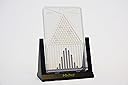
I purchased the new Index Fund Advisors (IFA) Galton Board (GB) with Pascal's Triangle (PT) - US Patent Number D748449 - from Amazon one week ago. It shipped promptly and arrived in perfect condition with excellent double-boxed packing and bubble wrap. The GB itself was shrink-wrapped in plastic to prevent movement during mailing. It worked perfectly for over a hundred GB cycles right out of the box, producing a symmetric bell-shaped curve of beads with no stuck beads. This new GB is a BIG step up from its smaller desktop version in terms of size, design, and documentation. It is the third evolution of these GBs and is twice the size - 12x8.5x4.5 inches - with twice as many beads - 6000. It has a redesigned bead reservoir, 14 rows of hexagonal pegs in a quincunx geometric pattern (like the die face with 5 dots) overlayed with PT, and 15 bead-collection bins below the last row of pegs. It includes a gold-colored bead that can be followed during its random walk to a bead bin where the golden bead is always visible. This GB is made with sturdy anti-static plastic, is well constructed, and has a larger base - 8.5x4.5 inches - for increased stability. It is durable and easy to use - just one finger is needed to rotate the GB to load and release the beads. This new GB has been thoughtfully designed so that the bead flow, which is confined to stay inside PT, is silky smooth, and produces a discrete representation of the continuous normal distribution (aka bell or bell-shaped curve) that closely matches PT bead-bin probabilities when on a level surface. A unique and very important feature in this GB is the fast, effortless bead-reload capability. No beads got stuck during bead flow or reload. It comes with a well-written, 15-page, 8.5x11 inch booklet that describes the many features and mathematical concepts included in this GB. A technical background is definitely NOT needed to enjoy this GB. Just watch the cascade of 6000 beads as they create "order in apparent chaos" as GB inventor Sir Francis Galton (1822-1911) wrote where "order" is the bell-shaped curve and "chaos" is the helter-skelter, chaotic flow of the beads as they fall through the GB. In my opinion, this is the best GB available today. I highly recommend it for people of all ages with any interest in the bell-shaped curve, used in so many areas of the natural and social sciences, or simply watching the bell-shaped curve being dynamically formed by 6000 bouncing beads in this fun and educational device. An expanded GB review follows that contains more information, with a few repetitions, about the history, mathematics, and inner workings of this GB. The Galton Board (GB, aka quincunx) was invented in 1873 by Sir Francis Galton (1822-1911) to introduce people to the normal distribution (aka bell or bell-shaped curve). (Galton called the normal distribution the curve of frequency in his book Natural Inheritance (1894).) His GB is a probability demonstrator that provided a dynamic illustration of the central limit theorem since the beads act independently and undergo a series of assumed independent and identical binomial processes (two possible outcomes). Beads inside the GB bounce either left or right off of the pegs, with assumed equal probability, in an apparent helter-skelter, chaotic manner. The beads end up producing a binomial distribution that has been shown to be a discrete representation of the continuous normal distribution for a well-constructed GB. Galton described this "mechanical" process as creating "order in apparent chaos." His GB successfully introduced the bell-shaped curve to people in the 19th century because the GB was just plain fun and interesting to watch. This new GB is a BIG step up from its smaller desktop version in terms of size, design, and documentation. It is the third evolution of these GBs and twice the size - 12x8.5x4.5 inches - with twice the number of beads - 6000. This GB is made of sturdy anti-static plastic and has a larger, more modern base - 8.5x4.5 inches - for increased stability. The GB is well constructed, durable, and is easy to use - just one finger is needed to rotate the GB to load or release the beads. The bead flow, which is constrained to be inside the overlayed PT, produces a binomial distribution of beads that closely matches the binomial distribution predicted by the binomial coefficients in PT. A unique and very important feature in this GB is the fast, effortless bead-reload capability. One golden bead is included to be able to follow its movements through the GB. Slowing down the bead flow by holding the GB in a more horizontal position makes it easier to follow the golden bead. The bead-bin channels are cleverly designed so that the golden bead will always be easily visible in the bead bins. The GB comes with a well-written, 15-page, 8.5x11 inch booklet that describes this GB characteristics including 6000 steel beads, 1 gold-colored bead, 14 rows of hexagonal pegs in a quincunx geometric pattern, the overlayed PT, and 15 bead-collection bins under the last row of pegs. The booklet also contains a wealth of information about the history of the GB, all the information on the faceplate, the normal distribution, PT, the binomial distribution of beads, the binomial expansion, combinatorics, the Sierpinski triangle, and the GB poster displayed at the 1961 Mathematica Exhibit in Los Angeles. The last section discusses the different faceplate information on the IFA GB Stock Market Edition, which can be ordered from Amazon in lieu of the GB with PT. The GB faceplate contains lots of color-coded mathematical and numerical information. A bell curve with mean mu and standard deviation sigma is drawn on the faceplate for easy comparison to the observed bead distribution. The 1, 2, 3, and 4 (maximum theoretical value for this GB) sigma lines are shown, along with probabilities of a bead landing in each sigma interval. The integers on the overlayed PT are the binomial coefficients, which are also the number of paths a bead can take to arrive at each PT location. There are more possible paths to the center bead bins than to the edge bead bins, which creates the bell curve. The faceplate also contains the equations for the normal distribution and its standard deviation, the probabilities and expected number of beads for the 15 bead-collection bins, interesting numerical patterns in PT, and the Fibonacci numbers. The GB itself - 11x6.75 inches - is a Golden Rectangle, which some ancients deemed divine. The bottom of the GB base contains contact information, US Patent Number D748449 (2017), and a website with many informative GB-related videos and articles. My bottom line is that I am extremely impressed with this well-constructed, math-in-motion GB that beautifully demonstrates "order in apparent chaos" while closely preserving the theoretical bead flow probabilities in PT. It is clear that great effort went into the design and engineering of this new GB. It is definitely a unique, mesmerizing, fun, and stimulating conversation piece for all ages. This GB can be used as an educational device that could spark interest in STEM (Science, Technology, Engineering, and Mathematics) projects. This GB is STEM.org authenticated, which validates its use for STEM educational activities. A technical background is NOT required to enjoy watching both the golden bead and the creation of the discrete bell-shaped curve from the chaotic bead interactions of 6000 beads inside the GB. I highly recommend this new GB to anyone with even a casual interest in observing, learning about, and/or teaching the stochastic behavior of many natural and other random phenomena. In my opinion, this is the best GB available today.