Desertcart purchases this item on your behalf and handles shipping, customs, and support to OMAN.
🚀 Elevate your projects with the ultimate dual-core wireless microcontroller!
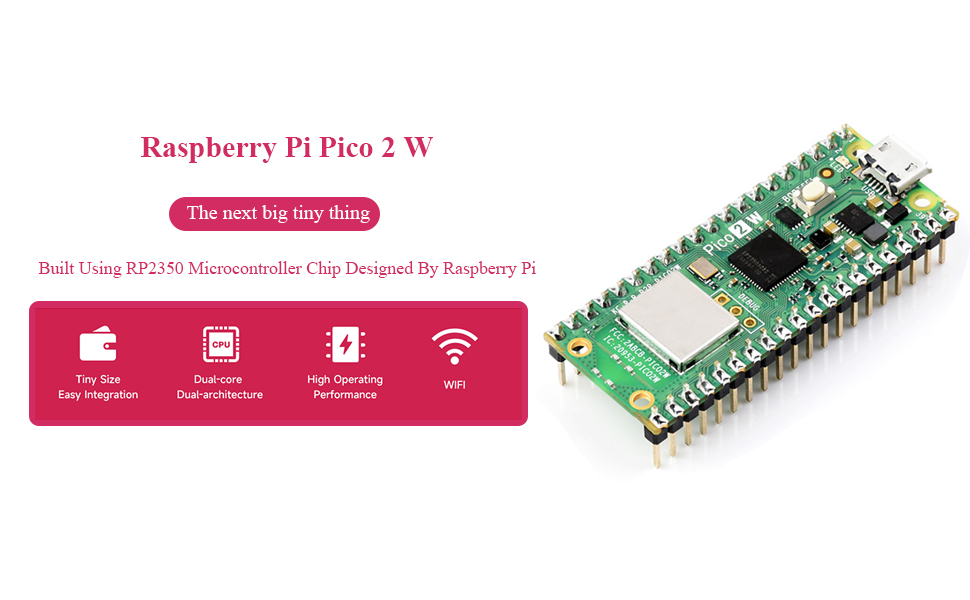
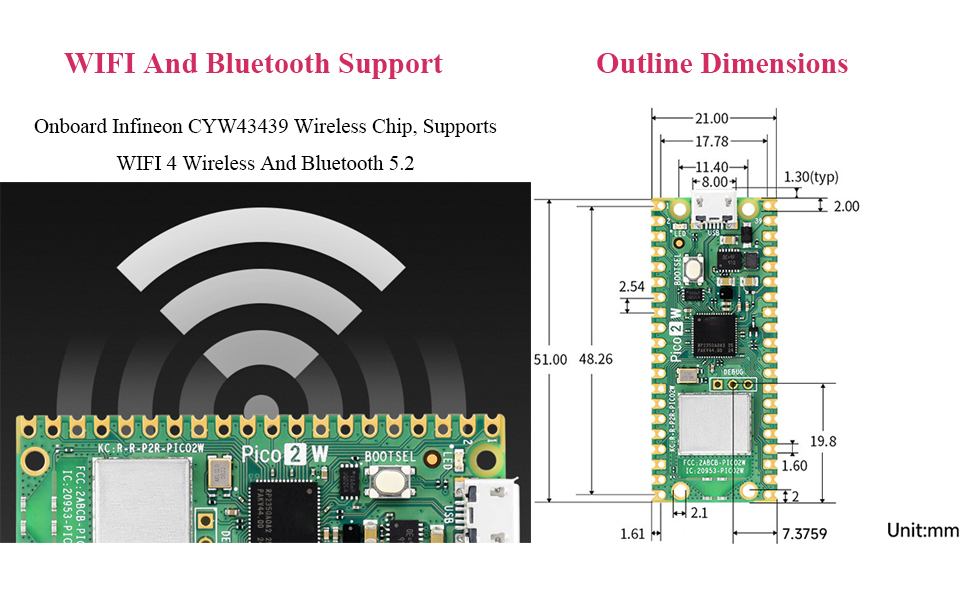
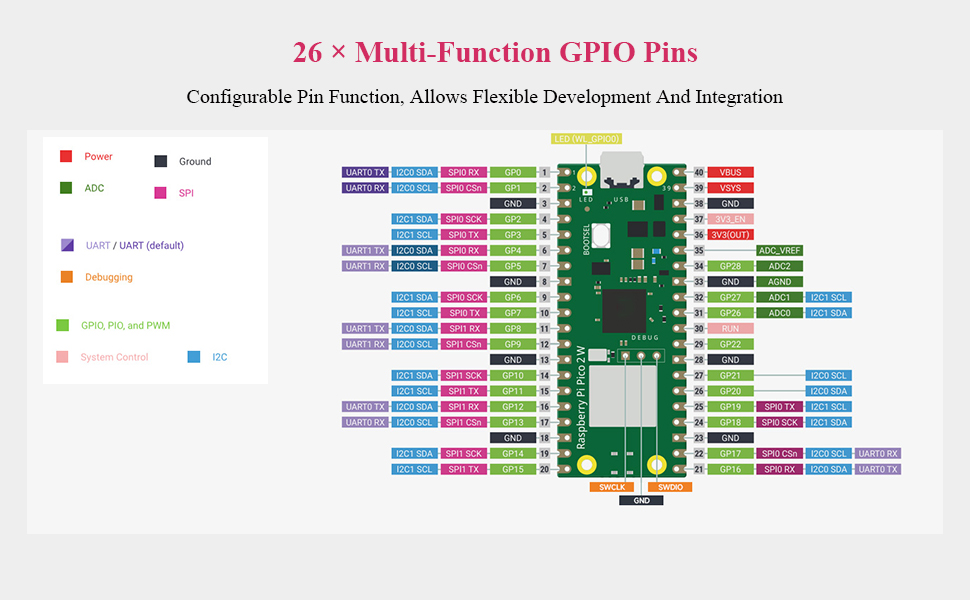
The UeeKKoo Pico 2 W is a cutting-edge microcontroller board featuring the official RP2350 dual-core chip (Arm Cortex-M33 & RISC-V) running up to 150 MHz. It integrates Wi-Fi 4 and Bluetooth 5.2 via an onboard Infineon CYW43439 wireless chip, includes 520KB SRAM and 4MB flash memory, and offers 26 multifunction GPIO pins with extensive peripheral support. The pre-soldered, color-coded header simplifies prototyping, while drag-and-drop MicroPython programming over USB makes it accessible for both beginners and pros aiming to build wireless, high-performance embedded systems.


| ASIN | B0DP54FWX1 |
| Best Sellers Rank | #40,222 in Computers ( See Top 100 in Computers ) #551 in Single-Board Computers |
| Brand | UeeKKoo |
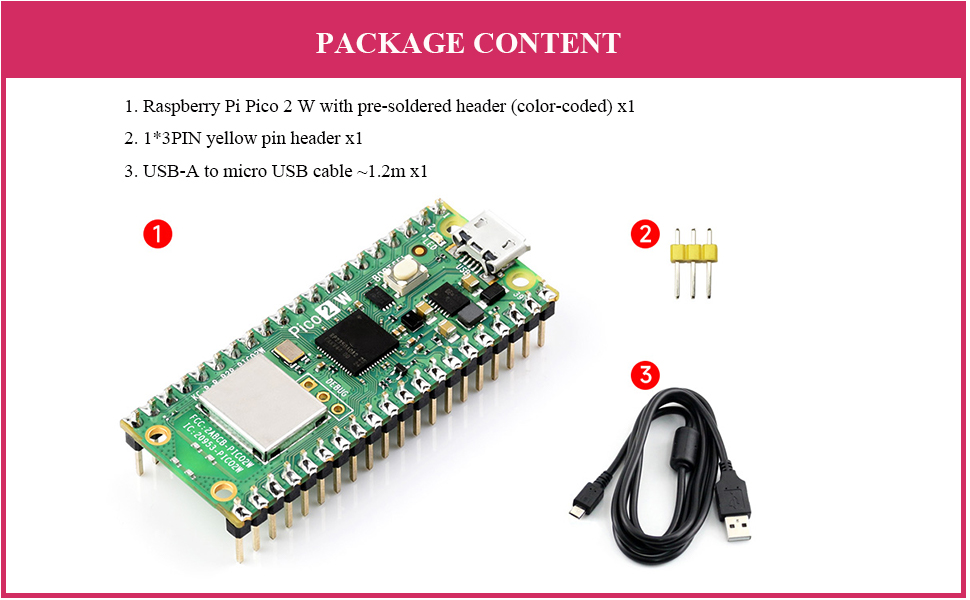
| Built-In Media | Pi Pico 2 W with pre-soldered header (color-coded), 1*3PIN yellow pin header, USB-A to micro USB cable ~1.2m |
| CPU Model | Cortex |
| CPU model | Cortex |
| CPU speed | 150 MHz |
| Compatible Devices | Computers (PCs, laptops, tablets) |
| Connectivity Technology | Wi-Fi 4, Bluetooth 5.2, USB 1.1 |
| Customer Reviews | 4.7 out of 5 stars 116 Reviews |
| Installed RAM memory size | 520 KB |
| Manufacturer | UeeKKoo |
| Memory Storage Capacity | 4 MB |
| Memory storage capacity | 4 MB |
| Model Name | Pico 2 W |
| Model Number | RPi Pico 2 W with header |
| Model name | Pico 2 W |
| Operating System | Linux |
| Processor Brand | ARM |
| Processor Count | 2 |
| Processor Speed | 150 MHz |
| RAM Memory Installed | 520 KB |
| RAM Memory Technology | DDR |
| Smart Home Compatibility | Not Smart Home Compatible |
| Total Usb Ports | 1 |
| Unit Count | 1 Count |
| Wireless Compability | 802.11n |
R**S
Great little device to run as a dedicated wireless PS5 Controller Dongle for PC
This was used to run a program that someone made to make my PS5 Controller run wireless on my PC and still get the full PS5 Haptics as I should if I am playing a PS5 style game game that was ported to PC or any game that was built for the PS5 that took the time to include the added Haptics when porting to PC. Like Deathloop. The controller works in bluetooth on the PC but I get basic rumble like an xbox controller, when I plug in the PS5 controller with USB I get full haptics in specific game that take advantage of the controller. This device and the program allowed me to go wireless with the PS5 controller on my PC. Super nice. make sure to 3D print a case or buy a 3d printed case to protect from shorting it out.
J**V
Easy-to-use board with great online documentation
Pros: - Decent build quality - Includes programming cable with micro-USB connector - Excellent online documentation - Easy installation process - Colour pre-soldered header matches the pinout diagram - Beginner-friendly - Worked well with Thonny on Windows 11 Cons: - Onboard LED not working The UeeKKoo Pico 2 W with Colour Pre-Soldered Header Compatible with Raspberry Pi Pico 2 W RP2350 Microcontroller Board with 2.4GHz 802.11n Wifi 4 and BLE 5.2 has a decent build quality. This board adds wireless capabilities to the popular Pi Pico 2 board. A programming cable with a micro-USB connector is included. Before using the Pico 2W board, you need to install MicroPython by flashing it with a .uf2 file. It comes with great online documentation, and the link is included in the bootloader. The online documentation also tells you where to download the .uf2 file. This is so refreshing to see, as many MCU boards I have reviewed failed to include any documentation. It is really not that hard for the manufacturer to include an external documentation link in the bootloader as demonstrated by UeeKKoo. For beginners, the difference is day and night! After you download the .uf2 file, you can boot into the bootloader of the board by holding the "boot" button on the board before plugging it into the computer. Wait until a folder pops up before you release the button. Just drag the .uf2 file into this folder, and if everything is done right, the folder will close, and the board will reboot. I used Thonny to test the Pico 2W board under review. With the board already plugged into my Windows laptop, I opened Thonny and selected the proper COM port for the board in the lower-right corner. Then I ran a little MicroPython script, and everything appeared to work fine. from machine import Pin import time # Set up GPIO pin 0 as an output because GP25 pin 25 does not turn on the LED led = Pin(0, Pin.OUT) while True: led.value(1) # Turn on the LED time.sleep(3) # Wait for 3 second led.value(0) # Turn off the LED time.sleep(1) # Wait for 1 second Basically, I toggled the GP0 output pin for 3 seconds high and 1 second low repeatedly. I used my multimeter to measure the voltage on Pin 1 of the board and observed that the voltage stayed at 3.3V for 3 seconds and 0V for 1 second. So it appears the basic function of the board is working. I did not test the WiFi or Bluetooth wireless interfaces. The onboard LED, which is supposed to be on GP25 from the documentation, does not work. I am not sure why. That's why I needed to use a multimeter to measure the voltage on Pin 1 (GP0 output). Overall, the basic functions of the UeeKKoo Pico 2 W board appear to work well with Thonny on a Windows 11 laptop. I love the colour pre-soldered header since the colour matches exactly what is in the pinout diagram of the Pico 2W board. When I measured the voltage on Pin 1, it was easy for me to tell that Pin 3 was Ground because it is black in colour. It just makes the whole debugging process much easier when you reference the official pin-out diagram of the board. The colour-coded headers are nice touches! I love it! The fairly extensive online documentation provided just makes the product so much more beginner-user-friendly. Good job, UeeKKoo! A great acquisition for me!
N**X
Love it
Great little board, and the extra colour coding looks great & is super useful!
A**R
Neat idea for hobbyists
This is an RP2350 board (looks like an original Raspberry Pico 2W board, with headers soldered on). No debug pins soldered, but it came with a 3 pin block (yellow) to solder yourself if desired. The board has a micro-USB connector, and a USB-A to micro-USB cable is supplied so you can power it. The distinctive feature of this Pico2W seems to be the colored header pins. Each type of pin has a different color (black=ground, dark green=GPIO, blue=ADC, red=power (5v+3.3v), lime green=system control). Even just looking at the power and ground makes it easier to find a desired GPIO pin. A very good idea for useability. Note that the colors are only visible if you have the pins pointing upwards. So if (for example) you have the board inserted into a breadboard, you won’t be able to see them. I did some trials (using Arduino IDE), and the board seemed to function with no issues. I think the Pico 2W board is a neat little board for hobbyists, and this variation with the colored headers is even better.
M**L
Great SBC Board
Great little single board computer. I flashed my project code onto it and was to and running.
Trustpilot
1 month ago
1 day ago