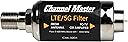
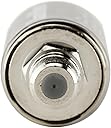
For those who don't know what this product is about, a quick (simplified) summary of major changes to Over-the-Air Television in the United States. UHF TV reception in the US originally consisted of channels 14 to 83 (460 to 890 MHz) introduced through FCC regulation in 4/11/1952. The 800 MHz portion (channels 70 to 83) of the UHF TV band were reallocated already back in 1983 for other services (including but not exclusively to mobile telephone service). Effective 6/12/2010 (immediately following the Analog to Digital TV conversion) the 700 MHz portion of the UHF TV band (channels 52 to 69) were auctioned off by the FCC of which AT&T (band 12, 699 to 746 MHz) and Verizon (band 13, 746 to 787 MHz) were the major winners. Since then the FCC conducted a "repack" requiring TV broadcasters to move from upper UHF channels to lower UHF channels or back to VHF (were many stations were broadcasting prior to the Analog to Digital TV conversion), including to the low-VHF band that was originally deemed unsuitable for digital television. In 2017 the FCC then auctioned off the 600 MHz portion of the UHF TV band (channels 38 to 51) of which T-Mobile was a significant winner (band n71, 617 to 698 MHz). TV broadcasters had until June 2020 to complete their relocation and to free up the 600 MHz spectrum. TV channel 37 has been and continues to be a reserved channel for radio astronomy which means that the usable UHF TV band has shrunk to channels 14 to 36 (460 to 608 MHz). All of the above refers to the actual RF channels on which your local stations really transmit (which has absolutely nothing to do with the channel numbers your TV will display). Depending on how old your TV tuner is, it will be designed to receive signals from the 600, 700 and possibly (so less likely) 800 MHz ranges which no longer contain any TV programming. The mostly mobile phone transmissions on those bands can interfere with the TV programming you are actually interested in. To prevent nearby cell towers and even your own cellphones from interfering with your TV reception, a number of companies make filters to block the unwanted signals from getting into your TV. This product (ChannelMaster CM-3201) is one of those products. It was twice as expensive as a similar product sold under the Philips brand name (SDM1520/27 also here at Amazon) which I also purchased. Needless to say, I was curious whether or not the higher price of the CM-3201 was worth it and I wanted to rely on science instead of subjective testing (e.g. how many times a particular channel pixelates within an hour). I therefore used a NanoVNA-H4 to measure the filter characteristics. I'll state upfront that using test equipment for 50 Ohm impedance with 75 Ohm impedance filters does introduce some errors into the measurements, however since this is the same impedance mismatch in both cases it still results in a valid comparison. An ideal (impossible) filter would have no attenuation below the cut-off frequency and infinity attenuation for any frequency above it (meaning that there would be no transition band at all). Real filters reveal their quality by how much they attenuate unwanted signals and how wide the transition range is (the frequencies between start of attenuation and full attenuation). Both filters showed a start of attenuation at 606 MHz (first visible sign of attenuation in the LogMag trace, not the 3dB attenuation commonly used to characterize filters) which is still within the frequency range for TV channel 36 (I subsequently tested the filters on a local station that uses RF channel 36 and the reception was fine). Also both filters showed reasonably low figures for insertion loss (the attenuation of a good signal just because the filter is being added). The CM-3201 (this product) showed a transition band of 36 MHz (less is better) and attenuation of almost 60dB (more is better, but 60dB is already excellent). The SDM1520/27 showed a transition band of 72 MHz (a bit disappointing that it is so wide) and attenuation of about 30dB (good, but higher would be better). In-line filters are often symmetrical and can be used in either direction. Both the CM-3201 and the SDM1520/27 have explicit input and output markings but I did not test whether the filters behave any different when used backwards. The ChannelMaster CM-3201 is significantly larger in diameter which may be a problem on some TVs with recessed antenna connectors (it wasn't a problem for me, I connected it to the input of the antenna amplifier which is the recommended place). Bottom line, this filter does work and it is much better than the half price competition. Not everybody may need these filters and of those who do, some may get satisfactory results from the cheaper filter. That said, why settle for less when the better product is still affordably priced ? However beware of any filters that are still sold which are based on the 2010 elimination of the 700 MHz band since those are not blocking cell transmissions in the 600 MHz range (those older filters are useless, regardless of price).