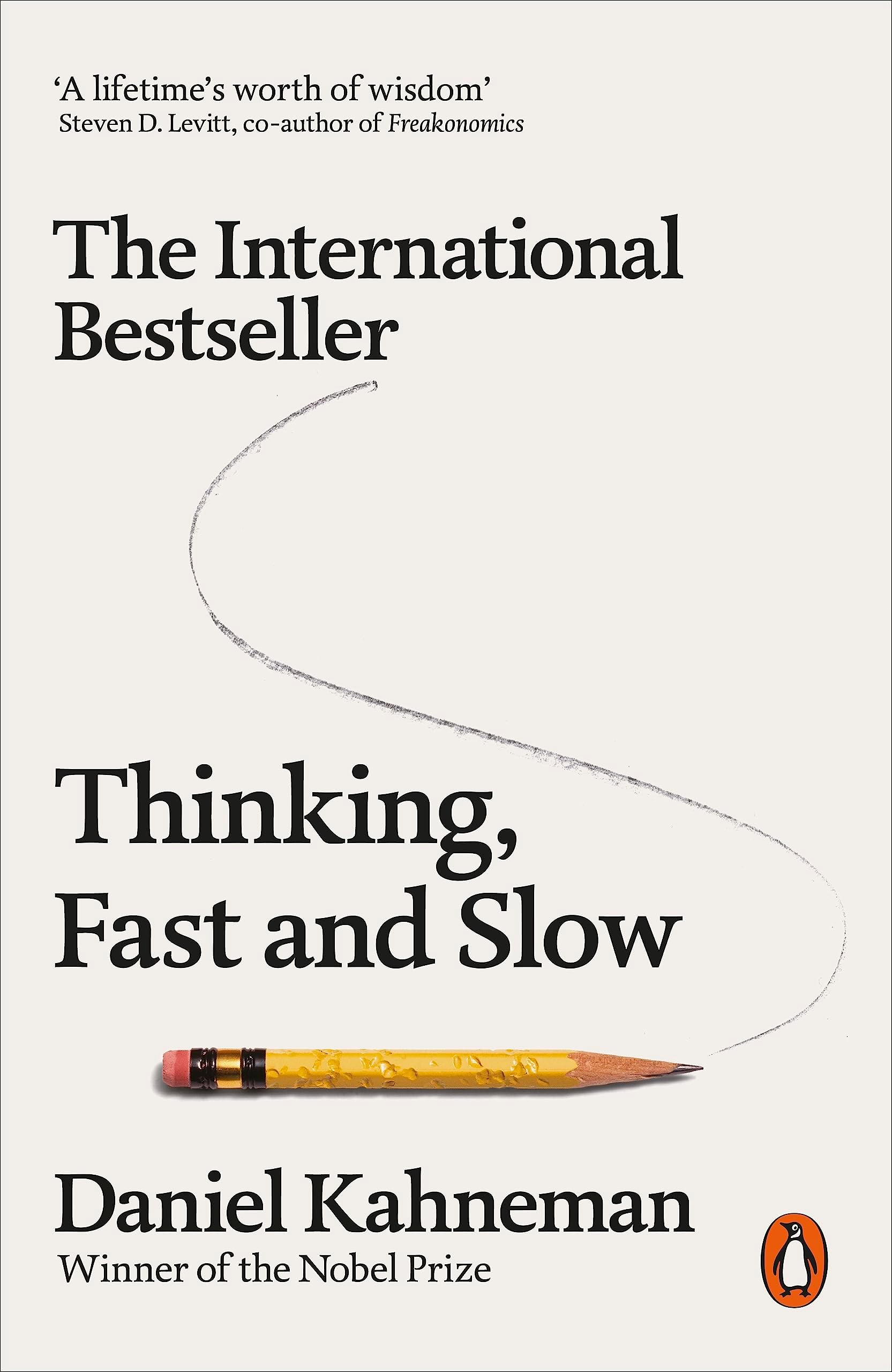


desertcart配送商品ならTHINKING,FAST AND SLOW(B)が通常配送無料。更にdesertcartならポイント還元本が多数。KAHNEMAN, DANIEL作品ほか、お急ぎ便対象商品は当日お届けも可能。 Review: Although the behaviorial economics economics is right now thrown doubt on because of either faked or dubious experimental records by a couple of scholars, this book impresses me with its coherent, convincing argument which reconciles with what I have been feeling about irraationality of human beings. However, that might be exactly what " System 1" of me tells me, though. This book teaches us how to exercise our "System 2" to put things in perspective so that we can enjoy more well-being as well as life satisfaction. Review: I am enjoying reading this book.


| ASIN | 0141033576 |
| Amazon 売れ筋ランキング | 洋書 - 126位 ( 洋書の売れ筋ランキングを見る ) Personal Transformation Self-Help - 4位 Professional Science Behavioral Sciences (洋書) - 5位 Behavioral Sciences (洋書) - 5位 |
| ISBN-10 | 0811227804 |
| ISBN-13 | 978-0141033570 |
| カスタマーレビュー | 4.3 5つ星のうち4.3 (46,472) var dpAcrHasRegisteredArcLinkClickAction; P.when('A', 'ready').execute(function(A) { if (dpAcrHasRegisteredArcLinkClickAction !== true) { dpAcrHasRegisteredArcLinkClickAction = true; A.declarative( 'acrLink-click-metrics', 'click', { "allowLinkDefault": true }, function (event) { if (window.ue) { ue.count("acrLinkClickCount", (ue.count("acrLinkClickCount") || 0) + 1); } } );… |
| ペーパーバック | 499ページ |
| 出版社 | PENGUIN UK (2012/5/24) |
| 寸法 | 12.8 x 3.4 x 19.6 cm |
| 発売日 | 2012/5/24 |
| 言語 | 英語 |
T**I
Although the behaviorial economics economics is right now thrown doubt on because of either faked or dubious experimental records by a couple of scholars, this book impresses me with its coherent, convincing argument which reconciles with what I have been feeling about irraationality of human beings. However, that might be exactly what " System 1" of me tells me, though. This book teaches us how to exercise our "System 2" to put things in perspective so that we can enjoy more well-being as well as life satisfaction.
C**C
I am enjoying reading this book.
T**N
原書で読むと以外と英語の勉強になります。
原書なので購入するのは「どうかな?」と思われておられるならば、高校や大学で辞書片手に四苦八苦して読んだ事を思い出し気安くユックリ読まれると良いのではないかと思います。英語の勉強と思って頑張ってみてください。
V**T
While the side effects of better understanding how my mind works was great, the real meat of reading this book was: - To be called "abjectly poor" by a 89 years old professor emeritus, best seller author and Nobel Prize awardee because my attitude would be different if my net worth were higher or lower by a "few thousand dollars". - Being assumed to know how to drive, not to mention owning a car. All jokes aside it was a great, enlightening read.
A**R
素早い発送 綺麗な本
すぐに発送いただき 本も予想以上に綺麗でした。ありがとうございました
R**B
Not so good as I expected
B**O
I Like the book so much
T**Y
名著です
我々の行動は95%直感で決まっているとも言われますが、fase(feel, unconscious)とslow(thinking)について学べ、我々の多くが陥る非合理性の特徴についても書かれていて面白かったです。
V**H
Hard cover. Very good quality. Finished reading first two chapters. The book essentially talks about how the mind works. This is helpful in identifying our biases and actively countering them. So definitely a read for those who are interested in understanding how does our brain impact our actions.
M**S
Même si l'expression est un cliché, disons-le sans hésitation : ce livre est un must. D'abord, songez au prestige que vous vous attirerez en glissant, au hasard d'une conversation, que vous êtes en train de lire un ouvrage signé d'un prix Nobel d'économie ! Mais surtout, cet ouvrage constitue une plongée des plus passionnantes dans les arcanes de l'esprit humain, sous la conduite d'un guide qui, en plus de sa profonde érudition et de son expertise, n'oublie jamais d'être accessible, pratique, voire drôle ! Plus d'une fois, au détour d'une page, vous vous surprendrez à penser : « Bien sûr, c'est cela ! », tant les démonstrations de Daniel Kahneman font écho à notre expérience quotidienne, aux mécanismes psychiques avec lesquels nous nous débattons dans notre for intérieur. Au fil des chapitres, l'auteur passe en revue les merveilles et les nombreux travers de la pensée intuitive, cette « star masquée » qui, sans que nous le réalisions, prend bien souvent le dessus sur notre esprit rationnel : hyper-sensibilité à l'environnement extérieur et à une kyrielle de biais (effet de halo, excès de confiance, etc.), tendance à poser ses conclusions d'emblée et à chercher ensuite les raisons qui les justifient, oubli des principes statistiques les plus élémentaires... Sans être inaccessible, le chapitre sur la théorie des perspectives - le domaine qui a valu à l'auteur son prix Nobel - est plus pointu et s'adresse aux lecteurs soucieux d'entrer dans le détail d'une théorie à la pointe des réflexions actuelles sur la prise de décision. Fort de ses plus de 500 pages, ce livre est un ouvrage de référence, à lire et à méditer en prenant son temps, car un contenu d'une telle richesse ne se digère pas en quelques heures.
Y**O
⭐️⭐️⭐️⭐️⭐️ (5/5) „Thinking, Fast and Slow“ – Meilenstein der Psychologie und Ökonomie 📌 Kurzfazit Kahneman, Nobelpreisträger für Wirtschaft, fasst in diesem Werk jahrzehntelange Forschung zu kognitiven Verzerrungen, Entscheidungsfindung und Heuristiken zusammen. Er erklärt die Dynamik zwischen zwei Denksystemen – dem schnellen, intuitiven „System 1“ und dem langsamen, analytischen „System 2“. Das Buch ist ein Standardwerk für alle, die verstehen wollen, warum Menschen oft irrational entscheiden. 📚 Inhalt in Kürze System 1: schnell, automatisch, intuitiv System 2: langsam, reflektiert, kontrolliert Heuristiken und Biases: Verfügbarkeitsheuristik, Anker-Effekt, Verlustaversion, Overconfidence Anwendungen: Wirtschaft, Politik, Alltagsentscheidungen Erklärung, warum klassische ökonomische Modelle (Homo oeconomicus) nicht ausreichen 🔬 Wissenschaftliche Relevanz Stärken: Umfassende Darstellung der Arbeit von Kahneman & Tversky – Grundlage der Verhaltensökonomie. Beeinflusst Ökonomie, Psychologie, Politikwissenschaft, Medizin und Management. Viele Erkenntnisse empirisch mehrfach bestätigt. Schwächen: Kritik in den letzten Jahren an der Replizierbarkeit mancher sozialpsychologischer Studien. Sehr dicht und anspruchsvoll geschrieben – kein „leichter“ Ratgeber. 👉 Fazit Wissenschaft: Trotz Kritik an einzelnen Studien bleibt das Buch ein wissenschaftlicher Eckpfeiler, weil es ein Paradigma veränderte. 🌍 Kulturelle Relevanz Weltbestseller, über 10 Mio. verkaufte Exemplare. Hat das Denken über Rationalität, Politik, Wirtschaft und Finanzen verändert. Populär in Management- und Leadership-Literatur, aber auch in Journalismus und Politik zitiert. Hat Begriffe wie „System 1 & 2“ in den kulturellen Mainstream gebracht. 💭 Meine persönliche Meinung Positiv: Tiefgründig, brillant, lehrreich. Eines der wenigen Bücher, die wirklich das Denken verändern können. Kritisch: Stellenweise schwerfällig, fast akademisch – nicht jedermanns Lesestil. Für mich: Pflichtlektüre, wenn man menschliches Verhalten verstehen will – intellektuell fordernd, aber lohnend. 🎯 Fazit Thinking, Fast and Slow ist ein epochales Werk, das die Psychologie und Wirtschaft nachhaltig geprägt hat. Es erklärt, warum wir oft systematisch falsch entscheiden – und liefert ein Vokabular, um darüber nachzudenken. ⭐️⭐️⭐️⭐️⭐️ – 5 von 5 Sternen Weil: wissenschaftlich fundiert, kulturell prägend, intellektuell bereichernd.
V**N
easy to read
G**E
This is an invaluable book that every person who considers him/herself educated should read - even study. Indeed, it is a scandal that mastering the material in this book isn't considered an essential component of a high school education. The author was awarded the Nobel in Economics for his work on what he calls decision theory, or the study of the actual workings of the typical human mind in the evaluation of choices, and the book itself presents the findings of many decades of psychological studies that expose the endemic fallacious thinking that we are all prone to, more or less. The lives of all of us could be improved by lessons learned from this book, not just individually, through self-education, but also on the large scale, if the large scale decision makers in this society in and out of government could be educated as well. In fact, it is largely because these large scale decision makers are no better than the rest of us in their ability to think straight and plan well, that society is as screwed up as it is, and that essentially all of its institutions are diseased and corrupt. The lesson there, however, is that decision making needs to be returned to the individual - that the powers that be need to be deprived of their powers to mess up the lives of the rest of us. Despite the many virtues of this book - it is well-written, engaging, and its academic author reasonably restrained in the tendencies of his tribe to blathering in abstractions - it is a bit disappointing at the very end, when the author proves unable to synthesize all his material into a comprehensive theory of the thinking, and deciding mind - or at least into a set of carefully formulated principles that provide a succinct summary of the principles of human thinking, both typical and ideal. Kahneman uses throughout a construct that implies that we are of two minds: System 1 is the fast-thinking, intuitive, mind, prone to jumping to conclusions; while System 2 is the slow-thinking analytical mind, that is brought into play, if at all, only to critique and validate the conclusions that we have jumped to. System 2, we are told, is lazy, and if often just rubber-stamps the snap judgements of System 1, or if pressed, rationalize them, instead of digging critically as well as constructively into the complex underpinnings of the material and sorting them out as best it can. Instead of working this construct up into a comprehensive model of mind, K merely uses it as a loose schema for representing the kinds of thinking thought to underlie the results derived from the many psychological experiments that he here reports on. This neglect raises the question at many points as to just how well the experimenters have really understood the thinking that underlies the behavior of their subjects. But this, I am sorry to say, is a weakness of virtually all psychological experimentation, which is still just beginning to come to grips with the complexity and varieties of cognitive style of the human mind. What Kahneman does do, however, is to provide convenient labels for many characteristic types of fallacious thinking, although again, the exact role of System 1 and System 2, and their interaction, is inadequately explicated. Instead, towards the end of the book, another, somehow related, but nominally independent theme is developed: the disturbing divergence between the experiencing self and the remembering self. This is in itself such an interesting and important idea, so pregnant with both psychological and philosophical implications, that it could have used a fuller treatment, and again, there is no coherent integration of this theme with the System1/System2 construct. The idea here is that our present experience includes our most salient memories of previous experiences - for example the highlights of past vacations, or out of the ordinary episodes of our lives. Somewhat surprisingly, though, what we remember is a systematic distortion of the actual experience. Our memory collapse the duration of various aspects of our experience and highlights only the peak moment(s) and the final moments, perhaps with a nod toward the initial presentation of the experience. And this systematic distortion of the actual experience in all its fullness, can lead us to make irrational and detrimental choices in deciding whether to repeat the experience in the future. Thus, a bad ending to an otherwise wonderful experience can spoil the whole thing for us in memory, and cause us to avoid similar experiences in the future, even though by simply anticipating and improving the ending we might make the whole experience as wonderful as most of the original was. Likewise, subjects in experiments involving either long durations of pain, or much shorter episodes of pain with a higher peak, were consistently more averse to the latter rather than the former - or they overemphasized the way these presentations ended as a factor in judging them as a whole. These are important findings that go the heart of the question of how best to steer our course through life, but here is the only attempt at integration of this remembering vs experiencing self theme, and the System 1/ System 2 theme that I find in the final chapter, Conclusions: "The remembering self is a construction of System 2. However, the distinctive features of the way it evaluates episodes and lives are characteristics of our memory. Duration neglect and the peak-end rule originate in System 1 and do not necessarily conform to the values of System 2". There is more here, but it merely repeats the earlier analysis of the relevant experiments. No evidence is presented as to the respective roles of System 1 and System 2 with respect to the laying down of memory, to its decay, or with respect to a recently discovered phenomenon: memory reconsolidation. Nor is any account taken of what has been learned, much of it in recent decades, about the interactions between short, intermediate, and long term memory, or any of the radically different modalities of episodic (picture strip) and semantic (organized, abstracted) memory. Consequently, Kahneman's vague reference to the "characteristics of our memory" is essentially a ducking of the question of what the remembering self is. I think that at best, the finding of the replacement of the original experience by an abstract predicated on peak-end bias is an exaggeration, though there's no question that "duration neglect" is in operation, and a good thing too, unless K means by "duration neglect" not just the stretches of minimally changing experience (which have little memorial significance anyway, but even the consciousness of how long the edited out parts were (this distinction was never made in Chapter 35, where the theme of the remembering vs. the experiencing self is first taken up). Speaking for myself anyway, I have a much fuller memory of my most important experiences than Kahneman seems to indicate. Naturally the highlights are featured, but what I tend to remember are representative moments that I took conscious note of at the time, as though making a psychological photograph. I remember these moments also because I bring them up from time to time when I'm thinking about that experience. For example, I'm thinking now of a long distance race I did in 2014 (a very tough half-marathon, with almost 2000' of climbing). I remember: the beginning section as well as the ending section; each of the rest stations; certain moments of each of the major hill climbs; at least one moment from each of the descents; and a number of other happenings during the almost three hour event. For me in this race, the peak experience occurred right at the end, when I all but collapsed, yet managed to stagger to the finish line. That ending does naturally come first to mind as a representation of the entire event, but it is merely the culmination of a long and memorable experience with many moving parts, and if I want, my remembering self can still conjure up many other moments, as well as a clear sense of the duration of each of the sections of the course. Over many years most memories fade, and it's certainly reasonable to suppose that in extreme cases, where they are all but forgotten, only a single representative moment might be retained. However, if we can say anything for sure about memory it is this: we remember what we continue to think of and to use, and we do that precisely because this material has continuing importance to us. The recent research in memory reconsolidation tells us that when we do bring up memories only occasionally, we reinforce them, but we also edit and modify them to reflect our current perspectives, and sometimes we conflate them with other seemingly related knowledge that we've accrued. We are thus prone to distort our own original memories over time, in some cases significantly, but we may still retain much more of the original experience that just the peak and the end, and if we do reinterpret our memories in the light of more recent experience, that's not necessarily a bad thing. In any case, the memories that occur in the present may be said to be a joint project of the experiencing as well as the remembering self, which rather erodes the whole Two Selves concept that Kahneman first posited. I do not mean to criticize the valuable evidential material in the book, and in general I think that Kahneman, and the other researchers and thinkers whom he quotes, have drawn reasonable conclusions from the experiments they report on. But ultimately, the book, as well as the fields both of psychology and brain neurophysiology suffer both in coherence and meaningfulness because they aren't predicated on a more comprehensive theory of mind. It's the old story in science, first formulated by Karl Popper in his 1935 book, The Logic of Scientific Discovery: unless we approach the data with an hypothesis in mind - unless, indeed, we seek out data likely to be relevant to a particular hypothesis, we're not going to make any enduring progress in understanding that data in a comprehensively meaningful way, let alone be able to make falsifiable deductions about elements of the system for which we have at present no data. Popper's quotation from the German philosopher Novalis comes to mind - "Theories are nets: only he who casts will catch." In the final, "Conclusions", chapter, K caricatures the abstract economists' model of homo econimicus (man as a rational optimizer of his utility), contrasting it with the more sophisticated and experientially grounded model of psychologists such as himself. In keeping with his penchant for framing (or spinning) his presentation favorably to his own perspective, he calls the economists' model "Econ", and his own "Human". In fact, "Econ" was never meant to represent man in all his humanity, and Kahneman's Economics Nobel, recognizing his decision theory contributions to economics, was preceded by many other Nobels to economists who had been expanding the concept of the economic actor into psychological territory for decades. In fact, the essential view of the Austrian economists dating from the 1920s (von Mises, Hayek, and their predecessors) is that economics is in the end wholly dependent on psychology because it is predicated on the unknowable, unquantifiable subjective value preferences of humans, acting individually and in concert. Cautious generalizations can perhaps be made about human psychology in general, but I think that on the whole the Austrians have been a bit wiser in their restraint than Kahneman and his many, and mostly lesser, pop psychology compatriots have proved in their often sensationalist extrapolations from lab experiments. Here is an example, I think of Kahneman over-reaching. He speaks repeatedly of the laziness of System 2, and its foot dragging reluctance to get involved in the thinking process, but in the real world, snap judgements are good enough for immediate purposes, and the better part of rationality may be to go with one's fast thinking intuitive System 1: indeed, Kahneman acknowledges this himself in passing, both in his beginning and his ending, but this isn't enough to counterbalance the overall argument of his book. Kahneman also, in his final chapter, speculatively extends his findings into the political sphere (his liberal Democratic Party bias has already been made clear by gratuitous and somewhat annoying usage of salient modern politicians in examples), but not to any great effect. Kahneman advocates "libertarian paternalism" consisting of government programs that people are enrolled in automatically unless they opt out by checking a box on forms - thus manipulating the presentation frame so as to trick them into signing on to what some government bureaucrat thinks is good for them. Of course, as long as people are allowed to opt out, one can't call the choice here anything but libertarian, though to be consistent with their socialist mores, liberals like Kahneman really ought to object to such practices as being manipulative advertising. This libertarian finds nothing objectionable about the way such a choice might be presented - after all, the average man, if adequately educated and prepared for the real world, should have no trouble seeing through the frames. What is not only paternalistic, but totalitarian in spirit, is the extortion of taxpayer money to finance such government programs in the first place. Somehow, it fails to occur to Kahneman that most people could be trained to recognize and avoid fallacious thinking during all those years of enforced and mostly wasteful schooling - just as most people can be trained to recognize the Müller-Lyer illusion for what it is. IMO every high school graduate should be required to learn to recognize and avoid the paradigm cases of fallacious thinking presented in Thinking, Fast, and Slow, and this material could profitably be expanded to cover the many rhetorical tricks used by the manipulators and spinmeisters, both public and private, who batten off of our society. With such training in critical thinking, and with the reintroduction of enough honest and rigor to begin high school graduates up to the 12th grade reading and writing proficiencies that were routine in the 1950s, the need for college as life preparation would be altogether obviated, and most young people could avoid wasting their early years in college, piling up debt, and get on with their work and/or their self-education, as they chose.
Trustpilot
1 day ago
2 weeks ago