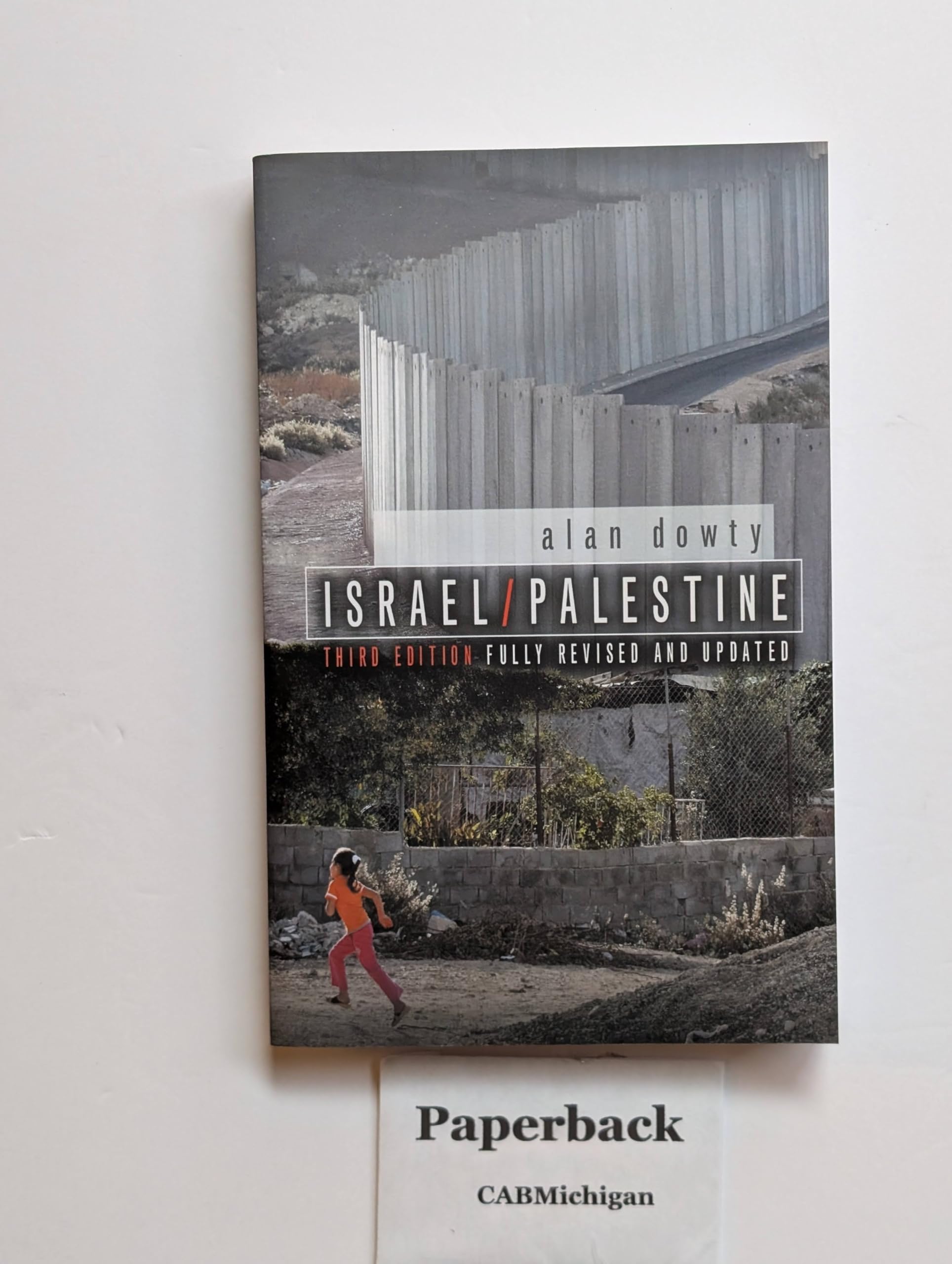
Israel / Palestine
Product ID: 8193823
What explains the peculiar intensity and evident intractability of the Israeli-Palestinian conflict? Of all the "hot spots" in the world today, the apparently endless clash between Jews and Arabs in the Middle East seems unique in its longevity and resistance to resolution. Is this conflict really different from other ethnic and nationalist confrontations, and if so, in what way? In this fully revised and updated third edition of his highly respected introductory text, Alan Dowty demystifies the conflict by putting it in broad historical perspective, identifying its roots, and tracing its evolution up to the current impasse. His account offers a clear analytic framework for understanding transformations over time, and in doing so, punctures the myths of an "age-old" conflict with an unbridgeable gap between the two sides. Rather than simply reciting historical detail, this book presents a clear overview that serves as a road map through the thicket of conflicting claims. This newly expanded edition updates the analysis to include the latest developments, and also integrates into the analysis a fuller account of the regional and international context of the conflict. In this account the opposed perspectives of the two sides are presented in full, leaving readers to make their own evaluations of the issues. The book thus expresses fairly and objectively the concerns, hopes, fears, and passions of both sides, making it clear why this conflict is waged with such vehemence -- and why, for all that, there are some grounds for optimism. Review: excellent analysis - Dowty offers a clear and thorough summary of the Israel/Palestine conflict. He covers the historical background that informs the positions of each side, and his explication of the stages of the conflict sheds much light on the reasons for the failure, so far, to find a solution. An excellent source for those wanting to understand both sides of this on-going problem. Review: Excellent analogy of the Palestine problem - I have been looking for an accurate and balanced book on this historic subject for a while now and I believe the author has provided it. considered opinions and well sourced.
| Best Sellers Rank | #2,302,369 in Books ( See Top 100 in Books ) #2,046 in Israel & Palestine History (Books) #2,252 in Middle Eastern Politics #6,984 in Political Science (Books) |
| Customer Reviews | 4.7 out of 5 stars 24 Reviews |
S**I
excellent analysis
Dowty offers a clear and thorough summary of the Israel/Palestine conflict. He covers the historical background that informs the positions of each side, and his explication of the stages of the conflict sheds much light on the reasons for the failure, so far, to find a solution. An excellent source for those wanting to understand both sides of this on-going problem.
R**C
Excellent analogy of the Palestine problem
I have been looking for an accurate and balanced book on this historic subject for a while now and I believe the author has provided it. considered opinions and well sourced.
M**R
In depth, reads like a storybook
VERY in depth. As much as I enjoyed the history behind the conflict, the pace my professor had us reading this book destroyed my social life for 3 weeks.
M**R
Dowty's book provides an excellent introduction to the history of the tragic conflict between ...
The recent resumption of violence between Israel and the Gaza Strip led me back to Professor Dowty's book, "Israel/Palestine", which I had read last year. Dowty's book provides an excellent introduction to the history of the tragic conflict between those with competing claims to this same region. He provides the history of this conflict with meticulous objectivity and even-handedness, which is quite difficult with a topic that generates so much emotion. He begins by framing the conflict as one between peoples with competing claims to the same piece of land. He presents the history of those competing claims from the perspective of both the Jewish people and the Arab population in Palestine, focusing on the period beginning in the latter part of the 19th century, during the waning days of the Ottoman Empire. He then details the history of the present-day conflict from the creation of the State of Israel to the present, providing the history of the wars, the intifadas, the peace negotiations, the various peace negotiations, and the various solutions that have been offered, including, of course, the well-known "two state solution." If you are looking for a one-sided polemic, this is not your book. But if you are looking for an objective presentation of the history of the conflict and the issues interfering with the negotiation of a lasting peace, this book provides you with an excellent introduction to that conflict.
D**N
Elegant and objecdtive analysis
First, I am not an expert on the Middle East; one reason I chose this book from Vine was a desire to learn more. I wasn't disappointed. From what I can tell, Dowty offers a perspective that is considerably more objective than most. He provides a detailed analysis of the Israeli perspective, drawing on religion and culture, and then contrasts directly with the Palestinian perspective. Generally I've seen an impassioned case for Israel (i.e., Zionism) and I saw the play Rachel Corrie, which presented a strong case for Palestine. The result (to me, anyway) was fascinating. Each side has a strong justification for claiming the disputed Palestinian territory. As Dowty points out, that's the problem. It's a clash over territory, not religion or culture. He provides a particularly sensitive interpretation of the Jewish case for a homeland, which I hadn't seen presented elsewhere. The case for the Jewish homeland is based on the historical reality that Jews were not able to become full citizens of other states; even when they fully assimilated and thought of themselves as citizens of a country, they were often expelled based on their ethnicity. At the same time, the Palestinians were living and occupying the country; they bore no animosity to the Jews from post World War II Europe, but they wanted to remain in charge. Dowty's analysis seems elegant (again, I'm not a very informed observer), but leaves us with no logical outcome.
S**E
Presents two sides compellingly, but with some sins of omission
What I like most about this book is that the author consistently makes an admirable effort to present the strongest possible argument for each side of the Israel/Palestine debate. I do agree with one previous reviewer that he spent much more time developing the history of Zionism than contemporaneous Palestinian Nationalism,but that is the exception. At its best moments, I felt as if I was reading papers related to the federalist/anti-federalist debate in the early years of the United States, or the debates about the events leading to the Peloppenesian War recorded by Thucydides. If you like a vigorous, detailed back-and-forth, this book will not disappoint. The one drawback for me is that the author omitted a lot to avoid certain murky topics, leaving me with the sense that there is a lot more going on than this book suggests. For instance, Dowty downplays the extent to which Palestinians have relied on terrorism to further their "resistance." There is no mention of the 1972 Olympics, for instance. I think I can provide a reasonable defense of that omission, and similar ones, on behalf of the author. The aim of the book is to give the best argument on each side. The most credible Palestinian point of view would not endorse terrorism, so it serves only to distort the debate. In addition to that, Israel hasn't behaved angelically either. They recently admitted to running a eugenics program against Ethopian women. Terrible though this is, it has little to do with the arguments related to Israel's right to exist. Best, then, to leave all such misdeeds out of the picture to avoid the charge of bias. Another thing left out of the book that would have been nice is a more detailed explanation about why feelings run so high about the Palestinian/Israeli conflict globally. Few Americans get into heated arguments at coffee shops about the Kashmir dispute, for instance. Why does the American right, even those who are not particularly religious, identify so much with Israel? Why does the Arab world and the Western academic left identify so much with Palestine? Finally, I would have liked to have seen two side-by-side guest writers, say by Alan Dershowitz and Tariq Ali, arguing it out for real in articles at the end of the book. It's not necessary, but it would have been a nice touch. In the interest of full disclosure, let me end by putting the cards on the table. I was pro-Israel before reading this book, and I am pro-Israel now. It's hard to say if I'm filtering the evidence presented in this book through a distorting, preconceived lens, or if my views turned out to be better supported by the evidence than I had thought, or if this author is biased in the same way that I am. Naturally, I opt for the second option, but a pro-Palestinian might prefer an alternative explanation.
R**K
Fair-minded and Illuminating
Alan Dowty is a Professor of Political Science Emeritus at Notre Dame. He has long been an expert in Israel Studies. In Israel/Palestine, he sets out to present the issues as fairly as possible so that the reader will feel the justice of each side. This is the third edition of a book first published in 2005, and it contains much material from the subsequent seven years. Some of the book's strengths: * A good history of the early days of Zionism under the Ottoman Empire, including how perfectly legal land sales caused tenant farmers to lose land that they had cultivated for generations. * A fascinating discussion of the origins of the 1967 war. Mere weeks before the war, no one saw it coming. Dowty describes how the whole process began with a Soviet disinformation campaign. * An excellent review of diplomatic efforts since the Oslo accords. * Dowty outlines the most plausible agreement that can be reached if enough momentum for peace can be generated on both sides. * He identifies a significant problem for both Israelis and Palestinians: Failure to predict how one's actions will affect the internal dynamics of the other side. Some of the book's weaknesses: * The focus on undoing the injustices of the past obscures the ongoing injustices. No mention is made of how lack of access to water, destruction of olive trees, or other humiliations experienced on a daily basis fuel the cycle of violence. * The United States is mentioned mostly as a facilitator of negotiations. There is little discussion of how the U.S. affects Israeli actions or internal politics. * Dowty uses the word "terrorism" without making any reference to Irgun's terrorist actions prior to independence. * He shows no interest in ecological issues. The book makes clear that no bi-national state is possible (like Belgium or Canada). Each "nationality" needs to be a large majority within its own borders. One can only hope that many citizens of both sides read this book. Other books of interest: * Jews: The Making of a Diaspora People * The Invention of the Jewish People * The Jewish State: A Century Later, Updated With a New Preface
P**N
A Qualified success: shows strengths and weaknesses of a dispassionate briefing
I am reviewing this book as a book not on its content, conclusions, positions or my own political views; is it worth reading, regardless of one's own position on the Arab-Israeli conflict in general and the future of Palestine in particular? I chose it because I wanted to get as clear a picture as I could of what actually has happened over the past century and where, if at all, there are areas of potential resolution to the never-ending conflict. The problem in reviewing it is that it is close to impossible to be neutral on the subject and even the facts aren't neutral.It is hard to read about an event without immediately labeling in in terms of justice/injustice or responsible/misguided, for instance. I think the book is a qualified success. It is careful in giving both points of view and is pretty thorough in its historical coverage. That said, it's heavy going and lacking color, perhaps because it aims at a dispassionate presentation. There is no organizing theme or perspective that adds color. I remain after reading it not much more knowledgeable than before. It's very plain. None of the key actors really come to life. The variety of military and political events and details of proposals and their outcomes blur and I didn't get any "ahha" insights, except for a useful contrast between conflicts that are fundamentally centered on values and where there is a chance and in the end an expectation of some degree of negotiated compromise and ones where there can be no adjustment because the core issue is control of the land. It suggests that the Oslo agreement - now anathema to both sides - was infeasible on that basis and brought a Western mindset that stressed compromise as solution. I don't recommend the book as either interesting for a general reader or providing strong organizing perspectives that clarify the agenda. But it seems to be a reliable and substantive briefing book, which is what I was looking for. It is certainly not an optimistic view though it does point to how such conflicts have historically worked their way through to some sort of stable solution. It suggests that the mainstream diplomatic processes are unlikely to achieve more than occasional and temporary progress. What I do recommend it for is its solid coverage of history. It provides facts on which to build one's own judgment. Perhaps that is all one can expect if you are looking for information rather than advocacy.
B**O
well researched
good factual book considering both sides of this intractable conflict without resorting to emotional language. I recommend this to anyone who would like an unbiased understanding of the issues.
Trustpilot
3 weeks ago
3 days ago