
Buy anything from 5,000+ international stores. One checkout price. No surprise fees. Join 2M+ shoppers on Desertcart.
Desertcart purchases this item on your behalf and handles shipping, customs, and support to OMAN.
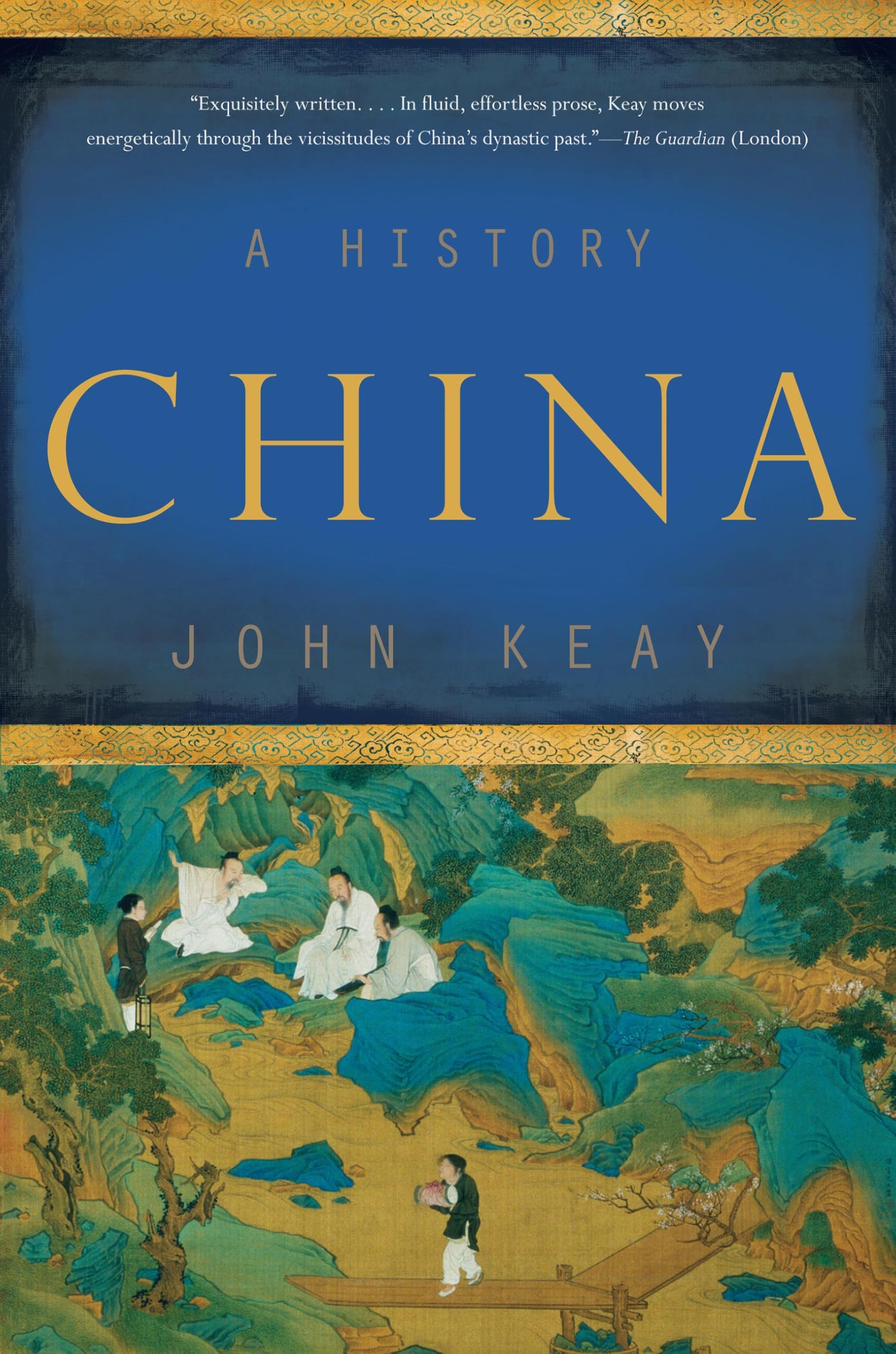
An authoritative and “exquisitely written” ( Guardian ) account of five thousand years of Chinese history Many nations define themselves in terms of territory or people; China defines itself in terms of history. Taking into account the country's unrivaled, voluminous tradition of history writing, John Keay has composed a vital and illuminating overview of the nation's complex and vivid past. Keay's authoritative history examines 5,000 years in China, from the time of the Three Dynasties through Chairman Mao and the recent economic transformation of the country. Crisp, judicious, and engaging, China is the classic single-volume history for anyone seeking to understand the present and future of this immensely powerful nation. Review: If Only It Hadn’t Been So Boring! - That was quite possibly the longest, most boring book I have ever read. I love history and gobble it up whenever I can, but I’m telling you I don’t think my pulse ever quickened with excitement a single time as I read this. If such a thing as an exciting passage exists, here would be an example of it: Orders to disperse were ignored, and arresting the ringleaders failed to quell the tumult. The protesters now pounded on the throne-room door. They kept it up for much of the day until the emperor, his patience exhausted, ordered his fearsome Embroidered Guard to clear the area by force. No deaths resulted from this operation, but 134 men were taken into custody. All were then heavily sentenced, and of the thirty-seven who were awarded floggings, nineteen died under the lash. It was actually a rod. The offenders were stripped and made to lie on the ground, and the strokes were administered on their bare buttocks, the indignity being exceeded only by the pain, as blood flowed copiously. More likely though, you’ll find a passage that had opportunities to maybe be interesting, instead fizzle out like this, with no further elaboration: At Sanyuanli, a village north of Guangzhou, in May 1839 these irregulars gathered en masse after some of their women were violated by the invading troops; then, amid heavy rainstorms, they engaged and briefly repelled a force of Indo-British infantry, inflicting minor casualties. But the most typical type of experience you get from reading this book is reading paragraph after paragraph after paragraph like this: Other contemporary movements, such as the Red Turbans and the Triads, also opposed the Manchu Qing as alien usurpers; they wanted to set the clock back to 1644 and restore the Ming. But the Taipings opposed the Qing as the last in a long line of heretical alien dynasties; the clock should go back to AD 221. This chimed, as it were, with important strands in recent thought. Eighteenth-century scholars equally unreconciled to the Qing had blamed the failure of the indigenous Ming on the Neo-Confucianism of Zhu Xi (he of the ‘Four Books’ and the text-bound ‘investigation of all things’) or Wang Yangming (and his dangerously malleable ‘innate sense’ of what was right and humane). They too, therefore, had looked back to an earlier tradition and especially to the Han dynasty when the classic texts still retained a pristine quality uncorrupted by later editing. Practising what they called ‘evidential research’, these scholars brought to bear on the classics a more scientific approach in linguistics, geography and astronomy, and so restored a certain vitality to Confucian studies. Here’s an example of the book giving a surprise chuckle: In the process the Summer Palace, a fanciful Louvre designed for the Qianlong emperor by the Jesuits, was looted and burned. Though no great loss to architecture, it was a body blow to Qing prestige. The woman who reads the audiobook did a great job. She was fun to listen to. I still gave the book 5 stars because I mean, come on, how could you not? Every detail of Chinese history for the last 5000 years, no matter how uninteresting, seems to have been included. The truth is, it’s an excellent book. It’s just mind-numbingly boring. Review: China: A History - Perspective of a Curious Layman - 'China: A History' is a dense and all-encompassing effort to capture the entirety of a long Chinese history in less than 600 pages. The author's writing style is pedantic, rigid, sophisticated, and overall meticulous with wordings, facts, and details. Some background: I've always been fascinated by China, but had little to no real understanding of the country. I knew of a couple provinces, and have heard of some of the dynasties, but that's about it. I can imagine that there's others who know little to nothing about China as well, who want to pick up a book and learn. This review is for these kinds of people. I'll start by saying that unfortunately it's not enough to pick up this book and read it from start to finish with the expectation that you will walk away with a pretty solid understanding of Chinese history. Like me, you will quickly be left behind. With that being said, the experience has to be more immersive and you can enjoy this text. That means researching things and getting summaries of what you had just read (or about to read, if you're keen on preparation). For example, it may help to look up a concise bullet-point summary of the Ming Dynasty before reading those chapters. For layman, and those without an eidetic memory, short summaries would have been extremely helpful. I often found myself page flipping when it came to referencing some of the time tables that the author included earlier in a chapter. Also, it's not too often that I have to look up so many words, but in this case I did. Many were items and objects that I had never heard of before. More imagery and explanations could have been helpful here, but it's not that big of a deal. I will give the author his due, as he had tried to prepare readers at the start of the text with some background on the Chinese language, naming customs, geography, and so forth. The more assiduous and less time-sensitive reader would best benefit in occasionally going back and re-reading the "prepatory" introduction. But to go from cover to cover, it just made it very difficult to synthesize that information and take it with you going forward. It's as if starting a journey through Mongolia, you were told orally where to go and all the turns to take, mountains to climb, rivers to cross; when instead you would have been better off just given a map to bring with you and follow. To fellow readers, take this chapter serious because the author will not hold your hand later on. Occasionally, reading the text felt like a drag. The author did have the enormously difficult task of condensing all of Chinese history into one volume. The undertaking could have allowed him to be more justifiably verbose. Interested, non-scholarly readers such as myself should feel a sense of gratitude that this wasn't the case. Though the author doesn’t often express personal views, some thoughtful reflections do appear toward the beginning and end of the book—and in those, you may find some gems of insight. With that, i'll end this review with the following beautifully written quote from the author: “Isolating the significant needs patience and perspective, commodities not available in the heat of the moment, then or now. As history’s stately march breaks into the trot of current affairs, then into the stampede of news stories, scholars are expected to swivel from the reconstruction of a reticent past to the deconstruction of a clamorous present. Hammered by reality, the historian turns annalist, turns journalist.”


| Best Sellers Rank | #55,121 in Books ( See Top 100 in Books ) #16 in India History #20 in Chinese History (Books) #48 in Japanese History (Books) |
| Customer Reviews | 4.4 out of 5 stars 991 Reviews |
J**H
If Only It Hadn’t Been So Boring!
That was quite possibly the longest, most boring book I have ever read. I love history and gobble it up whenever I can, but I’m telling you I don’t think my pulse ever quickened with excitement a single time as I read this. If such a thing as an exciting passage exists, here would be an example of it: Orders to disperse were ignored, and arresting the ringleaders failed to quell the tumult. The protesters now pounded on the throne-room door. They kept it up for much of the day until the emperor, his patience exhausted, ordered his fearsome Embroidered Guard to clear the area by force. No deaths resulted from this operation, but 134 men were taken into custody. All were then heavily sentenced, and of the thirty-seven who were awarded floggings, nineteen died under the lash. It was actually a rod. The offenders were stripped and made to lie on the ground, and the strokes were administered on their bare buttocks, the indignity being exceeded only by the pain, as blood flowed copiously. More likely though, you’ll find a passage that had opportunities to maybe be interesting, instead fizzle out like this, with no further elaboration: At Sanyuanli, a village north of Guangzhou, in May 1839 these irregulars gathered en masse after some of their women were violated by the invading troops; then, amid heavy rainstorms, they engaged and briefly repelled a force of Indo-British infantry, inflicting minor casualties. But the most typical type of experience you get from reading this book is reading paragraph after paragraph after paragraph like this: Other contemporary movements, such as the Red Turbans and the Triads, also opposed the Manchu Qing as alien usurpers; they wanted to set the clock back to 1644 and restore the Ming. But the Taipings opposed the Qing as the last in a long line of heretical alien dynasties; the clock should go back to AD 221. This chimed, as it were, with important strands in recent thought. Eighteenth-century scholars equally unreconciled to the Qing had blamed the failure of the indigenous Ming on the Neo-Confucianism of Zhu Xi (he of the ‘Four Books’ and the text-bound ‘investigation of all things’) or Wang Yangming (and his dangerously malleable ‘innate sense’ of what was right and humane). They too, therefore, had looked back to an earlier tradition and especially to the Han dynasty when the classic texts still retained a pristine quality uncorrupted by later editing. Practising what they called ‘evidential research’, these scholars brought to bear on the classics a more scientific approach in linguistics, geography and astronomy, and so restored a certain vitality to Confucian studies. Here’s an example of the book giving a surprise chuckle: In the process the Summer Palace, a fanciful Louvre designed for the Qianlong emperor by the Jesuits, was looted and burned. Though no great loss to architecture, it was a body blow to Qing prestige. The woman who reads the audiobook did a great job. She was fun to listen to. I still gave the book 5 stars because I mean, come on, how could you not? Every detail of Chinese history for the last 5000 years, no matter how uninteresting, seems to have been included. The truth is, it’s an excellent book. It’s just mind-numbingly boring.
M**N
China: A History - Perspective of a Curious Layman
'China: A History' is a dense and all-encompassing effort to capture the entirety of a long Chinese history in less than 600 pages. The author's writing style is pedantic, rigid, sophisticated, and overall meticulous with wordings, facts, and details. Some background: I've always been fascinated by China, but had little to no real understanding of the country. I knew of a couple provinces, and have heard of some of the dynasties, but that's about it. I can imagine that there's others who know little to nothing about China as well, who want to pick up a book and learn. This review is for these kinds of people. I'll start by saying that unfortunately it's not enough to pick up this book and read it from start to finish with the expectation that you will walk away with a pretty solid understanding of Chinese history. Like me, you will quickly be left behind. With that being said, the experience has to be more immersive and you can enjoy this text. That means researching things and getting summaries of what you had just read (or about to read, if you're keen on preparation). For example, it may help to look up a concise bullet-point summary of the Ming Dynasty before reading those chapters. For layman, and those without an eidetic memory, short summaries would have been extremely helpful. I often found myself page flipping when it came to referencing some of the time tables that the author included earlier in a chapter. Also, it's not too often that I have to look up so many words, but in this case I did. Many were items and objects that I had never heard of before. More imagery and explanations could have been helpful here, but it's not that big of a deal. I will give the author his due, as he had tried to prepare readers at the start of the text with some background on the Chinese language, naming customs, geography, and so forth. The more assiduous and less time-sensitive reader would best benefit in occasionally going back and re-reading the "prepatory" introduction. But to go from cover to cover, it just made it very difficult to synthesize that information and take it with you going forward. It's as if starting a journey through Mongolia, you were told orally where to go and all the turns to take, mountains to climb, rivers to cross; when instead you would have been better off just given a map to bring with you and follow. To fellow readers, take this chapter serious because the author will not hold your hand later on. Occasionally, reading the text felt like a drag. The author did have the enormously difficult task of condensing all of Chinese history into one volume. The undertaking could have allowed him to be more justifiably verbose. Interested, non-scholarly readers such as myself should feel a sense of gratitude that this wasn't the case. Though the author doesn’t often express personal views, some thoughtful reflections do appear toward the beginning and end of the book—and in those, you may find some gems of insight. With that, i'll end this review with the following beautifully written quote from the author: “Isolating the significant needs patience and perspective, commodities not available in the heat of the moment, then or now. As history’s stately march breaks into the trot of current affairs, then into the stampede of news stories, scholars are expected to swivel from the reconstruction of a reticent past to the deconstruction of a clamorous present. Hammered by reality, the historian turns annalist, turns journalist.”
R**R
Very good overview for general reader
First of all, John Keay writes well. His prose is clear, and his style is inviting. Second, this history does a good job of taking us from prehistoric times to the modern era, making sense out of a very complex history. If you are somewhat familiar with China, this volume will help you consolidate your knowledge. If you are unfamiliar, the book will give you a solid, broad framework for further study. For the general reader looking for a better understanding of China, this book is the one.
T**E
I always knew in the back of my mind that the people involved don't make history - it is a great, eye-opening, myth-busting read
I always knew in the back of my mind that the people involved don't make history -- historians make it, and this is the first time I've read a history of anything where the author points out how the history of China was this or that in one era, and in a later era was completely revised in order to present that latter's desired paradigm. So, the book may not describe what really happened although it is filled with facts; it does, however, tell you what those who documented what happened said, and then how what happened was later revised. For those who are interested in world history, and Chinese history in particular, it is a great, eye-opening, myth busting read.
A**N
Comprehensive history of pre-modern China
The history of China is complex. John Keay gives an overview of China and its rich history starting from before the country was unified under the Qin and up until modern times excluding the Communist party from the second half of the 20th century. There is of course a lot to try to convey in this 3000 year period but the author does well to give the reader an overview of both the history and evolution that China has witnessed. Having grown up with an absence of books on China's entire history this is a good addition to the literature for a wide audience. The author begins with some of the earliest records of China starting before 1000 BC but quickly gets into the period of warring states and the unification and beginning of the Qin dynasty. The author gives all the background needed to understand how later conflicts reference back to the early conflicts faced in China. The author gives the reader a brief picture of the world Confucius lived in and the philosophy he created that was probably the strongest current in Chinese government through its history. The book details the dynasties and the philosophies that drove each age. It also discusses how dynastic transitions were described by Chinese historians as the legitimate passing of the mandate of heaven on as rulers failed in their duties. The author gives an overview of all the major dynasties and in particular he focuses on the Han dynasty which is often seen as the golden age where borders were expanded and leadership was just. He focuses on the Tang dynasty where China resurfaced as a unified power and the Song where China was last ruled by its own people before being over run by a series of outside powers. One reads a history where China has not been unified throughout its history and fragmentation of the empire has been distinct in multiple periods. One learns of how China had frequent dynastic turnover as emperors were invaded and lost the faith of the people only for the cycle to repeat itself. One of course learns of the Mongolian invasion and their Yuan dynasty as well as the peasant uprising that led to the Ming dynasty. It is fascinating to learn about how the mandate of heaven was transferred to a peasant in more than one occasion when the broad population was discontent with the ruler of the times. The relative decline of China is described in the last 500 years as it went from most properous and populous to exploited as industrialization took place in the west and gun boat diplomacy defined trade relations. This happened in particular with the Manchu's as they conquered the Ming in the 17th century. From there one sees a sequence of bullying trade deals and incremental isolation of China. The author spends time discussing the opium wars and the nationalist movement in China with Sun Yat-Sen and leaves us at the end of the second world war. China: A History gives a relatively quick overview of the major dynasties in China and its early modern history. Multiple more volumes could no doubt be written but this is a good starting point to get a sense of how China has evolved and where its civilization started. The archaeological record continues to broaden as its academic world opens up. This book gives you exactly what the title says, a History of China. The writing is clear and the content is interesting, worth the read.
D**N
Yin and Yang
Perhaps nowhere is the saying, “The more things change, the more they stay the same” more appropriate than in China. China has the honor of being the civilization with the longest continuous history on Earth. China was not the first or the oldest civilization, but while ancient Egypt and Sumer have long since vanished from history, China remains. In that long 3000-4000 years of history, China has undergone many changes. Dynasties of rulers have risen and fallen. The country has been united into an empire, only to break apart and then be united once again. The Chinese Empire has expanded its frontiers into Central Asia, and has been restricted to northern or southern China, while foreigners have ruled other sections. China has been conquered and has regained its independence. Through all the revolutions and changes, China remains China. The Communists under Mao Zedong were determined to remake China into a modern, socialist country, yet they went about their goals in a characteristically Chinese fashion. Mao condemned Confucius and sought to end that sage’s influence on China. So did Qin Shi Huang, the first Emperor of China (previous rulers were referred to as “kings”). The Communists enforced a rigid Marxist conformity on China intellectuals. The Song Emperors enforced a rigid Neo-Confucian ideology. China, under Mao limited its contacts with foreigners. So did the Qing Emperors. The present rulers of China have converted China into a major trading nation. So did the Tang Emperors. The Communist Party does not tolerate any rival parties. No imperial dynasty was ever comfortable with parties or partisanship. Like the Emperors of old, the Chinese government thinks more in terms of taking a paternal interest in the lives of its subjects rather than in protecting human rights. Yet, one must not think China as being unchanging or Chinese history as being boring. China has seen drastic changes throughout its history. One might think of this history of change and continuity in terms of the Chinese philosophical ideas of Yin and Yang, opposites that work together. Passive, feminineYin might represent the periods of imperial unity and strength while active, masculine Yang might represent the chaotic periods of war and disunity that were, nevertheless, the most intellectually productive periods of Chinese history. I think there are few resources which explore the grand sweep of the Yin and Yang of Chinese history in one volume better than John Keay’s China, A History. In his book, John Keay tells the story of the Chinese nation from its Neolithic beginning right up to the modern age. Keay does not, as many writers of history books do, spend too much time on recent events while neglecting past centuries. Every dynasty gets the proper amount of attention, as do the periods of disunion. If I have any complaint at all about China, A History, it is that at 611 pages it is simply too short. Six hundred pages are hardly enough to give an outline of Chinese history. I am not complaining, however. If you want a general outline of Chinese history, China A History serves the purpose admirably and if you want to know more about any topic, there is the bibliography John Keay provides.
N**6
Short on Mechanics, Art, Nature and Concrete Detail
I like this book, John Keay is a brilliant writer, but this book frustrates me enormously at times. He's not good with concrete detail. He doesn't flesh out what life was for the ordinary people or the nobles in much concrete detail. It's a lot of this breathy historical generalist stuff. "The xxx dynasty would last another three hundred years... blah blah blah..." He doesn't tell you what the average life span of Chinese people were. I wish that every 300 or 500 years he'd tell me what the population of China was, "At the beginning of the Zhou Dynasty the population stood at..." I wish he'd tell me in concrete detail how the average person lived sometimes. He tells me about a thousand wars, but what was it like on the battlefield. Were they fought primarily with bows and arrows? What was the weaponry? Did everyone have a horse? What the fudge was a mideval Chinese battle like? Sometimes I wish he'd tell me how the peasants lived. "They had two bowls and three outfits. They worked from... when to when. In winter they froze because medieval hearths were... The typical hut had two rooms. Five people in a hut... Most kids died in Childbirth" Also for the seminal Chinese historical texts like the Tao Te Ching, you get virtually nothing. If you're writing a history of England, you need to spend a few pages talking about Shakespeare and his influence. I don't get a feel for how Li Po or all these incredible poets sprung out of China. I want to know more about the Tao Te Ching and how it has influenced Chinese thought and philosophy over the centuries. Also, he's a abysmal when it comes to nature. What is the main meat running around. What animals dominated China? What got hunted? What was eaten? Are the plants that everyone cultivated different over there than here? What did they cook? What were the houses primarily made of? Bamboo? Wood? And the book is really bad at art. The guy isn't a lover of the arts. How the arts flowered. It's like they don't exist. An was the climate in China different a few hundred years from now than it is now? What percentage was wooded. Was much of it dense forest that was being systematically cleared. You get little pieces here and there, that tell you come gripping concrete stuff, but not enough--and, in the author's defense, some passages are sumptuous--I love his interest in Quin's tomb. But it's piecemeal. You're getting a lot of names and summaries and you read it and it's interesting. But it's this kind of a hack glossy history. There are so many history books that give you a bunch of names and dates and paragraphs that often are really telling you nothing. You're reading this book, and much of it is fascinating, but you can't close your eyes and imagine what it looked like in China or understand what life was like, smelled like, felt like, much of the time. There's just not enough concrete detail!!!
S**N
This was a great overview of what is known about Chinese history
This was a great overview of what is known about Chinese history, from the earliest known Xia dynasty through to the Mongols and finally to the chaos of the 19th-20th centuries. Easy to read and the author doesn't shy away from controversy when there are possible multiple interpretations of events or where Western interpretation differs from interpretations of the Chinese themselves. I came to this being primarily interested in the revolutions and communist take over of the modern era and found that early Chinese history was just as fascinating. However, each period is only briefly covered, so if you want to look at one period in depth I'd try to find something a bit more specific. Great starting point!
C**N
Recomendable
Un libro fascinante. Excelente libro
C**O
Bom livro para o leitor interessado
Bem escrito, bem claro um pouco jornalístico
J**.
Enjoyable and informative
A great overview of Chinese history with plenty of people’s lives used to personalise
E**E
Beschadigd
Het boek start veelbelovend, maar jammer genoeg zat het beschadigd in de verpakking... jammer van de kwaliteit.
A**R
Fascinating and informative work
Trustpilot
1 month ago
2 months ago