

Desert Online General Trading LLC
Dubai, United Arab Emirates
Desert Online General Trading LLC
Dubai, United Arab Emirates
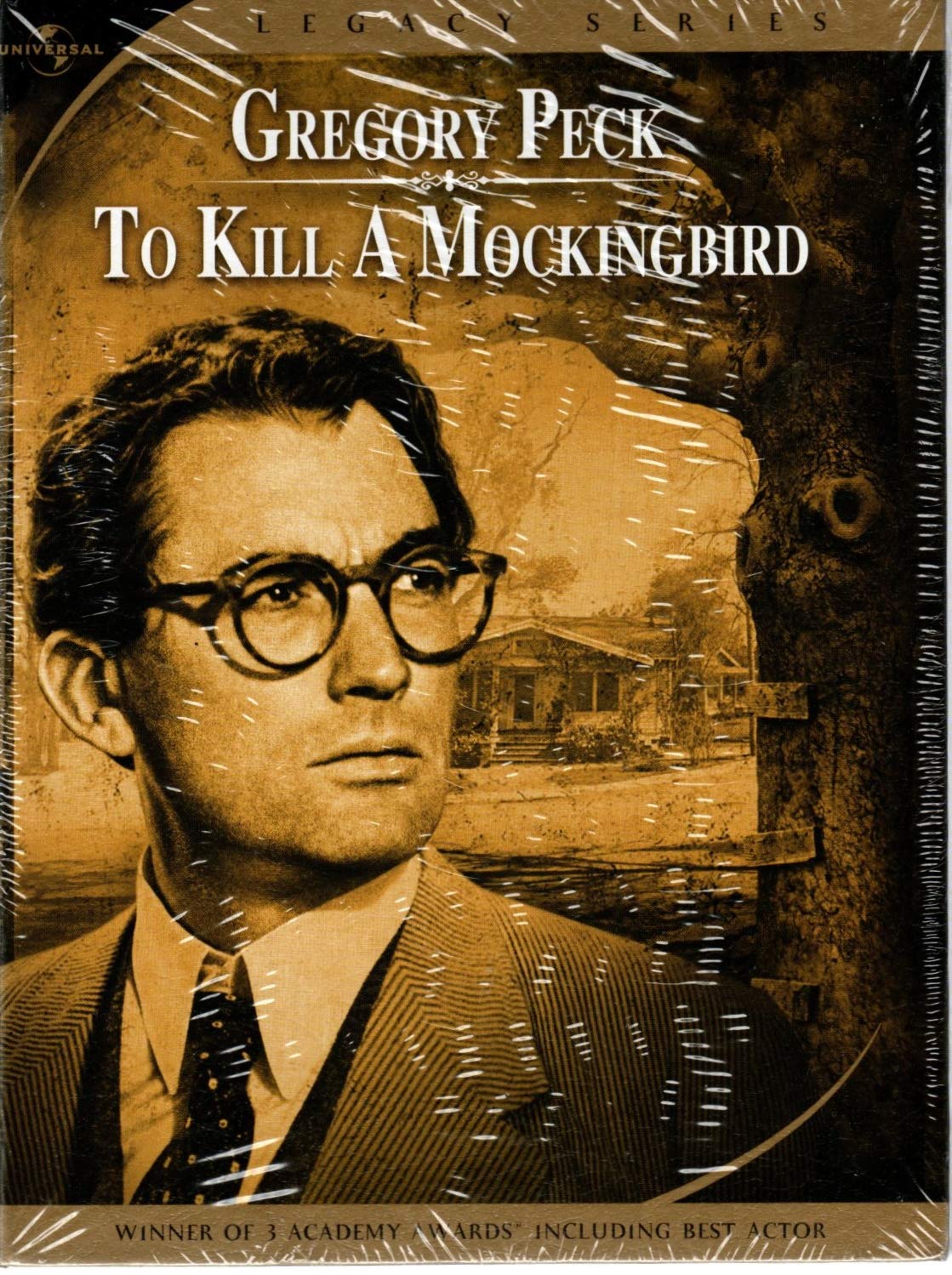
Product Description Proclaimed one of the 100 Greatest American Movies of All Time by the American Film Institute, To Kill A Mockingbird is now available as a 2-disc set. Hollywood icon Gregory Peck won the Best Actor Academy Award for his brilliant portrayal of the courageous but understated hero Atticus Finch. The film, based on Harper Lee's Pulitzer Prize-winning novel about innocence, strength and conviction, captured the Best Adapted Screenplay Oscar. To Kill A Mockingbird boasts Robert Duvall's screen debut as Boo Radley and Mary Badham's unforgettable, Oscar-nominated performance as Miss Jean Louise "Scout" Finch. Watch it and remember why "it's a sin to kill a mockingbird."Bonus Content: Academy Award Best Actor Acceptance Speech American Film Institute Life Achievement Award Excerpt From Academy Tribute to Gregory Peck Scout Remembers Feature Commentary with Director Robert Mulligan and Producer Alan Pakula Theatrical Trailer Production Notes A Conversation with Gregory Peck Fearful Symmetry: The Making of To Kill a Mockingbird Set Contains: The two-disc Legacy Series edition of To Kill a Mockingbird offers a definitive tribute to this timeless classic and the Hollywood star who embodied its enduring family values. Disco 1 offers the film itself (digitally remastered), along with four features that honor the late Gregory Peck. In an archival clip from the Academy Awards ceremony in 1963, Sophia Loren presents Peck with his Oscar® for Best Actor, and Peck's acceptance speech is characteristically humble and dignified. In accepting his Life Achievement Award from the American Film Institute in 1989, Peck recalls an amusing anecdote from fellow actor James Mason to express his appreciation for "the later years" and his intentions to work for as long as he can in the profession he loves. In the posthumous Academy tribute to Peck, daughter Cecilia gives a heartfelt appreciation of Peck's devotion as a father and husband, and it serves as an object lesson to parents everywhere on how consistent involvement in child-raising should be every parent's top priority. As Mary Badham recalls in "Scout Remembers," it was this quality of Peck's that made him a real-life embodiment of Atticus Finch, resulting in a close relationship (in part because Badham had lost her own parents at an early age) that lasted until Peck's death in 2003. The feature-length commentary by director Robert Mulligan and producer Alan Pakula is a bit sparse at times, but it's an essential record of the film's production history. Disc 2 is packed with two exceptional feature-length documentaries. Coproduced by Cecilia Peck and directed by acclaimed documentary filmmaker Barbara Kopple, A Conversation with Gregory Peck is a home movie in the best sense of the word: An intimate portrait of the actor in his later years, as he tours the U.S. with his one-man stage show of reminiscent storytelling, it also features visits to Ireland (where Martin Scorsese also appears at a benefit for the Irish film industry) and Paris (where French President Jacques Chirac expresses his affection for Peck's French-born wife, Veronique, at a posh state dinner). The film ends with birth of Peck's grandson Harper (named after To Kill a Mockingbird author Harper Lee), and the emotional connection between "Atticus" and happy grandpa Peck is a moment that could melt anyone's heart. And while the literary conceits of Fearful Symmetry are a bit too precious for a making-of documentary, it's clearly a labor of love for writer-director Charles Kiselyak, originally produced for the previous Mockingbird DVD, released in 1998. In addition to providing a thorough production history and interviews with all the major cast and crew, the 90-minute documentary weaves an emotional connection between the film's enduring greatness and the real-life residents of Monroeville, Alabama, who serves as the inspiration for Lee's classic novel. The Legacy Series DVD also includes 11 postcard-sized reproductions of Mockingbird movie posters, nicely packaged in a sleeve-pocket envelope. --Jeff Shannon
G**L
One of the best movies ever made -- everyone needs to see it
"To Kill a Mockingbird" is one of the finest stories ever put on film; and the hero of that story, Atticus Finch (who is played by the incomparable Gregory Peck), has to be one of the most admirable characters ever portrayed on the silver screen. If I could give this move more than five stars, I would. But, since I can only give it five stars, I'll have to be content with that. But please note that my five-star rating is for the movie itself, not for the special features included on this disc, which I found to be something of a letdown, in all honesty. (More on this later.) But the movie itself deserves the highest rating I can give it. It is a cinematic masterpiece that everyone ought to see.In 1960, Harper Lee (a childhood friend of celebrated writer Truman Capote), published her only novel, "To Kill a Mockingbird", which was based loosely on her own childhood memories of growing up in the small, sleepy, Southern town of Monroeville, Alabama, during the Great Depression. Lee maintains that the novel is not autobiographical, since many of the events it depicts are fictional; but the setting and characters are based on the places and people she knew as a child. The narrator, Jean Louise "Scout" Finch, is based on Harper Lee herself. Scout's devoted father, the respected local attorney, Atticus Finch, is based on Lee's own father, who was a lawyer. And Dill Harris, the boy who spent his summers living at his aunt's house next door to the Finches, is based on Truman Capote. Even the reclusive Radley family, who rarely ventured outside of their spooky, boarded-up house down the street from the Finches, is based on an actual family who lived near the Lees. They, too, had a mysterious son they kept hidden from view because they were ashamed of him, just like Boo Radley in the novel. In fact, most of the characters in the novel were based, at least loosely, on real people Harper Lee knew as a child. Perhaps that's part of the reason why this story feels so real. The portrait that Lee paints of life in the Depression-era Deep South is not only realistic, but vivid and nuanced. She is able to honestly portray the hardships of poverty and the evils of racism that she witnessed as a child without ever crossing the line into caricature, and without in any way undermining her nostalgic portrayal of the magical innocence of childhood."To Kill a Mockingbird" became a runaway bestseller, and ended up winning the Pulitzer Prize in 1961. And, even though the plot of the novel was not obviously well-suited to be adapted for the silver screen, it was made into a major motion picture the following year, with one of the biggest names in Hollywood, Gregory Peck, as its star. The movie wasn't able to depict everything that happened in the book, of course. (No movie ever can.) But we are fortunate that the talented screenwriter, Horton Foote, was able to find the essence of the story in Harper Lee's novel and turn it into a brilliant screenplay. What we end up with is a film that doesn't feel like a typical Hollywood movie. Instead, it feels more like an actual look at someone's bittersweet memories of childhood.I'm no literary critic; so I won't even attempt to plumb the depths of this story. It's far too rich for even a cursory exploration of its many themes in a review such as this. But I do want to comment very briefly on what I believe to be the single greatest thing about this story: the character of Atticus Finch. There are few people I can think of -- either in the real world or in works of fiction -- who are even remotely as admirable as Atticus Finch. I find it hard to even imagine a better role model for a young person (especially a young man) to emulate. He represents, at least in my view, the ideal father, the ideal lawyer, the ideal citizen, the ideal gentleman, and perhaps even the ideal human being. As a father, he sets a good example for his children, treats them with respect and kindness, nurtures them, allows them a measure of independence, encourages their curiosity, answers their questions as honestly as he can, tries his best to instill in them the right values, and gently explains things to them rather than lecturing them or yelling at them. As a lawyer, he has the highest possible standards of ethics and integrity, genuine compassion for his clients, a non-cynical respect for the law, and a commitment to justice. As a citizen, he is dutiful, respectful, trustworthy, hospitable, neighborly, tolerant, and unbigoted. As a gentleman, he is humble, peaceable, dignified, self-controlled, stalwart, courageous, and polite. And, as a human being, he is virtuous, kind, empathetic, hopeful, and wise. I wish I were even half the man that Atticus Finch is. The world would be a much better place if it had more Atticus Finches in it.This is a movie that everyone ought to watch. Not only is it a good story, with wonderful characters and a fascinating setting; but it also has some great lessons to teach about life, and about what it means to be a decent, honorable person. Everyone needs to be exposed to the example of Atticus Finch, who is one of the noblest heroes ever portrayed on film. I can't praise this movie highly enough; nor can my words do justice to it. You've simply got to see it for yourself.Unfortunately, my five-star review has to come with this caveat: While the movie itself is great, the special features on this disc are, at least in my view, underwhelming at best. The documentary "Fearful Symmetry", which tells the story of the real-life people and places behind the novel, and how the novel was turned into a movie, is pretty interesting. And, being a total geek, I actually enjoyed the mini documentary on film restoration that was included on this disc, which showed how various old movies, including "To Kill a Mockingbird", have been restored for digital release on DVD and Blu-ray. But the other special features didn't really appeal to me all that much. I think that Gregory Peck was a brilliant actor and an admirable human being; but the Gregory Peck hagiography on this disc simply went too far, in my opinion. The special features included with this motion picture should have been about the movie itself, or about Harper Lee's story, rather than about the star of the film. But four of the nine special features on this disc were about the life and career of Gregory Peck, and a fifth (an interview with Mary Badham, who played Scout in the movie) spent more time talking about what a great person Gregory Peck was than about anything else. For starters, there was a feature-length documentary that Peck's daughter co-produced, chronicling her father's reminiscences during his later years when he went on tour holding Q&A sessions before live audiences, which I might have enjoyed had it been edited down to a more reasonable length of half-an-hour or so, but which was simply exhausting at its actual running time of 97 minutes. In addition to this there were two very short clips showing Gregory Peck giving acceptance speeches, first for his Best Actor Oscar for his performance in "To Kill a Mockingbird", and second for his Lifetime Achievement Award from the American Film Institute. He didn't really have much to say on either occasion; so I'm not sure why these were included. But what really puzzled me was the inclusion of a poor-quality, amateur video recording of Peck's daughter speaking at a ceremony honoring her late father after his death. I found these special features a bit disappointing. But they can't take away from the overall quality of the movie. I seriously doubt that anyone bases their decision about whether or not to buy a movie on the quality of the special features included on the disc. Even if there were no special features on this disc at all, the movie would still be worth buying; and I highly recommend it.
N**
I must watch
Gregory Peck was one of the best actors of his time he will be missed what a shame I think every human being in this planet should have to sit down and watch this movie profound moving stirring a must watch
M**S
Doesn’t pull any punches with topics
You can’t miss with this classic American tale. Some adult themes and valuable lessons. Outstanding performances by the entire cast. Everyone should watch this movie at least once. Most people I know watch it each year.
A**R
One of the finest movies ever made
The caliber of movie that should be made more often
A**R
Yes
Could watch a thousand times
B**L
It would be a sin to miss "To Kill A Mockingbird"
WOW! What more can be said about To Kill A Mockingbird that has not been said before. It is such an awesome film, thanks to author Harper Lee's remarkably ingenious novel. It is no small wonder she won the Pulitzer Prize for it and Gregory Peck held her in such high esteem. It was undoubtedly the piece de resistance in his long and chequered career.The plot in the film is true to Harper Lee's novel. An adult Scout (played by Mary Badham) narrates and reflects on the events which took place over two summers when she was young girl, growing up in the Deep South, during the Depression-era 1930's. Atticus Finch (Gregory Peck) is her father, an attorney who has been appointed to defend a black man accused of raping a white woman. Atticus confronts the racist father Bob Ewell (James Anderson) who has -- though we are not made immediately aware it -- beaten his daughter for befriending Tom Robinson (Brock Peters), the black man falsely charged of beating and raping her. In a parallel development, Scout, brother Jem (Phillip Alford) and friend Dell (John Megna) must learn to deal with their own fear and prejudice towards Boo Radley (Robert Duvall), the shy, gentle and mentally-challenged man who lives a few doors down from them in a derelict house. As the trial unfolds, Atticus reasons Tom Robinson is guilty only of pity and friendship towards a white woman, Mayella Ewell (Collin Wilcox). The Ewell's, who collectively represent a bigoted society that cannot tolerate racial integration, have merely claimed trial to cover their own social guilt or shame for associating with a black man, thus the jury falsely condemns Tom Robinson. Shortly thereafter, he dies under suspicious circumstances while being transferred to a 'safe haven' in a neighbouring town. To avenge his humiliation in court, Bob Ewell attacks the Finch children. An unlikely guardian, Boo Radley, comes to their aid, killing Bob Ewell.So, where's the dead mockingbird? Well, Harper Lee's more subtle than that. To kill a mockingbird is actually a metaphor. The children, Tom Robinson and Boo Radley are mockingbirds. They live their lives as innocently as the mockingbird. They mean no harm to anyone or anything, just as the mockingbird merely warbles his birdsong, never disturbing corncribs and such things. Ultimately though, each character is either physically or symbolically killed: Tom Robinson is an innocent man falsely convicted and killed; the innocence of the children is lost to the ugliness of racial strife, which nearly leads to their death at the hands of Bob Ewell; and Boo Radley who kills Bob Ewell should be tried for murder, but will not be arrested and charged because of his innocent nature and selfless act of defending the children. After all, to use the words spoken by Atticus earlier in the film, it would be "a sin to kill a mockingbird".Director Robert Mulligan does a splendid job of impressing this innocence upon the viewer. At the beginning of the film, he zooms into Jem's cigar box of memorabilia which he collects over the course of the story, then pans the camera while Scout thumbs through the crayons, marbles, broken pocket watch and figurines. As she hums away like a hummingbird, Mulligan immediately creates a mood of innocence through the eyes of a child. He carries on with the day-to-day simplicity of childhood in a sleepy Southern town, until half way through the film; then we begin to see this innocence slowly whittled away, much in the way Harper Lee does in her book.Gregory Peck as Atticus Finch gives a reserved and dignified performance of his character, certainly deserving of his Academy Award. The children were naturals. Brock Peters (who passed away a few months ago) as Tom Robinson offers a plaintive and stirring performance. A young Robert Duvall, in his film debut, as the mute, gentle Boo Radley delivers a tremendous performance just with his eyes, facial expressions and body movement, saying more than some actors say in words, in a whole movie.I've also got to praise Universal Studios for getting this boxed DVD set right "To Kill a Mockingbird (Legacy Series Edition)". The 2005 release is a vast improvement over the 1998 version. On DVD 1, the film can be viewed with or without the director's comments. On DVD 1 and 2, there is a documentary on Gregory Peck, his family and friends, as well as archived clips dealing with "To Kill A Mockingbird". All are appropriately interspersed, adding genuine warmth and depth to the man who portrayed Atticus. Quite surprisingly, we discover the actor and character were in many ways one and the same person. Wait, this boxed set also comes with several postcards depicting various versions of the film's theatrical posters, which illustrate if anything how immensely popular the film was and remains to audiences around the world.In closing, I must say "To Kill A Mockingbird" is at once an amazingly simple, yet profoundly universal story. Strip away its period setting of the 1930's; its occurrence in America's Deep South; and we realise the events could just as easily happen today, anywhere in the world, to anyone. Above all, it is a story that teaches the importance of fairness, justice, respect and love, for it is in these noble acts man learns to transcend his horrible propensity for prejudice, intolerance, ignorance and hatred.
Trustpilot
2 weeks ago
1 week ago
5 days ago
3 weeks ago