
DOWNLOAD THE APP


Customer Services
Copyright © 2025 Desertcart Holdings Limited
DOWNLOAD THE APP
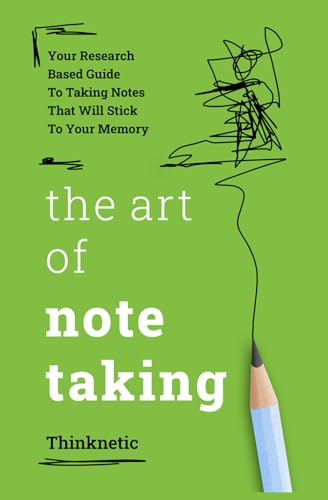


The Art Of Note Taking: Your Research-Based Guide To Taking Notes That Will Stick To Your Memory (Self-Learning Mastery) [Thinknetic] on desertcart.com. *FREE* shipping on qualifying offers. The Art Of Note Taking: Your Research-Based Guide To Taking Notes That Will Stick To Your Memory (Self-Learning Mastery) Review: this book is for students of all ages - Book Review of the Art of Note Taking I give this book 5 stars and if you saw my notes you would know why. I found out that I am the sentence note taker as opposed to being an outliner, a charter, a mind mapper, or a Cornell note taker. All of which is discussed and described in this book. With diagrams and examples as well as exercises Thinknetic takes you through methods of note taking that will help not only students but everybody become better note takers; well versed in their own knowledge. I didn’t like all of the exercises; however, they did fit within the book itself. Very helpful in the References sections are the articles behind some portions of the chapter offered as support for the findings of the authors. I recommend this book to any parent and anyone over the age of 8 years old. Teachers already teach this in elementary school but some students will decide to find a better way to help them learn. This book is for those students. Review: Good Place to Start; Nothing New for Older Students - Brief read at 147 pages. Covers the most popular systems for taking notes from Cornell to basic Sentence style. Goes too much in depth regarding how people learn separating between visual, auditory, kinesthetic further down to VARK system. And other learning groups like social and introverts. Unless I’m going to be a teacher, it doesn’t trivia since all I’m after is taking better notes. Much of the information relates to Psychology and NLP as presented in the body Unlimited Power by Tony Robbins that I read back in the 1990s. Then came the technique every book on learning and education falls back on - lThe Feynman Technique.” Breaking complex parts down to it’s most basic form until it can’t be simplified any more. What remains is the essence of the part being learned. Explaining in your own words to a 5 yr old is the other part of the technique. I believe combining Feynman Technique and Cornell Method of note taking in a Bullet Journal with an index would be a great way to keep notes. What should have been covered is taking notes rapidly in lectures. It was mentioned but only related to Sentence note taking method. Telegraph method should have been covered to break sentence down to noun verbs objects removing nonessential words like a telegraph. Later on filling in and cleaning up the sentences. Also short hand should have been covered as an alternative to typical g on a laptop in class. Good book for beginners if not perfect.


| ASIN | B0BMDF9YL5 |
| Best Sellers Rank | #335,058 in Books ( See Top 100 in Books ) #125 in Information Management (Books) #156 in College Guides (Books) #2,804 in Study Guides & Workbooks |
| Customer Reviews | 4.2 4.2 out of 5 stars (246) |
| Dimensions | 5.25 x 0.43 x 8 inches |
| ISBN-13 | 979-8363738487 |
| Item Weight | 6.7 ounces |
| Language | English |
| Part of series | Self-Learning Mastery |
| Print length | 170 pages |
| Publication date | November 14, 2022 |
| Publisher | Independently published |
N**N
this book is for students of all ages
Book Review of the Art of Note Taking I give this book 5 stars and if you saw my notes you would know why. I found out that I am the sentence note taker as opposed to being an outliner, a charter, a mind mapper, or a Cornell note taker. All of which is discussed and described in this book. With diagrams and examples as well as exercises Thinknetic takes you through methods of note taking that will help not only students but everybody become better note takers; well versed in their own knowledge. I didn’t like all of the exercises; however, they did fit within the book itself. Very helpful in the References sections are the articles behind some portions of the chapter offered as support for the findings of the authors. I recommend this book to any parent and anyone over the age of 8 years old. Teachers already teach this in elementary school but some students will decide to find a better way to help them learn. This book is for those students.
D**2
Good Place to Start; Nothing New for Older Students
Brief read at 147 pages. Covers the most popular systems for taking notes from Cornell to basic Sentence style. Goes too much in depth regarding how people learn separating between visual, auditory, kinesthetic further down to VARK system. And other learning groups like social and introverts. Unless I’m going to be a teacher, it doesn’t trivia since all I’m after is taking better notes. Much of the information relates to Psychology and NLP as presented in the body Unlimited Power by Tony Robbins that I read back in the 1990s. Then came the technique every book on learning and education falls back on - lThe Feynman Technique.” Breaking complex parts down to it’s most basic form until it can’t be simplified any more. What remains is the essence of the part being learned. Explaining in your own words to a 5 yr old is the other part of the technique. I believe combining Feynman Technique and Cornell Method of note taking in a Bullet Journal with an index would be a great way to keep notes. What should have been covered is taking notes rapidly in lectures. It was mentioned but only related to Sentence note taking method. Telegraph method should have been covered to break sentence down to noun verbs objects removing nonessential words like a telegraph. Later on filling in and cleaning up the sentences. Also short hand should have been covered as an alternative to typical g on a laptop in class. Good book for beginners if not perfect.
A**S
surprised by benefits of handwriting
p77: . rewriting notes is encouraged especially when taking notes of a lecture when you don't have much time to write and are quickly writing quotes. p79: . a legal reason to rewrite notes in your own words, is to avoid being guilty of plagiarism; you'll need copy the speaker's words when you don't understand them yet; but you should understand them after research. p101: . the Cornell doesn't encourage complete rewriting; instead you need to leave lots of space between points and leave a margin for notes made during the after-lecture review. p116: . users of handwriting learned better than laptop typers [Mueller, Oppenheimer 2014] and that was randomly controlled; however, handwriting is usually faster at indenting, graphing, and symbol writing which can help with recalling the lecture; so handwriters who could study their notes learned more than typewriters who studied typed notes even though typers wrote more words. . typers tended to do more quoting rather than writing what they learned, but handwriters learned more even when the subjects were instructed to not quote. Pam A. Mueller, Daniel M. Oppenheimer Psychological Science 2014 The Pen Is Mightier Than the Keyboard: Advantages of Longhand Over Laptop Note Taking. corrections: Mueller, P. A., & Oppenheimer, D. M. (2018). "The pen is mightier than the keyboard: Advantages of longhand over laptop note taking": Corrigendum. Psychological Science, 29(9), 1565–1568
J**8
Good read which builds up gradually to highlight the different learning styles and techniques suited towards them as well as a synthesis.
B**R
Multi-page advert in the front of the book advertising the publishers other books. Cherry picked reviews and blurbs about other books. I don't like being advertised to through products I have bought and neither should you.
D**E
I got bored with the beginning and never made it to the end.
Trustpilot
1 week ago
3 weeks ago