

Desert Online General Trading LLC
Dubai, United Arab Emirates
Desert Online General Trading LLC
Dubai, United Arab Emirates



⚡ Charge Ahead: Power Up Your Devices in Style!
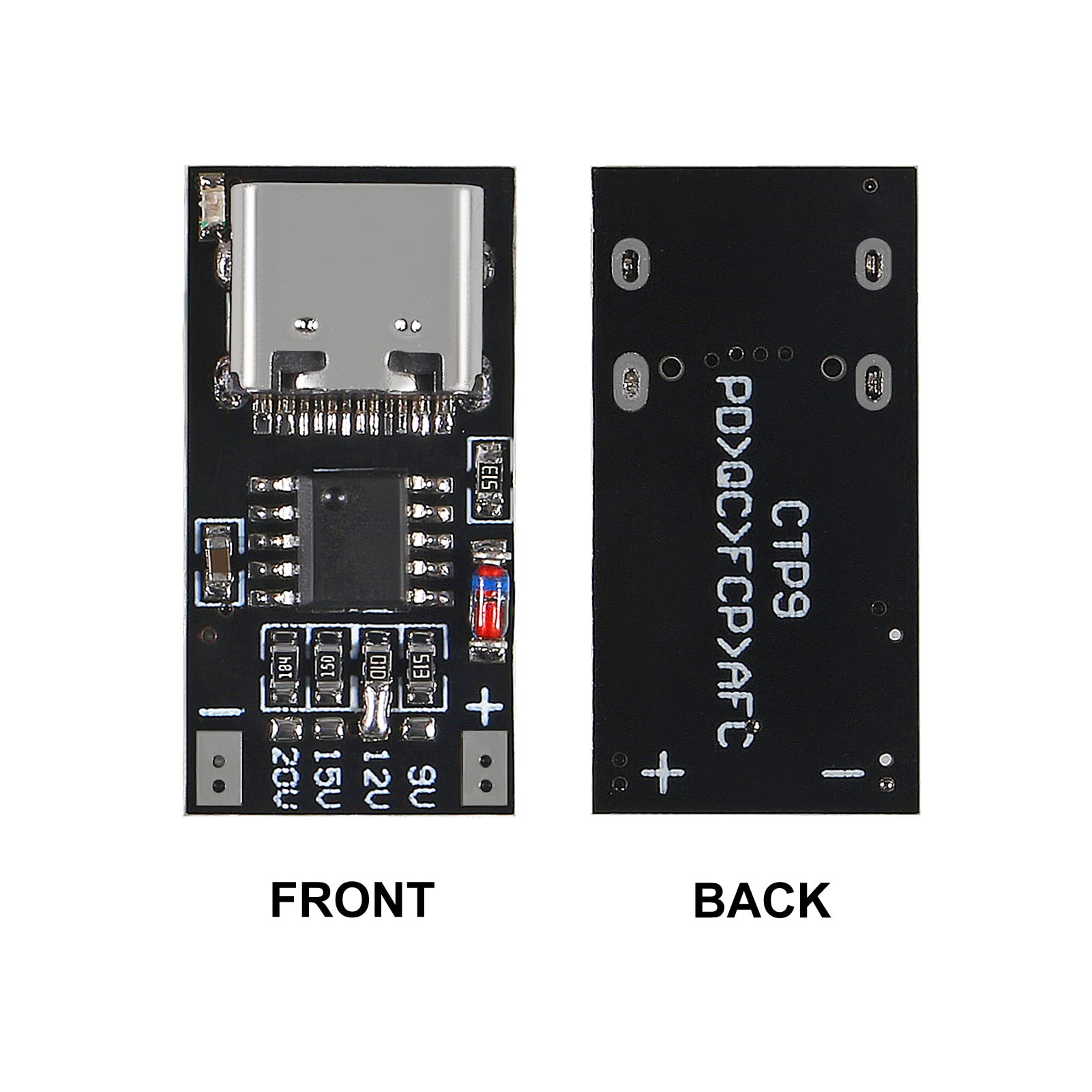
The 10PCS USB-C PD Trigger Board Module is a cutting-edge solution for fast charging, featuring support for multiple protocols including PD3.0 and QC4+. With its compact design and versatile voltage options, this module allows you to transform traditional devices into Type-C powered ones, ensuring you stay connected and charged in today's fast-paced world.
| Color | 10PCS |
| Output Voltage | 9 Volts, 12 Volts |
| Plug Type | Type C |
| Input Voltage | 20 Volts |
A**R
Decent USB-C PD Board for Hobby
Low power noise and very easy to use. Do note that there's a tiny shunt on one of the pads you will have to desolder to change the voltage that is a miniature black square and blends in with the PCB.The voltage can easily be set by soldering the pads between the resistor of the voltage you want to the pad next to it, so it's very intuitive. It works well, despite mediocre build quality, and is small enough to fit in many projects!
G**.
Work great, couple quirks.
Work great and easy to use. Notes for others, it won't limit current at all, so your project needs current limiting so it doesn't trip protection on the charger you use. They also will not negotiate a voltage if there's power on the output pins from a battery or something so you'll need a diode if you have a battery or other power in parrallel.Very happy with them.
E**K
Garbage.
Should be zero. Came jumpered for 12 volts. Put 13.8 into it. 13.8 come out. Tried all jumper settings. No instructions. I assumed no jumpers is 5 volts as there is no 5v jumper setting. Essentially this board does nothing but light a blue LED. So be careful what you plug into this. My guess is this is leftover failed items the Chinese sent to us to buy.
B**T
Better than just PD, support for QC gives more versatility
It does the job.The voltage can be set by soldering a bridge between the resistor of the corresponding voltage to the pad next to it - which is easier said than done if you don't have a steady hand or a precise tip on your soldering iron. Removing all bridges causes the decoy to resort to 5V, which is great if you're wanting to convert a 5V device to USB-C.Simply put, these do exactly as advertised and its support for QC means you can recycle/reuse older QC USB chargers that can do 9v and 12v.
T**D
Very handy to have around.
Very handy if you have any projects that you want to power with a USB-C PD setup. These come pre set for 12V, but if you are able to solder to the board you can change them to other voltages. I kept mine at 12V but soldered them to a barrel jack to power an astrophotography camera and it works great. The female USB-C port on the board seems well made and has a small blue status led next to it, which is nice to have. The small black shied slides completely over the chip, so it can be installed even after you have attached the wires to your project. It does need to be secured with glue, make sure to use a glue compatible with Pcb's.
A**N
Works fine; documentation could be better.
The voltages of these boards ARE switchable as advertised, unlike what another reviewer concluded, but I almost reached the same conclusion and threw in the towel.In order to switch the voltage, you must bridge from the outside pin to the specific resistor indicated on the board. However, it's not immediately apparent that the 12v resistor is already bridged on these boards using a very tiny zero-ohm resistor which is difficult to spot, and bridging any other resistor without removing that initial bridge will cause the board to drop down to 9v/5v.You MUST remove the tiny resistor from the 12v leg before bridging the other resistor. Took me quite a bit of poking around with a multimeter before realizing that resistor was there. Not the seller's fault, as the ad DOES indicate that it's pre-set to 12v. However, the advertising photos show a solder bridge, not a tiny SMD 0ohm resister, so it's really easy to miss!Could've saved some time if this was a little more clear from the beginning.Not yet sure how well the board lives up to its claims regarding its current-carrying-capacity. I'll update if I run into any shortcomings in that arena, but after figuring out the voltage selection, I just wanted to share that info for anybody else who is considering this purchase, or for anybody who has already purchased them and had issues figuring out how to change the voltage, such as the other reviewer who called them a "fake product".The product is NOT fake. Documentation is simply frustratingly sparse, as the photos don't indicate the presence of that near-invisible (at least to my 40-year-old eyeballs) resistor, which was probably added to the manufacturing process later on.Hopefully this helps save others from wasting a bunch of time scratching their heads.
J**R
THESE LITTLE THING ARE GREAT
I USED THESE FOR HAM RADIO 12V DEVICES
A**L
Seems good.
Build quality looks good, they do what they should.
Trustpilot
1 day ago
1 month ago