

Desert Online General Trading LLC
Dubai, United Arab Emirates
Desert Online General Trading LLC
Dubai, United Arab Emirates
Full description not available
K**N
Valuable resource that is also fun!
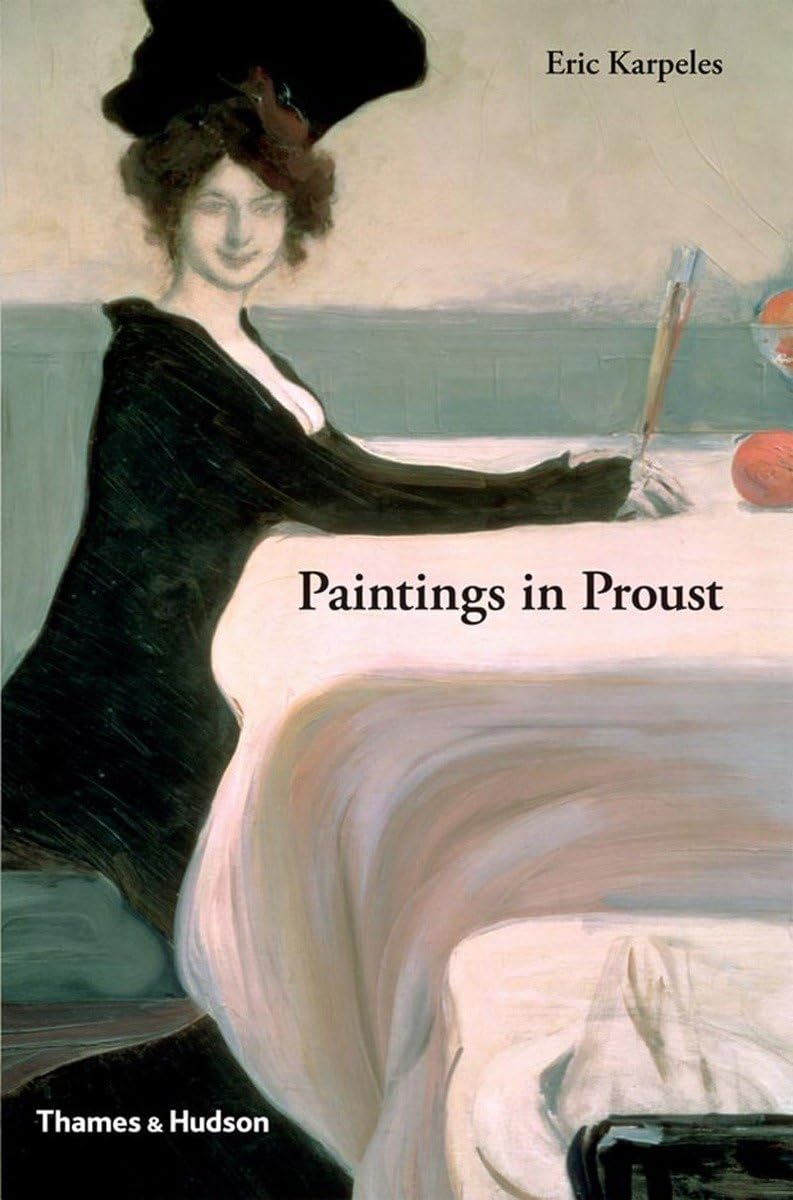
IN SEARCH OF LOST TIME is a richly textured work, peopled primarily by characters who are wealthy, educated, and often pretentious. They go to the theatre, the ballet, musical concerts, the opera, as well as museums and galleries. Most of them do it for social reasons-- to see and be seen by others in their social milieu. But some of them really do have a genuine affinity and appreciation for the higher mind. Art is a true part of their lives and the very way they think. They often discuss paintings and musical compositions, and in the process reveal their true values. Several of the characters are painters, musicians, actors, or writers. Two of the major characters, Swann and the Narrator, are always being reminded of people, places, clothing, and objects seen in paintings. For example, Proust will say that Odette reminded Swann of a figure in Botticelli’s “The Trials of Moses.” [That is an extremely condensed rendering of what Proust actually wrote!] I was not familiar with that painting when I read Proust back in the 70s (before computers and the Internet), so it was a drag doing research. There are many references to paintings all through Proust. Some of them are well-known (i.e., Rembrandt’s “The Night Watch”), but I was not familiar with the vast majority of the works referenced. I kept wishing that there were a book of reproductions of these paintings. I congratulate (and thank) Eric Karpeles for actually creating such a book and doing a splendid job of it.Karpeles’s delightful introduction is also erudite and perceptive, and did a good job of refreshing my memory about the historical period. Then come the paintings themselves in their order of appearance in the novel. For each one, Karpeles sets the stage by telling the situation and then quoting the relevant passage that refers to the painting. I took a great deal of joy reading this book. It was almost like having tea and madeleines, and brought back a lot of the delights of reading IN SEARCH OF LOST TIME. It has me seriously considering reading it a second time. If you’re thinking of reading Proust, this would be a really good book to have handy when you do read it. If you have read it, this will bring back a lot of good memories. Five stars.
C**S
Essential for any Proust lover
This is an absolutely essential companion to Proust's In Search of Lost Time. The book reproduces all the paintings and drawings that Proust makes clear reference to in his novel. It also contains works that he alludes to, but doesn't name or definitely describe, which Karpeles judges may have been the source of the inspiration. Some of these works are very difficult to track down; Karpeles does a truly wonderful service to all Proustians by gathering them together in one book. There are 206 illustrations, 196 in color. The quality of reproductions is excellent, although the details of some of the larger paintings suffer from reduced size.The book is arranged by the seven volumes of the novel. Each work of art is accompanied by a short introduction setting the context within the novel and the excerpt which references it. Karpeles also provides a helpful index which lists every reference in the novel to either the painters or paintings mentioned. The references include the page numbers from the French Tadie Pleiade Edition as well as the Moncrieff/Kilmartin and Moncrieff/Kilmartin/Enright translations (but not the latest Penguin translation).The footnotes at the end of the book are a gold mine of Proustian tidbits and should not be ignored. In addition to listing where the works are displayed and dimensions, Karpeles provides much interesting information and clarifies some textual issues. For example, in discussing the painter Mihaly Munkacsy, he explains that due to "Proust's often illegible scrawl ... Munkacsy's name was never used in the earliest editions of the novel .... The intense [editorial] scrutiny of Jean Yves Tadie restored Munkacsy to his rightful place ... and his correction resulted in the change also finally being made by ... Enright in his revision of the ... translation."There are some minor inconsistencies in the way the works are reproduced. For the most part they are shown in their entirety, but for a small few only a detail is provided as Proust refers only to that portion of the work. Generally details are reproduced in addition to the entire work. An example is the "patch of yellow" in Vermeer's View of Delft, which is highlighted (but without a caption identifying it as THE patch) with an illustration in the beginning of the Introduction. Because of the vagaries of color reproduction I've always thought the patch was difficult to pick out except when looking at the View in person. I would have liked a detail of Carpaccio's The Patriarch of Grado Exorcising a Demoniac highlighting the prototype for Albertine's Fortuny cloak that Proust describes. But these are minor quibbles to an overall excellent book.I should add that Karpeles makes a point not to reproduce paintings that may have been the inspiration of works that Proust "made up" such as Elstir's Miss Sacripant or his Le Port Carquethuit (any number of Monet's views of Rouen, Dieppe, or Honfleur may have been the model). He also confines himself to works Proust mentions in the novel, not in his letters or shorter pieces.HIGHLY RECOMMENDED.
Trustpilot
1 month ago
1 month ago