

Desert Online General Trading LLC
Dubai, United Arab Emirates
Desert Online General Trading LLC
Dubai, United Arab Emirates
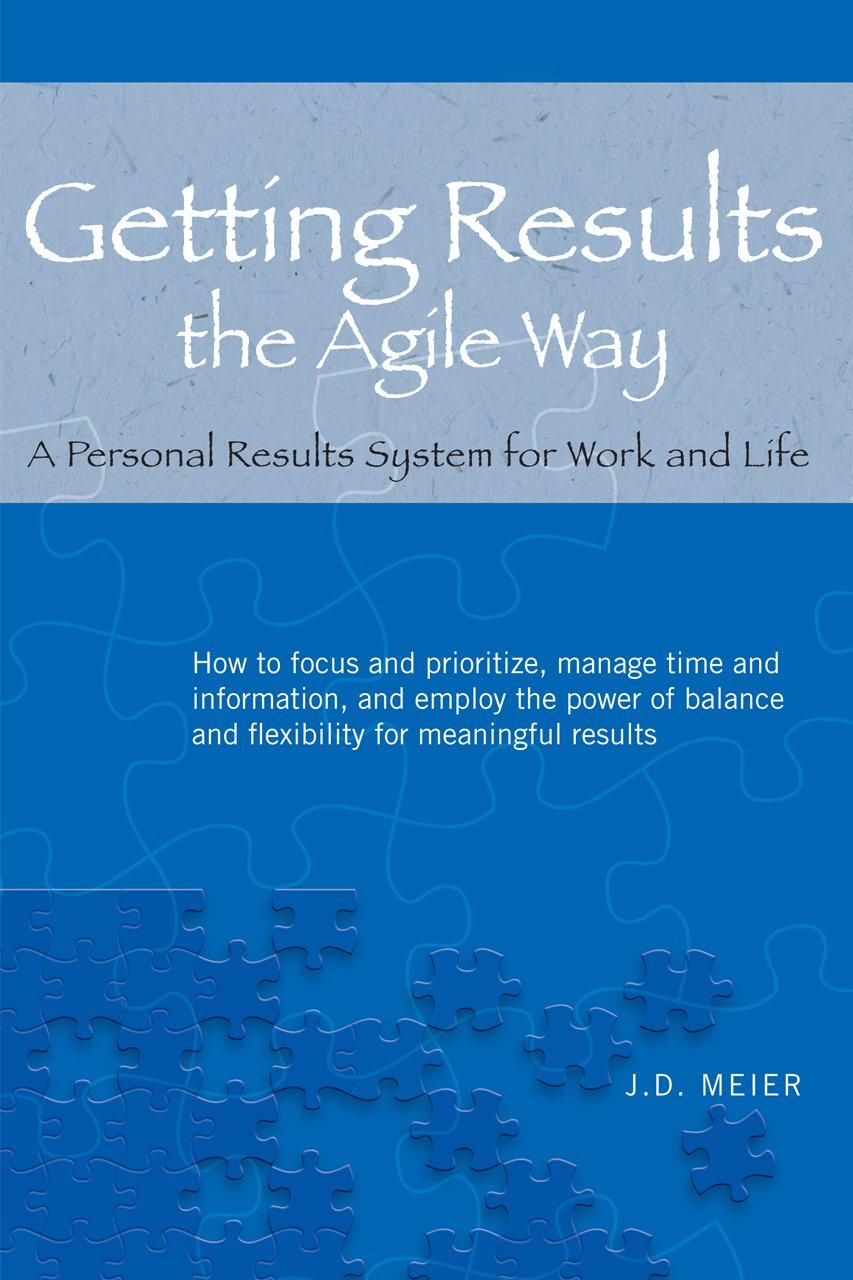
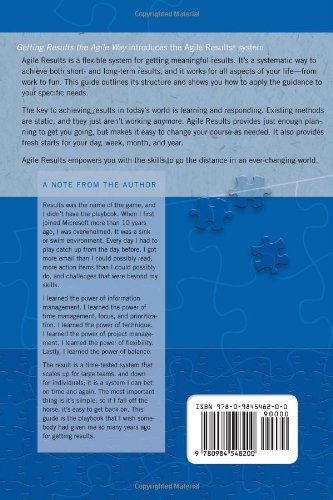

Full description not available
S**O
An Excellent book and adaptation of Agile for Personal Results.
This is one of those rare books that both explains a concept well and provides an extremely actionable system to actually put the ideas in action.Let me take a step back - 'Agile' is a framework used for product development. The goal is to develop the product iteratively, incrementally, and in a time-boxed fashion. Work gets done in 2 week sprints with 'just enough' analysis, as opposed to attempting to plan everything out up-front.What the JD Meier does in this book is present a simple way to translate this system into a personal workflow management technique.Here are the very basics:-At the beginning of your week (or 'sprint') plan out your key intended outcomes. You should try to bite off only what you can fit into your timeboxed sprint (in my case I like to plan 2 weeks at a time). As you do this more, you'll get better at estimating what you can bite off. Write these key intended outcomes / goals on a list.-At the beginning of each day, pick a couple things to work on, that map directly to your weekly (or 'sprint' goals). These should come directly from what you mapped out already.-At the end of the week (or sprint) evaluate how you performed. Ask yourself, what you can do to improve for next time.The system is simple. The beauty of it is that as work comes in, you can store it in a 'backlog' and feed it into your system based on priority. The author also recommends to do a monthly and yearly review with higher level goals, and recommends categorizing tasks by different areas in life (i.e. family / relationships, work, recreation, etc).This seems very simple, and it is in a sense, but it's also very powerful because most people don't actually have the attention span to work on a goal that they set out at the beginning of the week, and evaluate how they performed.Sprinkled around this simple concept are a number of little gems of wisdom... I'll list a few:-Intended Outcomes over Activities - focus on your intended goal. The fact that you put in X hours does not necessarily mean that you are any closer to your intended outcome, and does not mean that you accomplished anything. Your criteria for success should always relate to whether or not your achieved your intended outcome, and not the time or effort you put into an activity.-Rule of 3 - For any yearly, monthly, weekly, or daily goal setting, stick to working on 3 things at a time, you lose focus after any more than just 3.-'Good Enough' over Perfection - people will often obsess over achieving perfect results (I am guilty of this) and spend more time or resources than necessary on a problem. Focus on 'Good Enough' and 'Version' your results, meaning you can always come back and improve in a Version 2 or a Version 3 of the task at hand.-Throwing more time at something is one of the *worst* things you can do.-Fix time and flex scope - if you have an intended outcome, get 'good enough' done in the allotted time and move onto the next thing, instead of going for perfect. Over the long run this will force you to be more efficient.-Block time around eating / sleeping / working out.-Results over Productivity - A lot of systems focus on being 'productive' or always using your spare capacity to work on something. Actually you DON'T want to do this. It's ok to have an hour break between appointments or commitments, the goal is always to achieve RESULTS. If you block all of your time on so as to have no spare capacity, you are almost guaranteed to be working on a lot of low value items with no spare capacity, when in reality you need to be focused on fewer high value items that will really make a difference.This book is great. My only light criticism, is that it is probably hard to put into practice or truly 'get' the system if you haven't worked on an agile team before. It's still worth reading and re-reading certain parts a few times. I'd recommended phasing the system in, in small steps, starting with just the basics first.As companions to this book, I'd recommend Getting Things Done, Zen to Done, and The Pomodoro Technique which all do a good job complementing each other but cover slightly different things. Of all these books, this one and Getting Things Done are probably the most essential ones to read.
C**S
Not exactly what I was expecting
This is an interesting book.On the scale of productivity books, you've got Getting Things Done on one end -- extremely practical, starting with tasks; and the 7 Habits of Highly Effective People on the other -- addressing productivity from the opposite end, starting with who you are as a person, what your definition of happiness is and your mission before you can effectively drill down into the nitty gritty of what you should be doing each day. This book doesn't really fit into that continuum.I got the book and read the synopsis and thought it was going to be a book about a productivity system, but it isn't -- not really. It starts like that, but it never really fleshes it out. I was expecting examples and anecdotes, but there really aren't any. The author says "this system got me through the best of times and the worst of times," but that's all he says about it.Instead of using real-world examples, he repeats the Agile principles ad nauseam -- Fix time, flex scope; value is in the eye of the beholder; etc. I felt like I was watching Fight Club listening to them chant "his name is Robert Paulson."I was expecting Tony Robbins-style motivation, but there is absolutely none of that here. It's like an instruction manual -- a little cold.All that said, It's still a good book and I'm not going to take away stars because I was expecting something different. It's heavy on things to think about, but light on concrete suggestions for how to implement them.
W**T
A fine system for people with lives much like the author's
This book is very fractal. It introduces a concept and then circles back to it a couple times in increasing depth. It's a logical structure, but you end up feeling like you've read everything a couple times. Perhaps this is better for readers who skim.My other overall comment is that most productivity systems written out of software make me resentful because they assume that my home-life schedule is something that can be managed. I think I speak for a lot of working parents when I say that my schedule is something that I manage the same way surfers manage waves.Useful concepts I will take from this book:Outcomes, not activities. You don't want to be doing something, you want a finished product to show for your work. Write your tasks to reflect that.Fix time, flex scope. You have the time you have. Instead of changing that, change how much you are trying to get done in that time.Use your vision of the end result to drive your motivation and self-analysis.Don't wait for inspiration. Even uninspired work is more useful than nothing.Pretend to think like someone else to work your way through problems you are stuck on. Pick problem-solving heroes and ask yourself what they would do in a similar situation.Work from an abundance mentality. Instead of assuming there is only so much of anything to go around, ask yourself how you could make more.Growth feels awkward.Things I could have lived without:I thought that even for the structure of the book, there was a lot of repetition.I found the emphasis on exercise and diet pretty ableist. Not everyone can "work out to maintain their health".I was completely vexed by the assumption that emotional work was a knowable obligation. That may be true for other people, but I think that system would come up against a lot of grief given one week with kids who have the flu. To me, emotional work is much more interrupt-based, and when it's happening, it's the thing that's blocking everything else.Read if: You are looking for a way to think about organizing and timeboxing yourself that is derived from Agile development methods. There is a lot to be gained from some of the concepts presented here.Skip if: You will feel angry at a book that assumes you are in charge of your time allocation. You are not feeling patient about repetition.Also read: Cheaper By the Dozen for another way to think about time use.
Trustpilot
2 months ago
1 month ago
2 weeks ago
1 month ago