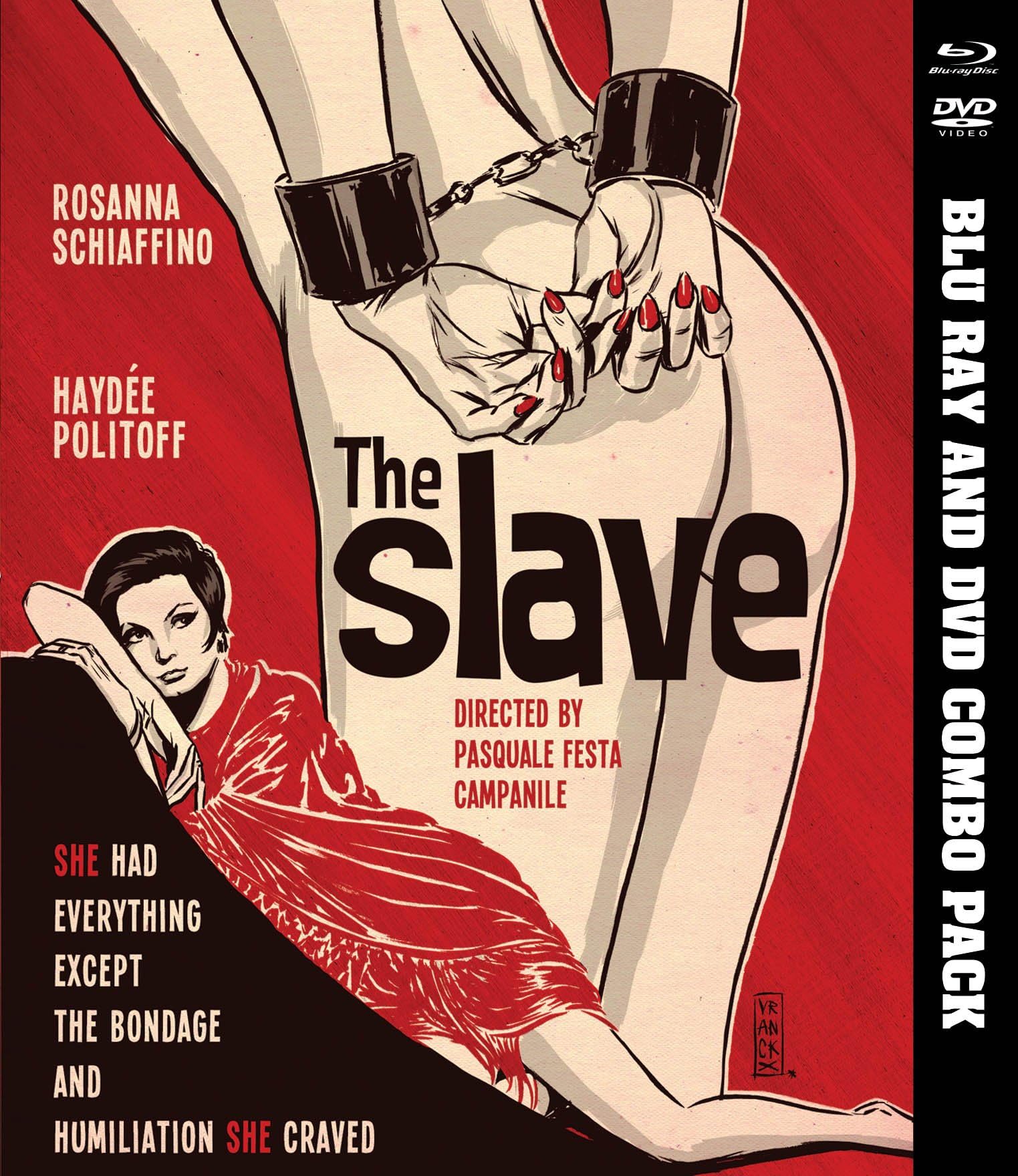
The Slave
Product ID: 6684403
Buy anything from 5,000+ international stores. One checkout price. No surprise fees. Join 2M+ shoppers on Desertcart.
Desertcart purchases this item on your behalf and handles shipping, customs, and support to OMAN.
"Silvia (Haydee Politoff) is young, beautiful and rich. She has everything - except the bondage and humiliation she craves to fulfil her erotic yearnings. Margaret (Rosanna Schiaffino) is a legendary movie star who loves to wade thigh high in 10,000 lira bank notes - and who is only too happy to give Silvia what she wants. In a strange, secluded house in Rome, the two women create a bizarre private world where Silvia's fantasies become real, as Margaret turns her into a Slave, a plaything of flesh, subject to the whims of an all powerful owner who can use her in any way she desires. Pasquale Festa Campanile (Hitch-Hike) directs a masterpiece of decadence, packed with sumptuous and shocking images. A brand new HD transfer from the original Techniscope negative. From the director of The Libertine and When Women Had Tails. Based on a scandalous European novel in the tradition of Story of "O" and The Image. Review: A must-see for fans of this genre! - The 1960’s found mainstream (or at least respectable) cinema was ready to deal with the topic of S&M. As was often the case during this decade, European filmmakers led the charge in figuring how to handle such adult material in an artful style: films like Belle De Jour, Venus In Furs and La Prisionaire provide artful examples of this trend. Films by Radley Metzger (The Russ Meyers of S&M; his low budget - and American - films were wildly successful and semi-respectable). The Slave is one of the lesser-known examples but is no less worthy than the aforementioned titles. In fact, it offers an ambitious and unique take on the subject of S&M that helps it stand apart from its competitors. The Slave was adapted by Fellini collaborators Tullio Pinelli and Brunello Rondi from Check To The Queen, a popular Italian novel written by Renato Ghiotti. The storyline follows Silvia (Haydee Politoff), a wealthy housewife who deals with her husband’s extended business trip by accepting a job with jet-set model Margaret (Rosanna Schiaffino). The job is no typical gig: Margaret basically wants a human plaything that will do her bidding without question. Silvia already harbors unusual fantasies about lesbian domination and she enters into the relationship with a fervor that surprises both herself and Margaret. The Slave is steeped in the kind of casual decadence that defines erotic-themed Italian films of this era. Much of the film takes place in a lavishly decorated mansion, characters swan about in haute couture and the eroticism is of the cool variety where sexual encounters are interspersed with philosophical exchanges about the nature of desire. Director Pasquale Festa Campanile, best known to American viewers for the disturbing thriller Hitch Hike, gives the material an elegant treatment, using Roberto Gerardi’s ‘scope-format photography to caress the elegant surroundings and topping it off with a plush Euro-lounge score from Piero Piccioni. However, the element of The Slave that truly distinguishes it from the rest of ’60s European S&M films is its ambivalent attitude towards its subject matter. While Campanile has no problem capturing the fantasy element of S&M on screen – Silvia’s sexual fantasies are filmed in a playful, lysergic style – he’s more interested in flouting the audience’s expectations about where these kinds of adventures lead. Unlike a lot of S&M films, there is no turning of the tables between master and slave or settling into a odd yet familiar sadist/masochist domesticity. Without getting to heavily into spoilers, the third act of The Slave suggests that fantasies aren’t meant to come true and self-knowledge is as important as acting on one’s desires. This ambitious take on the subject works partly because the gutsy script and Campanile’s savvy direction but what truly makes the ideas connect are the lead’s performances. Schiaffino starts out in brash, gleeful “bad girl” mode but adds interesting shadings as she goes along, making us realize her character might have unlikeable elements yet deserves a certain respect because she knows exactly who she is and is unfailingly honest about it. Politoff offers an counterweight to Schaffino’s work, creating an internalized performance where she uses her passive nature and vacant gaze to manipulate others. On a side note, Italian exploitation fans will also be happy to see an early performance from Gabriele Tinti as a randy actor who works with Margaret. The Slave conveys the allure of its S&M theme nicely but makes itself more interesting by offering how challenging it can be to apply such fantasy-inspired sexual concepts to real life. As such, it’s worthy of study for any students of erotic cinema’s development during the ’60s. The transfer is pretty impressive, particularly in its blu-ray incarnation. It was taken from the original negative and offers the film’s Techniscope framing in all its glory, with rich colors and a nice depth of detail. This transfer utilizes the original Italian mono soundtrack, presented with English subtitles, and it’s a solid mix for a film of this vintage. The extras begin with a pair of interview featurettes. The first is with film historian Roberto Curti, who covers a lot of material about Pasquale Festa Campanile and The Slave in just under 28 minutes. He begins with a thumbnail sketch of Campanile’s career and his place in Italian film history then segues into a discussion of The Slave‘s history, including biographical sketches of the different collaborators, differences between the novel and the film (most notably, the ending) and how the film was received by local audiences. Curti’s style is brisk and informative, making this a pleasant way for Euro-cultists to learn about this film and its director. The second featurette features Justin Harries, who runs Filmbar 70, a London establishment devoted to the Italian genre cinema of the ’60s to early ’80s era. After a few minutes about why such films are appealing to his audiences, he discusses a number of related and interesting topics. He contextualizes The Slave as part of a “bourgeoisie baiting” trend in Italian cinema of the late ’60s, explains how the sex comedy actually dominated the ’70s output of Italian genre cinema and covers the different reasons that genre filmmaking came to an end at the dawn of the ’80s in Italy. Harries has an interesting perspective and students of Euro-cult material will be intrigued by his scholarly approach. Some text-driven supplements follow. The first is a brief “about the film” essay that covers a lot of making-of and contextual info about The Slave in about five panels. Next up are a series of text bios for stars Rosanna Schiaffino, Haydee Politoff, Campanile and composer Piero Piccioni. All are illuminating – the story of how Politoff became an accidental star and ended up with such a bizarre filmography is particularly interesting – but viewers should be sure to go to the credits sections on the Politoff and Campanile bios as they feature several optional trailers and film clips. Given the eclectic careers of this duo, there’s a lot of colorful viewing to be found there. The final extra is the one you see on every Mondo Macabro release, their wild preview reel for their other releases: if you’ve never seen it, it’s a gonzo blur of monsters, sexy ladies and sudden bursts of surrealism. Review: Beautiful film - I'm not sure I understand the low average rating for this film. I thought it was a stunning work of art. No, it's not your typical exploitation film, it actually goes a lot deeper than that. If you're just watching this for nudity, there is some of that, but The Slave is more psychological than titillating. I would imagine that people who are deeply involved in B&D and S&M would enjoy this film for its realistic, though artful, depiction of a young woman who longs to be subservient, degraded, dominated. This movie has a lot of extravagant sets and costumes and is a wonderful example of late 60s/early 70s Italian filmmaking from the director who later made the exploitation cult classic, Hitch-Hike.
| ASIN | B00KI5SH02 |
| Actors | Gabriele Tinti, Haydee Politoff, Romolo Valli, Rosanna Schiaffino |
| Best Sellers Rank | #183,433 in Movies & TV ( See Top 100 in Movies & TV ) #2,990 in Mystery & Thrillers (Movies & TV) #10,373 in Drama Blu-ray Discs |
| Customer Reviews | 3.8 3.8 out of 5 stars (14) |
| Director | Pasquale Festa Campanile |
| Media Format | Anamorphic, Blu-ray, Dolby, Limited Edition, Multiple Formats, NTSC, Widescreen |
| Number of discs | 2 |
| Product Dimensions | 0.43 x 6.68 x 5.29 inches; 3.52 ounces |
| Release date | September 9, 2014 |
| Run time | 1 hour and 40 minutes |
| Studio | Mondo Macabro |
A**.
A must-see for fans of this genre!
The 1960’s found mainstream (or at least respectable) cinema was ready to deal with the topic of S&M. As was often the case during this decade, European filmmakers led the charge in figuring how to handle such adult material in an artful style: films like Belle De Jour, Venus In Furs and La Prisionaire provide artful examples of this trend. Films by Radley Metzger (The Russ Meyers of S&M; his low budget - and American - films were wildly successful and semi-respectable). The Slave is one of the lesser-known examples but is no less worthy than the aforementioned titles. In fact, it offers an ambitious and unique take on the subject of S&M that helps it stand apart from its competitors. The Slave was adapted by Fellini collaborators Tullio Pinelli and Brunello Rondi from Check To The Queen, a popular Italian novel written by Renato Ghiotti. The storyline follows Silvia (Haydee Politoff), a wealthy housewife who deals with her husband’s extended business trip by accepting a job with jet-set model Margaret (Rosanna Schiaffino). The job is no typical gig: Margaret basically wants a human plaything that will do her bidding without question. Silvia already harbors unusual fantasies about lesbian domination and she enters into the relationship with a fervor that surprises both herself and Margaret. The Slave is steeped in the kind of casual decadence that defines erotic-themed Italian films of this era. Much of the film takes place in a lavishly decorated mansion, characters swan about in haute couture and the eroticism is of the cool variety where sexual encounters are interspersed with philosophical exchanges about the nature of desire. Director Pasquale Festa Campanile, best known to American viewers for the disturbing thriller Hitch Hike, gives the material an elegant treatment, using Roberto Gerardi’s ‘scope-format photography to caress the elegant surroundings and topping it off with a plush Euro-lounge score from Piero Piccioni. However, the element of The Slave that truly distinguishes it from the rest of ’60s European S&M films is its ambivalent attitude towards its subject matter. While Campanile has no problem capturing the fantasy element of S&M on screen – Silvia’s sexual fantasies are filmed in a playful, lysergic style – he’s more interested in flouting the audience’s expectations about where these kinds of adventures lead. Unlike a lot of S&M films, there is no turning of the tables between master and slave or settling into a odd yet familiar sadist/masochist domesticity. Without getting to heavily into spoilers, the third act of The Slave suggests that fantasies aren’t meant to come true and self-knowledge is as important as acting on one’s desires. This ambitious take on the subject works partly because the gutsy script and Campanile’s savvy direction but what truly makes the ideas connect are the lead’s performances. Schiaffino starts out in brash, gleeful “bad girl” mode but adds interesting shadings as she goes along, making us realize her character might have unlikeable elements yet deserves a certain respect because she knows exactly who she is and is unfailingly honest about it. Politoff offers an counterweight to Schaffino’s work, creating an internalized performance where she uses her passive nature and vacant gaze to manipulate others. On a side note, Italian exploitation fans will also be happy to see an early performance from Gabriele Tinti as a randy actor who works with Margaret. The Slave conveys the allure of its S&M theme nicely but makes itself more interesting by offering how challenging it can be to apply such fantasy-inspired sexual concepts to real life. As such, it’s worthy of study for any students of erotic cinema’s development during the ’60s. The transfer is pretty impressive, particularly in its blu-ray incarnation. It was taken from the original negative and offers the film’s Techniscope framing in all its glory, with rich colors and a nice depth of detail. This transfer utilizes the original Italian mono soundtrack, presented with English subtitles, and it’s a solid mix for a film of this vintage. The extras begin with a pair of interview featurettes. The first is with film historian Roberto Curti, who covers a lot of material about Pasquale Festa Campanile and The Slave in just under 28 minutes. He begins with a thumbnail sketch of Campanile’s career and his place in Italian film history then segues into a discussion of The Slave‘s history, including biographical sketches of the different collaborators, differences between the novel and the film (most notably, the ending) and how the film was received by local audiences. Curti’s style is brisk and informative, making this a pleasant way for Euro-cultists to learn about this film and its director. The second featurette features Justin Harries, who runs Filmbar 70, a London establishment devoted to the Italian genre cinema of the ’60s to early ’80s era. After a few minutes about why such films are appealing to his audiences, he discusses a number of related and interesting topics. He contextualizes The Slave as part of a “bourgeoisie baiting” trend in Italian cinema of the late ’60s, explains how the sex comedy actually dominated the ’70s output of Italian genre cinema and covers the different reasons that genre filmmaking came to an end at the dawn of the ’80s in Italy. Harries has an interesting perspective and students of Euro-cult material will be intrigued by his scholarly approach. Some text-driven supplements follow. The first is a brief “about the film” essay that covers a lot of making-of and contextual info about The Slave in about five panels. Next up are a series of text bios for stars Rosanna Schiaffino, Haydee Politoff, Campanile and composer Piero Piccioni. All are illuminating – the story of how Politoff became an accidental star and ended up with such a bizarre filmography is particularly interesting – but viewers should be sure to go to the credits sections on the Politoff and Campanile bios as they feature several optional trailers and film clips. Given the eclectic careers of this duo, there’s a lot of colorful viewing to be found there. The final extra is the one you see on every Mondo Macabro release, their wild preview reel for their other releases: if you’ve never seen it, it’s a gonzo blur of monsters, sexy ladies and sudden bursts of surrealism.
R**K
Beautiful film
I'm not sure I understand the low average rating for this film. I thought it was a stunning work of art. No, it's not your typical exploitation film, it actually goes a lot deeper than that. If you're just watching this for nudity, there is some of that, but The Slave is more psychological than titillating. I would imagine that people who are deeply involved in B&D and S&M would enjoy this film for its realistic, though artful, depiction of a young woman who longs to be subservient, degraded, dominated. This movie has a lot of extravagant sets and costumes and is a wonderful example of late 60s/early 70s Italian filmmaking from the director who later made the exploitation cult classic, Hitch-Hike.
H**N
Beautiful movie, forced subtitles
Dear Mondo Macabro you have published a wonderful ignored movie in such beautiful look why have you ruined it all with forced subtitles? If you can not yet in 2015 for whatever reason bring out a bluray with optional subtitles is better do not even release the product. It's such a shame to waste the video with not removable text. I've bought Valerie and her week of wonders I don't speak Czech and I have to read the english subtitles but I'm really glad that Criterion have made subtitles optional. Plus the title The Slave is very ugly the original Scacco alla Regina (Check to the Queen) is so beautiful. There is not any deleted scenes but maybe I'm not really good to look for it. The vote is for Mondo Macabro, the movie is 5/5.
P**I
Two Stars
not what I expected
A**N
For more information see Check the Queen aka "Scacco alla regina" on IMDB.
Ignoew the rating. I have not heard of, or seen, the film and wanted more information. You can find it under the title Check the Queen aka Scacco alla regina on IMDB
R**M
Good things come to those that wait...
A huge 'thank you' to Mondo Macabro for finding this rare bit of Italo ero-weirdness and making it available in a great package. I initially became aware of this film waaay back in the late 60's, when it was first released, via some 'production promo stills' in a men's magazine. The pix included several hot fetish images of pony girl action and whipping scenes with (for the day) remarkably high production values and great looking women. It was noted in the article that the film was Italian and it was entitled: "The Slave" - that was the last I ever saw or heard of it back then and over the succeeding years I had searched the internet in vain looking for any trace of it - now: "hallelujah!" Mondo Macabro has 'found it' and given it a 1st class presentation! As is explained in the detailed extras included on both of the DVD & Bluray formatted disks - this film was made by the prolific Italian Writer/Director; Pasquale Festa Campanile - based upon a best selling erotic book of the day entitled "Check To The Queen" (in Europe) & "The Slave" (in N. America). The plot follows the story of a beautiful, bored, young, aristocratic woman with masochistic tendencies who becomes the willing servant/slave of a wealthy actress/mistress and the kinky games that they get up to, and where it all leads. Whereas the source novel followed in the footsteps of previously published Euro erotic S/M tales, such as "The Story of O" and "L'Image' - the film: 'The Slave' pre-dated (by nearly a decade!) many like cinematic eroductions, such as, French director Just Jaekin's (1970's) movie versions of "The Story of O", and the (John Willie B&D comics inspired) 'Perils of Gwendeline" - both of which contained similar fetish elements. Perhaps director Campanile was a bit ahead of his time with the transgressive BDSM content of his film - it apparently flopped at the domestic (Italian) box office, was never given a theatrical release in N. America, and faded quickly into obscurity - engendering the, previously noted, difficulty in finding any reference or access to it. While somewhat 'quaint', by today's standards, in the 'perverse' sexual realm - "The Slave" provides a very satisfactory viewing experience on multiple levels. Both of the principal actresses are gorgeous and Haydee Politoff (as Silvia, 'the slave') spends a fair portion of the film minus clothing and/or sporting 'outrageous' 60's style fashions or fetish garb. The sets are over the top 60's pop inspired masterpieces and there's even an amazing mechanical horse that has to be seen to be believed. The musical score is also xlnt classic Italo-schmaltz. The scenes of harnessed pony girls and chained whipping that I carried so long in my memory are to be found in several 'fantasy/dream' sequences within the story - ironically they are given a sort of fuzzy-lensed treatment and are not as clear as the 'printed' production stills I had seen - yet itz great to finally see them in 'context'. The film IS rich in fetish imagery! - but - may not be considered as particularly 'erotic' in its' presentation of those elements from our somewhat 'jaded' modern perspective. Ultimately "The Slave' succeeds primarily as a slice of 60's pop culture - combining fashion, fetish, and flesh into an amalgam that is visually very satisfying - even if the 'story' is a bit nebulous in its' conclusions. I really enjoyed it. The print quality (for regular DVD format) is excellent - Italian lang. w/ English subs - widescreen letterbox - and there are some great 'extras' ( in English!) with 2 informative interviews and interactive cast bios. Apparently a 'limited edition' of only 3500 copes - grab one qwik B4 it vanishes again!
Trustpilot
2 weeks ago
1 month ago