
DOWNLOAD THE APP


Customer Services
Copyright © 2025 Desertcart Holdings Limited
DOWNLOAD THE APP



🔍 Power up your cable game with precision and style!
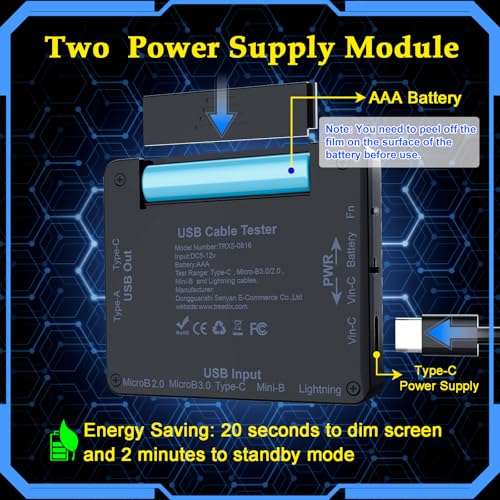
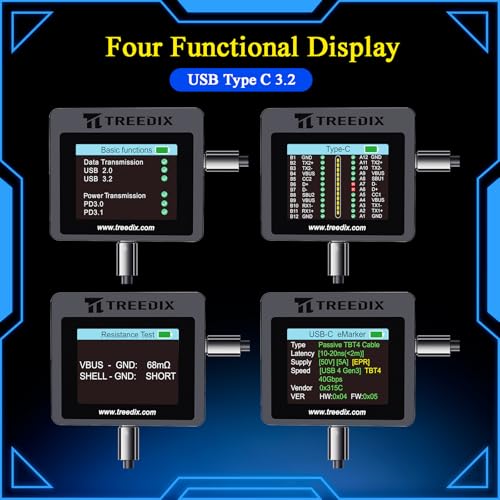
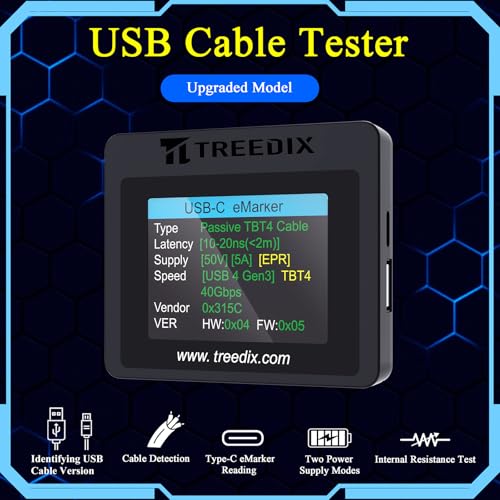
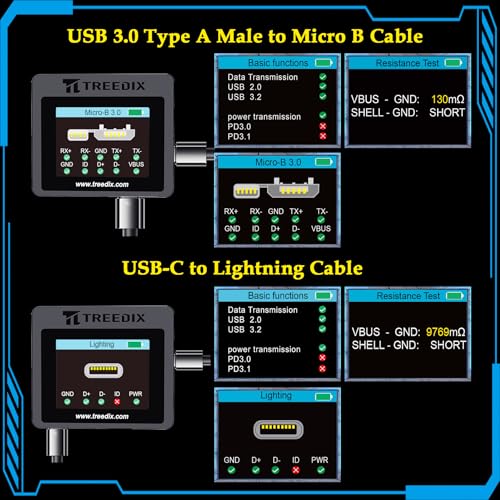
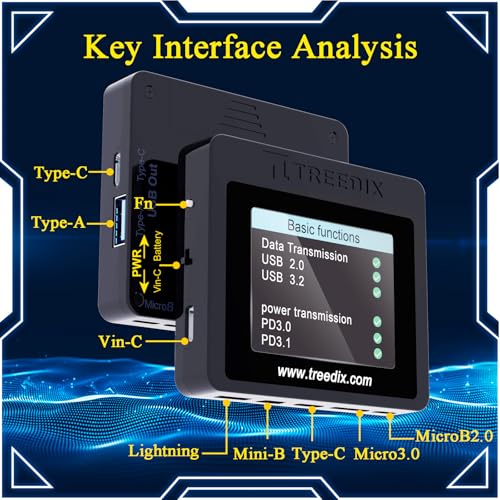
The USB Cable Tester by Treedix features a vibrant 2.4-inch color LCD to test USB cable continuity, internal resistance, and performance. It supports USB 2.0 through 3.2 and PD 3.0/3.1 protocols, including Type-C eMarker chip reading for detailed cable diagnostics. Powered by AAA batteries or USB-C 5V, it ensures fast, safe, and reliable cable verification for professionals managing multiple devices.


| ASIN | B0DYJL5Z67 |
| Batteries | 1 AAA batteries required. (included) |
| Batteries Included | Yes |
| Batteries Required? | Yes |
| Battery Cell Type | Zinc |
| Color | ブラック///ホワイト |
| Customer Reviews | 4.5 4.5 out of 5 stars (252) |
| Date First Available | March 13, 2025 |
| Included Components | USB Cable Tester |
| Item Weight | 90 g |
| Manufacturer | Treedix |
| Package Dimensions | 9.2 x 8.1 x 2.2 cm; 90 g |
| Part number | TRX5-0816-AC |
| Power source type | バッテリー駆動、コード付き電気 |
| Special Features | Cable Detection, Type-C eMarker Cable Chip Reading, USB Cable Version Identification |
I**M
Device is easy to use. Helped me sort my usb cables by potential use and identify the capabilities of unmarked cables.
O**.
Es una excelente herramienta, tengo demasiados cables en casa y pues ya con éste equipo ya podré clasificar si es para datos de baja velocidad, alta velocidad o simplemente cable de carga.
C**G
Item is as described. Fast delivery. It is a bit expensive but display the necessary info about the cables. I wished the device can update future firmware when technology evolved. Thank you very much.
M**R
One of the best purchases if you use lots of different Usb cables and devices. There are Soooo many reasons why certain cables don’t work. Usb is “less a standard” and “more a lottery” but this makes it simple to check and label every cable for it’s suited purpose.
D**E
This is a very nice device and provides a lot of useful information. It is easy to use and easy to read. It comes with a small instruction booklet that is quite clear. The basic process is to connect both ends of your cable to the device and slide a small switch to the desired power source (included AA battery or external USB C power source). There are four pages of information and you step through them by pressing a small button. The first page gives you a summary of the protocols supported (e.g., USB 2.0, 3.2, 4 and Thunderbolt). Note that it does not report the "generation" of USB 3.2. Your computer might have USB 3.0, 3.1, 3.1 gen 1, or 3.2 gen 1 interfaces - these are all equivalent to 3.2 gen 1 (5 Gbps) and the "USB 3.2" indicator that will light for cables that support that. However, it also will light for USB 3.1 gen 2 and USB 3.2 gen 2 (10 Gbps), and for USB 3.2 gen 2x2 (20 Gbps) cables. The fact that 3.2 lights up indicates it's at least 5 Gbps but might be more. The second page shows the wire connection list between the two ends of the cable. The third page shows some resistance and latency information. The fourth page shows data from the "e-marker" chip, if present. These chips are embedded in some USB C cables. If present, the e-marker will report the max data rate and the max charging power supported. If you have USB A-A or USB A-C cables, or USB C-C cables without e-marker chips, you won't be able to tell whether they are rated for 5 (gen 1) or 10 (gen 2) or 20 Gbps (gen 2x2). If you have a cable with a chip, you will see the maximum data rate on the fourth page. Note also that if you want to evaluate a USB A-A cable, you'll need a USB A to C adapter plug. The unit has a wide variety of USB 2.0 connectors but only one Type A USB 3 connector. To perform the tests, both ends of the cable have to be connected to the device so you must be able to adapt a Type A connector on one end of the cable to a Type C. Overall I recommend this, but I wish it could tell which USB A-A 3.x cables support 5 (gen1) or 10 Gbps (gen 2) interfaces. I suspect it is technically impractical to determine that in a low cost device. I found that almost all of the USB C "charging" cables I have lying around have no e-marker chip and no data capability at all or just USB 2.0 480 Mbps. An e-marker chip is required for any cable that supports 60W or greater charging; any cable lacking the chip must necessarily be rated for <60 Watts, but you cannot tell whether it's 15, 20, 30W, etc. Lastly, the device comes with an AA battery. You can use that to power it, or you can plug in a power source via a USB C cable.
Trustpilot
2 weeks ago
2 days ago