
DOWNLOAD THE APP


Customer Services
Copyright © 2025 Desertcart Holdings Limited
DOWNLOAD THE APP
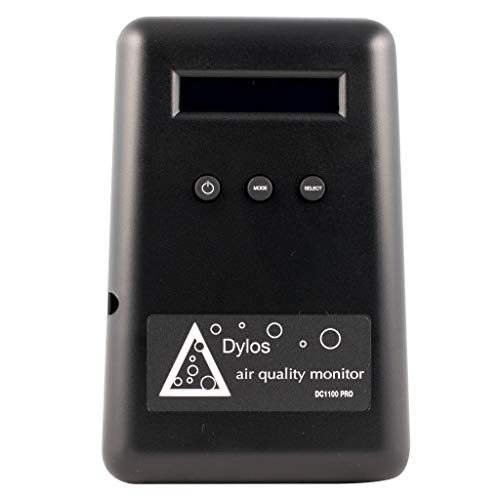

Legal Disclaimer Warranty: We only accept returns if unopened within 7 days of arrival. We will try our best to solve any defects in the case Review: good stuff Review: I purchased an IQAir Health Pro Plus a few months ago after suffering from a bad bout of bronchitis. I developed a variant of asthma which leads to coughing excessively when the air quality is poor. The IQAir has been a great addition to my home, but it bothered me that I had no scientifically objective way to determine how effective it was or how often I needed to use it. I purchased the Dylos DC1100 Pro to confirm that my IQAir was really working, and to get a better understanding of what the air quality in my house was. The first week I had it I found my baseline particle count in the home was about 160,000 particles per cubic foot. The outside air was running at 260,000. In the bedroom where I keep my IQAir, my count was 30,000. So I knew right away I was getting some benefit from it. I was also able to monitor what fan speed I needed to keep my IQAir running at to maintain a reasonable particle count. Running at speed 3 was working sufficiently. A week later we had a terrible bout of smog by the house. The outside air particle load shot up to over 10 million! I couldn't see more than a few feet in front of my house. I noticed that my IQAir was having a hard time keeping up with the smog and my bedroom was rising to over 80,000. So I knew I had to run the unit at full speed to get the count down. So I've been monitoring the counts closely and using the numbers to determine how often and at what speed I need to run the IQAir at for optimal efficiency. I've also been able to confirm that holding the Dylos up to the IQAir shows a count of 0, so I know I'm getting very clean air out of the machine. I've read that the filters on the IQAir last much longer than when the unit suggests a replacement. So rather than replacing when the light comes on, I'm going to rely on the Dylos to tell me whether I still have clean air coming out of the unit. I've read that some people have original HEPA filters in their IQAirs more than 8 years and still have zero particles blowing out of the unit. That is really amazing! I was curious to see how accurate the unit was, and today I had a chance to test it out. I had an IQAir rep come out to my house to evaluate my home for a whole house IQAir system, and he brought his $3,000 particle scanner with him. We went around the house measuring each room and comparing it to the Dylos. Both units were showing virtually identical numbers. So I know this unit is really accurate. I can't imagine going without the Dylos now that I have it. I check it every day to see how the air quality is, and I know when the numbers go up I have to do some things to adjust for it. For those of you who are suffering from allergies or asthma and find an air purifier to be of benefit, the Dylos is an invaluable tool to help you manage your air purification efforts. This is truly an amazing device that I highly recommend.
| ASIN | B004AWEG0Y |
| Are Batteries Included | No |
| Brand | ディロス |
| Customer Reviews | 3.8 3.8 out of 5 stars (177) |
| Date First Available | September 4, 2012 |
| Item Weight | 450 g |
| Model Number | DC1100-PRO |
| Product Dimensions | 11.43 x 7.62 x 17.78 cm; 450 g |
V**M
good stuff
A**R
I purchased an IQAir Health Pro Plus a few months ago after suffering from a bad bout of bronchitis. I developed a variant of asthma which leads to coughing excessively when the air quality is poor. The IQAir has been a great addition to my home, but it bothered me that I had no scientifically objective way to determine how effective it was or how often I needed to use it. I purchased the Dylos DC1100 Pro to confirm that my IQAir was really working, and to get a better understanding of what the air quality in my house was. The first week I had it I found my baseline particle count in the home was about 160,000 particles per cubic foot. The outside air was running at 260,000. In the bedroom where I keep my IQAir, my count was 30,000. So I knew right away I was getting some benefit from it. I was also able to monitor what fan speed I needed to keep my IQAir running at to maintain a reasonable particle count. Running at speed 3 was working sufficiently. A week later we had a terrible bout of smog by the house. The outside air particle load shot up to over 10 million! I couldn't see more than a few feet in front of my house. I noticed that my IQAir was having a hard time keeping up with the smog and my bedroom was rising to over 80,000. So I knew I had to run the unit at full speed to get the count down. So I've been monitoring the counts closely and using the numbers to determine how often and at what speed I need to run the IQAir at for optimal efficiency. I've also been able to confirm that holding the Dylos up to the IQAir shows a count of 0, so I know I'm getting very clean air out of the machine. I've read that the filters on the IQAir last much longer than when the unit suggests a replacement. So rather than replacing when the light comes on, I'm going to rely on the Dylos to tell me whether I still have clean air coming out of the unit. I've read that some people have original HEPA filters in their IQAirs more than 8 years and still have zero particles blowing out of the unit. That is really amazing! I was curious to see how accurate the unit was, and today I had a chance to test it out. I had an IQAir rep come out to my house to evaluate my home for a whole house IQAir system, and he brought his $3,000 particle scanner with him. We went around the house measuring each room and comparing it to the Dylos. Both units were showing virtually identical numbers. So I know this unit is really accurate. I can't imagine going without the Dylos now that I have it. I check it every day to see how the air quality is, and I know when the numbers go up I have to do some things to adjust for it. For those of you who are suffering from allergies or asthma and find an air purifier to be of benefit, the Dylos is an invaluable tool to help you manage your air purification efforts. This is truly an amazing device that I highly recommend.
R**K
Bought this machine because of the reviews and knew some of its limitations beforehand (from other air quality blogs/sites). A couple of key things to be aware of: - Measures all types of particles, including water particles. Taking a shower, boiling water, cooking, etc will all raise the particle count. - Not a VOC gas detector (like some others on the market. Ideally an integrated particle counter with a VOC gas detector would be ideal) - No smart app or any way to download the data (unless you shell out much more money for a very legacy PC interface) - Cabled. Means measuring around ur house requires constant plugging/unplugging or a really long extension cord. - The unit doesn't support 220-240V in case you live outside of the US. Biggest flaws: - A small hard-wired computer fan drives the whole unit. If the fan stops working for whatever reason (as is my case after 1.5 years), you're left with an unusual machine. - I question whether a cheap computer fan runs consistently/reliably enough to be even be used for this application. I'm not convinced these fans are spec'd tight enough to deliver a reliably similar airflow (ie. owners of the same model unit comparing readings) and especially over time. If the fan spins slower, it'll move less air through the unit and invariably affect the reading. The unit has no way to adjust fan RPM and a lookup of the OEM fan manufacturer doesn't indicate any capability for the fan to lock a sepecific RPM. If you received a unit with a defective/slower fan, you'll just think your air is cleaner than it actually is. - The readings are arbitrary and do not reflect any kind of standard measure. There are numerous posts online where folks have tried to figure out and convert the readings to API/AQI, but shouldn't this just be worked in? Also, see point above on data inconsistency - maybe they couldn't pin down consistent airflow across units making it difficult to apply a standard conversion logic? In light of all of this, the most frustrating part is how unreliable the device is. This would explain why they only provide a 90-day warranty! My machine's fan started making noises upon startup/shutdown after 8 months, and by 18 months, it fan finally stopped working altogether. I emailed support, and they replied back saying I need to ship it back to them (at my expense), I need to pay for repair costs (approx $45) and pay for shipping back to me. No offer to send me a replacement fan, and I can see why (with the poor design of a hardwired fan). How much harder to include a plug in fan (like every other computer fan)? Guess I'm stuck with sourcing my own fan, and soddering it back onto the board myself. On the bright side, I can confirm that (when it does work), it does report particles which goes up and down based on the environment, and also provides near real time feedback. The interval sampling mode (when it works) is also quite useful so the fan doesn't have to run 24/7 (which I'm pretty sure it's not spec'd for).
J**L
I believe strongly that if you are trying to control a parameter, you should measure it if at all possible. Closed-loop control systems just work better. The best examples I have are pretty technical, but the rule applies to simple household problem just as much as to fancy engineering problems. For instance, before getting and using a hygrometer, I fumbled around with numerous strategies to keep up the humidity in my apartment in the winter. Once I got the hygrometer, I was able to solve the problem once and for all in just a few days. A particle counter is to dust levels what a hygrometer is for humidity. They are useful if you have a respiratory condition, or if you work in a place (like a wood shop) with so much dust that even those without respiratory conditions could easily end up getting one if they're not careful. Unfortunately, most particle counters are expensive. This one is not, which may lead you to suspect that it's a toy. Dylos is a small company and this product isn't exactly the pinnacle of stylish industrial design, which does not improve the first impression. But this is a real particle counter that really counts particles. The user interface is not self-explanatory, but it is very simple and it takes just a few minutes to read the short manual (written in real English!). One difference from the more expensive particle counters is that this one relies on a PC-style fan, rather than a pump, to provide a constant flow of air to the sensor. From what I can gather on the internet, this could mean in theory that the counter would be off if you put it in an environment that already has very strong airflow. In my experience, though, putting it right in front of a big box fan does not have an effect on the reading, so the kind of airflow needed to throw off the measurement must be pretty extreme. Using the meter has been very interesting. Growing up with asthma and allergies, I have learned an elaborate set of dust-avoidance rituals, many of which I'm barely conscious of. With this meter, I can see which ones actually work, and how well. I can test the effectiveness of various means of air filtration, and how much dust is generated by various activities. After just a few days, it's already helping me improve the air quality in my apartment. For instance, one thing I had not realized is that during much of the day, opening the windows actually makes things worse. I live next to a freeway, you see. One thing to be careful of is that this or any other particle counter does not distinguish between different types of particles. Most of the time, it's a reasonable assumption that the fraction of particles in the air that are going to irritate your airways is about constant, so the readings are a pretty good measurement of air quality. I do find, though, that it's quite easy to get very high readings by cooking at a high temperature, whereas whatever it is this introduces into the air is nowhere near as irritating to me as dust or pollen. I'm not saying such readings are inaccurate: the soot and smoke generated when I burn a piece of toast is particulate matter just as much as dust is, and there is simply no way for a simple particle counter to distinguish. But it's something to be aware of.
P**E
Works as described. I can now see the increases in sub 2.5 micron particle count when my neighbors start burning an open fire outside and stink up the entire neighborhood. When that happens, I close all the windows and can verify that the indoor air quality is actually better than the outdoor air quality. HOWEVER, unit is affected by humidity in the air, so if there is a difference between indoor and outdoor humidity, results are not accurate. Unit is better suited for before/after readings in the home after installing various air filters. Large fluctuations in humidity will skew the results as the unit does not distinguish between water droplets and dust.
Trustpilot
2 months ago
5 days ago